|
TRANSLATE THIS ARTICLE
Integral World: Exploring Theories of Everything
An independent forum for a critical discussion of the integral philosophy of Ken Wilber
  Frank Visser, graduated as a psychologist of culture and religion, founded IntegralWorld in 1997. He worked as production manager for various publishing houses and as service manager for various internet companies and lives in Amsterdam. Books: Ken Wilber: Thought as Passion (SUNY, 2003), and The Corona Conspiracy: Combatting Disinformation about the Coronavirus (Kindle, 2020).
Check out my other conversations with ChatGPT Daniel Dennett and Ken Wilber on EvolutionDarwin's Dangerous Idea versus the Cosmic Drive Toward SpiritFrank Visser / ChatGPT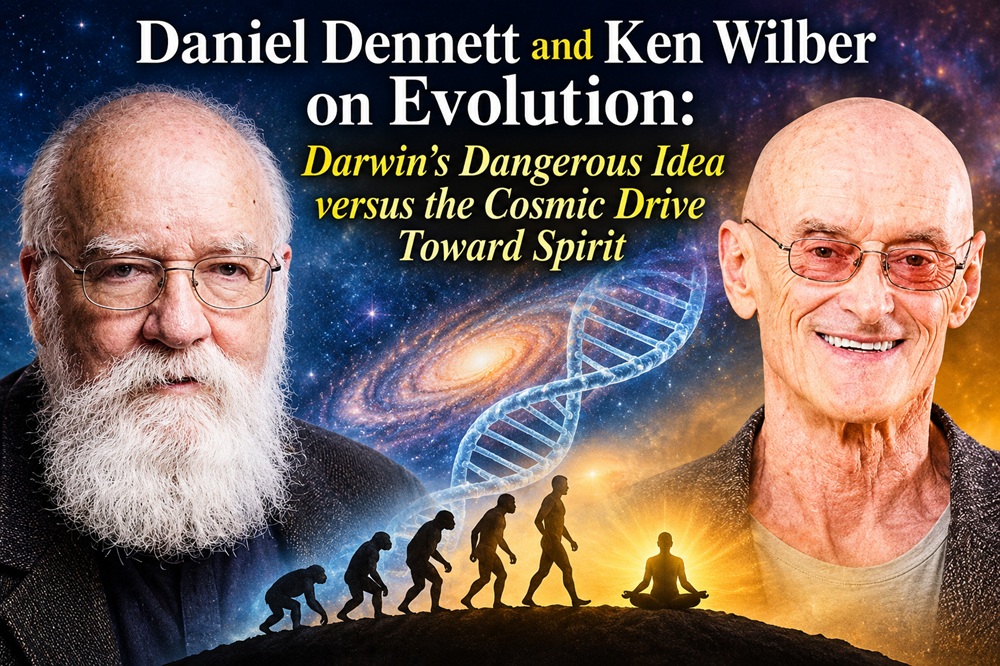
Introduction: Two Philosophers, Two Very Different EvolutionsFew philosophical subjects reveal the differences between Daniel Dennett and Ken Wilber more clearly than evolution. Both thinkers regard evolution as a fundamental key to understanding reality, human consciousness, and the development of increasingly complex forms of existence. Both also attempt to extend evolutionary thinking beyond biology into philosophy, culture, mind, and human development. Yet their approaches could hardly be more different. For Dennett, evolution is above all a natural process that needs no foresight, cosmic purpose, or spiritual agency. Darwin's theory is powerful precisely because it explains the emergence of design, complexity, and apparent purpose without requiring an intelligent designer or an underlying intentional force. Evolution is a process of cumulative, non-teleological change, and its explanatory power extends far beyond biology. For Wilber, evolution is not merely a biological process. It is an expression of a much larger developmental movement of the Kosmos toward increasing complexity, consciousness, and spiritual realization. Biological evolution is one manifestation of a universal evolutionary impulse that Wilber calls Eros. Evolution, in this interpretation, has a direction and a deeper metaphysical significance. The fundamental difference, therefore, is not whether evolution produces complexity or whether human consciousness represents something remarkable. Both acknowledge these developments. The difference concerns what needs explaining, what counts as an explanation, and whether evolutionary processes require an additional metaphysical principle. Dennett wants Darwinism to explain the apparent direction and ingenuity of evolution without invoking anything beyond natural processes. Wilber believes that Darwinian explanations, however successful within their proper domain, cannot account for the full developmental trajectory of the Kosmos. This disagreement provides an excellent opportunity to examine two competing philosophies of evolution: one grounded in methodological naturalism and the other in evolutionary spirituality. 1. Dennett: Darwin's Dangerous IdeaDennett's philosophical treatment of evolution is most fully developed in Darwin's Dangerous Idea. The book is an ambitious attempt to demonstrate that Darwin's theory is not simply a biological explanation but a revolutionary philosophical idea with consequences for virtually every area of intellectual inquiry. What makes Darwin's idea dangerous, according to Dennett, is that it undermines traditional assumptions about design, purpose, and intelligence. Before Darwin, the intricate organization of living organisms was commonly regarded as evidence of intelligent design. The eye, the nervous system, the human brain, and the extraordinary adaptations found throughout nature seemed to demand an explanation in terms of an intelligent creator or some prior organizing principle. Darwin changed the situation fundamentally. Natural selection demonstrated how apparently purposeful structures could emerge through a mindless process of variation and differential reproduction. The crucial insight is that design does not require a designer. Natural selection accumulates small modifications over enormous periods of time. Organisms that happen to possess advantageous variations are more likely to survive and reproduce. Over successive generations, this produces increasingly sophisticated adaptations. There is no need for the process to anticipate its eventual results. No future goal is pulling evolution forward. Dennett calls this a crane rather than a skyhook. A crane is a natural, mechanically grounded process capable of producing complexity from simpler beginnings. A skyhook, by contrast, is an unsupported explanatory device that supposedly suspends the world from above, introducing complexity or order without explaining how it arose. For Dennett, Darwinian evolution is the ultimate explanatory crane. 2. Dennett's Universal DarwinismDennett does not restrict Darwin's insight to biological evolution. He explores how Darwinian thinking can illuminate the emergence of intelligence, language, culture, and other forms of complexity. The essential pattern involves variation, selection, and retention. Where these processes operate, cumulative complexity can emerge without requiring an intelligent planner. This does not mean that every evolutionary process is identical to biological natural selection. Cultural evolution, for example, involves different mechanisms of transmission and selection. Nevertheless, Darwin's general insight provides a powerful conceptual framework for understanding how complex arrangements can emerge from relatively simple beginnings. Dennett also applies this perspective to human consciousness. The human mind, in his account, is not a supernatural entity that somehow entered the evolutionary process from outside. It is itself an evolutionary achievement. Our cognitive capacities, language, reasoning, and capacity for self-reflection have histories rooted in biological and cultural development. This has important philosophical consequences. Consciousness is not exempt from scientific investigation simply because it seems mysterious or uniquely valuable. Nor should human intelligence be regarded as the predetermined goal of evolution. Human beings are remarkable products of evolutionary history, but evolution did not have humanity in mind. Dennett's position is therefore both naturalistic and anti-anthropocentric. The human mind is part of nature, not nature's ultimate explanation. 3. Wilber: Evolution as the Development of the KosmosWilber also places evolution at the center of his philosophical system. But his understanding of evolution is substantially different from Dennett's. For Wilber, evolution is a universal process that extends from matter to life, from life to mind, and from mind to increasingly developed forms of consciousness and spirituality. He frequently describes this process through the concept of the Great Nest of Being, a developmental sequence in which increasingly complex and inclusive forms of existence emerge. Wilber's evolutionary vision is informed by several traditions: developmental psychology, systems theory, ecology, philosophy, mysticism, and the world's contemplative traditions. He distinguishes between the evolution of exterior forms and the development of interior consciousness, integrating these dimensions through his four-quadrant model. But there is an additional element that makes his philosophy distinctive: evolution is not simply what happens. It is driven by an underlying creative impulse. Wilber calls this impulse Eros. In his interpretation, Eros is the evolutionary tendency of the Kosmos toward greater depth, complexity, consciousness, and spiritual realization. It is not merely a metaphor for human desire or biological reproduction. Wilber repeatedly describes it as a genuine, fundamental feature of reality. This gives his evolutionary philosophy a metaphysical dimension absent from Dennett's account. Where Dennett asks how complexity can emerge through natural processes, Wilber asks what accounts for the apparent developmental direction of the Kosmos itself. His answer is that evolution expresses an intrinsic spiritual drive toward greater realization. 4. The Central Disagreement: Does Evolution Need a Direction-Giving Principle?Here the philosophical disagreement becomes particularly sharp. Dennett argues that the appearance of direction in evolution does not establish the existence of a force directing it. Natural selection provides a sufficient explanation for the emergence of adaptations that appear increasingly purposeful. Wilber, on the other hand, interprets the recurring emergence of greater complexity and consciousness as evidence of a deeper evolutionary tendency. But these positions are not simply two different descriptions of the same phenomenon. They involve competing standards of explanation. Dennett is suspicious of explanations that introduce additional entities or principles when established natural mechanisms can account for the phenomena. If natural selection, self-organization, physical constraints, and other known processes explain evolutionary developments, why introduce a cosmic Eros? Wilber believes that these mechanisms explain only part of the story. They describe the processes through which evolution occurs, but, in his view, do not adequately explain why the Kosmos exhibits an overall developmental tendency. The difficulty for Wilber is that identifying a pattern is not the same as demonstrating an additional causal principle. Even if complexity, consciousness, and certain forms of organization emerge repeatedly in evolutionary history, it does not follow that a universal force is responsible for them. To establish Eros as an explanatory principle, one would need to specify its mechanism, identify independent evidence for its operation, and demonstrate what it explains that existing evolutionary theories cannot. Without these elements, Eros risks becoming a metaphysical name for the very phenomenon it is supposed to explain. Dennett's approach is more demanding in this respect: an explanation should do more than redescribe the observed pattern in elevated philosophical language. 5. The Biological Problem: Is Evolution Actually Progressive?There is another important difference between the two philosophers: their interpretation of evolutionary history itself. Dennett is primarily interested in explaining how natural selection produces adaptive complexity. He does not need to claim that evolution always progresses toward greater complexity. Evolution is a branching historical process, not a ladder with humanity at its summit. This is important because biological evolution does not exhibit a universal tendency toward greater complexity. Many organisms have become simpler through evolutionary adaptation. Parasites, for example, have lost structures and functions that were no longer useful in their particular environments. Evolution frequently produces specialization rather than increasing complexity. And the overwhelming majority of species that have ever existed are extinct. The history of life is therefore not a straightforward march from primitive organisms toward increasingly sophisticated beings. Wilber's developmental picture is more vulnerable to this objection. His Great Nest of Being suggests an ascending sequence of increasingly inclusive levels: matter, life, mind, soul, and Spirit. Although he distinguishes developmental emergence from a simplistic linear progression, his metaphysical interpretation nevertheless gives evolution a general upward orientation. The problem is that several different processes are being brought together under one concept of evolution. Biological evolution involves changes in populations across generations. Psychological development involves changes in individual capacities and structures of understanding. Cultural evolution involves the transmission and transformation of collective knowledge and practices. Spiritual development, meanwhile, involves claims about transformations of consciousness that require their own investigation. These processes may exhibit interesting structural similarities, but similarities do not establish that they are manifestations of one universal evolutionary mechanism. Dennett is more careful about the distinction between the evolutionary processes themselves and the philosophical generalizations we might derive from them. Wilber's approach, by contrast, tends to integrate these different domains into one overarching developmental narrative. That makes his philosophy attractive as a grand synthesis, but it also creates the danger of confusing analogy with explanation. 6. The Problem of Eros: What Does It Actually Explain?This is perhaps the most consequential point of disagreement. Dennett's philosophical method demands that proposed explanations earn their place. An explanatory principle should illuminate something that would otherwise remain unexplained. It should not simply attach a name to an observed phenomenon. Wilber's Eros faces precisely this challenge. Suppose we observe that matter, under certain conditions, gives rise to life; that life produces nervous systems; that nervous systems eventually support consciousness; and that human consciousness develops increasingly sophisticated intellectual and cultural capacities. Wilber interprets this history as evidence of an intrinsic evolutionary drive toward greater depth. But what have we actually established? We have established that certain evolutionary transitions occurred. We have not demonstrated that they were driven by an additional cosmic principle. There is a fundamental distinction between describing a pattern and explaining its causes. Consider three questions:
The first two questions can be investigated through biology, physics, chemistry, systems theory, and other sciences. The third introduces an additional metaphysical hypothesis. Wilber's Eros is intended to answer that third question. But its explanatory value remains unclear. What exactly does Eros do? How does it operate? How would we distinguish a universe containing Eros from one in which complexity emerges through ordinary physical and biological processes? If Eros is simply another name for the fact that complex structures sometimes emerge from simpler ones, it adds no explanatory content. If it is supposed to be an actual causal force, it needs independent evidence. This is where Dennett's distinction between cranes and skyhooks becomes particularly relevant. Eros looks suspiciously like a skyhook: a proposed source of evolutionary direction that has not itself been adequately explained. Wilber might respond that Eros is not a supernatural intervention but an intrinsic feature of reality. Yet calling a metaphysical principle intrinsic does not establish its existence or explain its operation. The burden of proof remains. 7. Dennett's Own Limitations: Is Darwinism a Universal Explanation?It would nevertheless be a mistake to treat Dennett as having resolved every philosophical question about evolution. His enthusiasm for Darwinian explanation sometimes approaches what critics have called adaptationism: the tendency to interpret biological structures and developments primarily through their adaptive functions. Evolutionary biology is more complicated than that. Natural selection is indispensable, but it operates alongside genetic drift, developmental constraints, historical contingencies, gene flow, environmental changes, and other processes. Dennett was aware of many of these complications. Indeed, Darwin's Dangerous Idea discusses several controversies within evolutionary biology, including neutral evolution, punctuated equilibrium, and the role of constraints. He also examines the distinction between adaptations and features that acquire new functions through evolutionary co-option. Nevertheless, his philosophical ambition is to extend Darwinian thinking very broadly. This raises a legitimate question: how far can Darwin's explanatory logic be extended without losing its precision? The emergence of language, cultural traditions, morality, and scientific knowledge involves processes that are not simply equivalent to genetic natural selection. Dennett's concept of cultural cranes is illuminating, but analogies between biological and cultural evolution need to be carefully specified. Cultural transmission, imitation, deliberate innovation, institutional selection, and the preservation of knowledge have distinctive mechanisms. Moreover, explaining the evolutionary origins of a cognitive capacity does not automatically settle philosophical questions about its validity. For example, explaining why human beings developed mathematical reasoning does not establish the truth of mathematics. Explaining the evolutionary origins of moral sentiments does not determine which moral principles are justified. Dennett is right to naturalize these subjects, but naturalization is not the same as providing a complete account of every question they raise. There is also a larger cosmological issue. Darwinian evolution explains the diversification and adaptation of life, but it does not, by itself, explain why the universe has the physical laws and initial conditions that make life possible. This is not necessarily a deficiency in Dennett's philosophy. It is a recognition that different explanatory questions require different scientific investigations. His greatest contribution is not that Darwinism answers every conceivable question, but that it dramatically reduces the need for supernatural or metaphysical explanations where natural mechanisms suffice. 8. Wilber's Strength: An Ambitious Integrative VisionA fair comparison should also recognize what Wilber contributes. His evolutionary philosophy is not simply an attempt to replace biology with spirituality. He is interested in integrating several dimensions of reality that are often studied separately. His four-quadrant model, for example, distinguishes individual interiors, individual exteriors, collective interiors, and collective exteriors. This framework encourages us to examine evolutionary developments from multiple perspectives. A biological account of the human brain does not, by itself, describe the subjective experience of consciousness. Nor does an account of individual psychology fully explain the cultural and institutional conditions in which human consciousness develops. Wilber is right to emphasize that evolutionary narratives can become incomplete when they privilege only one explanatory perspective. His attention to developmental sequences is also valuable. Human capacities do not emerge fully formed. Cognitive, moral, emotional, and cultural development involve recognizable transformations, even though their trajectories are neither uniform nor inevitable. Where Dennett is primarily concerned with the naturalistic explanation of design and intelligence, Wilber attempts a more comprehensive philosophical map of developmental reality. But a map is not a mechanism. The four quadrants can remind us of the different dimensions that need investigation. They do not establish that Eros exists. The Great Nest can organize developmental observations. It does not demonstrate that the Kosmos is intrinsically directed toward Spirit. Wilber's integrative ambition is therefore more defensible than some of the metaphysical claims he uses to support it. One can appreciate the value of a multidimensional evolutionary philosophy without accepting its proposed cosmic driving force. 9. Two Different Understandings of the Meaning of EvolutionThe deepest disagreement between Dennett and Wilber concerns the relationship between evolution and meaning. For Dennett, meaning is not something that must be present in the universe before life begins. Meaning emerges through evolutionary processes. Organisms develop interests, preferences, goals, and eventually sophisticated forms of intentionality. Human beings develop language, symbolic systems, moral institutions, and cultural practices. Meaning is a natural achievement. This does not make meaning unreal or unimportant. It means that meaning has a history and can be studied as part of the natural world. Wilber, on the other hand, places meaning within a larger spiritual framework. Evolution is not merely the historical emergence of organisms and minds. It is also the unfolding of Spirit. This introduces an important difference between emergent meaning and pre-existing cosmic purpose. Dennett can explain why human beings experience their lives as meaningful without assuming that the universe itself has a predetermined destination. Wilber tends to interpret human meaning and spiritual aspiration as expressions of a deeper evolutionary movement already present in the Kosmos. The danger is that this interpretation can become circular. We observe spiritual aspirations and interpret them as evidence of Eros. We then invoke Eros to explain why spiritual aspirations arise. But unless Eros has independent explanatory support, this reasoning does not advance our understanding. Dennett's naturalistic account is less grandiose, but it avoids this particular problem. 10. Who Has the Better Philosophy of Evolution?The comparison can be summarized as follows:
In my assessment, Dennett offers the stronger philosophy of evolution, primarily because he maintains a more rigorous distinction between what needs explaining and what constitutes an explanation. His Darwinian approach is powerful precisely because it does not introduce additional metaphysical assumptions to account for evolutionary complexity. Wilber, by contrast, offers a more comprehensive metaphysical narrative, but its comprehensiveness comes at a price. He moves from the demonstrable fact of evolutionary emergence to the much more speculative claim that evolution is driven by an intrinsic spiritual force. That transition is insufficiently justified. The irony of Wilber's evolutionary philosophyThere is an interesting irony here. Wilber frequently presents Integral Theory as a framework that transcends and includes scientific knowledge. Yet when it comes to evolution, he appears dissatisfied with the explanatory resources of evolutionary science and introduces a metaphysical principle to complete the picture. But what does Eros actually contribute? If natural selection, physical self-organization, developmental constraints, and other natural processes can explain the emergence of increasingly complex structures under particular conditions, what explanatory work remains for Eros? Wilber might answer that science explains the mechanisms but not the ultimate reason why evolution happens. However, this risks confusing two different questions: why particular evolutionary developments occur under particular conditions, and why the universe exists with the properties that make those developments possible. Neither question is answered simply by introducing Eros. And if Eros is offered as the ultimate explanation, we can ask the same question again: why does Eros exist, and why does it have precisely these alleged properties? A metaphysical explanation that cannot be independently examined risks becoming an explanatory stopping point rather than an explanatory achievement. What Dennett could teach WilberPerhaps the most useful philosophical lesson Dennett offers is that we should resist the temptation to explain evolutionary outcomes by appealing to the very directionality we observe in them. The emergence of life does not prove that the universe wanted life. The emergence of consciousness does not prove that the universe was striving toward consciousness. And the emergence of spiritual aspirations does not establish that Spirit was directing evolution from the beginning. These developments deserve explanation, but their existence does not automatically validate a cosmic purpose. Wilber's developmental intuitions need not be discarded. They can be investigated through evolutionary biology, developmental psychology, cognitive science, cultural history, and systems theory. What needs to be abandoned, or at least substantially revised, is the assumption that these diverse developments must be manifestations of one universal spiritual force. Conclusion: From Cosmic Eros to Evolutionary ExplanationDaniel Dennett and Ken Wilber represent two substantially different philosophical responses to Darwin. Dennett accepts the radical implications of Darwin's discovery: apparent purpose can emerge without prior purpose, design without a designer, and intelligence without an intelligent origin. Evolutionary processes can produce extraordinary complexity without requiring a cosmic intelligence or an invisible developmental force. Wilber accepts much of evolutionary science but embeds it in a larger spiritual cosmology. For him, evolution is an unfolding of Spirit, driven by Eros toward greater complexity, consciousness, and depth. Both thinkers are concerned with the emergence of novelty. Both recognize that the history of the universe cannot be understood by examining isolated events alone. But they disagree about whether evolutionary development requires a metaphysical explanation beyond the natural processes we can investigate. My preference is clearly for Dennett's approach. This does not mean that Darwinian evolution has answered every question about the emergence of life, consciousness, or the universe. Nor does it mean that scientific naturalism should become a dogma that rules out questions before investigating them. It means that we should not mistake a philosophical interpretation of evolutionary history for an independently established causal explanation. Evolution does not need to be spiritually directed to be extraordinary. Indeed, one could argue that the genuine wonder of evolution becomes even greater when we understand how much can emerge without a cosmic planner, a predetermined destination, or a mysterious force called Eros. Dennett's Darwinian philosophy invites us to investigate how this happens. Wilber's Integral philosophy invites us to believe that something deeper must be happening. The difference between those two invitations is the difference between an explanatory research program and a metaphysical worldview. And that is ultimately why Darwin remains more dangerous to Wilber's philosophy than Wilber's philosophy is to Darwin. Comment Form is loading comments...
|