|
TRANSLATE THIS ARTICLE
Integral World: Exploring Theories of Everything
An independent forum for a critical discussion of the integral philosophy of Ken Wilber
  Frank Visser, graduated as a psychologist of culture and religion, founded IntegralWorld in 1997. He worked as production manager for various publishing houses and as service manager for various internet companies and lives in Amsterdam. Books: Ken Wilber: Thought as Passion (SUNY, 2003), and The Corona Conspiracy: Combatting Disinformation about the Coronavirus (Kindle, 2020).
Check out my other conversations with ChatGPT The Why That Smuggles in a HowA Critical Examination of Ken Wilber's Claim That Integral Theory Explains the Purpose of EvolutionFrank Visser / ChatGPT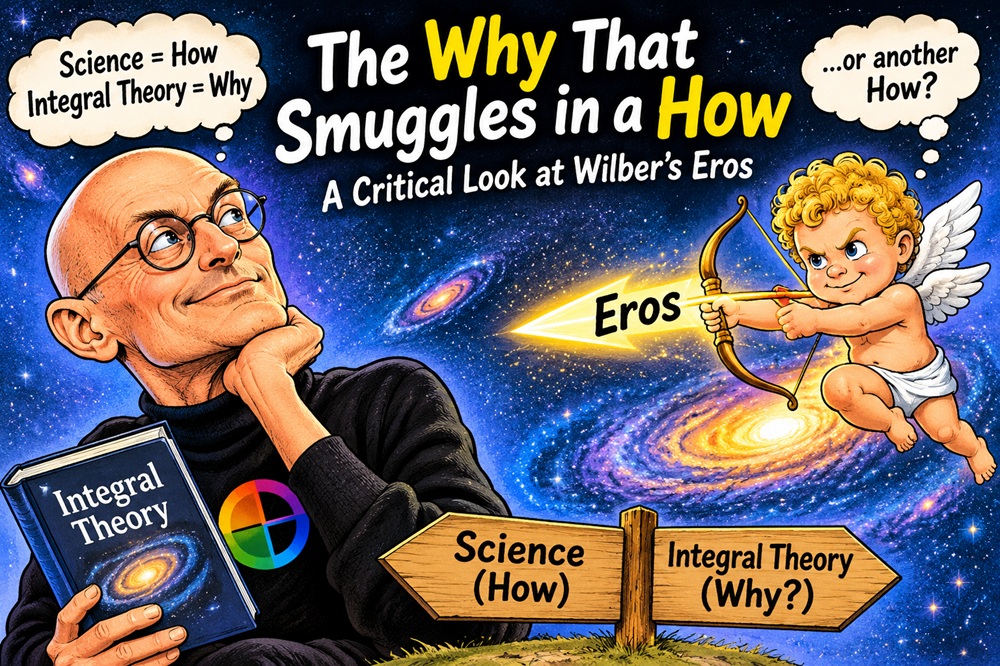 "The very drive of this Eros or self-organizing activity can be seen as the creative drive of Spirit itself.... This is an inherent drive—an actual force—present in the universe itself. It's as real a force as gravity, electromagnetism, and the strong and weak nuclear forces.... This Eros or self-organization also pushes our own growth and development and opens us to higher and higher stages of evolutionary unfolding.... The very drive of this Eros or self-organizing activity can be seen as the creative drive of Spirit itself." (Finding Radical Wholeness, p. 167) Introduction: Dividing the Labor Between Science and Integral TheoryKen Wilber frequently presents Integral Theory as complementary to scientific explanations of evolution. Science, according to his familiar distinction, explains the How of evolution, whereas Integral Theory addresses the Why. Science describes the mechanisms through which evolution takes place; Integral Theory supposedly explains why evolution happens in the first place. At first sight, this division of intellectual labor seems attractive. Science investigates observable processes, while philosophy addresses larger questions of meaning, purpose, and significance. Why should scientific explanations necessarily exhaust every possible philosophical question? But there is a serious problem with Wilber's formulation. His proposed answer to the Why of evolution does not actually remain a Why. It introduces another How: the supposed evolutionary force of Eros, a cosmic drive toward increasing complexity, consciousness, and greater levels of organizational depth. This is not a minor terminological problem. It exposes a fundamental weakness in Wilber's attempt to position Integral Theory as an explanation that goes beyond science while simultaneously claiming explanatory authority over the very processes science investigates. 1. What Does Science Explain?Modern evolutionary biology has developed an extensive explanatory framework for biological evolution. It investigates such processes as:
These mechanisms explain how populations change over generations, how adaptations emerge, and how biological diversity develops. Importantly, evolutionary biology does not require an overarching purpose behind these processes. Natural selection is not a cosmic intention. It is a population-level process in which heritable variations affect reproductive success under particular environmental conditions. Evolution can produce increasing complexity in some lineages, but it can also produce simplification, degeneration, and extinction. There is no universal evolutionary staircase that every organism must climb. This is where Wilber's interpretation begins to depart from mainstream evolutionary science. He sees the emergence of increasingly complex forms, from atoms to molecules, cells, organisms, nervous systems, and human consciousness, as evidence of a larger evolutionary tendency. But the observation that complexity has emerged in certain evolutionary histories does not establish that evolution is universally directed toward complexity, let alone that a cosmic force is responsible for it. That requires an additional argument. 2. Wilber's Answer: Eros as the Why of EvolutionWilber supplies that additional argument through his concept of Eros. In his interpretation, evolution is not simply a sequence of contingent natural processes. It is driven by an immanent spiritual impulse toward greater wholeness, complexity, and consciousness. Eros is therefore not merely a poetic description of evolutionary creativity. Wilber repeatedly gives it ontological status. It is supposed to be an actual causal principle operating throughout the universe. In his integral cosmology, Eros is the force behind the emergence of increasingly complex holons. It supposedly explains why matter gives rise to life, why life gives rise to mind, and why mind can develop toward increasingly encompassing forms of consciousness. This is where the distinction between the scientific How and the integral Why collapses. If Eros actually drives evolution, then it is not merely an answer to why evolution has meaning or significance. It is an answer to how evolutionary novelty comes about. Wilber has introduced a causal mechanism, or at least something functioning as one, into his supposedly complementary philosophical explanation. Calling it a Why does not change its explanatory function. 3. The Category Mistake: A Why That Functions as a HowConsider the following distinction:
The two columns are not addressing entirely different questions. Both are attempting to explain how something comes into existence. The difference is that scientific explanations propose identifiable processes that can be investigated, while Wilber's Eros functions as a generalized, all-encompassing causal principle without an independently established mechanism. This raises an obvious question: What exactly does Eros do? Does it introduce variation? Does it select among variations? Does it organize matter? Does it somehow influence the probability of certain evolutionary outcomes? Does it operate through physical forces already known to science, or does it introduce an additional causal influence? Wilber does not provide a sufficiently precise answer. Instead, Eros tends to become a universal explanatory label for whatever evolutionary novelty has already occurred. The result is an explanatory shortcut: wherever something more complex emerges, Eros is invoked as the underlying reason. But naming a supposed cause is not the same as explaining its operation. 4. The Problem of Scientific AccountabilityOnce Wilber claims that Eros is an actual force in the universe, he has entered the territory of empirical explanation. This creates a dilemma. If Eros has causal effects, those effects should, at least in principle, be distinguishable from what existing scientific explanations already account for. What observable consequences follow from its existence? Can it make predictions that evolutionary biology would not otherwise make? Can we identify circumstances in which Eros should produce greater complexity, and circumstances in which it should not? Could evidence count against its existence? If no conceivable observation could challenge the hypothesis, Eros becomes insulated from empirical criticism. It might remain a metaphysical interpretation, but it cannot then claim the explanatory status of an established cosmic force. If, on the other hand, Eros does make a difference to evolutionary outcomes, Wilber needs to specify what that difference is and how it can be investigated. He cannot have it both ways: Eros cannot simultaneously be an actual causal force and remain exempt from the standards of causal explanation. There is also a more fundamental question. Why should we introduce Eros when evolutionary biology already explains many of the phenomena Wilber attributes to it? An additional causal principle requires additional explanatory justification. It cannot simply be inferred from the existence of complexity. 5. Evolution Does Not Need a Cosmic DirectionAnother difficulty concerns Wilber's interpretation of evolutionary history. Evolutionary history does contain remarkable developments in complexity. But these developments are neither universal nor inevitable. Consider the enormous diversity of evolutionary trajectories:
Evolution is not a universal march toward greater complexity. Even the emergence of human consciousness, remarkable as it is, does not establish that the universe was somehow predisposed to produce it. Wilber's interpretation risks reading evolutionary history backward: because increasingly complex organisms eventually appeared, their appearance is treated as evidence of an underlying force that was driving the process all along. But the existence of an outcome does not establish that the outcome was intended, required, or cosmically favored. This is precisely the kind of teleological reasoning that modern evolutionary biology has learned to avoid. 6. The Difference Between Meaning and CausationThere is, however, a legitimate philosophical question hiding behind Wilber's formulation. What does evolution mean to us? How should we interpret the emergence of life and consciousness? Does the history of the universe have existential significance? These are meaningful questions. Science does not necessarily answer them simply by describing physical and biological mechanisms. But there is a crucial distinction between assigning meaning to evolutionary history and proposing a causal force behind it. One could, for example, interpret the emergence of consciousness as astonishing, valuable, and worthy of philosophical reflection without claiming that the universe contains an intrinsic drive toward consciousness. One could also explore whether increasing complexity has philosophical significance without asserting that complexity is the goal of cosmic evolution. Wilber repeatedly moves from the observation of evolutionary development to the assertion of an underlying evolutionary intention or tendency. That is an additional metaphysical commitment, not an unavoidable conclusion from the scientific evidence. Integral Theory could legitimately offer an interpretive framework for understanding the significance of evolution. It could examine the relationship between matter, life, mind, culture, and consciousness. But once it claims to explain what actually causes evolution to move in a particular direction, it must defend that claim as a causal hypothesis. 7. The Reversal of the ArgumentThere is an interesting irony here. Wilber presents his approach as an expansion of science: science explains the How, Integral Theory explains the Why. But the moment he introduces Eros as the actual force behind evolutionary development, he effectively reverses his own division. His Why becomes another How, only without the methodological discipline that makes scientific explanations accountable. And this is not a matter of demanding that every philosophical idea be experimentally testable. Metaphysics certainly has a legitimate place in intellectual inquiry. The problem is that Wilber does not consistently present Eros as merely a metaphysical interpretation. He presents it as something real that actually operates in the universe. That is a much stronger claim. If Eros is a metaphor for our experience of evolutionary creativity, it should be presented as such. If it is a philosophical interpretation of the emergence of complexity, its assumptions and limitations should be acknowledged. But if it is an actual force, it needs a theory of operation and evidence for its existence. The distinction cannot be dissolved by calling one explanation a Why and the other a How. 8. What Integral Theory Could Contribute InsteadIntegral Theory does not need Eros to make a potentially useful contribution to the discussion of evolution. It could investigate the different dimensions of evolutionary development, including biological complexity, cognitive capacities, cultural transformations, and the emergence of increasingly sophisticated forms of social organization. It could compare different explanatory frameworks and examine how they relate. It could also address philosophical questions about value, meaning, and the human interpretation of evolutionary history. But it would have to abandon the assumption that these developments demonstrate a universal cosmic drive. The emergence of higher levels of organization is an empirical and historical phenomenon requiring specific explanations in each domain. It does not automatically require a single metaphysical principle underlying them all. Indeed, the more seriously Integral Theory takes the sciences it incorporates, the less it should be tempted to supplement their explanations with an all-purpose force such as Eros. An integral approach should integrate knowledge, not fill explanatory gaps with metaphysical assumptions. Conclusion: Eros Is Not an Answer to WhyWilber's distinction between the scientific How and the integral Why sounds persuasive until we examine what his proposed answer actually entails. Science explains evolutionary processes through mechanisms such as mutation, selection, genetic drift, and developmental constraints. Wilber proposes Eros as the underlying force that drives evolution toward increasing complexity, consciousness, and wholeness. But a force that supposedly drives evolutionary processes is not an answer to why evolution has meaning. It is an attempted answer to how evolution happens. And that answer is precisely where Wilber's argument becomes problematic. He introduces a cosmic causal principle without adequately explaining its mechanism, demonstrating its independent existence, establishing its predictive value, or showing why existing scientific explanations are insufficient. The result is not a genuine division of explanatory labor between science and Integral Theory. It is a second, metaphysical account of evolutionary causation, presented as though it occupied a completely different explanatory category. Wilber wants the authority of science for the evolutionary history he describes, and the explanatory freedom of metaphysics for the cosmic force he invokes to account for it. But he cannot have both without defending the connection between them. The fundamental question is therefore not whether science can answer every conceivable Why. It is whether Wilber's Eros answers anything that science has not already explained, or whether it merely gives a spiritual name to the evolutionary processes whose outcomes he finds philosophically significant. Until that question is answered, Eros remains less an explanation of evolution than an additional assumption about it. And the distinction between the How and the Why, on which Wilber's defense of Integral Theory partly rests, collapses under the weight of his own argument. Appendix: Wilber's Inconsistent Allocation of What, How, and WhyThere is a further problem with Wilber's distinction: he is not consistent in allocating the What, How, and Why of evolution to science and Integral Theory. In some formulations, science gets the What and How, while Integral Theory supplies the Why. In Up from Eden (1981), however, Wilber already argues that conventional evolutionary theory is deficient not only in explaining the Why but also the How. His solution is the doctrine of involution, according to which evolution unfolds potentials already enfolded in existence. In Finding Radical Wholeness (2024), he returns to a distinction between the chronological What and theoretical Why, but then defines the latter through Eros: an actual force that supposedly initiates, drives, and directs evolutionary development. These are not interchangeable formulations. If science fails to explain the How, Wilber must demonstrate how his own alternative mechanism works. If science does explain the How, he must explain what additional causal work Eros performs. And if Eros is merely an interpretation of evolutionary history, it cannot simultaneously be presented as an actual force comparable to gravity and electromagnetism. The shifting allocation reveals a deeper problem: Wilber moves between scientific explanation, metaphysical interpretation, and causal speculation without consistently distinguishing them. Ultimately, the issue is not whether science can answer every Why. It is that Wilber repeatedly turns his philosophical Why into a causal How, while resisting the evidential demands that such a claim entails. "The orthodox scientific theory of evolution seems correct on the what of evolution, but it is profoundly reductionistic and/or contradictory on the how (and why) of evolution." (Up from Eden, 1981, p. 305) "The strict theory of natural selection suffers from not acknowledging the role played by Spirit in evolution." (Eye to Eye, 1983 p. 205) "The what of evolution is not doubted at all, it is the why of evolution that creates so much controversy and why so many biologists have introduced the third notion of self-organization that drives the whole series. And so that drives us from quarks to atoms to molecules, to single cellular animals to multi-cellular animals to fish to amphibians to reptiles to mammals, to primates and humans. That is all driven by a self-organizing Eros, and that's an absolutely crucial component of Integral Theory. (14:30-15:35)" (2024 Interview by Raquel Torrent) There are at least two quite different aspects of modern evolutionary theory—there is the chronological what of evolution, and there is the theoretical why of evolution. The 'what' is almost always accepted by a smart orange rationality, the 'why' almost never. (Finding Radical Wholeness, 2024, p. 166) Comment Form is loading comments...
|