|
TRANSLATE THIS ARTICLE
Integral World: Exploring Theories of Everything
An independent forum for a critical discussion of the integral philosophy of Ken Wilber
  Frank Visser, graduated as a psychologist of culture and religion, founded IntegralWorld in 1997. He worked as production manager for various publishing houses and as service manager for various internet companies and lives in Amsterdam. Books: Ken Wilber: Thought as Passion (SUNY, 2003), and The Corona Conspiracy: Combatting Disinformation about the Coronavirus (Kindle, 2020).
Check out my other conversations with ChatGPT The Universe as a Cosmic Holomovement?A Critical Review of Joe Corbett's Fourfold Theory of EverythingFrank Visser / ChatGPT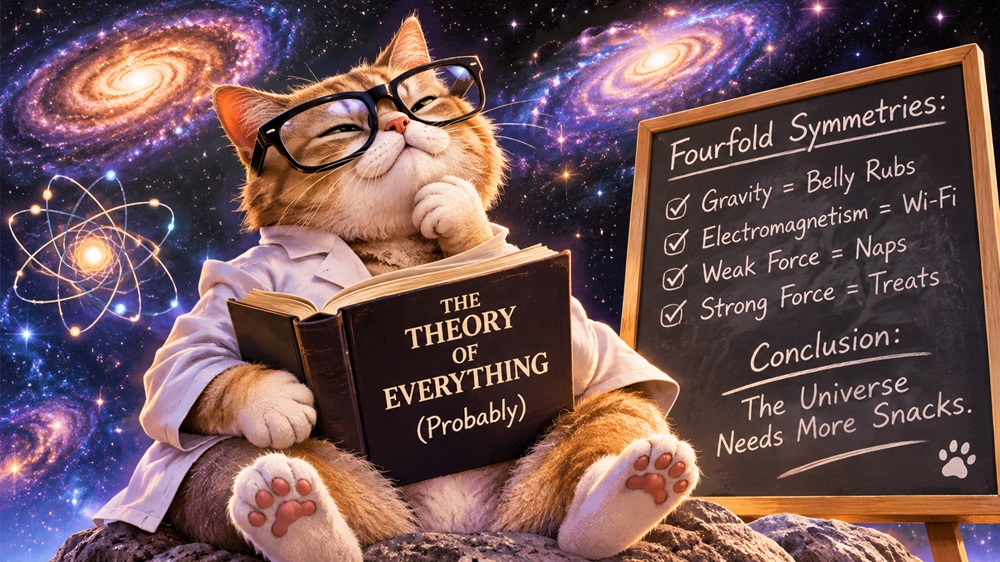 1. Introduction: An ambitious synthesisJoe Corbett's latest essay "The Unfolding of the Universe through Fourfold Symmetries and the Holomovement" is an ambitious attempt to construct a unified account of reality, ranging from quantum physics and cosmology to biology, psychology, culture, and ethics. Its central proposition is that the universe unfolds through four interlocking sets of symmetries, organized along two dimensions: external and internal, and individual and collective. Corbett combines this fourfold architecture with David Bohm's notion of the implicate and explicate orders, collectively understood as the holomovement. He adds a second dynamical process, an oscillation between quantum possibility and probability, and proposes that the interaction of these processes continuously generates the concrete events and entities of existence. The ambition is unmistakably integral in character. It seeks to overcome the fragmentation of scientific disciplines without reducing consciousness, meaning, culture, and values to physical processes alone. Physics, biology, psychology, and society are presented as different manifestations of one underlying reality. There is something intellectually attractive about this project. It recognizes that reality is relational, that levels of organization interact, and that the emergence of new structures cannot always be understood by examining isolated components. But there is a fundamental problem: does Corbett actually explain how the universe unfolds, or does he primarily redescribe everything in a common vocabulary of symmetries, information, oscillation, and emergence? My assessment is that the latter is closer to the truth. The article offers an interesting metaphysical framework, but its repeated identification of physical, biological, psychological, and social processes is not accompanied by the arguments needed to establish that these processes instantiate the same underlying dynamics. 2. The fourfold architecture: Symmetry or analogy?The heart of Corbett's proposal is a classification of reality into Ken Wilber's familiar four quadrants, which he maps onto physical, biological and socio-cultural realities. The external-individual dimension includes gravity, the body, nature, the signifier, and truth. The external-collective dimension includes electromagnetism, spirit, society, syntax, and justice. The internal-individual dimension includes the weak nuclear force, mind, self, signified, and beauty. Finally, the internal-collective dimension includes the strong nuclear force, soul, culture, semantics, and the good.
The classification is elegant in its symmetry. But elegance is not evidence. Why should gravity correspond to the body, electromagnetism to spirit, the weak nuclear force to mind, and the strong nuclear force to soul? The physical forces have precisely defined properties, mathematical descriptions, and experimentally established domains of operation. The corresponding psychological and cultural concepts do not share these properties in any demonstrated sense. For example, the strong nuclear force binds quarks into composite particles and helps bind protons and neutrons within atomic nuclei. What exactly is the equivalent binding mechanism in a collective unconscious or a culture? Shared identity, ritual, and collective memory may indeed bind human groups together. But this is a sociological analogy, not evidence that the strong nuclear force has a higher-level cultural counterpart. Similarly, electromagnetism enables communication through electromagnetic radiation and electrical interactions. But calling collective spirit its psychological or social equivalent does not establish a causal relationship between the two. Corbett moves rather quickly from resemblance to correspondence, and from correspondence to a unified architecture. This is the central weakness of the fourfold model: it has not established whether its categories are discovered structural features of reality or conceptual assignments made by the theorist. 3. The problem of category errorsThere is a deeper issue than the questionable correspondences themselves. Corbett appears to treat concepts belonging to fundamentally different explanatory domains as though they were interchangeable. Consider the following pairs: - Gravity and the body. - Electromagnetism and collective spirit. - The weak force and the individual mind. - The strong force and the collective soul. - Truth and beauty. - Justice and the good. These are not simply different descriptions of the same phenomena. They belong to different explanatory categories. Gravity is a physical interaction described by general relativity. The body is a biological organization of matter. Truth is an epistemological concept. Justice is a normative and political concept. One can certainly investigate how these domains interact. For example, the physical conditions of human existence constrain social organization, while cultural values influence human behavior. But this does not mean that these domains are manifestations of four universal symmetries. Indeed, the model risks confusing a useful organizational metaphor with an ontological discovery. A genuinely explanatory theory would have to establish the mechanisms connecting these domains. It would need to demonstrate why these particular correspondences are necessary, rather than merely suggestive. Why four symmetries? Why these particular correspondences? Could alternative assignments work equally well? What would count as evidence against the proposed architecture? The article does not adequately address these questions. 4. Bohm's holomovement: A suggestive metaphor becomes a universal explanationThe second major component of Corbett's theory is David Bohm's concept of the holomovement. Bohm proposed that the apparently separate objects and events of the manifest universe are enfolded within a deeper, interconnected order. The explicate order is the world as it appears in relatively distinct forms; the implicate order is the deeper enfolded order from which these forms emerge. The idea is philosophically interesting. It challenges the assumption that reality consists fundamentally of independent objects interacting externally. It also offers an alternative conceptual vocabulary for thinking about quantum interconnectedness. But Corbett takes this proposal considerably further. In his account, the implicate-explicate relationship becomes the universal mechanism of physical, biological, psychological, and cultural development. Genetic information, unconscious memories, collective myths, social institutions, and quantum fields are all treated as different manifestations of the same enfolding-unfolding process. This is where the argument becomes problematic. Bohm's holomovement is a philosophical and physical proposal, not an experimentally established universal mechanism of development across every domain of reality. Moreover, Bohm's own interpretation of quantum mechanics should not be confused with the standard textbook account of wave-function collapse. In Bohmian mechanics, particles have definite configurations, and the wave function evolves according to the Schrödinger equation. The familiar measurement collapse is treated as an effective phenomenon, not an additional fundamental collapse process of the kind assumed in some other interpretations. plato.stanford.edu+1 Corbett combines Bohm's holomovement with a rather different account of quantum measurement, without sufficiently explaining how the two are reconciled. The result is an eclectic synthesis in which different interpretations of quantum mechanics appear to be incorporated into one grand metaphysical narrative. That is not necessarily illegitimate as philosophical speculation. But it requires considerably more justification than the article provides. 5. The double oscillation: Where physics meets semanticsPerhaps the most ambitious, and least convincing, aspect of Corbett's proposal is his introduction of a second oscillation. The first oscillation is between the implicate and explicate orders. The second takes place within the implicate order itself, between possibility and probability. Corbett associates possibility with signifieds (potential contents of meaning) and probability with semantics (the field of relations among meanings). He then proposes that these two processes interact continuously, eventually producing concrete actualities. This is an imaginative construction, but what exactly is being described? In quantum physics, probability has a precise mathematical meaning. It is associated with the formal structure of quantum theory and the probabilities of measurement outcomes. In semantics, probability can refer to the likelihood of particular interpretations, associations, or linguistic constructions. But these are not automatically the same kind of probability. Nor is possibility in ordinary language identical to quantum superposition. Corbett effectively imports the vocabulary of quantum mechanics into the domain of meaning and then uses the resulting analogy to explain both. There is a serious danger of equivocation here. A word such as possibility can have different meanings in different disciplines without those meanings referring to one underlying physical process. The problem becomes particularly apparent when Corbett describes signifieds as potential contents of meaning and semantics as the probable relations among those contents. This may be an interesting theory of how meanings emerge in human cognition and communication. But why should it be regarded as a quantum-like process? What mathematical formalism describes this oscillation? How are the probabilities calculated? What observations would confirm the proposed relationship? Without answers, the double oscillation remains a metaphor dressed in the language of physics. 6. Quantum collapse and the universal birth of the "It"Corbett repeatedly describes the emergence of an actuality as a collapse of possibility into a determinate "it." This is one of the most revealing aspects of the essay. In quantum mechanics, the measurement problem concerns the relationship between the mathematical evolution of the wave function and the definite outcomes observed in experiments. Different interpretations approach this problem differently. But Corbett extends the language of collapse to virtually everything. A particle detection is a collapse. A metabolic event is a collapse. A spoken word is a collapse. A personal decision is a collapse. A historical turning point is a collapse. The common denominator is that a range of possibilities becomes a concrete actuality. But this is an extremely general description of change. It does not establish that these events share a quantum mechanism. Consider a person deciding whether to go for a walk. Before making the decision, several possible courses of action may be entertained. Eventually one is selected. We can describe this as a transition from potentiality to actuality. But we do not thereby demonstrate that the person's decision involves a wave-function collapse. Likewise, biological development involves the interaction of genetic information, environmental conditions, cellular processes, and evolutionary history. It does not follow that this process is best explained by an extension of quantum measurement theory. Corbett's language obscures important distinctions between physical measurement, biological selection, psychological decision-making, and historical contingency. There is also a problem with the claim that each actuality immediately re-enters the implicate order and alters the probabilities of all subsequent events. In a broad informational sense, the past certainly constrains the future. But what does this additional language contribute to our understanding? If the claim simply means that events have consequences, it is hardly a new discovery. If it means something more substantial, Corbett needs to specify what that something is. 7. Biology: Complexity is not evidence of a universal organizing principleThe biological section attempts to show how the fourfold architecture reappears at higher levels of organization. The body becomes a coherent organism, the mind emerges as a capacity for differentiation and representation, and the self stabilizes as a center of perspective. Biological signaling becomes the equivalent of signification. Genetic and epigenetic information become implicate orders. Environmental feedback supposedly collapses possible developmental trajectories into concrete forms. There are interesting observations here. Biological organisms are indeed information-processing systems. They continuously respond to environmental conditions, regulate their internal states, and modify their behavior. Development and evolution involve feedback between organisms and their environments. But these observations are already part of established biology, neuroscience, systems theory, and evolutionary theory. Corbett does not demonstrate that the holomovement provides an additional explanatory mechanism. More importantly, he repeatedly risks conflating different meanings of information. Genetic information is not semantic information in the ordinary linguistic sense. A DNA sequence has functional consequences through biochemical processes, but it does not follow that DNA possesses meaning in the same sense as a sentence or a cultural symbol. Similarly, an organism's response to environmental conditions is not necessarily an act of interpretation in the human psychological sense. One can use informational language to describe biological systems, but one should not assume that all information-processing systems operate according to the same principles. The central question remains: what does the fourfold model explain about biological evolution that evolutionary biology and systems theory cannot already explain? The article provides no convincing answer. 8. Psychology: The holomovement of the selfCorbett's psychological account is somewhat more persuasive because the language of enfolding and unfolding can be fruitfully applied to human experience. Our conscious experience is indeed shaped by memories, expectations, unconscious processes, and environmental influences. Our sense of identity is continuously reconstructed through interactions between past experience and present circumstances. The distinction between an implicate personal history and its explicate expression in conscious experience is a potentially useful metaphor. But again, metaphor should not be mistaken for mechanism. The unconscious is not a quantum vacuum. Memory is not literally an implicate order. Imagination is not necessarily a wave function oscillating between possibility and probability. There are established psychological and neuroscientific approaches to memory, predictive processing, cognition, and personal identity. Corbett would need to demonstrate how his proposal advances these approaches. There is also an unresolved problem concerning consciousness itself. The article assigns the mind to the internal-individual quadrant and the self to the same general dimension. But this is classification, not explanation. Why does subjective experience exist at all? How does physical organization give rise to phenomenal consciousness? What makes a system capable of experiencing rather than merely processing information? Calling consciousness an expression of the holomovement does not answer these questions. It relocates them into a more encompassing metaphysical vocabulary. 9. Society and culture: From physical symmetries to moral valuesThe social and cultural section extends the fourfold model into collective life. Here, the correspondences become particularly ambitious. Spirit is understood as the collective atmosphere of a people, soul as the depth of collective identity, syntax as the formal ordering of social communication, and semantics as the system of shared meanings. Justice, truth, beauty, and the good are presented as values associated with the different dimensions of the architecture. Again, these are recognizable concerns of sociology, anthropology, linguistics, political philosophy, and ethics. The problem is not that they belong in a unified discussion of reality. The problem is that Corbett treats their inclusion as evidence of the universality of his fourfold scheme. Consider justice. Justice is not simply another manifestation of an external collective symmetry. It involves competing principles, institutions, power relations, historical circumstances, and moral judgments. Likewise, the good is not a universal organizing force whose existence can be inferred from the stability of collective systems. Societies can be stable and profoundly unjust. Cultural cohesion can support solidarity, but it can also sustain authoritarianism, exclusion, and persecution. The fact that social systems exhibit patterns of organization does not mean that they are naturally oriented toward moral flourishing. Corbett's framework would benefit from a much sharper distinction between descriptive and normative statements. Explaining how societies organize themselves is one thing. Establishing what makes a society just or good is quite another. 10. The teleological temptation: Is the universe going somewhere?An important question raised by the article concerns the direction of cosmic evolution. Corbett states that the four symmetries enable the emergence of increasingly complex structures, eventually including bodies, minds, cultures, and values. He is careful to say that the cosmos does not evolve through simple linear progress. Nevertheless, his presentation suggests a continuous unfolding of increasingly differentiated and meaningful forms. This invites a familiar question: is the universe merely capable of producing complexity, or does it possess an inherent tendency toward complexity and consciousness? These are very different propositions. The emergence of complex structures is a genuine feature of cosmic history. But complexity does not increase everywhere, nor does evolution guarantee progress toward higher forms of organization. Stars form and die. Ecosystems flourish and collapse. Species emerge and become extinct. Civilizations develop and disintegrate. There is no obvious universal trajectory from elementary particles to human consciousness, let alone from human consciousness to justice, beauty, and the good. If Corbett intends to suggest that the universe contains an intrinsic tendency toward increasingly meaningful organization, he needs to provide evidence for that proposition. Otherwise, the model risks becoming another version of cosmic teleology: the assumption that the universe is somehow oriented toward the emergence of the very phenomena we happen to value most. This is particularly important because the appearance of consciousness and morality in cosmic history does not establish that they were implicit goals of the universe from the beginning. An explanation of emergence should not quietly become an explanation of purpose. 11. What is missing: A theory needs explanatory constraintsPerhaps the most important criticism of Corbett's essay is methodological. A theory that attempts to explain everything should be subject to particularly demanding standards. Otherwise, its universality becomes its greatest weakness. I would suggest five criteria for evaluating the proposal. First, operational definitions. What precisely constitutes an external or internal symmetry? Are these measurable properties, philosophical categories, or metaphors? The article moves between these possibilities without clearly distinguishing them. Second, causal mechanisms. How exactly does gravity relate to the body, or the strong nuclear force to collective identity? What connects these phenomena beyond conceptual resemblance? Third, independent empirical support. What observations support the proposed fourfold architecture independently of the theory itself? Fourth, predictive power. Does the model generate predictions that could not be derived from existing physics, biology, psychology, or sociology? Fifth, falsifiability. What conceivable discovery would count against the theory? If every phenomenon can be accommodated by assigning it to one of the four dimensions and describing it as another manifestation of the holomovement, the theory risks becoming immune to criticism. These are not unreasonable demands. They are precisely what distinguishes a scientific theory from an all-encompassing philosophical interpretation. A useful comparison can be made with Bohm himself. His implicate order was not simply a poetic description of interconnectedness. It was embedded in a specific attempt to understand quantum theory and its ontological implications. Even so, extending it into consciousness and other domains raises additional philosophical questions rather than automatically answering them. Corbett would strengthen his case considerably by distinguishing what is borrowed from established physics, what is proposed as a new theoretical development, and what is offered as philosophical analogy. 12. The integral ambition: Beyond fragmentation, but at what cost?There is a recognizable integral ambition behind Corbett's project. Modern knowledge is divided into specialized disciplines. Physics investigates physical interactions, biology studies living systems, psychology investigates cognition and behavior, and sociology examines collective organization. An integral perspective seeks to understand how these domains relate without reducing one to another. I sympathize with that ambition. Indeed, the fragmentation of knowledge is a legitimate philosophical problem. But integration does not mean that everything must be made to fit one predetermined conceptual architecture. There is a difference between demonstrating connections and imposing correspondences. The former requires investigation. The latter can be accomplished through creative classification. This distinction is particularly important in the context of integral theory, where the desire to transcend disciplinary boundaries sometimes encourages the construction of increasingly elaborate metaphysical systems. Wilber's AQAL framework, for example, offers a comprehensive map of perspectives and dimensions of reality. Corbett's fourfold model appears to pursue a related ambition, but adds a physical and cosmological foundation through Bohm's holomovement. The question is whether this addition provides explanatory substance or merely gives an existing integral intuition a more scientific-sounding vocabulary. I suspect it is largely the latter. The presence of physics terminology does not automatically make a philosophical synthesis more scientifically grounded. Indeed, it can make the distinction between scientific findings and speculative interpretation more difficult for readers to recognize. 13. Conclusion: Integralism at Its Worst: When Everything Connects to EverythingCorbett's essay is not merely an unsuccessful attempt at a scientific theory of everything. It illustrates a recurring methodological failure within integralism itself: the assumption that reality's complexity can be captured by imposing a universal architecture of correspondences. The result is a conceptual system in which physical forces, biological processes, psychological functions, linguistic structures, and ethical values are assigned matching positions in an overarching scheme. Their apparent correspondence is then presented as evidence of their underlying unity. But this is circular. The unity is built into the classification before it is supposedly discovered. Instead of investigating the actual mechanisms connecting different domains of reality, the integralist constructs a comprehensive map and mistakes its internal consistency for evidence that the territory conforms to it. This is precisely what a critical, scientifically informed integral approach should resist. Integration should be the outcome of successful explanation, not a requirement imposed on reality in advance. Comment Form is loading comments...
|