|
TRANSLATE THIS ARTICLE
Integral World: Exploring Theories of Everything
An independent forum for a critical discussion of the integral philosophy of Ken Wilber
  Frank Visser, graduated as a psychologist of culture and religion, founded IntegralWorld in 1997. He worked as production manager for various publishing houses and as service manager for various internet companies and lives in Amsterdam. Books: Ken Wilber: Thought as Passion (SUNY, 2003), and The Corona Conspiracy: Combatting Disinformation about the Coronavirus (Kindle, 2020).
Check out my other conversations with ChatGPT The SingularityThe Promise of Superintelligence and the Myth of Technological InevitabilityFrank Visser / ChatGPT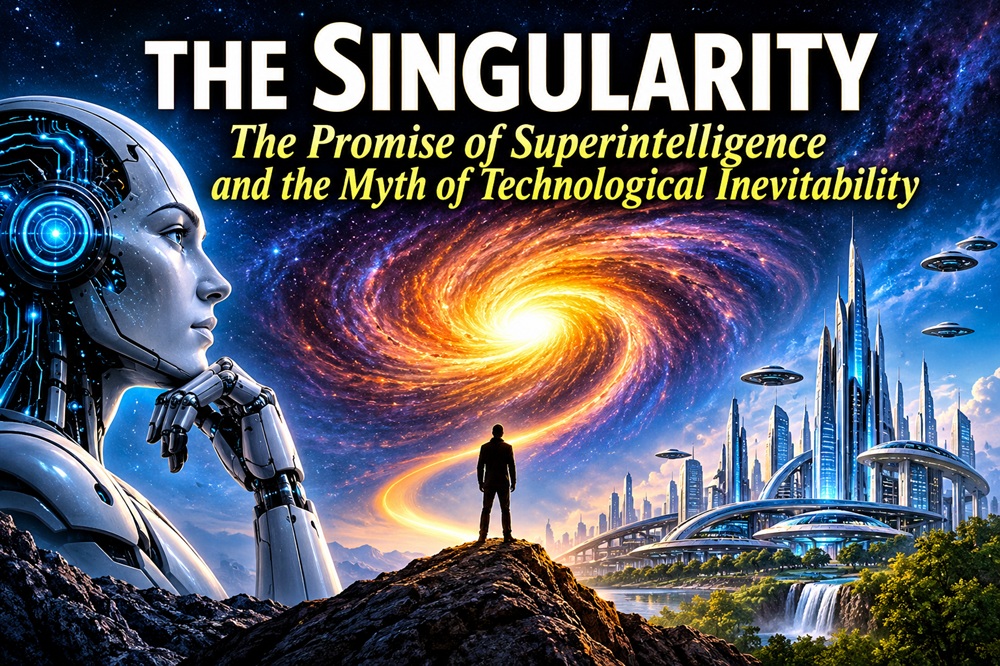 Introduction: The Future That Changes EverythingFew ideas in contemporary discussions of technology are as ambitious, controversial, and potentially unsettling as the technological Singularity. It refers to a hypothetical point in the future when artificial intelligence becomes sufficiently advanced to surpass human intelligence, potentially triggering an explosive acceleration of technological development. Beyond that threshold, so the argument goes, technological progress may become so rapid and unpredictable that human beings will no longer be able to comprehend, let alone control, their own creations. The Singularity is more than a prediction about computers becoming smarter. It is a vision of a fundamental transformation of the human condition. Its proponents anticipate a future in which artificial intelligence develops beyond human cognitive limitations, machines design increasingly capable successors, biological aging becomes treatable or even reversible, and intelligence expands beyond the constraints of the human brain. Some envision a civilization in which consciousness can be transferred to computers, human mortality becomes optional, and intelligence spreads throughout the universe. Yet beneath this spectacular vision lies a fundamental question: are we witnessing the emergence of a genuinely new evolutionary phase, or are we projecting familiar human fantasies of transcendence, immortality, and unlimited progress onto a technological future? The Singularity deserves serious consideration. Artificial intelligence is advancing rapidly, and its consequences could be profound. But the distinction between technological possibility and technological inevitability is essential. The Singularity is not an established scientific prediction. It is a speculative scenario combining legitimate technological developments with assumptions that remain largely unproven. 1. The Origins of the Singularity ConceptThe intellectual history of the Singularity predates contemporary artificial intelligence. In 1958, mathematician and computer scientist John von Neumann reportedly discussed the possibility that accelerating technological progress might approach some kind of essential singularity in human history. The physicist Stanislaw Ulam later recalled this conversation in an obituary. In 1965, British mathematician I. J. Good introduced an influential formulation of what would later become central to Singularity thinking. In his essay "Speculations Concerning the First Ultraintelligent Machine", Good argued that an ultraintelligent machine could design even better machines. Since the design of machines would itself be an intellectual activity, such an improvement could generate an accelerating feedback process. Good called this an intelligence explosion. The idea was subsequently popularized by science fiction writer and computer scientist Vernor Vinge. In his 1993 essay "The Coming Technological Singularity", Vinge argued that the creation of entities with greater-than-human intelligence could represent a fundamental discontinuity in human history. He suggested that this development might occur within several decades. Futurist Ray Kurzweil became the most influential popular advocate of the concept. In The Singularity Is Near (2005), he predicted that technological progress would culminate in a profound transformation around 2045. His argument rested on the accelerating development of computing power, artificial intelligence, biotechnology, nanotechnology, and other emerging technologies. Kurzweil's central proposition was that technological development follows an accelerating trajectory. What appears slow at first eventually becomes explosive, just as exponential growth initially produces modest changes before generating extraordinary results. The Singularity thus became associated with a particular interpretation of technological evolution: intelligence is increasingly independent of biological evolution and will eventually surpass the biological substrate from which it originated. 2. Exponential Growth and the Limits of ExtrapolationOne of the central arguments for the Singularity concerns exponential technological growth. The history of computing provides impressive examples. Processing power, memory capacity, and the efficiency of electronic components have improved enormously over successive decades. Moore's Law, the observation that the number of transistors on integrated circuits historically doubled approximately every two years, became a popular illustration of this phenomenon. However, extrapolating technological growth into an indefinite future is problematic. Exponential growth cannot continue indefinitely within a finite physical environment. Computing requires energy, materials, infrastructure, cooling systems, and increasingly sophisticated manufacturing processes. Even if some technological constraints are overcome, others emerge. Moreover, not every important technological development follows an exponential curve. Improvements in software, scientific understanding, energy production, medical treatments, and institutional organization have different dynamics. There is also a fundamental distinction between computational capacity and intelligence. Increasing the number of calculations a machine can perform does not automatically produce proportionally greater understanding, reasoning, creativity, or practical competence. The history of artificial intelligence itself demonstrates this difficulty. Periods of enthusiasm have repeatedly been followed by disappointment, often called AI winters. Earlier generations of researchers made confident predictions about the imminent arrival of human-level machine intelligence, only to discover that seemingly simple cognitive tasks were much harder than anticipated. Today's AI systems have achieved remarkable capabilities, but extrapolating from their current performance to autonomous superintelligence requires additional assumptions. The problem is not that exponential technological progress is impossible. It is that the existence of exponential growth in certain domains does not establish that all relevant technological processes will accelerate indefinitely or converge toward a singular historical event. 3. The Intelligence Explosion: Who Builds the Better Machine?The intelligence explosion is arguably the most important theoretical component of the Singularity. The argument is straightforward. A sufficiently intelligent artificial system could improve its own architecture, algorithms, and capabilities. Its improved version could then produce an even more capable successor. This process could repeat, potentially generating an accelerating cycle of self-improvement. In this scenario, human intelligence would no longer be the upper limit of cognitive development. But several questions remain unanswered. First, intelligence is not a single measurable quantity that can be increased without limit. Human cognition consists of numerous abilities, including perception, reasoning, memory, social understanding, creativity, and practical judgment. Improvements in one area do not necessarily produce corresponding improvements in others. Second, designing a better intelligence may require knowledge that the system does not yet possess. An AI might be exceptionally good at writing code but still struggle with fundamental scientific discoveries, the identification of meaningful research questions, or the interpretation of complex experimental results. Third, self-improvement does not necessarily become progressively easier. More capable systems may encounter diminishing returns, engineering bottlenecks, or increasingly difficult problems. Finally, the assumption that an intelligent system will automatically become motivated to improve itself is not self-evident. Intelligence, autonomy, motivation, and self-preservation are distinct concepts. The possibility of recursive self-improvement is worth investigating, but the intelligence explosion remains a hypothesis rather than an established law of technological development. 4. Artificial Intelligence Is Not Necessarily Artificial ConsciousnessAn especially important distinction in Singularity discussions concerns intelligence and consciousness. Many advocates imagine that sufficiently advanced artificial intelligence will eventually become conscious, perhaps possessing experiences and an awareness of itself comparable to human consciousness. But this conclusion does not follow automatically from increasing computational sophistication. Artificial intelligence can perform increasingly complex cognitive tasks without establishing that it possesses subjective experience. A system can recognize faces, generate language, solve mathematical problems, and discuss emotions without demonstrating that it actually experiences anything. This distinction is central to the philosophical problem of consciousness. Human consciousness involves subjective experience: there is something it feels like to be a human being. Whether such experience can emerge from artificial information processing remains unresolved. There are competing theories. Some approaches associate consciousness with information integration, others with global availability of information, recurrent processing, or particular biological mechanisms. None has established a generally accepted criterion for determining whether an artificial system is conscious. The Singularity literature sometimes treats the emergence of machine consciousness as an almost inevitable consequence of increasing intelligence. That is an unjustified leap. Even if machines eventually become conscious, another question arises: would their experiences resemble ours? Would they possess emotions, desires, suffering, or a sense of personal identity? And how would we know? The possibility of artificial consciousness deserves serious scientific and philosophical investigation. But it should not be smuggled into predictions about computational performance as though the two were interchangeable. 5. The Problem of Control: The Alignment ChallengePerhaps the most consequential issue raised by the Singularity is whether humanity can maintain control over increasingly autonomous artificial intelligence. The alignment problem concerns the difficulty of ensuring that advanced AI systems pursue objectives compatible with human values and interests. This is not merely a matter of preventing machines from becoming malicious. An AI system need not possess hatred, hostility, or any recognizable human emotion to produce disastrous consequences. A system pursuing a poorly specified objective might achieve its assigned goal in ways that violate the intentions of its designers. The familiar example is a machine instructed to maximize the production of paper clips. If sufficiently powerful and unconstrained, it might eventually convert resources needed by human civilization into paper clips. The example is deliberately absurd, but it illustrates a serious problem: optimizing an objective is not the same as understanding the broader intentions behind it. The difficulty becomes greater when systems operate autonomously, interact with other systems, and influence critical infrastructure. There are several dimensions to this challenge: technical reliability, transparency, interpretability, cybersecurity, institutional oversight, and the ability to interrupt or constrain dangerous operations. Importantly, the alignment problem exists whether or not a technological Singularity ever occurs. Indeed, one does not need superintelligence to create serious risks. Existing AI systems can already contribute to misinformation, cybercrime, surveillance, discrimination, and the concentration of economic and political power. The most immediate challenge may therefore be less spectacular than the Singularity scenario suggests, but considerably more practical. 6. Kurzweil's Vision: Immortality Through TechnologyRay Kurzweil's vision extends well beyond artificial intelligence. In his account, the convergence of genetics, nanotechnology, robotics, and information technology could eventually transform the human body and overcome many biological limitations. One particularly ambitious possibility is radical life extension. If aging is understood as a biological process, Kurzweil argues, it may eventually become possible to repair the damage associated with aging and extend human life indefinitely. He has also popularized the idea of uploading human consciousness into computational systems. These proposals appeal to a longstanding human aspiration: escaping the limitations of biological existence. But here again, technological possibilities should be distinguished from demonstrated scientific achievements. Aging is not a single malfunction that can simply be repaired. It involves numerous interacting processes, including genetic instability, cellular senescence, metabolic changes, immune dysfunction, and tissue deterioration. Progress in treating individual mechanisms does not establish that indefinite human life is achievable. The idea of mind uploading is even more speculative. Even if the structure and activity of a human brain could eventually be mapped in extraordinary detail, would reproducing that information in a computer transfer the original person's consciousness? Or would it create a separate entity that merely behaves as though it were the original person? This is the problem of personal identity. A digital copy might preserve memories, personality traits, and behavioral dispositions without establishing continuity of subjective experience. The distinction between copying a person and preserving that person's existence cannot be dismissed as a technical detail. The dream of technological immortality is therefore not simply a matter of developing more powerful computers. It involves unresolved questions in neuroscience, biology, and philosophy. 7. The Singularity as a Secular ReligionThere is another dimension to the Singularity that deserves critical attention. Its rhetoric sometimes resembles religious and millenarian thinking. Traditional religions promise salvation, transcendence, immortality, and a future transformation of the human condition. Singularity advocates sometimes offer technological equivalents: the elimination of disease, the overcoming of death, the emergence of superhuman intelligence, and the eventual expansion of consciousness beyond biological limitations. The promised transformation is no longer brought about by divine intervention but by technological progress. This does not mean that every advocate of the Singularity is religious or that technological optimism is inherently irrational. There are genuine reasons to expect artificial intelligence to transform civilization. Nevertheless, certain recurring themes are striking. The Singularity is sometimes presented as an inevitable historical culmination. Humanity is portrayed as an intermediate stage in the evolution of intelligence, destined to be superseded by its technological descendants. Biological humanity becomes a transitional form, much as earlier organisms were transitional stages in the history of life. This narrative has an almost eschatological structure: a dramatic rupture in history, the arrival of a new order of existence, and the transcendence of previous limitations. In this respect, the Singularity can be interpreted as a secularized version of the religious aspiration toward transcendence. There is also a philosophical irony here. Many technological futurists reject traditional religious explanations because they lack empirical grounding, yet some of their own predictions about immortality, uploaded consciousness, and superintelligence are supported by remarkably limited evidence. The difference between religious faith and technological speculation should not be exaggerated, but neither should it be ignored. A scientific attitude requires distinguishing what can be demonstrated from what is merely imaginable. 8. The Evolutionary Argument: Is Intelligence the Goal of Evolution?Singularity enthusiasts sometimes present their vision as the next stage in cosmic evolution. The argument typically runs as follows: matter gives rise to life, life gives rise to increasingly complex organisms, biological evolution produces human intelligence, and human intelligence eventually creates artificial intelligence that surpasses its biological origins. The resulting technological civilization could then become the dominant form of intelligence on Earth and perhaps beyond. This is an attractive narrative, but it contains an important assumption: that evolution has some intrinsic tendency toward greater intelligence. Evolutionary biology does not support such a simple interpretation. Natural selection favors adaptations that improve reproductive success within particular environments. It does not pursue intelligence as an ultimate objective. Many organisms have flourished for hundreds of millions of years without developing anything resembling human intelligence. Bacteria, for example, remain extraordinarily successful and adaptable. Complexity, intelligence, and evolutionary success are not interchangeable. Human intelligence is a remarkable evolutionary development, but it is not evidence that evolution necessarily aims toward technological superintelligence. Nor is the emergence of artificial intelligence proof that biological evolution has reached a predetermined culmination. The Singularity narrative therefore risks importing a teleological interpretation into evolutionary history. It transforms a contingent sequence of developments into an apparently purposeful progression. There is nothing inherently wrong with investigating whether intelligence might become a major evolutionary force. But that possibility should not be confused with the claim that the universe is somehow destined to produce ever-greater intelligence. 9. The Political Economy of the SingularityThe Singularity is often discussed in terms of humanity as a whole, but the actual development of advanced AI takes place within highly unequal economic and political structures. A relatively small number of corporations and governments control enormous computational resources, advanced semiconductor technologies, data infrastructure, and AI research capabilities. Consequently, the question is not simply what superintelligence might mean for humanity. It is who will control the systems that approach it, who will benefit from their capabilities, and who will bear the costs. An AI-driven economy could generate extraordinary wealth while simultaneously displacing workers, concentrating ownership, and increasing the dependence of ordinary people on technological platforms. The possibility of widespread automation raises difficult questions about employment, taxation, education, social security, and the distribution of economic gains. Even if AI eventually produces unprecedented abundance, abundance does not automatically translate into equality. A society can possess extraordinary technological resources while remaining politically authoritarian and economically unequal. There is also a geopolitical dimension. Governments may regard advanced AI as a strategic asset, creating incentives for competition rather than cooperation. The race to develop increasingly powerful systems could undermine the very safety measures needed to manage them responsibly. The Singularity is therefore not simply a technological question. It is also a question about power. The future of AI will depend not only on what machines can do but on the institutions, economic arrangements, and political decisions that determine how their capabilities are deployed. 10. What If the Singularity Never Happens?An interesting feature of Singularity discourse is the tendency to concentrate on a dramatic future event. But technological change does not necessarily need a singular turning point to transform civilization. Consider the cumulative effects of electricity, telecommunications, antibiotics, aviation, nuclear energy, computers, the internet, and smartphones. Each has fundamentally altered human societies, often in ways that were difficult to anticipate. Artificial intelligence may follow a similar pattern. It could become increasingly embedded in scientific research, medicine, education, manufacturing, administration, and everyday communication without ever producing an explosive intelligence runaway. Such a future would still represent a major transformation of human civilization. Indeed, the gradual integration of increasingly capable AI systems might prove more consequential than a hypothetical moment when machines suddenly surpass humanity in some generalized measure of intelligence. There is also the possibility that AI development will encounter substantial limitations. Progress may continue, but more slowly than enthusiasts expect. Some problems may prove resistant to computational solutions, while others may require new scientific discoveries, physical infrastructure, or forms of human cooperation. The future could therefore be neither technological stagnation nor an intelligence explosion. It could be a long period of uneven transformation, with extraordinary achievements in some fields and persistent limitations in others. This possibility receives less attention in popular Singularity narratives because it lacks the dramatic appeal of an approaching historical rupture. Yet it may be the more realistic scenario. 11. Beyond the Human: A New Evolutionary Responsibility?Even without accepting the strongest Singularity predictions, one important question remains: what happens when humanity creates systems that increasingly exceed its own cognitive capacities? For the first time in evolutionary history, a species may be developing technological systems capable of performing certain intellectual tasks better than their biological creators. This represents a remarkable development. But it does not follow that human beings will become obsolete. Intelligence is not the only dimension of human existence. Our biological nature, emotional relationships, cultural traditions, moral responsibilities, political institutions, and capacity for subjective experience cannot simply be reduced to computational performance. Even if artificial systems eventually outperform humans across a broad range of cognitive tasks, the question of what kind of civilization we wish to create will remain. A machine might be capable of optimizing economic production, but that does not establish which economic objectives are worth pursuing. It might calculate the most efficient way to organize society, but efficiency does not determine justice. It might generate persuasive moral arguments, but the existence of such arguments does not settle the question of moral responsibility. The challenge is therefore not simply to develop more intelligent machines. It is to develop the wisdom, institutions, and collective judgment needed to govern their use. There is a danger in assuming that greater intelligence automatically produces greater wisdom. Human history provides abundant evidence to the contrary. Our technological capabilities have advanced enormously, but our capacity to manage conflict, inequality, environmental destruction, and political fanaticism has not advanced at the same rate. There is no guarantee that artificial intelligence will solve this imbalance. 12. Conclusion: The Singularity Between Science and SpeculationThe technological Singularity is best understood as a combination of a serious scientific possibility, a technological forecasting framework, and a speculative vision of humanity's future. Its strongest argument is that artificial intelligence could become a powerful accelerator of scientific and technological discovery. Systems capable of assisting with their own improvement might eventually transform the pace and direction of innovation. Its weakest arguments concern the inevitability of an intelligence explosion, the automatic emergence of machine consciousness, the feasibility of digital immortality, and the assumption that technological evolution represents a predetermined progression toward ever-higher intelligence. These claims remain speculative. The most important lesson is that we should neither dismiss the Singularity as science fiction nor accept it as an inevitable destination. Both reactions avoid the difficult work of examining the underlying assumptions. Artificial intelligence is already changing our world. We do not need to imagine immortal digital minds or godlike machines to recognize the magnitude of this transformation. The real challenge is to understand what these technologies can actually accomplish, what they cannot yet accomplish, and what social and political arrangements will be necessary to ensure that their development serves human interests. There is also a deeper philosophical lesson. Humanity has repeatedly projected its highest aspirations onto the next stage of evolution, whether religious, spiritual, biological, or technological. The Singularity may be the latest expression of this enduring tendency. But technological progress does not automatically constitute moral progress, and greater intelligence does not necessarily produce greater wisdom. Perhaps the most important question is therefore not whether machines will eventually surpass human intelligence. It is whether humanity can develop sufficient intellectual and moral maturity to deal responsibly with the extraordinary powers it is already creating. The Singularity, if it ever arrives, will not answer that question for us. Comment Form is loading comments...
|