|
TRANSLATE THIS ARTICLE
Integral World: Exploring Theories of Everything
An independent forum for a critical discussion of the integral philosophy of Ken Wilber
  Frank Visser, graduated as a psychologist of culture and religion, founded IntegralWorld in 1997. He worked as production manager for various publishing houses and as service manager for various internet companies and lives in Amsterdam. Books: Ken Wilber: Thought as Passion (SUNY, 2003), and The Corona Conspiracy: Combatting Disinformation about the Coronavirus (Kindle, 2020).
Check out my other conversations with ChatGPT A History of the DevilFrom Ancient Adversary to the Embodiment of EvilFrank Visser / ChatGPT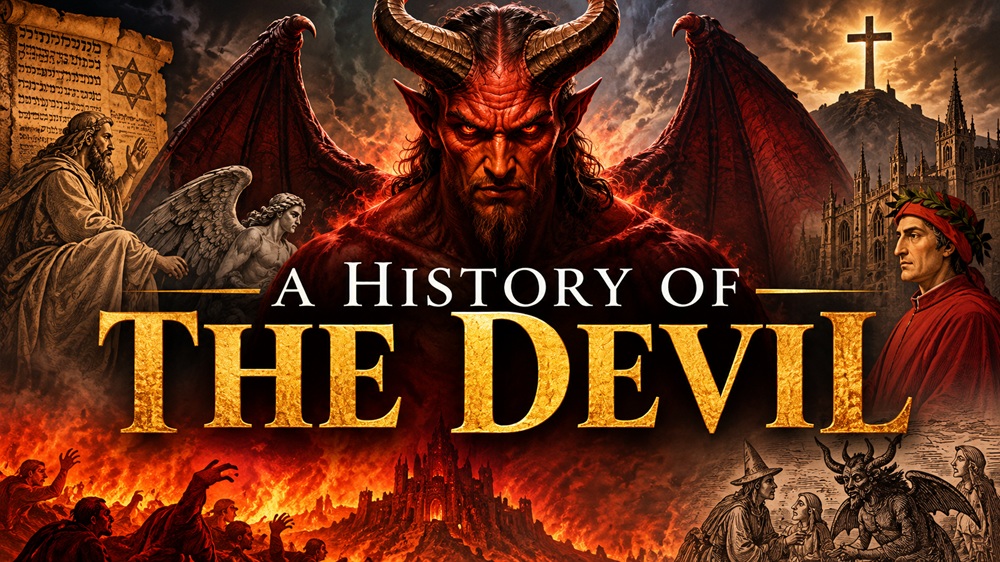 Introduction: The Invention of the Ultimate EnemyFew figures in the history of religion have undergone a transformation as remarkable as the Devil. Today, he is commonly imagined as a supernatural being who opposes God, tempts humanity, rules over hell, and seeks to lead human souls into eternal damnation. His familiar appearance—with horns, a tail, cloven hooves, and a pitchfork—is deeply embedded in Western popular culture. Yet this image is the product of a long historical development. The Devil did not emerge fully formed in the earliest religious traditions. Nor does the Bible present a single, consistent account of his identity, origins, powers, or ultimate destiny. The figure we now call Satan is the result of centuries of religious speculation, theological controversy, cultural exchange, political symbolism, and artistic imagination. He began as something closer to an adversarial functionary in the heavenly court, developed into a cosmic opponent of God, and eventually became one of the most recognizable characters in Western civilization. His history also raises an intriguing question: how did a religion built around the worship of an all-powerful, perfectly good God come to require an equally dramatic embodiment of evil? The answer lies in the changing ways human beings have attempted to explain suffering, injustice, temptation, moral failure, and the apparent presence of evil in a divinely created world. 1. Before Satan: Evil in the Ancient WorldThe concept of a supernatural embodiment of evil was not unique to Judaism or Christianity. Ancient civilizations developed numerous ways of explaining destructive forces, suffering, chaos, disease, and misfortune. In Mesopotamian religion, supernatural beings such as demons and hostile spirits could cause illness, infertility, nightmares, and other calamities. They were not necessarily organized into a single kingdom of evil. Rather, the supernatural world contained competing powers, some protective and others dangerous. In ancient Egyptian religion, the god Seth could represent disorder, violence, and destructive forces, although he was not simply evil. Even the chaotic serpent Apophis, enemy of the sun god Ra, belonged to a cosmic mythology in which order and chaos were continually struggling. These traditions provide an important background. They demonstrate that human beings had long imagined invisible agents responsible for misfortune and disorder. But the Jewish conception of Satan introduced something different: an adversarial figure operating in relation to the God of Israel. There was initially no fully developed doctrine of a rebellious supernatural being commanding an army of demons and ruling a separate kingdom of darkness. That transformation would take centuries. 2. Satan in the Hebrew Bible: The Heavenly ProsecutorThe Hebrew word satan means adversary, opponent, or accuser. In its earliest biblical appearances, it does not necessarily designate a personal name. One particularly revealing passage is found in the Book of Job. Here, ha-satan, literally "the adversary," appears among the heavenly beings who present themselves before God. He challenges Job's righteousness, suggesting that Job is faithful only because God has protected and rewarded him. God permits the adversary to test Job, first by taking away his possessions and family, and subsequently by afflicting his body. This is a fascinating theological arrangement. Satan is not an independent enemy of God. He operates within the divine administration and requires God's permission to act. Indeed, the story raises an uncomfortable question: if God authorizes the testing of Job, how much responsibility for the resulting suffering belongs to the adversary, and how much belongs to God? A similar picture appears in Zechariah 3, where Satan stands as an accuser against the high priest Joshua. Again, he appears as a prosecutorial figure rather than the commander of an independent kingdom of evil. The Hebrew Bible also contains the story of the serpent in the Garden of Eden. However, Genesis does not identify this serpent as Satan. It is a cunning creature that persuades Eve to eat from the forbidden tree. The identification of the serpent with the Devil belongs to later Jewish and Christian interpretation. Another important passage occurs in 1 Chronicles 21, where Satan incites David to conduct a census of Israel. Interestingly, the parallel account in 2 Samuel 24 attributes the incitement to God himself. This difference suggests that Jewish religious thought was gradually developing new ways of assigning responsibility for destructive or morally questionable events. The figure of Satan was beginning to acquire a more distinct identity. 3. The Persian Connection: Zoroastrianism and Cosmic DualismOne of the most important developments in the history of the Devil occurred during the centuries when Jewish communities came into contact with Persian culture. Following the Babylonian exile, the Jewish people lived under Persian imperial rule. During this period, they encountered religious ideas associated with Zoroastrianism. Zoroastrianism, traditionally associated with the prophet Zarathustra, presents a cosmic struggle between the forces of truth and righteousness, represented by Ahura Mazda, and destructive falsehood, associated with Angra Mainyu, also known as Ahriman. Unlike the early biblical conception of Satan, this tradition contains a more pronounced opposition between good and evil. The universe becomes the setting for a cosmic conflict, with human beings participating in the struggle through their moral choices. The historical extent of Persian influence on Jewish demonology and apocalyptic thought remains debated. Scholars cannot simply demonstrate that Jewish ideas about Satan were copied from Zoroastrianism. Nevertheless, the similarities are striking. During the Second Temple period, Jewish literature increasingly described supernatural conflicts between angelic and demonic powers, the emergence of evil forces, and the expectation of a final divine victory. The theological landscape was changing from one in which God governed everything, including adversity, toward one in which evil could be associated with rebellious supernatural agents. This development helped prepare the ground for the Devil of later Christianity. 4. Second Temple Judaism: The Rise of the Cosmic EnemyBetween approximately 500 BCE and the first century CE, Jewish religious literature developed increasingly elaborate accounts of supernatural evil. Some texts describe fallen angels who rebel against God, corrupt humanity, and produce destructive offspring. The Book of Enoch, particularly its account of the Watchers, tells of heavenly beings who descend to earth, violate divine boundaries, and introduce forbidden knowledge and violence. Other Jewish writings describe figures such as Mastema and Belial, who function as leaders or representatives of evil forces. The Dead Sea Scrolls, associated with the community at Qumran, reveal an especially developed form of cosmic dualism. The community imagined humanity divided between the forces of light and darkness, associated with the Prince of Light and the Angel of Darkness, sometimes identified with Belial. This was not necessarily a belief in two equally powerful gods. God remained supreme, but the world was understood as a battlefield between opposing spiritual forces. This development is important because it supplied early Christianity with a much more elaborate demonological vocabulary than that found in the older Hebrew scriptures. By the time of Jesus, the idea of Satan as a powerful supernatural adversary was already familiar in certain Jewish religious circles. 5. Satan in the New Testament: The Enemy of ChristIn the New Testament, Satan becomes a much more prominent figure. He is no longer merely a heavenly accuser. He is presented as the tempter, deceiver, ruler of demons, and opponent of God's kingdom. The temptation of Jesus in the wilderness is particularly significant. Satan offers Jesus worldly power and authority in exchange for worship. The confrontation symbolizes a struggle between two competing visions of power: domination and worldly authority on the one hand, and obedience to God on the other. Jesus repeatedly encounters demons and is accused by opponents of exercising demonic power himself. In the Gospels, Satan is described as the ruler of demons, and Jesus' exorcisms become demonstrations of the approaching kingdom of God. The Gospel of John calls Satan a murderer and the father of lies. In other New Testament writings, he is described as the adversary who prowls around seeking someone to devour. The Book of Revelation provides perhaps the most dramatic imagery. Satan appears as the great dragon, identified with the ancient serpent, who deceives the world and wages war against the forces of heaven. Here the identification between the serpent of Genesis and the Devil becomes explicit. Christianity thus inherited several different strands of Jewish thought and combined them into a more unified narrative. Satan became the principal supernatural antagonist of the Christian story. 6. Where Did Lucifer Come From?One of the most interesting episodes in the history of the Devil concerns the origin of his familiar name, Lucifer. The traditional Christian story maintains that Lucifer was originally a magnificent angel who rebelled against God because of pride. He attempted to elevate himself above his creator, was defeated by the heavenly armies, and was cast out of heaven. But the biblical foundation for this story is considerably less straightforward than popular belief suggests. The name Lucifer comes from the Latin translation of a passage in Isaiah 14:12, which refers to the morning star, traditionally associated with Venus. The original Hebrew expression, Helel ben Shachar, is commonly translated as "shining one, son of dawn." The passage is actually a satirical song directed against the king of Babylon, whose arrogance and downfall are compared to the fall of a brilliant celestial figure. It was not originally written as a biography of Satan. Similarly, Ezekiel 28 contains an elaborate lament against the king of Tyre, employing imagery of a magnificent being in Eden who falls because of pride. Later Christian interpreters connected this passage with the fall of Satan. By combining these texts with other biblical passages, Christian theology gradually constructed a narrative of a beautiful angel who became the embodiment of pride and rebellion. The distinction is important: the familiar Lucifer story is a theological synthesis, not a straightforward account found in one biblical passage. 7. The Devil in Early ChristianityDuring the first centuries of Christianity, theologians struggled with an important philosophical problem. If God created everything and is perfectly good, how could an evil supernatural being exist? One influential response came from Augustine of Hippo (354-430 CE). Augustine had earlier been associated with Manichaeism, a religion that explained the universe through a struggle between two fundamental principles, Light and Darkness. He eventually rejected this dualism in favor of Christian theology. For Augustine, evil was not an independent substance created by God. Rather, evil was a privation of good: a corruption, distortion, or absence of something that should be good. The Devil, therefore, was not originally evil by nature. He was created good as an angel but became evil through the misuse of his freedom. Pride was the decisive turning point. This solution had considerable theological advantages. It preserved God's status as the creator of everything while explaining evil through the freedom of created beings. However, it also introduced a difficult question: why would a perfect angel freely choose evil in the first place? The explanation ultimately relied on free will itself. The Devil's rebellion thus became a cosmic illustration of the dangers of freedom detached from divine goodness. 8. The Medieval Devil: Hell, Demons, and Popular ImaginationDuring the Middle Ages, the Devil became an increasingly vivid and frightening presence in European religious culture. Theologians developed elaborate classifications of demons, descriptions of hell, and accounts of supernatural temptation. The Devil was believed to be actively involved in human affairs. He could tempt individuals, encourage heresy, inspire sinful behavior, and potentially possess human bodies. Monastic literature frequently described encounters with demonic forces. Saints were portrayed as resisting temptations through prayer, fasting, and spiritual discipline. The medieval imagination also transformed Satan visually. The Devil acquired features associated with animals, including horns, claws, wings, tails, and hooves. His appearance often borrowed from pre-Christian representations of nature spirits and pagan deities. The resemblance to the Greek god Pan is particularly interesting, although the precise historical development of these visual conventions is complex. The Devil also became increasingly associated with the punishment of sinners in hell. There is, however, a curious theological distinction: Satan was not originally conceived as the administrator of hell in the same sense that a king governs a kingdom. In Christian theology, hell is ultimately a place of punishment for the Devil and his followers as well. Nevertheless, popular imagination increasingly portrayed him as its ruler. Medieval literature helped consolidate this picture. In Dante Alighieri's Inferno, Satan occupies the deepest region of hell, frozen in ice rather than surrounded by flames. He is a grotesque, imprisoned figure, eternally trapped in the consequences of his rebellion. This image is quite different from the popular conception of a powerful supernatural monarch. 9. The Devil and the Witch HuntsBetween the fifteenth and seventeenth centuries, the Devil became central to one of the darkest episodes in European history: the witch hunts. The belief developed that certain individuals, particularly women, had entered into a pact with Satan in exchange for supernatural powers. Witches were accused of attending nocturnal gatherings, participating in obscene rituals, harming livestock, causing disease, and undermining Christian society. The publication of the Malleus Maleficarum in 1486, associated with the Dominican inquisitor Heinrich Kramer, helped popularize a systematic demonological framework for identifying and prosecuting alleged witches. It is important to emphasize that witch persecution was not simply an uninterrupted campaign conducted by the medieval Church. The most intense European witch hunts occurred during the early modern period, particularly in the sixteenth and seventeenth centuries, and involved secular as well as ecclesiastical authorities. Tens of thousands of people were executed, with women forming the majority of the victims. The Devil served as an ideological explanation for social anxieties, religious conflicts, unexplained misfortunes, and perceived threats to established authority. The belief in Satan could therefore have very concrete consequences. An invisible supernatural enemy became the justification for persecuting very visible human beings. 10. The Devil in Literature: Milton's Rebel AngelThe Devil acquired a new and remarkably influential literary identity in the seventeenth century through John Milton's epic poem Paradise Lost (1667). Milton presents Satan as a proud, rebellious angel who leads an unsuccessful revolt against God and subsequently attempts to corrupt humanity. The poem opens with Satan and his followers already defeated and cast into hell. Yet Milton's Satan is not merely a monster. He is eloquent, ambitious, defiant, and psychologically complex. His famous declaration, "Better to reign in Hell, than serve in Heaven," captures the attraction of absolute independence, even when it leads to destruction. This literary portrayal proved extraordinarily influential. Later readers sometimes found Satan more dramatically compelling than the supposedly virtuous characters surrounding him. Romantic writers, in particular, became fascinated by the figure of the rebellious outsider who refuses to submit to established authority. Milton did not intend to turn Satan into a hero. Nevertheless, his literary achievement helped transform the Devil from an object of religious terror into a character capable of eliciting psychological and even political sympathy. The Devil had acquired a personality. 11. The Enlightenment: The Devil Loses His CredibilityThe scientific revolution and the Enlightenment fundamentally altered European attitudes toward supernatural explanations. Natural philosophy increasingly explained phenomena previously attributed to invisible spiritual agents. Lightning, disease, mental illness, unusual behavior, and natural disasters could now be investigated through observation and scientific reasoning. The Devil gradually lost his position as an everyday explanatory principle. Enlightenment thinkers also questioned the morality of traditional Christian demonology. How could a perfectly good and omnipotent God permit an immensely powerful supernatural enemy to torment humanity? And why should human beings be eternally punished for actions performed during a finite lifetime? These questions contributed to broader criticism of traditional doctrines of sin, hell, divine justice, and salvation. The Devil did not disappear, however. He increasingly became a metaphor for human irrationality, cruelty, political oppression, and destructive passions. The supernatural adversary was gradually being replaced by psychological and social explanations of evil. 12. The Devil in Modern Psychology and PhilosophyThe nineteenth and twentieth centuries produced several influential reinterpretations of the Devil. For Friedrich Nietzsche, the traditional Christian opposition between good and evil was itself a subject of philosophical criticism. He regarded much Christian morality as an expression of resentment and the suppression of human vitality. Nietzsche did not simply replace Satan with a positive symbol of liberation, but his philosophy helped undermine the moral framework within which the Devil had traditionally been understood. Sigmund Freud approached religion through psychology. Although he did not develop a systematic theory of Satan, his account of unconscious impulses, aggression, guilt, and repression provided naturalistic alternatives to supernatural explanations of temptation and destructive behavior. Carl Gustav Jung offered a particularly interesting reinterpretation. For Jung, the Devil could be understood as an archetypal expression of the shadow: those aspects of human personality that individuals and societies refuse to acknowledge. The shadow includes aggression, selfishness, envy, cruelty, and other impulses that people prefer to project onto an external enemy. From this perspective, the Devil is not necessarily an independent supernatural being. He is also a symbol of the disowned dimensions of human psychology. There is a revealing irony here. Throughout religious history, humanity has repeatedly projected its own capacity for evil onto supernatural beings. Yet the same capacity remains present in ordinary human behavior. The Devil may therefore tell us as much about ourselves as about our religious traditions. 13. The Political Devil: Evil as an Enemy of SocietyThe Devil has also had a long political career. Religious and political authorities have frequently portrayed their opponents as agents of Satan. During the Reformation, Catholics and Protestants accused one another of serving the Devil. Religious dissenters, heretics, and political enemies were regularly described in demonic language. This pattern continued into modern ideological conflicts. Totalitarian movements have often constructed images of absolute evil embodied in supposedly subhuman enemies. Political opponents become existential threats rather than legitimate participants in a common society. Although such language is not always explicitly religious, its psychological structure resembles traditional demonology. The enemy is no longer merely mistaken or dangerous. He represents evil itself. This is one of the most enduring functions of the Devil: providing an external explanation for everything that a community finds intolerable. The problem, of course, is that demonizing opponents makes compromise and mutual understanding increasingly difficult. A society that believes it is fighting the Devil may eventually convince itself that almost any action is justified. 14. The Devil in Contemporary Popular CultureToday, the Devil remains a powerful cultural symbol, even in increasingly secular societies. He appears in literature, films, television, music, comedy, horror, and popular entertainment. The figure of Mephistopheles in Goethe's Faust represents a particularly sophisticated development. He is not simply a monster but an intelligent, ironic, manipulative presence who exposes human vanity and weakness. In contemporary cinema, Satan can appear as a supernatural villain, a charming manipulator, a philosophical rebel, or even a comic character. The figure has become remarkably flexible. Sometimes he represents temptation and moral corruption. At other times he symbolizes rebellion against authority, freedom from conventional morality, or the seductive appeal of forbidden knowledge. In popular culture, the Devil has arguably become more interesting than the religious doctrines that originally produced him. He survives not necessarily because people believe in his literal existence, but because the symbolism remains psychologically and artistically productive. 15. The Great Theological Problem: Why Does God Need a Devil?The historical development of Satan reveals a fundamental problem within monotheistic theology. If God is omnipotent, omniscient, and perfectly good, why does evil exist? There are several traditional responses. One is the free-will defense: God created beings capable of making independent choices, and some chose evil. Another is the privation theory associated with Augustine: evil is not a substance but a corruption or absence of goodness. A third approach regards suffering and adversity as necessary conditions for moral and spiritual development. But none of these explanations entirely resolves the problem. The free-will defense does not explain natural disasters, disease, or suffering experienced by beings incapable of meaningful moral choice. The privation theory describes the nature of evil but does not fully explain why a perfectly good creator permits it. And the suggestion that suffering is necessary for spiritual development can become morally troubling when applied to extreme human misery. Introducing Satan may seem to solve the problem by providing an independent source of evil. But this creates another difficulty. If Satan is sufficiently powerful to undermine God's creation, then divine omnipotence appears compromised. If Satan can do nothing without God's permission, responsibility for the resulting evil seems to return to God. The Devil therefore does not eliminate the problem of evil. In some respects, he merely relocates it. 16. Beyond the Devil: A Naturalistic Understanding of EvilA contemporary naturalistic perspective does not require a supernatural personification of evil. Human cruelty, aggression, deception, domination, and destructiveness can be investigated through evolutionary biology, psychology, neuroscience, anthropology, and political science. This does not mean that evil is unreal or that moral distinctions are arbitrary. It means that we do not need to introduce an invisible supernatural agent to explain why people sometimes behave atrociously. Human beings are capable of extraordinary cooperation, empathy, generosity, and sacrifice. They are also capable of violence, exploitation, cruelty, and self-deception. These tendencies emerge from complex interactions between biological dispositions, individual psychology, social environments, cultural beliefs, and institutional structures. The history of the Devil suggests that supernatural explanations often emerge when people struggle to understand the destructive dimensions of human existence. But externalizing evil can become dangerous. If we regard evil as something that exists primarily outside ourselves, we may become less capable of recognizing it within our own beliefs, institutions, and behavior. The Devil can thus be understood as a mirror: a symbol of everything human beings fear, reject, and sometimes refuse to acknowledge about themselves. Conclusion: The Devil as Humanity's Most Enduring InventionThe Devil has traveled a remarkable historical journey. He began as an adversarial figure within the Hebrew religious imagination, developed into a supernatural opponent of God during the Second Temple period, became the great tempter and cosmic enemy in Christianity, and acquired an elaborate mythology through medieval theology. Renaissance and early modern demonology turned him into a frightening presence in everyday life. Milton transformed him into a compelling literary rebel. Enlightenment rationalism weakened his supernatural credibility, while modern psychology and philosophy reinterpreted him as a symbol of the darker dimensions of human existence. This history tells us something important about religion itself. Religious ideas are not static revelations that remain unchanged across centuries. They develop through cultural exchange, theological debate, political circumstances, literary imagination, and changing understandings of human nature. The Devil is an especially revealing example of this process. Perhaps the most important lesson is that humanity's struggle with evil does not require the existence of a supernatural enemy. The horrors of history, from religious persecution to genocide and political oppression, demonstrate that human beings are perfectly capable of producing evil without assistance from the underworld. And there is a final irony. For centuries, religious institutions warned humanity against the Devil's deceptions. Yet the belief that one's own enemies are agents of absolute evil has itself repeatedly produced intolerance, persecution, and violence. The Devil may be fictional as a supernatural individual, but the human capacity to create devils out of other people is very real. In that sense, the most interesting question is no longer whether the Devil exists. It is why human beings have needed him so desperately. Comment Form is loading comments...
|