|
TRANSLATE THIS ARTICLE
Integral World: Exploring Theories of Everything
An independent forum for a critical discussion of the integral philosophy of Ken Wilber
  Frank Visser, graduated as a psychologist of culture and religion, founded IntegralWorld in 1997. He worked as production manager for various publishing houses and as service manager for various internet companies and lives in Amsterdam. Books: Ken Wilber: Thought as Passion (SUNY, 2003), and The Corona Conspiracy: Combatting Disinformation about the Coronavirus (Kindle, 2020).
Check out my other conversations with ChatGPT The Great DelayWhy Life Emerged Early but Complex Life Took Billions of YearsFrank Visser / ChatGPT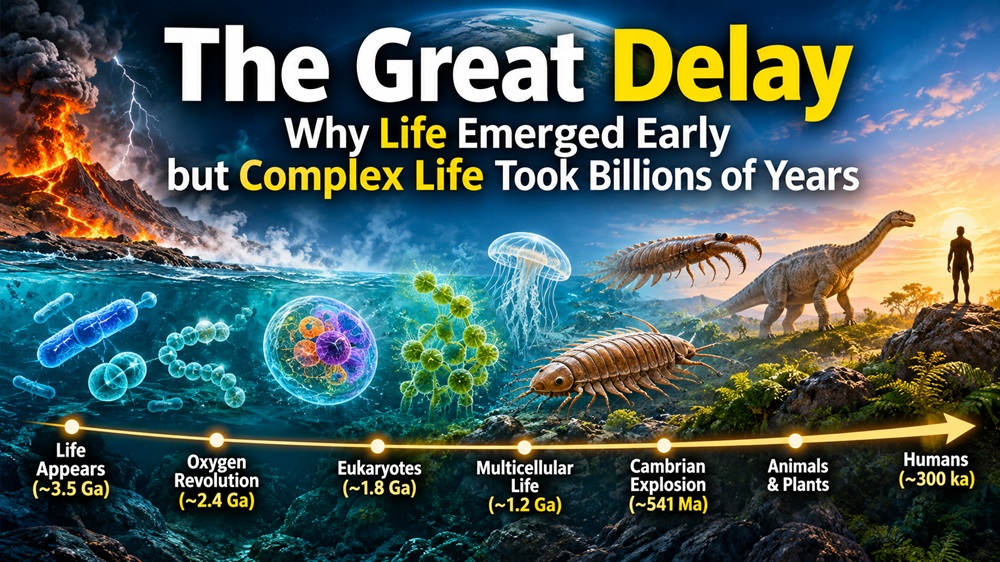
The Paradox of Earth's Biological HistoryOne of the most intriguing features of the history of life on Earth is the enormous difference between the time it took for life to emerge and the time it took for complex life to develop. Earth formed approximately 4.54 billion years ago. The earliest evidence of life dates back at least 3.5 billion years, and possibly considerably earlier. This means that life appeared relatively soon after our planet became habitable. Yet for most of Earth's subsequent history, life remained remarkably simple. Microorganisms dominated the planet for billions of years before complex cells, multicellular organisms, animals, and eventually human beings appeared. Why did the transition from non-life to life apparently happen relatively early, while the transition from simple to complex life took so extraordinarily long? This is a fascinating evolutionary paradox. It challenges the intuitive assumption that once life begins, biological complexity should steadily increase. Instead, Earth's history reveals a much more complicated picture: the emergence of life may not have been the most difficult transition in evolutionary history. Some of the subsequent innovations required entirely different conditions, mechanisms, and environmental transformations. The distinction is important. The origin of life and the evolution of complex life are two separate scientific problems. The first concerns how chemistry became biology. The second concerns how biological systems acquired new levels of organization. 1. Life Appeared Relatively Early
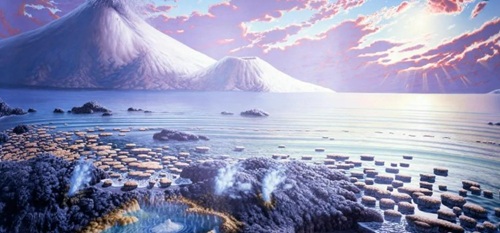 Earth formed around 4.54 billion years ago. During its earliest period, it was an extremely hostile environment, with intense volcanic activity, frequent impacts, and an atmosphere very different from today's oxygen-rich one. Nevertheless, geological evidence indicates that liquid water existed relatively early. By at least 3.8 billion years ago, conditions may already have permitted environments in which prebiotic chemistry could take place. The oldest widely discussed evidence of life comes from rocks approximately 3.5 billion years old, although some older geological and isotopic evidence has been interpreted as potentially biological. These interpretations remain debated. What is striking is that life seems to have emerged during the first billion years or so of Earth's existence, perhaps considerably earlier. We do not yet know precisely how this happened. Several hypotheses investigate possible pathways:
None of these hypotheses has yet established a complete, experimentally confirmed pathway from non-living chemistry to the first evolving biological systems. Nevertheless, the early appearance of life suggests that the transition from chemistry to biology may be possible under a wider range of planetary conditions than once imagined. 2. The Long Reign of Microbial Life
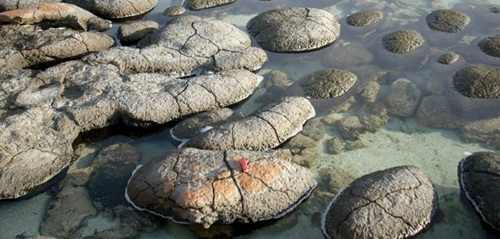 For roughly two billion years, perhaps longer, Earth's biosphere was dominated almost entirely by microorganisms. These organisms were not necessarily primitive in the sense of being chemically or metabolically unsophisticated. Bacteria and archaea developed extraordinarily diverse biochemical strategies. They learned to exploit sunlight, chemical gradients, sulfur compounds, iron, hydrogen, and numerous other energy sources. Some microorganisms developed photosynthesis. Others established complex ecological relationships. Microbial communities transformed the chemistry of oceans and eventually the atmosphere. Yet the basic cellular organization remained relatively simple. The important distinction here is between biochemical sophistication and structural complexity. A bacterium can perform thousands of coordinated biochemical reactions without possessing a nucleus, specialized tissues, organs, or a nervous system. Evolution does not necessarily reward organisms for becoming structurally more complicated. It rewards reproductive success under particular environmental conditions. For billions of years, microorganisms were exceptionally successful. They occupied virtually every available ecological niche, reproduced rapidly, and adapted to changing environments. There was no evolutionary requirement for them to become animals. 3. The Oxygen Revolution: A Planetary Transformation
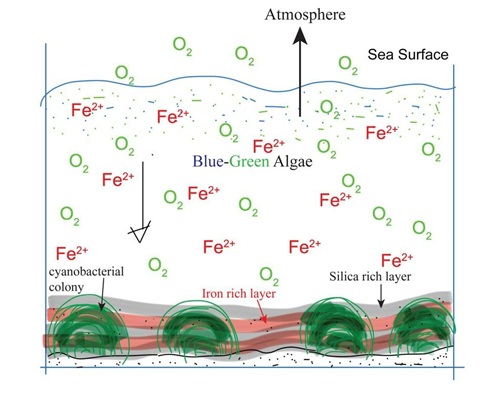 One of the most important events in Earth's biological history was the Great Oxidation Event, beginning approximately 2.4 billion years ago. Certain microorganisms, particularly ancestral cyanobacteria, had evolved oxygen-producing photosynthesis. They used sunlight to extract electrons from water, releasing oxygen as a by-product. Initially, this oxygen did not accumulate freely in the atmosphere. It reacted with dissolved iron and other substances in the oceans and crust. Eventually, however, oxygen began accumulating in the atmosphere, fundamentally changing the planet. This transformation had enormous consequences. First, oxygen was toxic to many organisms that had evolved in an oxygen-free environment. The new atmosphere therefore represented an ecological catastrophe for some existing forms of life. Second, oxygen made possible highly efficient aerobic respiration. Compared with many anaerobic metabolic pathways, aerobic respiration can extract substantially more usable energy from organic molecules. This greater energy availability would eventually become important for the evolution of larger and more complex organisms. However, oxygen alone did not produce complex life. It was a necessary enabling factor in some evolutionary transitions, not a sufficient explanation for them. The planet had to undergo several additional biological innovations before complex organisms could become widespread. 4. The Eukaryotic Revolution: A Major Evolutionary Bottleneck
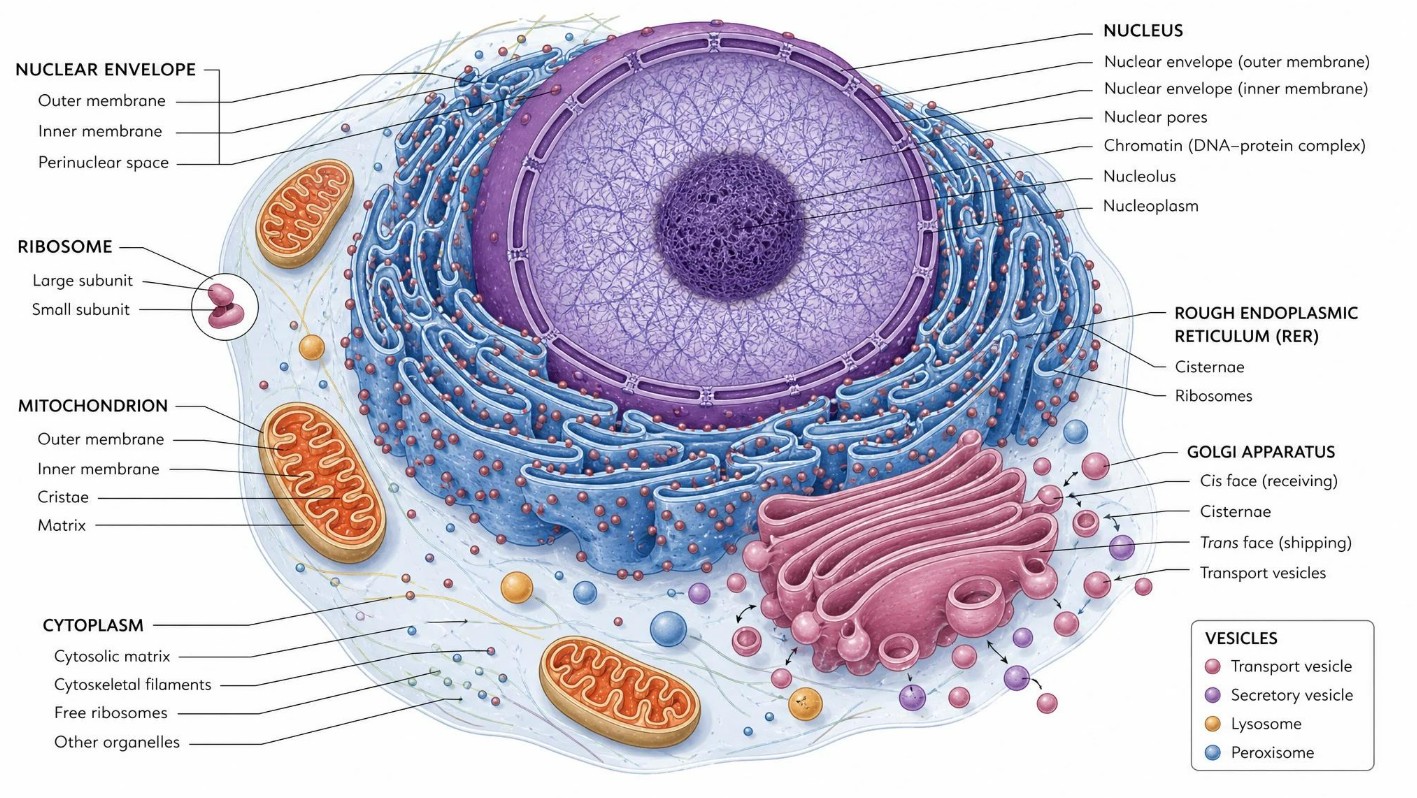 Perhaps the most consequential transition in the history of life was the emergence of the eukaryotic cell. Bacteria and archaea are prokaryotes: their cells lack a membrane-bound nucleus and the elaborate internal organization characteristic of eukaryotes. Eukaryotic cells, by contrast, contain a nucleus, mitochondria, and other specialized internal structures. The origin of eukaryotes is generally placed somewhere between approximately 2.1 and 1.6 billion years ago, although the precise date remains uncertain. How did this transformation occur? The leading explanation involves endosymbiosis. According to this theory, an ancestral archaeal host incorporated a bacterium related to modern alphaproteobacteria. Instead of digesting it, the host maintained a lasting relationship with it. Over evolutionary time, this bacterium became the mitochondrion.
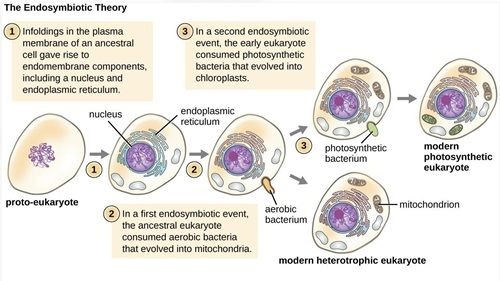 This was an extraordinary evolutionary development. The relationship eventually produced a new type of cellular organization, with profound consequences for biological evolution. Mitochondria provide cells with an efficient energy-producing system. They also retain a small genome of their own, a reminder of their bacterial ancestry. The significance of this transition cannot be overstated. All known animals, plants, fungi, and other complex eukaryotic organisms descend from this ancient evolutionary history. It is possible that the origin of eukaryotic cells was much less probable than the emergence of microbial life itself. We have only one known example of this transition. In this sense, the history of life contains a major evolutionary bottleneck: life emerged relatively early, but the cellular architecture that eventually enabled complex organisms took much longer to appear. 5. Multicellularity: From Cells to Organisms
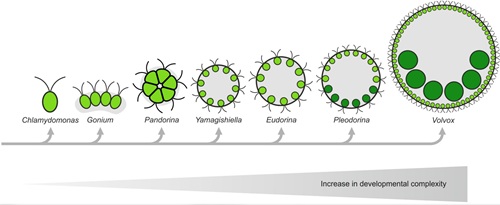 The next major development was multicellularity. At first glance, multicellularity might seem like a relatively straightforward innovation. Cells simply remain attached after dividing, forming colonies. But the evolutionary transition from a collection of cells to an integrated multicellular organism is much more demanding. It requires mechanisms for:
In other words, cells must begin behaving as parts of a larger biological system rather than as independent organisms. Multicellularity evolved independently in several lineages, including animals, plants, fungi, and various algae. Some forms of multicellularity are relatively simple; others involve highly specialized tissues and organs. This distinction matters because multicellularity was not one single evolutionary event. It was a recurring solution to different ecological and biological problems. Some multicellular organisms appeared well before the Cambrian explosion. However, the diversification of large, complex animals occurred much later. 6. The Cambrian Explosion: When Animals Diversified
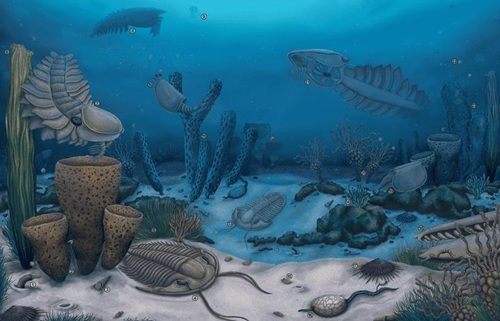 Around 541 million years ago, the Cambrian Period began. It witnessed a remarkable diversification of animal life, often called the Cambrian explosion. Within a geologically relatively short period, many of the major animal body plans recognizable today appeared in the fossil record. There were organisms with shells, jointed limbs, complex eyes, swimming appendages, and sophisticated feeding structures. Predators and prey became increasingly involved in evolutionary arms races. The oceans became ecologically more elaborate. However, the expression Cambrian explosion can be misleading. Animal evolution did not begin suddenly 541 million years ago. Earlier multicellular organisms existed during the Ediacaran Period, and molecular evidence suggests that some animal lineages originated before their unmistakable fossils appeared. The Cambrian diversification was therefore not the sudden creation of complex life from nothing. It was an exceptionally important phase in a much longer evolutionary process. Several factors may have contributed:
There is no universally accepted single explanation. The Cambrian explosion probably resulted from several interacting biological and environmental developments. 7. Why Did Complex Life Take So Long?We can now return to the central paradox. If life emerged relatively early, why did complex organisms take billions of years to develop? There are several complementary explanations. A. Evolution has no predetermined destinationThe first and perhaps most important explanation is that evolution does not have an intrinsic tendency toward complexity. Natural selection favors organisms that reproduce successfully in their particular environments. It does not reward complexity for its own sake. A bacterium that reproduces rapidly, survives environmental extremes, and efficiently exploits available resources is not evolutionarily inferior to a mammal. Indeed, bacteria remain extraordinarily successful. They dominate many ecosystems and account for a substantial proportion of Earth's biological diversity and biomass. From an evolutionary perspective, there was nothing wrong with a predominantly microbial planet. It was already a successful biosphere. Complexity emerged only when particular evolutionary circumstances made it advantageous or viable. B. Major evolutionary transitions are difficultThe history of life is not simply a sequence of increasingly complicated organisms. It contains several fundamental transitions in the organization of biological systems. Consider the following examples:
Each transition required more than the accumulation of additional genetic information. It involved new forms of cooperation, coordination, and biological organization. Evolutionary biologists refer to some of these developments as major evolutionary transitions. One recurring theme is the emergence of a new level of individuality: entities that previously reproduced independently become integrated into a larger reproductive system. The transition from single cells to multicellular organisms is a particularly clear example. C. Energy availability places constraints on complexityA third explanation concerns bioenergetics. Complex organisms require energy not only to maintain themselves but also to operate their internal systems. A large animal must support circulation, digestion, movement, cellular maintenance, immune responses, reproduction, and often nervous-system activity. These activities require substantial and continuous energy supplies. The evolution of mitochondria was especially important because it gave eukaryotic cells access to new possibilities for energy production and cellular organization. One influential hypothesis, developed by biologist Nick Lane and others, argues that the energetic advantages associated with mitochondria helped make the evolution of complex cells possible. This does not mean that mitochondria automatically produced complexity. Rather, they helped overcome energetic constraints that may have limited the evolutionary possibilities of prokaryotic cells. The relationship between energy availability and biological complexity remains an active research subject. D. The environment had to become sufficiently hospitableThe atmosphere and oceans of early Earth were very different from those of today. Oxygen availability changed over geological time, and even after the Great Oxidation Event, oxygen levels fluctuated considerably. A further increase in oxygenation occurred during the Neoproterozoic, approximately 800-540 million years ago. This period overlaps with the emergence and diversification of complex multicellular organisms and animals. Oxygen may have enabled larger body sizes, more active lifestyles, and more demanding metabolic processes. But oxygen was not the only limiting factor. Nutrient availability, ocean chemistry, climate, geological activity, and ecological interactions also mattered. We should therefore resist the temptation to identify one environmental variable as the master explanation for the entire history of complex life. 8. The Role of Contingency: Could Complex Life Have Emerged Earlier?
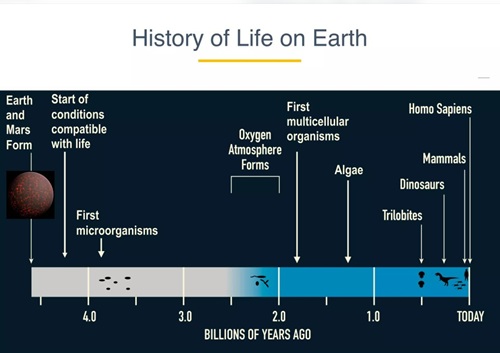 An important implication of this history is that evolutionary outcomes depend partly on contingency. Evolution is constrained by existing biological structures. New organisms do not start from scratch. They inherit genetic systems, cellular architectures, developmental pathways, and ecological relationships from their ancestors. Sometimes an innovation creates possibilities that were previously unavailable. Sometimes a particular evolutionary pathway becomes accessible only because several earlier developments have occurred. The origin of eukaryotic cells is an excellent example. If the ancestral host and bacterial partner had not established their extraordinary symbiotic relationship, the subsequent evolution of animals, plants, and fungi might never have happened in the forms we know. This raises an interesting question: was the emergence of complex life inevitable, given enough time, or was it a remarkably fortunate outcome of a particular evolutionary history? We do not know. The fact that eukaryotic life appears to have originated only once is particularly suggestive. Although multicellularity evolved repeatedly, the emergence of the complex eukaryotic cell represents a singular event in the known history of life. That does not prove that it is extraordinarily improbable everywhere in the universe. But it certainly warns against assuming that microbial life will naturally and routinely develop into complex organisms. 9. The Paradox in Perspective: A Geological TimelineThe contrast becomes especially striking when we place the major events alongside one another.
Dates are approximate; some early evolutionary events remain disputed, and fossil first appearances do not necessarily mark the actual origin of a lineage. The timeline reveals something remarkable. Life existed for approximately three billion years before the Cambrian explosion. Animals themselves have occupied only a relatively small fraction of Earth's total biological history. And modern humans? We appeared extremely late. If Earth's entire 4.54-billion-year history were compressed into one calendar year, the earliest known life would appear around the end of March. Eukaryotic cells would emerge around the middle of the year. The Cambrian explosion would occur in mid-November, and Homo sapiens would appear only during the final hour or so of December 31. Human civilization would occupy only the very last seconds. This is a useful corrective to our natural tendency to regard human existence as the culmination of a long evolutionary process. 10. What Does This Mean for Life Elsewhere in the Universe?
 The history of life on Earth has important implications for astrobiology, the scientific study of life beyond our planet. Suppose microbial life is relatively common in the universe. Does that mean complex organisms are common as well? Not necessarily. Earth demonstrates that the emergence of microbial life and the emergence of complex organisms are separated by enormous evolutionary intervals. Even if the transition from chemistry to primitive life is relatively easy, subsequent transitions may be much more difficult. This suggests several possibilities. First, microbial life might be widespread. If the chemical ingredients and environmental conditions necessary for life are reasonably common, simple organisms could exist on many planets and moons. Second, complex life might be much rarer. The evolution of eukaryotic cells, multicellularity, and sophisticated organisms may require a combination of biological innovations and environmental conditions that are less common. Third, technological intelligence might be rarer still. On Earth, billions of years of evolution produced countless species, but only one known lineage developed technological civilization. We should be careful here. We have only one example of a biosphere, so we cannot calculate the statistical probability of these transitions. Earth's evolutionary history is evidence of what can happen, not a representative sample of what usually happens. Nevertheless, the distinction between microbial life and complex life is fundamental to the search for extraterrestrial organisms. Finding microorganisms on Mars, Europa, or Enceladus would be an extraordinary discovery. It would not automatically imply that complex organisms, let alone intelligent civilizations, are common. 11. Does Evolution Really Produce Increasing Complexity?There is a final conceptual issue worth considering. When we look backward from humans, we can construct an apparently progressive narrative: simple cells, complex cells, multicellular organisms, animals, mammals, primates, humans. But this is partly an illusion created by looking backward from the particular organism we happen to be. Evolution has no predetermined objective. It does not operate according to a universal ladder of increasing complexity. Most evolutionary lineages do not become progressively more complex. Many remain relatively simple, while others become more specialized. Some lose structures that their ancestors possessed. Some become parasites and undergo substantial simplification. There is, nevertheless, an interesting statistical phenomenon: the maximum observed complexity of life has increased over geological time. One explanation is that evolution began with relatively simple organisms, placing an initial lower boundary on complexity. Subsequent diversification allowed some lineages to explore increasingly complex forms, even though most organisms did not follow that trajectory. This distinction between increasing maximum complexity and universal evolutionary progress is essential. It allows us to recognize the extraordinary history of biological innovation without introducing a mysterious force that supposedly drives evolution toward higher levels of existence. Natural selection, genetic variation, symbiosis, ecological interactions, developmental mechanisms, and changing environmental conditions provide powerful explanatory frameworks. Where their explanatory reach remains incomplete, scientific investigation continues. There is no need to assume that evolution has an inherent cosmic purpose. Conclusion: The Real Miracle Was Not Just the Origin of LifeThe history of Earth presents us with two remarkable developments. The first was the emergence of life from non-living chemistry, apparently relatively early in Earth's history. The second was the much later emergence of complex cellular organization and multicellular organisms. The second transition took billions of years and depended on a remarkable succession of biological innovations. The development of oxygen-producing photosynthesis transformed the planet. Endosymbiosis helped create the eukaryotic cell. Multicellularity enabled new forms of biological cooperation. Changing environmental conditions and ecological interactions eventually facilitated the diversification of complex animals. The lesson is that the emergence of life and the emergence of complexity are fundamentally different evolutionary problems. Life did not spend billions of years waiting to fulfill some predetermined evolutionary destiny. Microbial organisms were already extraordinarily successful. Complex life emerged through a contingent sequence of innovations, opportunities, and environmental changes. Perhaps the most important implication is also the most humbling: a planet can be inhabited for billions of years without producing anything remotely resembling an animal, a forest, or a human being. Life may be relatively easy to establish, while complex life requires a much longer and more exceptional evolutionary history. That is the real significance of Earth's great biological delay. Comment Form is loading comments...
|