|
TRANSLATE THIS ARTICLE
Integral World: Exploring Theories of Everything
An independent forum for a critical discussion of the integral philosophy of Ken Wilber
  Frank Visser, graduated as a psychologist of culture and religion, founded IntegralWorld in 1997. He worked as production manager for various publishing houses and as service manager for various internet companies and lives in Amsterdam. Books: Ken Wilber: Thought as Passion (SUNY, 2003), and The Corona Conspiracy: Combatting Disinformation about the Coronavirus (Kindle, 2020).
Check out my other conversations with ChatGPT Baruch SpinozaThe Philosopher Who Replaced God with NatureFrank Visser / ChatGPT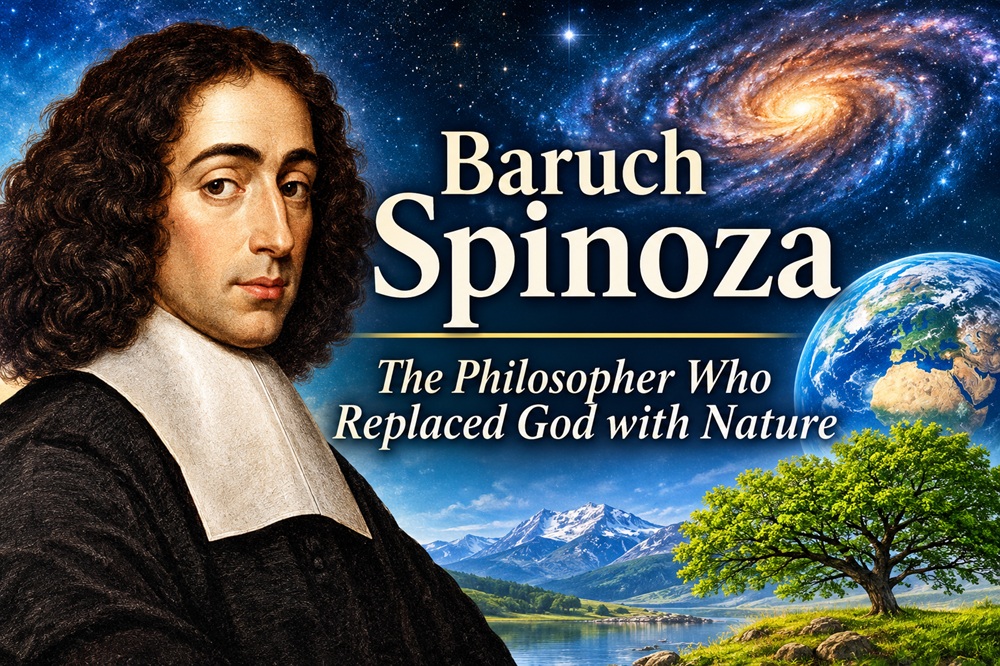 Introduction: A Radical Thinker Ahead of His TimeFew philosophers have challenged the foundations of Western religious and philosophical thought as profoundly as Baruch Spinoza (1632-1677). Born in Amsterdam into a Portuguese-Jewish family of Sephardic descent, Spinoza developed a philosophical system that effectively dissolved the traditional distinction between God and the natural world. Rather than conceiving of God as a supernatural creator standing outside the universe, he identified God with Nature itself. His famous expression Deus sive Natura—God or Nature—encapsulates a revolutionary vision that continues to provoke admiration, controversy, and debate. Spinoza was not simply an atheist in the modern sense, nor was he a conventional religious thinker. He rejected the anthropomorphic God of the Abrahamic traditions, divine intervention, miracles, providence, and the idea that human beings occupy a privileged position in creation. Instead, he proposed an entirely immanent conception of reality, governed by necessity and intelligible through reason. His philosophy anticipated important elements of modern naturalism, scientific thinking, secular biblical criticism, and even contemporary discussions about the relationship between mind and body. Yet Spinoza's system also raises difficult questions. Does identifying God with Nature explain anything beyond giving the natural world a religious name? Can human freedom survive in a universe governed by necessity? And does his rationalistic vision adequately account for the complexity of human experience? 1. The Life of an Intellectual OutsiderSpinoza was born on November 24, 1632, in Amsterdam, into a prosperous Jewish merchant family. His education included traditional Jewish theology, Hebrew, and the Talmud, but he also became increasingly interested in European philosophy and contemporary scientific developments. His intellectual curiosity eventually brought him into conflict with the religious authorities of his community. In 1656, at the age of twenty-three, he was subjected to a severe ban (herem) by the Amsterdam Portuguese-Jewish congregation. The precise reasons remain debated, but his increasingly radical religious and philosophical views were clearly incompatible with orthodox Judaism. Spinoza subsequently lived independently, supporting himself through lens grinding while developing his philosophical writings. He maintained contact with intellectual circles but declined invitations that might have compromised his independence, including a professorship at the University of Heidelberg. His relatively short life was devoted to philosophical inquiry rather than academic advancement or institutional influence. He died in 1677, probably from a respiratory illness aggravated by years of exposure to glass dust from his lens-grinding work. His principal philosophical masterpiece, Ethics, was published posthumously in the same year. Written in a highly unusual geometrical format, with definitions, axioms, propositions, demonstrations, and corollaries, it attempted to construct a complete philosophical account of reality, humanity, and the good life. 2. Deus sive Natura: God Is NatureThe central proposition of Spinoza's philosophy is that there exists only one substance: God, or Nature. This is perhaps the most radical aspect of his thought. Traditional monotheistic religions distinguish between God, the creator, and the created universe. God exists independently of the world, possesses intentions, makes decisions, issues commandments, and intervenes in human affairs. Spinoza rejects this entire framework. For him, God is not a supernatural personality but the infinite, self-existing reality of which everything else is an expression. Nothing exists outside God, because there can be no second substance independent of the infinite substance. This does not mean that individual objects are illusions. Trees, animals, planets, human beings, and thoughts are real, but they are finite expressions or modifications of the one underlying substance. Spinoza therefore offers a radically monistic ontology: everything belongs to one interconnected reality. His identification of God with Nature should not be confused with the ordinary notion that God is simply the sum of physical objects. Spinoza's Nature encompasses the infinite reality and its necessary productive power, not merely the observable universe. He distinguishes between Natura naturans (Nature naturing), the active, productive reality of substance, and Natura naturata (Nature natured), the totality of its modes and expressions. This distinction is philosophically important. Nature is not merely a collection of things. It is the self-expressing reality from which all particular things follow. For modern readers, this is one of Spinoza's most attractive ideas. It offers a conception of spirituality without supernaturalism, divinity without a personal deity, and unity without requiring an external creator. But it also introduces a question that deserves closer examination: does calling Nature God add anything to our understanding of Nature itself? Spinoza's answer would be that it reveals the ultimate metaphysical character of reality. A scientific naturalist might respond that the terminology adds a theological dimension without providing additional explanatory power. 3. Everything Happens by NecessityAnother defining feature of Spinoza's philosophy is his rejection of metaphysical contingency. Everything follows necessarily from the nature of God or Nature. Nothing could have happened differently, given the totality of conditions and the necessary structure of reality. This position is radically different from the traditional religious understanding of creation. In conventional theology, God freely chooses to create the world and could presumably have created a different one. For Spinoza, such a conception projects human decision-making onto an infinite reality that has no intentions or preferences. Nature does not deliberate, choose, or pursue purposes. Everything follows from its own necessary laws. Spinoza therefore rejects teleology: the idea that natural processes exist for the sake of some future goal. Human beings frequently interpret events in terms of purposes because they are conscious of their desires but ignorant of the causes that determine them. We imagine that nature was designed for our benefit because we tend to understand the world through our own interests. This critique remains remarkably relevant. It challenges religious explanations of natural phenomena, but it also questions popular forms of spiritual evolutionism that interpret the universe as progressing toward greater consciousness, enlightenment, or some ultimate cosmic destination. From a Spinozist perspective, the universe does not need to be moving toward anything. Its existence and development follow from its own nature. This is an important corrective to philosophical systems that introduce cosmic purpose whenever they encounter complexity or novelty. However, Spinoza's necessity raises a problem of its own. If everything follows necessarily, what does it mean to distinguish between better and worse possibilities? And how can human beings meaningfully pursue improvement if their actions are themselves determined? Spinoza attempts to answer these questions through his account of human freedom. 4. The Mind and Body: One Reality, Two AttributesSpinoza's treatment of the mind-body problem is another of his major philosophical achievements. Descartes had famously distinguished between two fundamental substances: thinking substance (res cogitans) and extended substance (res extensa). This dualism created the notorious problem of explaining how an immaterial mind could interact with a material body. Spinoza rejected Cartesian dualism. Mind and body are not two separate substances interacting with one another. They are two ways of understanding the same underlying reality. Spinoza calls these ways of understanding attributes. Human beings know two attributes of the infinite substance particularly well: thought and extension. A human body and the corresponding human mind are therefore not two independent entities. They are the same individual expressed under different attributes. This position is often described as psychophysical parallelism, although that term can oversimplify his more comprehensive metaphysics. The significance is considerable. Spinoza does not need to explain how an immaterial mind influences a material body, because the two are not separate causal systems. His approach anticipates certain contemporary philosophical positions that reject Cartesian dualism, although it should not be confused with modern neuroscience or physicalist theories of consciousness. There remains, however, a major unresolved question: why should physical reality have a mental aspect at all? Spinoza establishes a metaphysical framework in which thought and extension are attributes of the same substance, but he does not provide an empirical explanation of consciousness. His system tells us how mind and body fit into his ontology, not how subjective experience emerges or why it exists. For contemporary naturalists, this distinction is important. A metaphysical solution to the mind-body problem is not necessarily a scientific explanation of consciousness. 5. Human Freedom: Understanding NecessityAt first sight, Spinoza appears to leave little room for human freedom. If everything is determined by necessity, then our decisions, desires, and actions must also be determined. Yet he does not conclude that human freedom is meaningless. Instead, he radically redefines it. For Spinoza, freedom is not the ability to escape causality or make choices independently of all determining conditions. Such freedom would be an illusion. Genuine freedom consists in understanding the causes that determine us and acting increasingly through adequate knowledge rather than being passively driven by external influences. A person who reacts impulsively to anger, fear, jealousy, or resentment is relatively unfree because their actions are governed by forces they do not understand. A person who understands the causes of these emotions can acquire greater control over their responses. Freedom, in this sense, is a movement from passive determination toward active understanding. This is one of the most psychologically valuable aspects of Spinoza's philosophy. It anticipates important insights in contemporary cognitive psychology, psychotherapy, and theories of emotional regulation. Understanding why we behave as we do can change how we behave. Knowledge does not remove causality, but it can become a new causal factor in our lives. Nevertheless, Spinoza's conception of freedom is not equivalent to the ordinary notion of free will. We may become more rational and less reactive, but our increasing rationality is itself part of the causal order. This is a coherent philosophical position, although those who believe that moral responsibility requires genuine alternative possibilities will find it unsatisfactory. 6. The Conatus: The Striving to PersistOne of Spinoza's most influential psychological concepts is conatus: the inherent striving of every individual thing to persevere in its existence. Everything, from a simple physical object to a complex organism, expresses this fundamental tendency according to its particular nature. In human beings, conatus appears as desire, the fundamental drive underlying our emotions, motivations, and actions. Spinoza does not regard desire as something inherently irrational or morally suspect. It is an expression of our nature. Good and bad are consequently understood in relation to what increases or diminishes our power of acting. Joy is associated with a transition toward greater power or perfection, while sadness corresponds to a transition toward diminished power. These are not merely subjective feelings. They express changes in our capacity to exist and act. This approach offers a naturalistic alternative to moral systems based on divine commandments or supernatural ideals. Rather than asking whether an action conforms to an external moral authority, Spinoza asks whether it contributes to human flourishing and rational activity. His ethics is therefore grounded in human nature rather than divine legislation. There is an interesting parallel here with evolutionary biology, particularly the idea that organisms exhibit self-preserving tendencies. However, Spinoza's conatus should not simply be identified with biological survival or Darwinian natural selection. It is a much broader metaphysical principle. His account raises an additional question: does the tendency to persist provide an adequate foundation for morality? Human flourishing involves cooperation, empathy, justice, and concern for others, not merely individual self-preservation. Spinoza recognizes this and argues that rational human beings discover that cooperation with others is beneficial to their own flourishing. 7. Ethics Without Heaven or HellSpinoza's ethics is among the most radical attempts to construct a moral philosophy without relying on supernatural rewards and punishments. He rejects the traditional idea that morality is based on obedience to God's commandments. Since God does not possess human-like intentions, there can be no divine legislation in the conventional sense. Nor does Spinoza believe in an afterlife involving personal rewards and punishments. His ethical ideal is the rational understanding of ourselves and the world, leading to a more harmonious and joyful existence. This does not mean that anything goes. Spinoza believes that reason can establish genuine standards for human flourishing. A rational person recognizes that cooperation, friendship, honesty, and mutual assistance are generally more conducive to human well-being than hatred, deception, and domination. The highest human good is not obedience but understanding. In this respect, Spinoza belongs to a long tradition of philosophical naturalism that attempts to ground ethics in the conditions of human existence. His approach is especially interesting today because it avoids two common extremes: religious moral absolutism and the assumption that abandoning religious authority necessarily leads to moral relativism. One can reject supernatural foundations while still maintaining that some ways of living are objectively more conducive to human flourishing than others. 8. The Intellectual Love of GodThe culmination of Spinoza's Ethics is his concept of amor Dei intellectualis, the intellectual love of God. This is not the emotional devotion to a personal deity found in conventional religion. It is the joy arising from an adequate understanding of reality as an expression of the infinite and necessary order of Nature. The more adequately we understand the world, the less we are dominated by confused emotions and arbitrary expectations. We begin to see ourselves not as isolated individuals struggling against an indifferent universe but as finite expressions of an infinite reality. This intellectual transformation brings a particular kind of liberation. Spinoza calls the highest form of human knowledge intuitive knowledge, or the third kind of knowledge (scientia intuitiva). It involves grasping particular things through their relationship to the fundamental nature of reality. The result is an intellectual love that transcends ordinary personal attachments without requiring belief in supernatural intervention. This is arguably the most spiritual dimension of Spinoza's philosophy, although he would probably have resisted many contemporary interpretations of spirituality. His God is not a mysterious cosmic consciousness that guides human evolution, communicates revelations, or intervenes in history. It is the infinite reality of which everything is an expression. The attraction of this position is understandable. It offers a form of existential reconciliation with the universe without demanding religious faith. Yet one should not confuse the emotional appeal of this vision with its philosophical demonstration. Spinoza's argument that understanding necessity leads to intellectual love is part of his larger metaphysical system. Readers who reject its foundations may appreciate the psychological insight without accepting the theological language. 9. Spinoza and Religion: The Freedom to ThinkSpinoza was also a pioneering critic of religious authority and biblical interpretation. In his Theological-Political Treatise (1670), he argued that scripture should be understood historically rather than treated as a source of supernatural scientific knowledge. The Bible, he maintained, was written by human beings within particular historical circumstances. Its language, imagery, and teachings must be interpreted in their original contexts. Miracles do not violate the laws of Nature, because Nature's laws express the necessary order of God. What people call a miracle is simply an event whose natural causes they do not understand. Spinoza also distinguished philosophical truth from religious obedience. The purpose of religion, in its most socially useful form, is not to teach metaphysical science but to encourage justice, charity, and practical morality. His political conclusion was equally radical: a stable society should protect freedom of philosophical inquiry and expression. Religious authorities should not dictate what citizens are permitted to think. Spinoza thus became an important precursor of modern secularism, religious criticism, and liberal political thought. His position was not without limitations. His conception of democracy and political participation did not fully anticipate modern universal suffrage, and some of his political arguments reflect the intellectual assumptions of his seventeenth-century environment. Nevertheless, his defense of intellectual freedom remains remarkably contemporary. 10. Spinoza and Contemporary NaturalismWhy does Spinoza continue to attract attention among philosophers, scientists, and secular thinkers? One reason is that he offers a metaphysical vision of unity without requiring supernatural explanations. His philosophy rejects the separation between God and Nature, mind and body, humanity and the universe. It seeks to understand everything within one comprehensive framework. This has obvious affinities with contemporary naturalism. However, there are important differences between Spinoza's seventeenth-century metaphysics and modern scientific naturalism. Spinoza begins with the existence of an infinite substance and attempts to deduce the structure of reality from its necessary properties. Modern science, by contrast, proceeds through observation, experimentation, mathematical modeling, and the testing of hypotheses. His geometrical method gives his philosophy an appearance of mathematical rigor, but philosophical propositions do not acquire the empirical reliability of scientific laws merely because they are presented as deductions. There is also a difference between saying that everything belongs to one reality and demonstrating precisely how that reality operates. Spinoza's monism is a powerful metaphysical proposal, but it is not a substitute for physics, biology, neuroscience, or cosmology. His continued relevance lies less in providing scientific answers than in asking questions that remain philosophically important: What does it mean to be part of Nature? Is human freedom compatible with causality? Can morality be grounded in human flourishing? And can a meaningful sense of spirituality survive without supernaturalism? 11. Critical Assessment: The Limits of Spinoza's SystemSpinoza's achievement is enormous, but his philosophy is not beyond criticism. First, his metaphysical monism is difficult to establish. Why must there be exactly one substance? His arguments depend on definitions and premises about substance, causation, and infinity that are not universally accepted. The fact that his system is internally systematic does not establish that its foundations are true. Second, his strict determinism creates problems for ordinary understandings of moral responsibility. Although his alternative conception of freedom is intellectually sophisticated, it does not satisfy everyone who believes that genuine agency requires the possibility of acting otherwise. Third, his treatment of consciousness remains incomplete from a contemporary perspective. Identifying thought and extension as attributes of one substance avoids Cartesian interactionism, but it does not explain the subjective character of experience. Fourth, his intellectualist conception of human flourishing may underestimate the importance of embodied experience, emotional relationships, cultural diversity, and forms of practical wisdom that do not reduce easily to rational understanding. Finally, his identification of God with Nature raises a question that is particularly important for contemporary secular philosophy: is the religious vocabulary necessary? One can accept much of Spinoza's naturalistic outlook while rejecting the claim that Nature should be called God. Conversely, those who find the word God meaningful in his system must explain what it contributes beyond the affirmation of an infinite, self-organizing reality. These criticisms do not diminish his historical importance. They indicate where his philosophical project remains open to further investigation. Conclusion: A Spirituality Without SupernaturalismBaruch Spinoza occupies a unique position in the history of philosophy. He was simultaneously a metaphysician, rationalist, religious critic, political thinker, and precursor of modern naturalism. His greatest achievement was perhaps his attempt to overcome the traditional separation between humanity, Nature, and divinity. There is no supernatural creator standing outside the universe, no cosmic interventionist directing history, and no privileged human destiny guaranteed by divine providence. There is only the infinite reality of Nature, expressing itself through an endless diversity of finite forms. Human beings are part of this reality, not exceptions to it. Our freedom consists in understanding our place within the causal order, our happiness in increasing our capacity to act rationally, and our highest fulfillment in an intellectual appreciation of existence itself. For contemporary readers, Spinoza offers an intriguing alternative to both traditional religion and nihilistic materialism. He demonstrates that rejecting supernaturalism need not entail abandoning philosophical depth, ethical seriousness, or a sense of existential wonder. His vision is not a scientific theory of cosmic purpose, nor does it establish that the universe possesses consciousness or is evolving toward some spiritual destination. It offers something different: an invitation to understand reality without projecting our hopes, fears, and intentions onto it. Perhaps this is Spinoza's most enduring lesson. We do not need to imagine that the universe exists for us, or that it is guided by a supernatural intelligence, to recognize our extraordinary place within it. We are Nature becoming capable of understanding itself. And that, without requiring anything supernatural, is already a remarkable philosophical proposition.
Comment Form is loading comments...
|