|
TRANSLATE THIS ARTICLE
Integral World: Exploring Theories of Everything
An independent forum for a critical discussion of the integral philosophy of Ken Wilber
  Frank Visser, graduated as a psychologist of culture and religion, founded IntegralWorld in 1997. He worked as production manager for various publishing houses and as service manager for various internet companies and lives in Amsterdam. Books: Ken Wilber: Thought as Passion (SUNY, 2003), and The Corona Conspiracy: Combatting Disinformation about the Coronavirus (Kindle, 2020).
Check out my other conversations with ChatGPT Norman FinkelsteinThe Passionate Prosecutor of Israel and the Limits of Intellectual AdvocacyFrank Visser / ChatGPT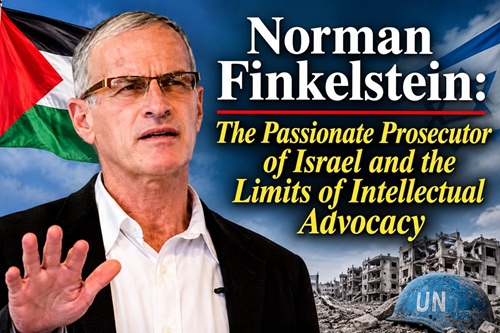 Introduction: A scholar at war with the establishmentNorman Finkelstein is one of the most controversial intellectuals in contemporary discussions of Israel, Palestine, the Holocaust, and the politics of human rights. An American political scientist, author, and outspoken critic of Israeli government policies, he has spent much of his career challenging what he considers the ideological protection of Israel from ordinary standards of international law and moral accountability. Finkelstein is an unusual public intellectual. He combines academic training with the temperament of a courtroom prosecutor. His arguments are often meticulously documented, his language frequently combative, and his willingness to confront powerful institutions virtually limitless. He has made enemies across much of the political establishment, including among Jewish organizations, mainstream commentators, and fellow academics. His intellectual position is rooted partly in family history. Both his parents survived the Holocaust, while numerous relatives perished in Nazi extermination camps. This background makes his political trajectory particularly striking: a Jewish scholar whose personal inheritance of Holocaust memory has led him to become one of the most uncompromising critics of Israeli state policy. Yet Finkelstein deserves neither automatic admiration because of his background nor automatic dismissal because of his political conclusions. His work raises important questions about historical responsibility, international law, selective indignation, and the relationship between scholarship and activism. At the same time, his confrontational style, selective emphases, and occasional reluctance to acknowledge the complexity of opposing arguments invite serious criticism. The challenge is to distinguish the importance of his central arguments from the limitations of the intellectual persona through which he presents them. The Holocaust, family history, and political conscienceFinkelstein's biography is inseparable from his intellectual development. His parents were Holocaust survivors who became deeply critical of the way their experiences were subsequently incorporated into American and Israeli political discourse. This background informed his most controversial book, The Holocaust Industry: Reflections on the Exploitation of Jewish Suffering (2000). The book argues that the Holocaust, after initially receiving relatively little attention in American public life, became increasingly instrumentalized after the 1967 Six-Day War. According to Finkelstein, certain Jewish organizations and political institutions transformed Holocaust memory into a political and financial resource, sometimes invoking the uniqueness of Jewish suffering to shield Israel from criticism and to advance claims for compensation. This was a deliberately provocative thesis. Finkelstein was not arguing that the Holocaust was exaggerated or that its victims did not deserve remembrance and restitution. Rather, he questioned the institutional uses to which Holocaust memory had been put. There is a legitimate subject here. Historical suffering can indeed become politically instrumentalized. Governments and organizations can invoke collective trauma selectively, and moral authority can be converted into political leverage. However, Finkelstein's presentation sometimes risks collapsing important distinctions. The existence of opportunistic organizations does not establish that Holocaust remembrance as a whole is politically manipulative. Nor does the political use of historical memory necessarily invalidate the underlying moral claims. His criticism is strongest when directed at identifiable institutions, financial arrangements, and political arguments. It becomes less convincing when it approaches a general theory of the Holocaust's postwar public significance. Most importantly, criticism of the political instrumentalization of Holocaust memory must never become a means of diminishing the historical reality or extraordinary significance of the Holocaust itself. The Israeli-Palestinian conflict: A forensic approach to historyFinkelstein's most substantial scholarly contribution concerns the historical origins of the Israeli-Palestinian conflict. His first major book, Image and Reality of the Israel-Palestine Conflict (1995), challenged a number of conventional accounts of the establishment of Israel and the displacement of Palestinians. He became particularly influential through his criticism of Joan Peters's From Time Immemorial (1984), which advanced the argument that Palestine had been largely empty before Jewish immigration and that much of the Arab population had arrived relatively recently. Finkelstein argued that Peters had manipulated demographic evidence and misrepresented historical sources. This was not simply a political disagreement. It was a dispute about the standards of historical scholarship: whether sources had been represented accurately, whether demographic statistics had been used legitimately, and whether ideological assumptions had been allowed to determine historical conclusions. His subsequent work, particularly Beyond Chutzpah: On the Misuse of Anti-Semitism and the Abuse of History (2005), extended this approach to the writings of Harvard law professor Alan Dershowitz. Finkelstein accused Dershowitz of selectively presenting evidence and misrepresenting the historical record in The Case for Israel. The resulting controversy became a public intellectual confrontation, complete with accusations, counteraccusations, and threats of litigation. There is something valuable about Finkelstein's insistence that political convictions should not exempt anyone from ordinary standards of scholarship. A historian should not be permitted to manipulate evidence simply because the political cause being defended is considered morally important. But there is also a danger in making the exposure of other people's errors the organizing principle of one's intellectual career. The forensic scholar can become so preoccupied with prosecuting the opposing argument that he devotes insufficient attention to constructing a comprehensive alternative explanation. Finkelstein is often at his best when identifying specific factual misrepresentations. He is less consistently persuasive when moving from those corrections to sweeping conclusions about the motives and ideological commitments of his opponents. The controversy surrounding his academic careerFinkelstein's confrontational intellectual style eventually collided with academic institutions. His most notorious professional dispute involved DePaul University in Chicago, where he taught political science from 2001. In 2007, the university denied him tenure, triggering an unusually bitter public controversy. The case involved competing interpretations of academic freedom, scholarly standards, institutional pressure, and political influence. Finkelstein and his supporters regarded the decision as an injustice connected to his criticism of Israel. His opponents, including Dershowitz, argued that his scholarship and professional conduct were legitimate grounds for scrutiny. It is difficult to separate the academic issues from the political circumstances. The controversy undoubtedly raised questions about whether criticism of Israeli policy could become a liability in American universities. At the same time, academic freedom does not mean that a scholar is immune from evaluation. It protects the right to express controversial opinions, but it does not automatically guarantee tenure. The distinction matters. One can defend Finkelstein's right to conduct controversial research and criticize political pressure on universities without concluding that every institutional decision against him must have been politically motivated. The available archival documentation at New York University provides a useful overview of his academic career and the controversies surrounding his publications. The politics of Holocaust memoryFinkelstein's most enduring contribution may be his insistence that historical victimhood cannot confer permanent political immunity. This is a principle with implications far beyond Israel. A country that has experienced extraordinary historical suffering does not thereby acquire an exemption from international law. Neither does a community's traumatic history give its political representatives unlimited moral authority. Indeed, one might argue that historical suffering should produce a particularly strong sensitivity to the suffering of others. Finkelstein repeatedly invokes this principle when discussing Israeli treatment of Palestinians. His parents' experiences during the Holocaust have become part of his moral vocabulary: the suffering of one population cannot justify the oppression of another. This is a powerful argument, although it needs to be handled carefully. There is a difference between recognizing the historical significance of the Holocaust and criticizing the ways in which its memory is invoked in contemporary political debates. The danger in Finkelstein's approach is that his understandable anger at the political exploitation of Holocaust memory sometimes makes him insufficiently attentive to the legitimate fears and historical experiences of Jewish communities. Antisemitism did not disappear with the defeat of Nazi Germany. Jewish insecurity is not simply an ideological construction, and the historical persecution of Jews cannot be reduced to a political instrument. A serious critique of Israeli nationalism must therefore distinguish between legitimate Jewish historical concerns, Zionism as a political movement, the policies of particular Israeli governments, and the actions of the Israeli state. Finkelstein is right to resist the conflation of these categories when criticism of Israel is dismissed as antisemitism. But the same distinctions should also be applied consistently when assessing the language and conduct of anti-Israel movements. Gaza and the moral dilemma of October 7The events of October 7, 2023, and Israel's subsequent military campaign in Gaza brought Finkelstein back into the international spotlight. He became one of the most outspoken critics of Israel's military conduct, describing the destruction of Gaza as genocidal and accusing Western governments and international institutions of complicity through their political support and failure to intervene effectively. His arguments have focused on the scale of civilian destruction, the displacement of the population, the destruction of essential infrastructure, and the apparent contradiction between Western declarations of universal human rights and the actual policies pursued toward Israel. These are serious questions. The devastation of Gaza demands scrutiny, and the application of international humanitarian law should not depend on the identity of the state or non-state actor involved. However, Finkelstein's treatment of October 7 presents a more difficult intellectual and moral problem. He has repeatedly emphasized the historical conditions under which Hamas emerged, the decades of occupation, the blockade of Gaza, and the absence of meaningful political alternatives for Palestinians. Historical context is indispensable. The attack did not emerge from nowhere, and a serious explanation must examine the political circumstances that preceded it. But explanation is not justification. The deliberate killing of civilians, hostage-taking, and other violations of humanitarian law cannot be excused simply by invoking the oppression experienced by the perpetrators or the population from which they emerged. Finkelstein has acknowledged that crimes were committed on October 7, but has resisted straightforward condemnation of the attack as a whole, arguing that its historical and political context must be understood. His position has generated considerable criticism, including from people who otherwise share his opposition to Israeli policy. This is where his moral reasoning becomes vulnerable. A commitment to Palestinian liberation should not require intellectual accommodation of Hamas. Nor should opposition to Israeli state violence require treating every act of Palestinian resistance as politically or morally defensible. There is a difference between defending a population's right to resist occupation and defending the methods employed by particular organizations. The same distinction applies in reverse: Israel's legitimate responsibility to protect its population does not justify collective punishment, indiscriminate attacks, or the destruction of civilian life. A genuinely universalist position would apply these standards consistently. The problem of political selectivityFinkelstein's political outlook is strongly shaped by a left-wing, anti-imperialist tradition. He sees the United States as the principal external supporter of Israeli power and regards Western political institutions as deeply compromised by their relationship with Israel. There is considerable substance to examining American military assistance, diplomatic protection, and the influence of strategic interests on Middle Eastern policy. But anti-imperialist analysis can become reductive when it interprets almost every development through the framework of Western domination. The Israeli-Palestinian conflict has its own historical dynamics, political actors, ideological divisions, and internal power struggles. Hamas is not merely an instrument of resistance. It is also an authoritarian Islamist organization with its own political objectives. Palestinian society is not politically homogeneous, and neither is Israeli society. A serious analysis must accommodate these realities. Finkelstein's tendency to concentrate on the crimes and responsibilities of Israel and its Western supporters sometimes leaves insufficient room for examining the internal failures of Palestinian political leadership. This does not mean creating an artificial equivalence between the parties. The power imbalance is enormous, and the responsibilities of an occupying power are distinctive. But asymmetry of power does not eliminate the moral agency of weaker actors. Indeed, a politics that treats weaker actors as incapable of moral responsibility risks becoming patronizing. His latest work: The international failure over GazaFinkelstein's 2026 book, Gaza's Gravediggers: An Inquiry into Corruption in High Places, extends his criticism beyond Israel and the United States to the international institutions supposedly established to protect human rights. His argument is that the failure to prevent or adequately respond to the catastrophe in Gaza exposes a profound crisis of the international human rights system. This is an interesting development in his intellectual trajectory. Rather than concentrating exclusively on the political and military conduct of Israel, he increasingly directs his attention toward the institutional mechanisms that have failed to constrain it. His criticism of the United Nations and international human rights organizations deserves consideration. Institutions can become trapped between their declared principles and the political interests of their most powerful members. Nevertheless, his language is frequently more polemical than analytical. Describing the United Nations as effectively dead, for example, expresses moral outrage but does not adequately distinguish between the failures of the Security Council, the work of humanitarian agencies, international courts, and independent investigative mechanisms. These institutions do not all have the same mandates, powers, or responsibilities. Finkelstein's anger may be understandable, but a more differentiated institutional analysis would strengthen his argument. The problem of the polemicistOne of the most interesting aspects of Finkelstein's public persona is his rhetorical style. He is frequently sarcastic, caustic, impatient, and dismissive. His interviews can be entertaining precisely because he is so willing to challenge conventional wisdom and embarrass opponents. He has little interest in the diplomatic language that often characterizes academic and political discussions. This has advantages. Intellectual debate sometimes needs people who are prepared to say plainly that an argument is dishonest, that evidence has been manipulated, or that an institution is failing its responsibilities. But polemics also have costs. Finkelstein can give the impression that he has already reached his verdict before hearing the opposing case. His prosecutorial approach is particularly effective when exposing demonstrable factual errors, but less effective when dealing with genuinely competing interpretations. There is a difference between winning an argument and illuminating a problem. His public confrontations sometimes become performances in which intellectual superiority is demonstrated rather than a shared understanding pursued. This can alienate precisely those people who might otherwise be persuaded by his arguments. His uncompromising attitude also creates a problem of intellectual accountability. If one demands exceptional standards of historical accuracy from opponents, one must accept the same standards for one's own claims. This is especially important in a conflict in which information warfare, propaganda, selective reporting, and emotionally charged narratives are widespread. What Finkelstein gets rightDespite these reservations, dismissing Finkelstein as merely an anti-Israel polemicist would be a serious mistake. Several of his contributions deserve recognition. First, he has consistently challenged the assumption that historical victimhood provides permanent political immunity. The Holocaust must never become a justification for disregarding Palestinian rights. Second, he has insisted that historical claims should be tested against documentary evidence rather than accepted because they serve an established political narrative. Third, he has drawn attention to the selective application of international law. Western governments cannot credibly defend universal human rights while applying radically different standards to allies and adversaries. Fourth, he has highlighted the political dangers of conflating criticism of Israel with antisemitism. Such conflation can undermine legitimate political debate, even though genuine antisemitism must also be confronted. Finally, his insistence that the Palestinian population deserves the same dignity, security, political rights, and freedom as any other population is entirely defensible. These are not marginal contributions. They concern the fundamental relationship between universal moral principles and political power. What Finkelstein gets wrongThe limitations of his approach are equally important. His greatest weakness is his tendency to allow political commitment to narrow the range of questions he is prepared to entertain. His account of the conflict is often strongest when examining Israeli policy and Western complicity, but less comprehensive when addressing the ideological and political responsibilities of Palestinian organizations. His reluctance to condemn October 7 unequivocally illustrates this problem. The historical oppression of Palestinians is real, but it cannot transform attacks on civilians into morally acceptable political instruments. Similarly, his treatment of Jewish historical insecurity sometimes lacks the sensitivity required to distinguish between the political exploitation of Holocaust memory and legitimate concerns about antisemitism. And his polemical style, while occasionally brilliant, can undermine the very intellectual standards he demands of others. A scholar who spends much of his career exposing the misuse of evidence must remain especially vigilant against confirmation bias. Conclusion: A necessary dissident, but not an infallible oneNorman Finkelstein occupies an important position in contemporary political debate. He is an intellectual dissident who has challenged powerful institutions, questioned established historical narratives, and insisted that the Palestinian experience cannot be excluded from discussions of universal human rights. His personal history gives his criticism of Israeli nationalism a particular resonance, but it is ultimately the quality of his arguments, not his ancestry, that should determine their validity. I would distinguish between three aspects of his work.
There is a broader lesson here. Universalism cannot mean defending universal human rights only when they support one's preferred political cause. The rights of Palestinians do not depend on the moral perfection of their political representatives. Equally, the rights and security of Israelis do not depend on the moral legitimacy of their government. One can oppose Israeli occupation, defend Palestinian self-determination, condemn Hamas's attacks on civilians, oppose antisemitism, and reject the collective punishment of Gaza without contradiction. Indeed, this is precisely what a consistent universalist position requires. Finkelstein is right to demand that Israel be held accountable. But the same intellectual courage should extend to examining the failures, authoritarianism, and moral compromises of Palestinian political organizations. His work is therefore best approached neither as an authoritative account to be accepted wholesale nor as partisan polemic to be dismissed wholesale. He is an important corrective to mainstream political discourse, but a corrective is not a complete worldview. The ultimate task is to transcend the limitations of political loyalty without abandoning the principles that make political criticism necessary in the first place. That is a standard Norman Finkelstein has helped establish for others. It is also a standard by which his own work should be judged.
Comment Form is loading comments...
|