|
TRANSLATE THIS ARTICLE
Integral World: Exploring Theories of Everything
An independent forum for a critical discussion of the integral philosophy of Ken Wilber
  Frank Visser, graduated as a psychologist of culture and religion, founded IntegralWorld in 1997. He worked as production manager for various publishing houses and as service manager for various internet companies and lives in Amsterdam. Books: Ken Wilber: Thought as Passion (SUNY, 2003), and The Corona Conspiracy: Combatting Disinformation about the Coronavirus (Kindle, 2020).
Check out my other conversations with ChatGPT EpigeneticsThe New Genetics or the Latest Biological Hype?Frank Visser / ChatGPT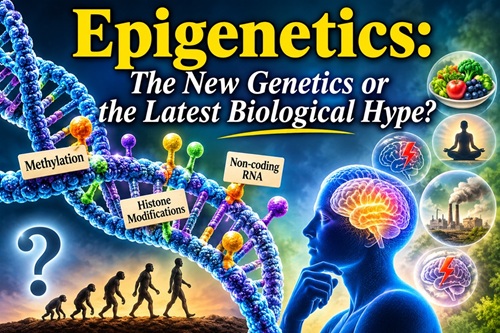
Introduction: Beyond the DNA SequenceEpigenetics has become one of the most fashionable concepts in contemporary biology. It is frequently presented as a revolutionary development that fundamentally changes our understanding of heredity, evolution, development, and even human identity. Whereas classical genetics emphasized the DNA sequence as the principal carrier of hereditary information, epigenetics draws attention to mechanisms that regulate how genes are activated, suppressed, and expressed. The implications appear enormous. Environmental influences can affect gene expression. Stress, nutrition, toxins, ageing, and other experiences can leave molecular marks on cells. Some of these changes can persist through cell division, and certain epigenetic effects may even be transmitted across generations. This has inspired an attractive narrative: we are not simply prisoners of our genetic inheritance. Our environment and experiences can influence how our genes function, and perhaps even how our descendants develop. There is considerable truth in this picture. But there is also a danger of exaggeration. Epigenetics is sometimes portrayed as a vindication of Lamarckian evolution, a refutation of genetic determinism, or evidence that organisms possess a remarkable capacity to rewrite their hereditary destiny. In popular accounts, a sophisticated field of molecular biology can become a vehicle for much broader philosophical and ideological claims. The central question is therefore not whether epigenetics is real. It unquestionably is. The question is what it actually establishes, what remains uncertain, and where legitimate scientific findings are being stretched beyond their evidential limits. 1. What Is Epigenetics?The term epigenetics has a complicated history. Developmental biologist Conrad Waddington introduced it in the 1940s to describe the processes through which genes and developmental conditions interact to produce an organism. Today, the term is used more specifically for molecular processes that influence gene activity without changing the underlying DNA sequence. Several mechanisms are particularly important. DNA methylation involves the addition of methyl groups to DNA, often affecting whether particular genes are expressed. Its effects depend on the genomic location and biological context. Histone modifications involve chemical changes to proteins around which DNA is packaged. These modifications can influence how accessible particular regions of DNA are to the cellular machinery responsible for gene expression. Non-coding RNA molecules can regulate gene expression through several mechanisms, including influencing the stability and translation of messenger RNA. Together, these processes help determine which genes are active, when they are active, and in which cells they function. This is crucial because nearly all cells in a human body contain essentially the same genome, yet a neuron, a liver cell, and a muscle cell have radically different properties. Their differences cannot be explained simply by possessing different DNA sequences. They also depend on different patterns of gene regulation. Epigenetics is therefore not an alternative to genetics. It is an essential part of understanding how genetic information is used. 2. The End of Genetic Determinism?One of the most frequently advertised implications of epigenetics is that it undermines genetic determinism. The argument is understandable. If environmental conditions influence gene expression, then our biological characteristics cannot be understood exclusively by examining our DNA sequence. Genes do not operate in isolation. Their expression depends on regulatory networks, cellular conditions, developmental history, and environmental inputs. However, this is not quite the revolution it is sometimes made out to be. Modern genetics abandoned simplistic genetic determinism long before epigenetics became fashionable. Developmental biology, gene regulation, gene-environment interactions, and systems biology had already established that the relationship between genes and observable characteristics is complex. A gene is not a blueprint that independently specifies a finished organism. Nor does the genome function as a fixed script that simply unfolds into a predetermined result. Epigenetics adds important details to this picture, but it does not overturn the basic principles of molecular genetics. Indeed, there is a danger of replacing one simplistic picture with another. If genetic determinism says that DNA determines everything, epigenetic determinism might suggest that environmental experiences can determine everything by modifying gene expression. Neither position is scientifically defensible. Biological development involves continuous interactions between genes, cells, organisms, and environments. Epigenetics helps us understand some of these interactions; it does not provide a master explanation of them. 3. Does Experience Rewrite Heredity?Perhaps the most fascinating aspect of epigenetics concerns the possibility that environmental influences can affect subsequent generations. In certain organisms, epigenetic modifications can survive the production of reproductive cells and influence offspring. This raises an intriguing possibility: experiences affecting one generation might leave biological traces in another. The idea has obvious affinities with Jean-Baptiste Lamarck's historical theory of inheritance of acquired characteristics. Lamarck proposed that organisms could acquire characteristics through their interaction with the environment and pass these characteristics to their descendants. Classical Darwinian genetics, by contrast, emphasized hereditary variation arising through genetic mechanisms, with natural selection acting on the resulting differences. Epigenetics has revived interest in the relationship between these positions. But describing it as a straightforward vindication of Lamarck would be misleading. First, not all epigenetic changes are inherited. Many are erased during the formation of reproductive cells or early embryonic development. Second, some modifications are maintained only through ordinary cell divisions within an organism. Third, even when an effect crosses generations, its persistence and biological significance must be established rather than assumed. It is also essential to distinguish between several generations of exposure. When a pregnant female mammal is exposed to a substance, the fetus and the developing reproductive cells inside that fetus may also be exposed. An effect observed in the next generation does not necessarily demonstrate genuine transmission through an unexposed generation. In humans, demonstrating stable transgenerational epigenetic inheritance is particularly difficult. Environmental exposures are entangled with shared lifestyles, socioeconomic circumstances, cultural transmission, and genetic inheritance. Epigenetic inheritance is a real biological phenomenon in some contexts. But its importance in long-term human evolution remains a much more open question. 4. Epigenetics and Evolution: A New Inheritance System?The evolutionary implications of epigenetics are potentially more interesting than its implications for individual development. Traditional evolutionary theory emphasizes genetic variation, inheritance, and natural selection. Mutations and recombination generate genetic variation, while selection, genetic drift, and other evolutionary processes influence the distribution of hereditary variants in populations. Epigenetic variation introduces another possible source of phenotypic variation. If organisms can inherit differences in gene regulation without inheriting corresponding differences in DNA sequence, then evolutionary processes may sometimes operate on a broader range of inherited variation than genetic sequence variation alone. This is an important qualification to simplistic versions of the Modern Synthesis, but it does not automatically require an alternative evolutionary theory. Consider an organism exposed to a changing environment. Its epigenetic machinery may alter gene expression in ways that influence its physiology or development. If these changes persist through reproduction, they may affect the characteristics of subsequent generations. Natural selection can then act on the resulting phenotypic differences. There are several possibilities:
The last possibility is particularly interesting. Epigenetic variation might sometimes provide an intermediate stage in evolutionary adaptation, potentially preceding or interacting with genetic changes. However, an important distinction must be maintained: an inherited epigenetic effect is not necessarily an adaptive one. A change can be inherited without improving reproductive success. Nor does the fact that an organism responds to an environmental challenge demonstrate that the response evolved specifically for that challenge. The scientific challenge is to establish the relative importance of these mechanisms in actual evolutionary history. Epigenetics broadens our understanding of inheritance, but it does not abolish the central importance of genetic evolution. 5. The Problem of CausalityOne of the most persistent difficulties in epigenetic research is distinguishing causal mechanisms from correlations. Suppose researchers discover that individuals exposed to prolonged stress exhibit particular DNA methylation patterns. They also find that these individuals have an increased incidence of certain psychological or physiological problems. Does the epigenetic modification cause the problem? Possibly. But other explanations must be considered. The modification might be a consequence of the condition rather than its cause. It might be a response to a third factor. It might be correlated with genetic differences. It might also occur in one tissue without having the same significance in another. The distinction matters enormously. Finding a particular epigenetic signature in people suffering from depression, for example, does not establish that the signature caused their depression. Nor does finding a similar signature in the offspring of people exposed to severe stress establish that the offspring inherited their parents' psychological experiences through molecular mechanisms. Good epigenetic research therefore requires more than identifying molecular differences. It requires experimental manipulation, replication, appropriate controls, tissue-specific investigation, and a plausible causal mechanism. This is particularly important in human studies, where researchers cannot easily isolate environmental variables or conduct controlled experiments across multiple generations. A 2024 review by Hasan Khatib and colleagues examined 80 studies claiming or being cited as evidence for mammalian transgenerational epigenetic inheritance. Their analysis identified substantial confusion about what should count as convincing evidence. The lesson is straightforward: molecular sophistication does not automatically guarantee strong causal evidence. 6. Epigenetic Clocks: Can We Measure Biological Age?One of the more promising applications of epigenetics is the development of epigenetic clocks. These are statistical models that use patterns of DNA methylation at particular genomic locations to estimate biological age or other aspects of physiological ageing. Some clocks correlate with chronological age remarkably well. Others have been developed to estimate mortality risk, disease susceptibility, or aspects of accelerated ageing. This research has attracted considerable attention because it offers a potential way to measure biological processes that are not adequately captured by simply counting birthdays. But here too, caution is necessary. An epigenetic clock is not necessarily a direct measurement of the ageing process itself. It is a statistical predictor constructed from molecular patterns that correlate with age or health-related outcomes. A clock that predicts mortality does not automatically identify the mechanisms responsible for mortality. Nor does changing an epigenetic clock's reading necessarily mean that an organism has become biologically younger. The distinction between a biomarker and a causal mechanism is essential. Nevertheless, epigenetic clocks represent a valuable research development. They may eventually help researchers evaluate interventions, identify disease risks, and investigate why individuals of the same chronological age experience different trajectories of biological ageing. 7. Epigenetics Is Not a Biological Magic WandThe popularization of epigenetics has encouraged some remarkably expansive claims. We are sometimes told that our thoughts change our genes, that trauma is passed down through generations, that positive thinking can rewrite our biological destiny, or that lifestyle choices can switch harmful genes off and beneficial genes on. Some of these statements contain a kernel of scientific truth. Others are misleading simplifications. For example, psychological stress can influence physiological processes, including hormonal and immune responses, which can in turn affect gene regulation. But this does not mean that thoughts directly rewrite the genome. Likewise, nutrition can influence metabolic pathways and epigenetic processes. But there is no general principle according to which eating particular foods can selectively switch desirable genes on and undesirable genes off. The language of switches is itself potentially misleading. Gene regulation is not simply a matter of turning genes on or off. It involves degrees of activity, timing, cellular context, interactions between regulatory mechanisms, and complex feedback systems. Epigenetics also does not imply that individuals can overcome every biological disadvantage through lifestyle choices. Social circumstances, inherited genetic variation, developmental conditions, environmental exposures, and chance all contribute to biological outcomes. The popular message that we are entirely responsible for our biological destiny is therefore just as simplistic as the genetic determinism it claims to replace. There is an additional danger here: the commercialization of epigenetics. Wellness industries can exploit the scientific vocabulary to sell personalized diets, supplements, anti-ageing interventions, and promises of biological transformation. The existence of genuine epigenetic mechanisms does not validate every product or intervention marketed under their name. 8. Does Epigenetics Vindicate Holism?There is a philosophical temptation to interpret epigenetics as a triumph of holistic thinking over reductionism. After all, genes are influenced by their cellular environment, organisms respond to external conditions, and biological development involves interactions at multiple levels. This seems to support the idea that life cannot be understood by studying individual genes in isolation. There is an important point here, but it needs careful formulation. Reductionism is not the claim that genes operate independently of everything else. Modern molecular biology has long investigated regulatory networks, cellular interactions, metabolic pathways, and environmental influences. Nor is holism automatically a scientific explanation. Saying that everything is interconnected does not tell us which connections matter, how they operate, or what consequences follow. Epigenetics provides concrete examples of biological regulation across different levels of organization. But it does so through identifiable molecular mechanisms, not through an appeal to an unspecified holistic principle. It is therefore better understood as an enrichment of mechanistic biology than as a refutation of it. There is also no justification for invoking a mysterious organizing intelligence, cosmic purpose, or spiritual agency to explain epigenetic phenomena. The fact that organisms exhibit sophisticated regulatory capacities does not establish that these capacities were directed toward particular future outcomes. Biological organization is impressive enough without adding explanatory entities for which independent evidence is lacking. 9. Epigenetics and the Temptation of Neo-LamarckismThe renewed interest in acquired inheritance has understandably attracted philosophers and evolutionary theorists dissatisfied with narrow interpretations of Darwinism. Epigenetics appears to offer a middle ground between two extreme positions: that inheritance is exclusively genetic and that organisms can somehow transmit everything they acquire during their lifetimes. But the historical analogy with Lamarck should not be pushed too far. Lamarck's theory involved a general account of evolutionary change in which the use and disuse of organs, together with environmental influences, contributed to the production and inheritance of adaptive characteristics. Modern epigenetics establishes something much more specific. Certain molecular modifications can influence gene expression, and some of these modifications can persist through cell divisions or, under particular circumstances, across generations. This is not the same as demonstrating that organisms routinely transmit useful acquired characteristics to their descendants. Nor does it establish that evolution is fundamentally driven by organisms' needs or efforts to adapt. An organism's epigenetic response can be beneficial, neutral, or harmful. The environment does not necessarily induce the most useful response. Evolutionary outcomes remain contingent. The appropriate conclusion is neither that Lamarck was simply right nor that Darwinian evolution needs to be abandoned. Rather, contemporary biology has identified additional mechanisms of inheritance that complicate older accounts of how hereditary variation is generated and maintained. That is a genuine scientific development, not a historical vindication of an entire evolutionary philosophy. 10. What Epigenetics Does Not ExplainA final issue concerns the explanatory ambitions sometimes attached to epigenetics. The discovery that gene expression is regulated by complex molecular mechanisms raises further questions. How did these regulatory systems evolve? How do they interact with the developmental processes of organisms? How do environmental signals become translated into particular molecular responses? Why do some regulatory patterns persist while others disappear? Epigenetics provides important answers to parts of these questions, but it does not solve the larger problem of biological organization. In particular, it does not explain the origin of life, the emergence of consciousness, or the supposed tendency of evolution toward increasing complexity. These subjects are sometimes brought together in popular discussions of biological complexity, as if epigenetics provides evidence for a general evolutionary movement toward greater organization. That conclusion does not follow. Epigenetic regulation is itself the product of evolutionary history. Its existence does not demonstrate that evolution is guided by an intrinsic drive toward complexity, progress, or higher levels of consciousness. Nor does it establish that environmental responsiveness is evidence of an overarching intelligence inherent in nature. We should distinguish between explaining how a biological mechanism works and interpreting that mechanism as evidence for a much larger philosophical worldview. The first is a legitimate scientific undertaking. The second requires independent arguments and evidence. Conclusion: An Important Addition, Not a Scientific RevolutionEpigenetics deserves its prominent place in contemporary biology. It has considerably expanded our understanding of gene regulation, cellular differentiation, development, ageing, environmental responses, and certain forms of inheritance. It has also demonstrated that the relationship between organisms and their environments is more intimate and dynamically regulated than simplistic genetic models suggest. But several qualifications are necessary. First, epigenetics does not replace genetics. It explains important mechanisms through which genetic information is regulated and expressed. Second, environmental influences on gene expression do not automatically translate into inherited modifications. The distinction between changes within an organism, effects on its immediate offspring, and genuine transgenerational inheritance must be respected. Third, epigenetic inheritance does not necessarily constitute adaptation. Inherited modifications can be beneficial, neutral, or harmful. Fourth, the discovery of epigenetic mechanisms does not vindicate unrestricted Lamarckism, invalidate Darwinian evolution, or establish that organisms can freely rewrite their biological inheritance. Finally, epigenetics should not become another scientific vocabulary through which philosophical, spiritual, or commercial claims acquire an undeserved appearance of empirical legitimacy. The most interesting lesson of epigenetics is perhaps a relatively modest one: heredity is more complicated than the transmission of DNA sequences alone. Biological organisms are not passive expressions of genetic instructions, but dynamically regulated systems in which genetic, cellular, developmental, and environmental processes interact. This is a substantial scientific insight. It makes biology richer without making it mysterious. And that is precisely why epigenetics deserves serious attention rather than exaggerated celebration.
Comment Form is loading comments...
|