|
TRANSLATE THIS ARTICLE
Integral World: Exploring Theories of Everything
An independent forum for a critical discussion of the integral philosophy of Ken Wilber
  Frank Visser, graduated as a psychologist of culture and religion, founded IntegralWorld in 1997. He worked as production manager for various publishing houses and as service manager for various internet companies and lives in Amsterdam. Books: Ken Wilber: Thought as Passion (SUNY, 2003), and The Corona Conspiracy: Combatting Disinformation about the Coronavirus (Kindle, 2020).
Check out my other conversations with ChatGPT The Kremlin's War of LiesThe Most Blatant Russian War PropagandaFrank Visser / ChatGPT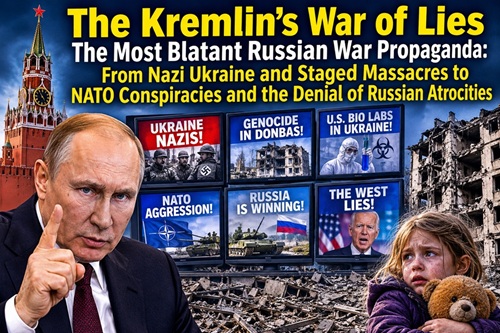 Introduction: When Propaganda Becomes an Instrument of WarRussia's invasion of Ukraine on February 24, 2022, was accompanied by one of the most systematic propaganda campaigns in modern European history. The Russian government did not merely attempt to justify a military operation after the fact. It constructed an alternative reality in which an aggressor became a victim, an invaded country became a Nazi threat, documented atrocities became Western fabrications, and Russia's military failures became evidence of an elaborate NATO conspiracy. Russian state television, particularly Channel One, Rossiya-1 and NTV, together with state-controlled news agencies such as RIA Novosti and TASS, have played a central role in this campaign. International outlets such as RT and Sputnik have helped distribute its narratives beyond Russia's borders. What makes this propaganda particularly striking is not simply the number of falsehoods. It is the sheer brazenness with which contradictory explanations can coexist. A Ukrainian military force can simultaneously be described as incompetent, on the verge of collapse, and dangerously powerful. Ukraine can supposedly be controlled by Washington while also being portrayed as a country whose government is incapable of making independent decisions. Russia can claim to be defending its population while systematically attacking Ukrainian cities. This is not journalism operating under ordinary standards of evidence. It is information warfare: the deliberate manipulation of public perception to sustain a political project and weaken resistance to it. The following examples illustrate some of its most blatant and consequential manifestations. 1. The fabrication of a Nazi threat: Ukraine must be denazifiedPerhaps the most extraordinary justification for the invasion was Putin's declaration that Russia had to denazify Ukraine. In his February 24, 2022, address announcing the invasion, Putin presented Ukraine as a country controlled by neo-Nazis and extremists. The Russian government subsequently made this one of the central themes of its domestic propaganda. The historical irony is difficult to overstate. Ukraine's president, Volodymyr Zelensky, is Jewish. His family history includes relatives who died in the Holocaust. Ukraine is a functioning electoral democracy, notwithstanding the extraordinary circumstances and restrictions imposed by martial law during the war. There are, of course, far-right organizations and nationalist movements in Ukraine, just as there are in other European countries. Some Ukrainian military formations have also attracted controversy because of their origins and symbolism. But the existence of such groups does not make a country Nazi-controlled. In the 2019 parliamentary elections, the combined far-right electoral alliance received approximately 2.15 percent of the vote and failed to obtain parliamentary representation. The Kremlin's strategy is to take a genuine but marginal phenomenon and inflate it into the defining characteristic of an entire country. There is an additional historical manipulation here. By invoking the Soviet Union's enormous sacrifices in defeating Nazi Germany, Putin appropriates the moral authority of the Second World War for an entirely different purpose: legitimizing a war of conquest against a neighboring country. The word denazification thus becomes a propaganda instrument. It transforms an attack on a sovereign state into a supposedly noble continuation of the struggle against fascism. The US State Department documented how this narrative was deployed before and after the invasion, including its revival following the discovery of Russian atrocities in Bucha. 2. The invented genocide in DonbasAnother central Russian justification was the claim that Ukraine had been committing genocide against Russian-speaking inhabitants of Donbas. This accusation was particularly useful because genocide is among the gravest crimes recognized under international law. By using the term, Moscow attempted to present its intervention as a humanitarian necessity rather than an act of aggression. Russian television repeatedly portrayed the Ukrainian government as conducting a systematic campaign of extermination against the Russian-speaking population of eastern Ukraine. There had indeed been an armed conflict in Donbas since 2014, with civilian casualties, displacement and serious human rights violations. But this is not evidence of genocide. The United Nations human rights monitoring reports did not substantiate the Kremlin's genocide allegations. Ukraine subsequently brought the matter before the International Court of Justice, arguing that Russia was abusing the Genocide Convention to justify its military aggression. In March 2022, the Court ordered Russia to suspend its military operations. It also observed that it was not in possession of evidence substantiating Russia's allegation that genocide had been committed in Ukrainian territory. The propaganda campaign had another particularly grotesque dimension: the invention of emotionally charged stories about Ukrainian atrocities. One notorious example dates back to 2014, when Russian television broadcast a story about Ukrainian soldiers allegedly crucifying a young boy in eastern Ukraine. The account was subsequently exposed as fabricated. Such stories are not incidental mistakes. They serve a recognizable propaganda purpose: to make the enemy appear so monstrous that virtually any action against it becomes defensible. 3. Bucha: Denying the evidence of mass murderThe Russian response to the discovery of murdered civilians in Bucha in April 2022 provides perhaps the clearest example of the Kremlin's propaganda machinery operating in full defensive mode. After Russian forces withdrew from Bucha, journalists and investigators found numerous bodies of Ukrainian civilians in the streets. Some victims had their hands tied behind their backs. Others showed evidence consistent with summary executions. The evidence was devastating. Instead of acknowledging the crimes and investigating the responsible soldiers, Russian authorities and state media launched an extensive campaign to discredit the evidence. The explanations included:
The contradictions were remarkable. Different Russian outlets and officials offered mutually incompatible explanations, without apparent concern for consistency. But independent evidence undermined these claims. Satellite imagery documented bodies lying in the streets during the period of Russian occupation. Investigative organizations compared this imagery with ground-level footage and established that the bodies had been present before the Russian withdrawal. United Nations investigations also documented killings of civilians and attributed responsibility to Russian forces. The propaganda response followed a familiar pattern: deny the event, challenge the evidence, accuse the investigators of bias, introduce alternative explanations, and eventually suggest that nobody can know what really happened. This last move is particularly important. Propaganda does not always need to persuade audiences that its alternative explanation is true. Sometimes it is sufficient to convince them that the truth is unknowable. The European Union documented the Kremlin's changing explanations in its analysis of the Bucha massacre. The Centre for Information Resilience independently examined the satellite evidence and the attempts to discredit it. 4. The American bioweapons laboratories conspiracyOne of the more elaborate conspiracy theories promoted by Russian officials and state media concerned alleged American biological weapons laboratories in Ukraine. The basic allegation was that the United States had established secret biological weapons facilities in Ukraine, potentially developing pathogens specifically designed to target Russians. The story was particularly effective because it combined a real fact with an invented conclusion. There are indeed biological laboratories in Ukraine, and the United States has supported biological threat reduction programs in the country. Such programs are intended to improve the security of biological materials and prevent dangerous disease outbreaks. But the existence of laboratories does not establish the existence of a biological weapons program. Russian propaganda transformed ordinary international public-health cooperation into an elaborate conspiracy involving secret American experiments, ethnic targeting and biological warfare. The allegations were repeatedly revived when convenient. In May 2026, EUvsDisinfo documented another wave of claims suggesting that American officials had effectively confirmed the existence of the supposed Ukrainian bioweapons program. This was misleading: the existence of biological research facilities was being presented as confirmation of an entirely different allegation. The technique is characteristic of Russian disinformation: start with something real, remove its context, add a speculative interpretation, and present the resulting conspiracy as established fact. 5. Russia is not attacking Ukraine: It is fighting NATOAs the war progressed and Russia's initial expectation of a rapid victory collapsed, another narrative became increasingly important: Russia was not really fighting Ukraine. It was fighting NATO. According to this interpretation, Ukraine is merely a Western proxy, while the United States and European countries are conducting a coordinated war against Russia using Ukrainian soldiers. There is a factual basis for part of this narrative: Western countries have supplied Ukraine with weapons, intelligence, financial assistance and training. This support has been essential to Ukraine's ability to resist the invasion. But the propaganda consists in transforming this assistance into a claim that NATO initiated the war or that Ukraine is not an independent political actor. The distinction is fundamental. Ukraine is a sovereign country exercising its right to defend itself against an invading army. Its decision to seek Western support does not transform Russia's invasion into a defensive war against NATO. Nor does it mean that Ukrainian soldiers are simply acting on American instructions. Ukraine has its own national interests, political institutions, military leadership and population. The NATO narrative serves several purposes simultaneously. First, it provides an excuse for Russia's military difficulties. If Ukrainian forces successfully resist Russian attacks, this can be presented as evidence of an enormous Western military conspiracy rather than Ukrainian military competence. Second, it creates a domestic siege mentality. Russians are encouraged to believe that their country is surrounded by enemies and that defeat in Ukraine would represent an existential threat to Russia itself. Third, it seeks to undermine Western public support for Ukraine by portraying assistance as participation in a dangerous confrontation with a nuclear power. This is one of the Kremlin's most persistent narratives, according to the European External Action Service's analysis of Russian information manipulation. 6. The systematic inversion of responsibility: Ukraine attacks civilians, Russia liberates themOne of the most cynical characteristics of Russian television coverage is its systematic inversion of responsibility. Russian attacks on Ukrainian cities are generally presented as legitimate military operations against military targets. Civilian casualties are minimized, questioned or attributed to Ukrainian air defenses. By contrast, Ukrainian attacks on military installations inside Russia are frequently portrayed as deliberate terrorist attacks against innocent civilians. This distinction is especially revealing when Russian media discuss attacks on energy infrastructure. When Russian missiles destroy Ukrainian electricity facilities, the attacks are described as legitimate military operations. When Ukraine attacks Russian military infrastructure or facilities supporting the Russian war effort, the same media often describe the actions as terrorism. The underlying principle is not an objective assessment of the military targets or the civilian consequences. It is the identity of the perpetrator. Russian military action is presumed legitimate; Ukrainian military action is presumed criminal. This double standard is particularly visible in the treatment of civilian suffering. Russian state media devote considerable attention to Ukrainian attacks that cause casualties in Russian territory, while the scale and consequences of Russian attacks on Ukrainian residential areas and civilian infrastructure receive very different treatment. The European External Action Service's 2026 threat report describes this recurring pattern: Russian information operations portray Ukrainian attacks as deliberate attacks on civilians while presenting Russian strikes as legitimate military actions and frequently downplaying civilian casualties. 7. The kidnapped Ukrainian children: Rebranding deportation as humanitarian rescuePerhaps the most disturbing example of propaganda concerns the removal of Ukrainian children from occupied territories and their transfer to Russia. The Russian government has repeatedly presented these transfers as humanitarian evacuations, protection of vulnerable children or the reunification of families. There are circumstances in which civilians, including children, genuinely need evacuation from combat zones. But that does not justify the unlawful transfer of children across an international border, their placement with Russian families, or efforts to erase their Ukrainian identity. The International Criminal Court issued arrest warrants in March 2023 for Vladimir Putin and Maria Lvova-Belova, Russia's Commissioner for Children's Rights, over the alleged war crimes of unlawful deportation and transfer of children from occupied areas of Ukraine to Russia. Rather than addressing the substance of the allegations, Russian propaganda has tended to portray international criticism as politically motivated hostility toward Russia. This is another example of the larger propaganda strategy: turn an accusation supported by documentary evidence and international legal proceedings into a supposed conspiracy against the Russian state. The suffering of the children becomes secondary to the Kremlin's need to defend its image. 8. The propaganda of military victory: Russia is always winningA particularly persistent feature of Russian war coverage is the presentation of an almost uninterrupted sequence of military victories. Russian television regularly announces the capture of settlements, the destruction of Ukrainian military formations, enormous Ukrainian casualty figures and the imminent collapse of Ukrainian resistance. Some of these reports are based on genuine battlefield developments. Others are exaggerated, premature, misleading or impossible to verify independently. The larger problem is the systematic distortion of military reality. Three recurring techniques deserve attention. Exaggerating Ukrainian losses. Russian military briefings frequently publish enormous estimates of Ukrainian personnel and equipment destroyed. These figures are often presented without independently verifiable evidence. Minimizing Russian losses. Russian casualties, equipment losses and operational failures receive considerably less attention. When setbacks cannot be concealed, they are attributed to temporary difficulties, inadequate local commanders or overwhelming Western intervention. Presenting limited territorial gains as strategic breakthroughs. The capture of a relatively small settlement can be celebrated as a major turning point, even when the broader military situation remains largely unchanged. This produces an interesting psychological effect. Russian audiences are repeatedly told that Ukraine is collapsing, that Western support is failing and that Russia is advancing inexorably. Yet the war continues, and the promised decisive victory remains elusive. The objective is not necessarily to provide an accurate account of military developments. It is to maintain the perception that victory is inevitable and that continued sacrifice is justified. EUvsDisinfo's 2026 monitoring describes precisely this combination of exaggerated Russian military success, selective reporting of battlefield developments and attempts to portray Ukraine as increasingly weakened. 9. The propaganda method: Contradictions are not a problemThere is something more interesting here than simply identifying individual falsehoods. Russian war propaganda does not always operate according to the principle that one particular explanation must be believed. Instead, it frequently employs a strategy sometimes described as the firehose of falsehood. The expression captures four important characteristics:
Consider the treatment of Bucha. The Russian information environment offered several explanations: the massacre never happened, the bodies were planted, the killings were committed by Ukrainians, and the footage was fabricated. These explanations do not form a coherent alternative account. They are competing attempts to undermine the original evidence. The same technique appears in the broader portrayal of Ukraine. It is simultaneously a failed state, a Nazi dictatorship, an American puppet, a terrorist regime and a formidable military adversary. These descriptions are logically incompatible. But they serve different propaganda purposes. The purpose is to create an information environment in which audiences are continually exposed to assertions that reinforce their existing political loyalties while making independent verification increasingly difficult. Mattia Massoletti's analysis for the Italian Institute for International Political Studies describes the principal functions of Russian state-media narratives: legitimizing the invasion, discouraging Western support, stabilizing domestic opinion and constructing an enemy image of Ukraine and the West. 10. Why Russian propaganda is particularly dangerousIt would be a mistake to dismiss Russian war propaganda as merely ridiculous television entertainment for a domestic audience. It has several practical political and military functions. Domestic legitimation. The invasion must be presented as necessary, defensive and historically justified. Otherwise, the Russian population might reasonably ask why its government has sacrificed so many lives and resources in a war against a neighboring country. Mobilization. The portrayal of Russia as threatened by a hostile West helps legitimize military mobilization, repression and economic sacrifices. International division. By promoting narratives about NATO aggression, Western hypocrisy, Ukrainian corruption and the supposedly inevitable collapse of European support, Moscow hopes to weaken the international coalition supporting Ukraine. Moral disengagement. If Ukrainians are represented as Nazis, terrorists or Western puppets, their suffering becomes easier to dismiss. If Russian atrocities are dismissed as fabrications, the moral responsibility of the aggressor can be avoided. Negotiating leverage. By repeatedly portraying Ukraine as an artificial state without legitimate sovereignty, Russia attempts to normalize the idea that Ukraine's territorial integrity and political independence are negotiable matters. The propaganda therefore does not merely accompany the war. It helps sustain the political conditions under which the war can continue. Conclusion: An Alternative Reality in the Service of Imperial AmbitionThe most blatant Russian war propaganda is not simply a collection of fabricated stories. It is a comprehensive system of political communication designed to reverse the moral and factual meaning of the war.
The common denominator is the systematic removal of Russia's responsibility. This is what makes the propaganda so revealing. Its individual stories may change, but its underlying political purpose remains remarkably consistent: to deny Ukraine's independent existence, justify Russian territorial ambitions and prevent the Russian public from confronting the actual nature of the war. There is also a fundamental difference between ordinary political bias and this kind of propaganda. Democratic governments also manipulate information, selectively present evidence, exaggerate their achievements and sometimes lie. Western media are not immune to ideological framing, national bias or sensationalism. Nor should every statement from Kyiv or Washington be accepted without scrutiny. But this does not establish equivalence. In an open society, journalists, opposition politicians, researchers and independent investigators can challenge official accounts. Governments can be exposed, criticized and voted out of office. Competing interpretations can be publicly examined. In Putin's Russia, independent reporting on the war has been severely restricted, opposition has been repressed, and describing the invasion as a war rather than a special military operation has itself carried legal risks. The propaganda system is therefore reinforced by the political system that produces it. Ultimately, the most important question is not whether Russian television viewers believe every individual story. It is whether the continuous bombardment of fabricated explanations succeeds in making them indifferent to the distinction between truth and falsehood. That is perhaps the greatest achievement of modern authoritarian propaganda: not necessarily convincing everyone that the government is telling the truth, but making truth itself seem impossible to establish. And that is precisely the kind of information environment in which an imperial war can be conducted with the least possible domestic resistance.
Comment Form is loading comments...
|