|
TRANSLATE THIS ARTICLE
Integral World: Exploring Theories of Everything
An independent forum for a critical discussion of the integral philosophy of Ken Wilber
  Frank Visser, graduated as a psychologist of culture and religion, founded IntegralWorld in 1997. He worked as production manager for various publishing houses and as service manager for various internet companies and lives in Amsterdam. Books: Ken Wilber: Thought as Passion (SUNY, 2003), and The Corona Conspiracy: Combatting Disinformation about the Coronavirus (Kindle, 2020).
Check out my other conversations with ChatGPT Douglas MurrayThe Defender of Western Civilization or Its Most Vocal Culture Warrior?Frank Visser / ChatGPT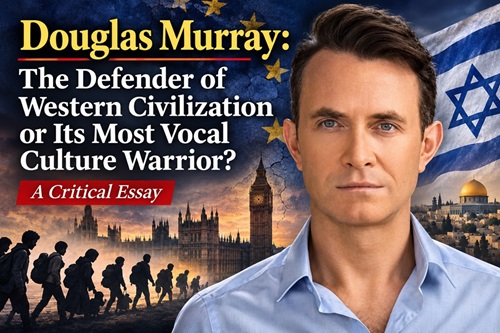 Introduction: The West Under SiegeFew contemporary political commentators have made the defence of Western civilization such a central part of their public identity as the British journalist and author Douglas Murray. Articulate, combative, widely read, and remarkably effective in public debate, Murray has become one of the most recognizable intellectual voices of the contemporary political right. His central message is relatively straightforward: Western civilization is under threat, not only from external enemies but also from its own intellectual and political elites. Immigration, Islamism, multiculturalism, identity politics, progressive ideology, historical self-criticism, and declining national confidence are, in his account, symptoms of a broader civilizational crisis. This message has found a receptive audience, particularly among people who believe that Western societies have become reluctant to defend their own cultural inheritance. Murray gives voice to frustrations that mainstream political institutions have sometimes been unwilling to acknowledge. He is particularly effective at exposing inconsistencies in progressive rhetoric, the selective application of moral standards, and the reluctance of some Western commentators to confront religious extremism. But there is a fundamental question that deserves more attention: Does Murray actually defend Western civilization, or does he increasingly defend a particular ideological interpretation of it? There is a difference between identifying genuine threats to liberal democracy and constructing an overarching narrative in which almost every social transformation becomes evidence of civilizational decline. Murray's work frequently moves between these two activities, and that is where its intellectual limitations become apparent. 1. The Strange Death of Europe: Immigration as Civilizational ThreatMurray's 2017 book The Strange Death of Europe established much of his contemporary reputation. Its subtitle, Immigration, Identity, Islam, already indicates the three elements of his argument. Europe, Murray maintains, has lost confidence in its own cultural identity. Its political elites have encouraged mass immigration while refusing to discuss its consequences honestly. Multiculturalism has weakened social cohesion, and the arrival of substantial Muslim populations has introduced cultural and religious tensions that European governments have been reluctant to confront. There are legitimate subjects here. Immigration policy involves difficult questions about integration, housing, employment, public services, social trust, and the capacity of democratic institutions to manage demographic change. Religious conservatism can conflict with liberal principles, particularly concerning freedom of expression, gender equality, sexuality, and freedom of conscience. Murray is right that these questions should not be dismissed as inherently xenophobic. But his treatment of them is considerably less convincing. The central weakness of The Strange Death of Europe is its tendency to turn a complicated historical and sociological process into a story of civilizational exhaustion. Europe is presented as a civilization that has become so uncertain of its own worth that it is effectively surrendering to forces it no longer understands. This is a powerful literary narrative, but it is not a sufficiently developed explanation. Europe has always been culturally heterogeneous. Its history consists of migrations, religious conflicts, imperial expansion, commercial exchanges, intellectual borrowing, and political transformations. The European civilization Murray wants to preserve was never a completely homogeneous cultural possession. Furthermore, immigration is not a single phenomenon. Economic migration, asylum, family reunification, and irregular migration involve different circumstances and require different policies. Treating them primarily as manifestations of a common demographic threat obscures important distinctions. Murray also gives insufficient attention to the enormous differences between Muslim communities, individual religious beliefs, political Islamism, and violent jihadism. Criticism of Islam as a religious tradition is entirely legitimate. But it does not follow that Muslims as a population constitute a coherent civilizational challenge. A recurring problem is that Murray's warnings sometimes approach collective suspicion: an entire religious population becomes suspect because certain ideological currents within it are incompatible with liberal democracy. That is not a particularly liberal solution to the problem. 2. Islamism, Islamophobia, and the Problem of GeneralizationMurray's criticism of Islam is one of the most controversial aspects of his work. He has repeatedly argued that Western societies have failed to confront the illiberal dimensions of Islamic religious and political movements. There is considerable truth in some of these criticisms. Islamist movements have advocated theocratic government, restricted women's rights, persecuted religious minorities, and justified violence in the name of religion. The treatment of apostates, homosexuals, and religious dissidents in certain Muslim-majority countries deserves unambiguous condemnation. Murray is also right to criticize the tendency of some progressive activists to excuse religious authoritarianism when it presents itself as resistance to Western power. But there is a distinction between criticizing religious doctrines, opposing political Islamism, and treating Muslims as a collective cultural problem. Murray does not always maintain that distinction convincingly. His 2006 speech in the Netherlands, delivered in connection with a conference commemorating Pim Fortuyn, is particularly revealing. He called for conditions for Muslims in Europe to be made harder across the board and advocated stopping immigration from Muslim countries. He subsequently withdrew some of his most inflammatory remarks, describing them as products of an angry period. These were not simply arguments for better integration or more effective counterterrorism policies. They suggested that religious identity itself could justify collective restrictions. That is a serious departure from the liberal principle that individuals should be judged by their actions rather than their religious background. Murray's critics have consequently questioned whether his concern is really limited to political extremism. James Bloodworth's critical profile in Prospect documents the longstanding controversy surrounding Murray's statements and his association with organizations concerned with Islamist extremism. The deeper problem is that his rhetoric can create precisely the kind of collective identity politics he claims to oppose. If progressive activists are wrong to treat Western societies as inherently oppressive, conservatives are equally wrong to treat Muslim populations as inherently threatening. Both approaches replace individual judgment with collective attribution. 3. The Madness of Crowds: A Critique of Identity PoliticsIn The Madness of Crowds (2019), Murray turns his attention to contemporary identity politics. He examines feminism, homosexuality, transgender issues, racial politics, and what he regards as the growing influence of ideological orthodoxies in universities, media, and public institutions. Here Murray identifies several genuine problems. Political movements can develop their own orthodoxies. Moral causes can become competitive status systems. Language policing can discourage honest discussion. The pursuit of social justice can sometimes produce intolerance toward dissenting opinions. His defense of freedom of speech is important, especially when unpopular arguments are dismissed through accusations rather than answered through reasoned debate. But Murray's treatment of these subjects is uneven. He frequently presents the most extravagant examples of progressive activism as representative of broader movements. The result is an intellectual imbalance: the excesses of the political left receive extensive attention, while comparable excesses on the right receive considerably less scrutiny. Consider the difference between defending transgender people's freedom from discrimination and accepting every proposition advanced by contemporary gender activism. These are not the same thing. One can support equal treatment while questioning particular scientific, philosophical, or political claims. Similarly, opposition to racism does not require accepting every proposition associated with contemporary critical race theory. Murray is right to resist ideological conformity. But he sometimes substitutes one conformity for another: a conservative cultural orthodoxy in which progressive movements are treated as manifestations of a single intellectual disease. There is also a curious asymmetry in his understanding of identity. He is suspicious of identities organized around race, gender, and sexuality, yet remarkably comfortable with a broad collective identity called Western civilization. Why should one collective identity be inherently suspect while another is celebrated? The answer cannot simply be that one is historically superior to the other. Western civilization itself contains enormous internal disagreements, injustices, and competing traditions. A genuinely liberal position would defend the freedom of individuals to question all identities, including national, religious, cultural, and civilizational ones. 4. The War on the West: Selective Historical MemoryIn The War on the West (2022), Murray argues that Western civilization is being subjected to an unprecedented campaign of delegitimization. He objects to the tendency to interpret Western history almost exclusively through colonialism, slavery, racism, imperialism, and exploitation. Again, there is a legitimate argument here. Historical understanding should not become a simplistic exercise in moral condemnation. The achievements of Western science, philosophy, political institutions, medicine, and democratic government deserve recognition. But the opposite distortion is equally problematic. The fact that Western civilization produced the Enlightenment, constitutional government, modern science, and human rights does not cancel out its history of colonial domination, slavery, racial hierarchy, and imperial violence. Nor does acknowledging those injustices require rejecting everything Western civilization has achieved. Murray sometimes writes as if criticism of Western history is itself evidence of hostility toward the West. This is a remarkably convenient position for anyone wishing to avoid uncomfortable historical questions. The intellectual problem is that he tends to interpret historical criticism as an attack rather than asking whether particular criticisms are justified. A civilization confident in its achievements should be capable of examining its failures without collapsing into self-hatred. Indeed, this capacity for self-criticism is one of the most valuable aspects of the Western intellectual tradition. There is a further irony here. The Enlightenment was not merely a celebration of European achievement. It was also a movement of criticism directed against established authority, religious dogma, inherited privilege, and political absolutism. To defend the Enlightenment while discouraging uncomfortable criticism of one's own civilization is to defend only part of its legacy. 5. Israel, Hamas, and the Limits of Civilizational SolidarityMurray's political identity has become increasingly associated with his outspoken defense of Israel, particularly since the Hamas-led attacks of October 7, 2023. His 2025 book On Democracies and Death Cults develops this position into a broader civilizational argument. He portrays Israel as a democratic society defending itself against a movement committed to religious extremism and destruction. He also argues that Western supporters of the Palestinian cause have sometimes aligned themselves, knowingly or otherwise, with deeply illiberal forces. There is much that deserves recognition in this argument. The October 7 massacre was an atrocity. Hamas is an authoritarian Islamist organization whose ideology is incompatible with liberal democracy. Antisemitism within sections of the political left is real, and the tendency to excuse or minimize violence against Israeli civilians because of the identity of its perpetrators is morally indefensible. Murray has been particularly effective in documenting the experiences of Israeli victims and survivors and challenging attempts to erase the antisemitic dimensions of Hamas's ideology. But his analysis becomes much less convincing when the defense of Israel turns into an almost unconditional defense of Israeli government policy. There is a fundamental distinction between Israel's right to exist, its right to defend its population, and the legitimacy of every military action undertaken by its government. These are three different questions. The October 7 attacks cannot provide Israel with unlimited moral or political justification for everything that follows. International humanitarian law applies regardless of the identity of the combatants or the justice of their original cause. The protection of civilians, proportionality in the conduct of hostilities, and the prohibition of collective punishment are not optional considerations. Nor does criticism of Israeli military operations automatically constitute antisemitism. This is where Murray's civilizational framing becomes particularly problematic. If Israel is presented as the frontline of Western civilization against barbarism, criticism of its actions can easily be interpreted as siding with the enemies of civilization. But that is a false choice. One can condemn Hamas, oppose antisemitism, support Israel's security, defend Palestinian rights, and criticize the Israeli government simultaneously. Indeed, the ability to hold these positions together is an important test of consistent liberal principles. Murray's approach too often places the moral emphasis on one side of the conflict while giving insufficient attention to the suffering and political aspirations of the other. The Palestinian population is not Hamas. Just as Muslims cannot collectively be held responsible for Islamist terrorism, Palestinians cannot collectively be held responsible for the actions of Hamas. A universalist moral standard must apply to both Israelis and Palestinians. 6. The Rhetoric of the Culture WarriorOne of Murray's greatest strengths is his ability to communicate. He is an accomplished debater, a fluent public speaker, and an effective writer. He knows how to formulate an argument, expose contradictions, and deliver memorable rhetorical blows. His appearances on television and podcasts have helped him reach audiences far beyond the traditional readership of conservative political magazines. But there is an important distinction between winning a debate and establishing the truth. Murray's preferred rhetorical technique is often to identify the most absurd or indefensible position held by his opponents and use it as evidence of a much broader ideological failure. This works extremely well in public debate. It is less satisfactory as a method of intellectual investigation. His critics are sometimes portrayed not as people with competing interpretations but as participants in a cultural movement that has lost its moral compass. The political left becomes a relatively homogeneous entity, as does the progressive university establishment, the multicultural elite, or the pro-Palestinian movement. This is a form of intellectual simplification. There are substantial disagreements within all these groups. There are also conservatives who criticize Israel, liberals who defend Western civilization, socialists who oppose authoritarian Islamism, and religious people who support secular democracy. A serious intellectual should be interested in these internal differences rather than continually reinforcing political divisions. Murray's polemical style also encourages an unfortunate asymmetry: the errors of opponents become evidence of their entire worldview, while the errors of political allies are treated as isolated incidents or understandable reactions. That is not a particularly reliable method of reaching balanced conclusions. 7. The Neoconservative BackgroundMurray's intellectual development is relevant to understanding his present position. He published Neoconservatism: Why We Need It in 2005, defending a political tradition associated with American interventionism, the promotion of democracy, and a robust understanding of Western strategic interests. He also founded the Centre for Social Cohesion in 2007 and subsequently became associated with the Henry Jackson Society, where he served as associate director. His present worldview therefore did not emerge exclusively from the controversies surrounding immigration or identity politics. It belongs to a longer tradition of conservative and neoconservative thinking about Western power, security, and cultural identity. This background helps explain his tendency to interpret international conflicts in terms of a struggle between liberal democratic civilization and authoritarian or extremist forces. Such a distinction can be useful. Democratic institutions really are threatened by authoritarian movements, and Western governments should not be indifferent to the fate of liberal societies elsewhere. But the neoconservative tradition also has a problematic history. The invasion of Iraq in 2003, justified partly through the language of liberation and democratization, demonstrated how dangerous it can be to confuse the promotion of democratic values with the exercise of military power. The destruction of authoritarian regimes does not automatically produce stable democratic societies. Murray's civilizational rhetoric sometimes seems insufficiently attentive to this lesson. The West is not necessarily defending freedom whenever it exercises power, and its geopolitical adversaries are not necessarily wrong about every issue simply because their political systems are authoritarian. A consistent defense of democracy requires skepticism toward one's own government's actions as well as those of its adversaries. 8. The Missing Self-Criticism: What About the Political Right?Perhaps the most revealing limitation of Murray's worldview is the relatively modest attention he gives to the dangers emerging from the political right. If Western civilization is genuinely worth defending, its internal threats deserve at least as much attention as its external ones. Consider the following developments:
These are not marginal issues. The rise of Donald Trump, in particular, poses difficult questions for anyone who regards liberal democracy as the foundation of Western civilization. A movement that claims to defend the West should be prepared to criticize Western leaders when they undermine democratic institutions. It should also recognize that authoritarianism does not become less dangerous simply because it speaks the language of patriotism, Christianity, national sovereignty, or anti-wokeness. There is an unfortunate tendency among contemporary conservative commentators to regard the political left as the primary threat to civilization while treating the political right as a necessary corrective. Murray sometimes falls into this pattern. But liberal democracy cannot survive on selective vigilance. Its principles must apply irrespective of political affiliation. 9. What Murray Gets RightA critical assessment should not overlook Murray's genuine contributions. There are several important subjects on which his interventions deserve serious consideration. First, he is right that Western societies should not be ashamed of defending their fundamental political achievements. Freedom of expression, religious liberty, secular government, gender equality, democratic accountability, and individual rights are worth defending. Second, he is right that multiculturalism cannot mean the suspension of criticism. Cultural practices and religious doctrines should remain open to scrutiny, particularly when they conflict with individual freedoms. Third, he has drawn attention to antisemitism, including its contemporary manifestations within political movements that otherwise present themselves as progressive. Fourth, he has challenged the tendency to romanticize political movements simply because they oppose Western governments. Resistance to Western power does not automatically make a movement emancipatory. Finally, his defense of freedom of speech is valuable. Democratic societies need open debate, including debate about immigration, religion, national identity, and the limits of multiculturalism. These are not trivial contributions. The problem is not that Murray raises these questions. It is that he too frequently approaches them from a predetermined ideological position. He is more convincing as a critic of progressive excesses than as an independent analyst of the political and cultural developments shaping the contemporary world. 10. Beyond Murray: Defending Liberal Democracy Without Civilizational TribalismThere is a larger philosophical issue underlying Murray's work. He tends to organize political reality around a confrontation between Western civilization and its enemies. This creates a relatively clear moral geography: liberal democracy on one side, authoritarianism and extremism on the other. But the actual world is considerably more complicated. Western societies contain authoritarian movements. Non-Western societies contain democratic traditions and reform movements. Religious communities are internally diverse. Political identities are rarely as coherent as polemical commentators suggest. Even the notion of Western civilization requires clarification. Is it essentially Christian? Enlightenment-oriented? Capitalist? Democratic? Secular? European? American? Historically, these traditions have frequently been in conflict. The Enlightenment challenged Christian authority. Liberalism challenged inherited hierarchies. Socialism challenged capitalism. Feminism challenged patriarchal institutions. Secularism challenged religious control over public life. Many of the achievements Murray wants to defend emerged through precisely the kind of intellectual and political opposition that he sometimes treats with suspicion. The West is not a finished cultural product that needs to be protected from change. It is an evolving collection of institutions, traditions, intellectual achievements, and political experiments. Its greatest strength is not cultural purity but its capacity for self-correction. This also suggests an alternative to Murray's civilizational pessimism. Immigration does not necessarily mean cultural decline. Religious diversity does not necessarily mean the disappearance of secular democracy. Criticism of historical injustice does not necessarily mean hatred of one's own civilization. These developments can create problems, but they can also produce opportunities for renewal. The relevant question is not whether societies change, but whether they possess the institutions and shared democratic principles necessary to manage that change. Conclusion: A Defender of the West Who Needs to Defend Its Principles More ConsistentlyDouglas Murray is an important and influential contemporary conservative commentator. He is intelligent, articulate, courageous in addressing controversial subjects, and often perceptive in identifying ideological inconsistencies. His books have stimulated necessary discussions about immigration, Islamism, identity politics, antisemitism, and the future of Western societies. But his intellectual project has a recurring weakness: he frequently turns complex political problems into a morality play about the survival of Western civilization. This makes his writing compelling, but sometimes less illuminating than it appears. His criticism of Islamism can slide into collective suspicion of Muslims. His defense of Western history can become selective historical memory. His opposition to identity politics can coexist uneasily with an idealized Western identity. His defense of Israel can become insufficiently critical of Israeli government policy. And his concern about authoritarianism would be more convincing if it were applied equally to the political right. There is also something paradoxical about his position. Murray wants to defend the liberal achievements of Western civilization, yet his rhetoric sometimes encourages precisely the kind of tribal polarization that liberal democracy was designed to overcome. The real test of a defender of Western civilization is not how forcefully he attacks its opponents, but how consistently he applies its principles to his own political allies. That means defending the rights of Muslims as firmly as those of Christians, the rights of Palestinians as firmly as those of Israelis, and democratic institutions against authoritarianism regardless of whether it comes from the left or the right. It means defending freedom of speech without demanding ideological conformity, and defending historical achievements without denying historical crimes. Perhaps most importantly, it means recognizing that Western civilization does not need to be protected from every criticism. It needs to remain open to criticism if it is to retain its vitality. Murray is right to warn against complacency. But he sometimes replaces one form of ideological complacency with another. The future of liberal democracy will not be secured by a permanent culture war between the West and its supposed enemies. It will depend on the willingness of democratic societies to defend universal principles, including when doing so is politically inconvenient. That is a more demanding intellectual project than Murray's civilizational polemics. And it is ultimately a more convincing defense of the West.
Comment Form is loading comments...
|