|
TRANSLATE THIS ARTICLE
Integral World: Exploring Theories of Everything
An independent forum for a critical discussion of the integral philosophy of Ken Wilber
  Frank Visser, graduated as a psychologist of culture and religion, founded IntegralWorld in 1997. He worked as production manager for various publishing houses and as service manager for various internet companies and lives in Amsterdam. Books: Ken Wilber: Thought as Passion (SUNY, 2003), and The Corona Conspiracy: Combatting Disinformation about the Coronavirus (Kindle, 2020).
Check out my other conversations with ChatGPT Near-Death ExperiencesA Glimpse of the Afterlife or an Extraordinary Function of the Living Brain?Frank Visser / ChatGPT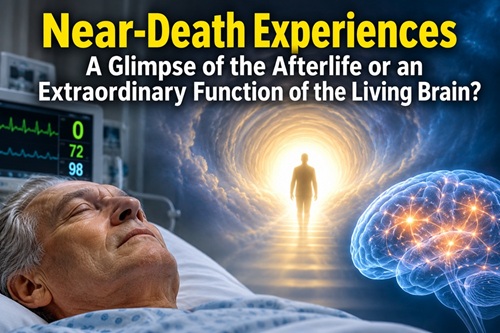 1. The Fascination with Almost DyingFew human experiences have attracted as much fascination, controversy and metaphysical speculation as the Near-Death Experience (NDE). People who have come close to death, or have temporarily lost vital bodily functions, sometimes report extraordinary experiences: leaving their bodies, travelling through tunnels towards brilliant lights, encountering deceased relatives, experiencing overwhelming feelings of peace and love, reviewing their lives, or entering what seems to be another dimension of existence. For many experiencers, these events are more real than ordinary waking life. They may permanently change their attitudes towards death, religion, spirituality and the meaning of existence. Some return convinced that consciousness survives bodily death. Others describe their experiences in religious language, interpreting them as encounters with God, heaven, angels or a universal intelligence. The subject deserves serious attention. The experiences themselves are real as psychological events, often deeply transformative, and sometimes difficult to explain in their entirety. But the interpretation of those experiences is another matter altogether. The central question is deceptively simple: do Near-Death Experiences provide evidence that consciousness can exist independently of the brain, or do they reveal just how extraordinary the human brain can become under extreme physiological conditions? This essay argues that the first conclusion is considerably less justified than the second. NDEs are fascinating phenomena, but their existence does not establish the existence of an afterlife. The distinction between experiencing something and correctly interpreting its source is essential. 2. What Actually Happens During a Near-Death Experience?Although individual accounts vary, researchers have identified a number of recurring features. These include a sense of leaving one's physical body, observing medical procedures from an apparently external perspective, moving through a dark tunnel, encountering an intense light, meeting deceased relatives or spiritual beings, experiencing a panoramic review of one's life, and feeling an overwhelming sense of peace and connectedness. Not every experiencer reports all these elements. Some describe elaborate journeys, while others remember only a fleeting sensation of separation from the body. Some experience frightening or disturbing episodes rather than the familiar imagery of heavenly peace. The American psychiatrist Raymond Moody popularized the subject with his 1975 book Life After Life. Moody collected accounts from people who had survived situations in which they believed themselves to be close to death. His work helped establish NDEs as a subject of public and academic interest. Later researchers, notably cardiologist Pim van Lommel in the Netherlands, investigated the phenomenon more systematically. His 2001 study, published in The Lancet, examined 344 survivors of cardiac arrest. Approximately 18 percent reported some form of NDE. This finding is important. NDEs are not simply fictional stories invented by a handful of religious enthusiasts. They are reported across different populations and circumstances, and they can be investigated scientifically. However, the fact that an experience is genuine does not establish that its apparent content corresponds to an external reality. A dream can feel entirely real. A hallucination can be emotionally overwhelming. An experience of meeting a deceased loved one can profoundly affect someone without establishing that the deceased person was actually present. The distinction between phenomenological reality and external reality will remain central throughout this discussion. 3. The Brain Under Extreme ConditionsOne of the most important questions is what happens to the brain when the body approaches death. During cardiac arrest, the heart stops pumping blood effectively. The brain is deprived of oxygen and glucose, and consciousness is rapidly lost. If circulation is not restored, irreversible brain damage and eventually death follow. But dying is not an instantaneous event in which every biological process stops simultaneously. Different tissues and neural systems deteriorate at different rates. Some residual electrical activity can persist, and experimental research has identified transient changes in brain activity during the process of dying. A 2023 study published in Proceedings of the National Academy of Sciences examined four dying patients and detected surges of gamma activity in the brains of two of them following withdrawal of life support. The researchers suggested that these patterns might be associated with conscious processing, although the patients' subjective experiences were unknown. This is intriguing, but it should not be exaggerated. Four patients, only two of whom displayed the relevant activity, cannot establish that a dying brain produces NDEs. Nor does gamma activity by itself demonstrate conscious awareness. Nevertheless, the findings challenge the simplistic assumption that the brain simply switches off like an electrical appliance. The process of dying may involve complex and changing patterns of neural activity. It is conceivable that some NDEs arise during these transitional periods, although precisely when particular experiences occur remains difficult to establish. There is another complication: many people who report NDEs have not actually been at the point of irreversible death. They may have suffered cardiac arrest, severe illness, trauma or other medical emergencies from which they subsequently recovered. The expression near-death therefore covers a heterogeneous collection of circumstances. It should not be confused with the experience of having died and returned. 4. Neurological Explanations: Several Pieces of the PuzzleThere is no single universally accepted neurological explanation for every feature of NDEs. Nevertheless, several well-established lines of research offer plausible explanations for important components. Out-of-body experiences. The sensation of floating above one's body has been associated with disturbances in the brain's integration of visual, tactile and vestibular information. Research involving the temporoparietal junction has demonstrated that interfering with this region can produce unusual experiences of bodily displacement and altered self-location. The brain normally constructs a remarkably stable sense of being located inside a body. Under unusual conditions, that construction can become unstable. The tunnel and the light. Changes in visual processing, oxygen deprivation and altered neural activity have been proposed as possible contributors to tunnel-like perceptions and intense light phenomena. However, the precise neurological mechanisms remain uncertain. The familiar tunnel narrative should not be treated as an established physiological sequence. The life review. Some experiencers describe an extraordinarily rapid panoramic recollection of their lives. Memory retrieval under extreme stress, altered temporal perception and unusual interactions between emotional and autobiographical memory systems may contribute to this phenomenon. Feelings of peace and unity. Extreme physiological stress, altered neurotransmission and changes in the brain systems involved in emotion and self-awareness may contribute to experiences of bliss, transcendence and the disappearance of ordinary ego boundaries. Encounters with deceased relatives. Such experiences may involve internally generated imagery, autobiographical memory, emotional expectations and dream-like processes. Their subjective intensity does not establish the independent presence of the people encountered. These explanations are not necessarily complete. But they demonstrate that we need not immediately invoke an immaterial consciousness or supernatural realm to investigate NDEs. An important distinction must be maintained: explaining how an experience might arise is not the same as explaining every detail of an individual experience. Scientific investigation remains open-ended. 5. The DMT Hypothesis and Altered States of ConsciousnessAnother intriguing avenue of research concerns psychedelic substances, particularly dimethyltryptamine (DMT). DMT is a powerful psychedelic compound capable of producing intense alterations in perception, identity, time and the sense of reality. Some users report encounters with apparently autonomous beings, journeys into unfamiliar environments, feelings of cosmic unity and experiences resembling descriptions of NDEs. This resemblance has led some researchers to investigate whether endogenous DMT might play a role in the dying brain. The hypothesis is attractive because it offers a possible neurochemical connection between psychedelic experiences and certain NDE characteristics. However, the evidence does not establish that the human brain releases a massive quantity of DMT during dying, or that such a release explains NDEs. The presence of DMT in mammalian tissues is not sufficient evidence for this theory. The more general lesson is perhaps more important: the human brain can generate experiences that feel like encounters with another reality. This is already familiar from dreaming, psychosis, psychedelic experiences, meditation and certain neurological conditions. We should be cautious about treating the apparent transcendence of ordinary consciousness as proof that consciousness has actually transcended the brain. 6. The Evidential Challenge: Can NDEs Demonstrate Consciousness Beyond the Brain?This is where the debate becomes philosophically and scientifically significant. The strongest argument advanced by proponents of survival is not simply that people experience beautiful lights or meet deceased relatives. It is that some individuals allegedly acquire information during an NDE that they could not have obtained through their ordinary senses. These are sometimes called veridical NDEs. For example, a patient undergoing cardiac arrest may later describe medical procedures, conversations or events that supposedly took place while the patient was unconscious. Some accounts involve details about the hospital environment or the actions of medical personnel. If such reports could be independently verified, and if the information could demonstrably not have been acquired through ordinary means, they would present a genuine scientific challenge. But there are substantial methodological difficulties. First, cardiac arrest does not necessarily mean that all brain activity has ceased. Second, the precise timing of an experience is difficult to establish retrospectively. Third, patients may have heard sounds or registered fragments of information before or after their period of apparent unconsciousness. Fourth, memories can be reconstructed and unconsciously supplemented after the event. There is also the problem of selective reporting. Extraordinary stories are more likely to be publicized than ordinary or ambiguous experiences. This does not mean that every remarkable account is false. It means that extraordinary claims require unusually careful verification. The AWARE studiesCardiologist Sam Parnia and colleagues have attempted to investigate these questions through the AWARE research programme (AWAreness during REsuscitation). The first AWARE study, published in 2014, examined cardiac arrest survivors and included attempts to test whether patients could identify visual targets placed in locations that would be inaccessible to someone lying in a normal position. One survivor reported an auditory account of events associated with resuscitation that researchers considered broadly consistent with aspects of the clinical circumstances. However, no successful identification of the hidden visual targets was demonstrated. The subsequent AWARE-II study, published in 2023, investigated 567 in-hospital cardiac arrests. Only a small number of survivors completed interviews suitable for detailed analysis. Some reported memories or experiences associated with resuscitation, but the study did not establish that consciousness can function independently of the brain. These investigations are important precisely because they attempt to move beyond anecdotal testimony. So far, however, they have not delivered the decisive evidence that advocates of an afterlife would need. The scientific question remains open, but openness should not be confused with confirmation. 7. Pim van Lommel and the Nonlocal Consciousness HypothesisThe Dutch cardiologist Pim van Lommel deserves particular attention because his work has been influential in the European NDE debate. His 2001 Lancet study was a prospective investigation of NDEs among cardiac arrest survivors. It established that a significant minority of patients reported such experiences. In his subsequent book, Consciousness Beyond Life, van Lommel developed a more ambitious interpretation. He questioned whether consciousness could be entirely produced by the brain and suggested that the brain might function more like a receiver or interface for a consciousness that is fundamentally nonlocal. This is an interesting philosophical possibility, but it is not a conclusion established by his clinical research. The receiver analogy is particularly problematic. A radio receives signals generated elsewhere, but we know this because radio waves can be independently detected, measured and manipulated. We can identify the physical mechanisms involved. What would constitute the equivalent evidence for nonlocal consciousness? Where is this consciousness located? How does it interact with the brain? What information does it carry? How could its existence be independently detected? And what predictions would distinguish the hypothesis from ordinary brain-based explanations? Without answers to these questions, nonlocal consciousness remains a metaphysical proposal rather than an established scientific theory. The fact that we do not yet understand consciousness completely does not license us to insert an immaterial consciousness into the explanatory gap. 8. Cultural Differences: Is There One Universal Afterlife?A further complication concerns the interpretation of NDEs across cultures. Although certain features appear relatively widespread, the content and interpretation of experiences can vary according to religious, cultural and personal expectations. Some people encounter Jesus, angels or heavenly landscapes. Others describe deceased ancestors, religious figures from different traditions or encounters with apparently impersonal forms of light and awareness. Even the interpretation of the experience can change according to the person's worldview. This raises an important question: if NDEs provide direct access to an objectively existing afterlife, why are their descriptions so culturally variable? One response is that the underlying experience is universal but interpreted through culturally conditioned mental frameworks. That is certainly possible. But it also supports a more naturalistic explanation: the brain constructs experiences using the memories, expectations, symbols and emotional associations available to it. The difficulty for afterlife advocates is that culturally specific content cannot simply be dismissed as interpretation when it supports one tradition, while being treated as literal revelation when it supports another. If NDEs are evidence for an objective spiritual realm, we need some independent way of distinguishing genuine information about that realm from the cultural expectations people bring into the experience. 9. The Psychological Consequences: What NDEs Can Teach UsEven if NDEs do not establish an afterlife, their psychological significance should not be underestimated. Many experiencers report a reduced fear of death, greater appreciation of life, increased compassion and a diminished attachment to material possessions. Some change their professional priorities, relationships and attitudes towards other people. These transformations deserve respect. A person who has experienced what feels like an encounter with eternity may return with a fundamentally altered perspective on existence. That experience can become a defining event in their biography. But we must distinguish between the psychological value of an experience and the truth of the beliefs subsequently derived from it. A religious conversion can transform someone's life without proving the theological claims associated with that conversion. A psychedelic experience can inspire profound ethical insights without demonstrating that the user has encountered an objective cosmic intelligence. Likewise, an NDE can provide someone with a powerful sense of meaning without establishing that personal consciousness survives death. There is also a more difficult question. Are all NDEs positive? Not necessarily. Some experiencers report terrifying, isolating or disturbing episodes. These accounts are less prominent in popular discussions, but they remind us that the phenomenon is not simply a universal advertisement for heavenly bliss. A serious investigation must include the full range of experiences rather than selecting only those that support comforting conclusions. 10. The Philosophical Problem: Does Consciousness Need a Brain?The NDE debate inevitably leads to the broader philosophical problem of consciousness. Why should physical processes in the brain give rise to subjective experience at all? Why is there something it feels like to be a human being? This is sometimes called the hard problem of consciousness, a term popularized by philosopher David Chalmers. There are several competing philosophical approaches. Materialists generally regard consciousness as arising from physical processes in the brain, although the precise explanation remains disputed. Dualists argue that mind and matter are fundamentally different kinds of reality. Idealists reverse the usual relationship, treating consciousness as fundamental and the physical world as dependent upon it. Panpsychists suggest that consciousness, or some primitive form of experience, is a fundamental feature of reality. NDEs are frequently invoked in support of dualism or idealism. But there is a logical problem here. Even if consciousness is not yet fully explained by neuroscience, it does not follow that it can exist independently of the brain. The explanatory gap is not positive evidence for a nonphysical mind. Consider an analogy. Before the development of modern biology, the processes underlying heredity were poorly understood. That ignorance did not establish the existence of a supernatural life force. The eventual discovery of DNA provided a physical mechanism that earlier theories had lacked. The analogy is not exact, because consciousness presents distinctive philosophical problems. Nevertheless, it illustrates an important principle: incomplete knowledge does not automatically validate a preferred metaphysical alternative. The relationship between consciousness and the brain remains one of the major unresolved questions in science. NDEs may contribute valuable evidence, but they do not settle the issue. 11. The Spirituality Industry and the Commercialization of DeathNDEs have also become part of a substantial spiritual and commercial culture. Books, documentaries, conferences, podcasts and online communities frequently present these experiences as evidence of a universal spiritual reality. Some authors claim to have discovered the secrets of death, the structure of heaven or the ultimate purpose of human existence. A number of popular accounts move rapidly from personal testimony to sweeping metaphysical conclusions. The problem is not that people share their experiences. Nor is it that they find comfort in spiritual interpretations. The problem arises when subjective testimony is presented as scientific proof. There is a familiar pattern: First, someone undergoes an extraordinary experience. Second, the experience is interpreted as an encounter with a transcendent reality. Third, the interpretation is generalized into a claim about the nature of consciousness. Finally, the claim is presented as confirmation of an entire spiritual worldview. Each step requires additional evidence, but popular NDE literature often treats the entire sequence as self-evident. This is particularly problematic when NDEs are used to support claims about reincarnation, universal consciousness, divine purpose or the evolutionary destiny of humanity. An experience of timelessness does not establish that the universe has an eternal purpose. An encounter with overwhelming love does not demonstrate that love is a fundamental cosmic force. A feeling of unity does not prove that all existence is literally one consciousness. These may be meaningful philosophical or religious interpretations, but they should not be confused with empirical discoveries. 12. What Would Count as Convincing Evidence?It is worth asking what kind of evidence would genuinely change the scientific debate. The most promising approach is not to collect increasingly elaborate anecdotes, but to design experiments that can distinguish between competing explanations. For example, researchers could place randomized visual targets in locations inaccessible to patients undergoing resuscitation. If someone later identified a target accurately, and the result could be independently verified under carefully controlled conditions, that would be significant. Repeated successful results would be even more compelling. Researchers would also need to establish the timing of reported experiences as precisely as possible, document the patient's physiological condition and exclude ordinary channels of information. Ideally, independent research teams should be able to reproduce the findings. The essential issue is not whether an NDE is extraordinary. It is whether it contains information that cannot reasonably be explained through known sensory, neurological or psychological processes. A genuinely verified case of perception during demonstrably absent capacity for ordinary sensory processing would be scientifically important. Repeated evidence of such perception would require serious reconsideration of existing theories. But that evidence has not yet emerged in a sufficiently robust and reproducible form. Science should neither prejudge the answer nor lower its evidential standards because the subject concerns death. 13. The Existential Implications: Must We Believe in an Afterlife to Find Meaning?Perhaps the most important implication of NDE research is not metaphysical but existential. Human beings have always struggled with mortality. Religion has traditionally offered various solutions: resurrection, reincarnation, liberation from the cycle of birth and death, or absorption into an eternal spiritual reality. NDEs seem to offer modern experiential confirmation of some of these ancient promises. But there is another possibility. Perhaps the most important lesson of NDEs is not that we are immortal, but that our ordinary relationship with life and death is psychologically and emotionally more complex than we realize. The human brain can generate experiences of extraordinary intensity. Under extreme conditions, our ordinary sense of identity, time, space and embodiment can change dramatically. These experiences can expose the limitations of everyday consciousness and transform our understanding of what it means to be alive. None of this requires an afterlife. Indeed, accepting the possibility that personal consciousness ends with the death of the brain need not diminish the value of existence. It can make the present more precious. We do not need eternity to justify compassion, love, creativity or intellectual curiosity. Nor does the absence of guaranteed cosmic purpose imply that human life is meaningless. Meaning can emerge from relationships, achievements, knowledge, moral commitments and participation in the ongoing history of life. The finite character of existence is not necessarily a defect that requires supernatural correction. 14. Conclusion: Extraordinary Experiences, Insufficient EvidenceNear-Death Experiences are among the most fascinating phenomena at the intersection of neuroscience, psychology, medicine and philosophy. They reveal that the human brain can generate experiences of remarkable complexity and emotional intensity under extreme conditions. They also raise legitimate questions about the nature of consciousness, memory, perception and the process of dying. Their study should continue, and researchers should remain open to findings that challenge existing assumptions. But the leap from NDEs to the survival of personal consciousness is not scientifically justified at present. The recurring features of NDEs, their neurological parallels, their cultural variability and the difficulties surrounding the verification of apparently paranormal perceptions all counsel caution. The most important distinction is between the experience and its interpretation. People genuinely experience what they report. That does not mean that the apparent world encountered during the experience exists independently of their brains. Nor should the limits of present neuroscience be mistaken for evidence of supernatural realities. There is a familiar temptation to turn every unexplained phenomenon into confirmation of what we already believe. Religious people see heaven, spiritual people see universal consciousness, and materialists see unusual brain activity. But none of these interpretations should be accepted merely because it fits a preferred worldview. The scientific task is to determine what actually happens, not to provide comforting metaphysical conclusions. Perhaps the greatest irony of the NDE debate is that we may not need to leave the natural world to discover how extraordinary human consciousness really is. The dying brain may have more secrets to reveal than either the spiritual imagination or current neuroscience has yet explored. And that, in itself, is a sufficiently remarkable prospect.
Comment Form is loading comments...
|