|
TRANSLATE THIS ARTICLE
Integral World: Exploring Theories of Everything
An independent forum for a critical discussion of the integral philosophy of Ken Wilber
  Frank Visser, graduated as a psychologist of culture and religion, founded IntegralWorld in 1997. He worked as production manager for various publishing houses and as service manager for various internet companies and lives in Amsterdam. Books: Ken Wilber: Thought as Passion (SUNY, 2003), and The Corona Conspiracy: Combatting Disinformation about the Coronavirus (Kindle, 2020).
Check out my other conversations with ChatGPT Noam ChomskyThe Limits of the Great DissidentFrank Visser / ChatGPT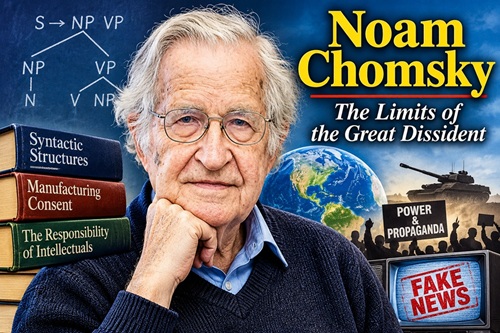 Noam Chomsky occupies an extraordinary position in modern intellectual history. He revolutionized linguistics, challenged established assumptions about human language, became one of America's most prominent critics of imperialism, and helped shape the intellectual vocabulary of the political left. For generations of students, activists, and dissidents, Chomsky represented something increasingly rare: an intellectual willing to confront powerful institutions without seeking their approval. Yet precisely because of his stature, Chomsky deserves more than admiration. He deserves critical examination. His intellectual achievements are substantial, but his political judgments have often been considerably less impressive. His relentless criticism of American foreign policy sometimes developed into a framework in which Western wrongdoing received overwhelming attention, while the crimes, ambitions, and ideological commitments of America's adversaries received comparatively less scrutiny. His famous skepticism toward official narratives could become selective skepticism. And his sophisticated analysis of propaganda occasionally seemed to underestimate how easily dissidents themselves can become prisoners of a preferred narrative. The central paradox of Chomsky's career is that an intellectual who taught generations to question authority sometimes appeared reluctant to apply the same degree of suspicion to political movements and governments that positioned themselves against the United States. This is not an argument for dismissing Chomsky. It is an argument for taking him seriously enough to disagree with him. 1. The revolutionary linguist: Chomsky's genuine achievementAny assessment of Chomsky must begin with his contribution to linguistics. His 1957 book, Syntactic Structures, challenged the dominant behaviorist understanding of language acquisition. Against the idea that language is primarily learned through imitation, reinforcement, and conditioning, Chomsky argued that human beings possess an innate capacity for acquiring grammatical structures. His work helped transform linguistics and influenced cognitive science, psychology, philosophy, and computer science. The broader philosophical implication was significant. Human beings were no longer viewed simply as passive products of environmental conditioning. The human mind possessed internal structures that made certain forms of learning possible. This was a major intellectual intervention, although subsequent developments in linguistics have challenged, revised, and sometimes rejected important aspects of Chomsky's theories. There is an interesting contrast here with his political work. In linguistics, Chomsky developed theories that invited empirical investigation, technical disagreement, and theoretical refinement. In political commentary, however, his arguments sometimes became more repetitive and resistant to revision. His scientific reputation also gave his political opinions an authority that did not necessarily follow from his scientific accomplishments. Being a revolutionary linguist does not automatically make someone an equally reliable historian, geopolitical analyst, or moral philosopher. This distinction is essential when evaluating Chomsky. 2. Manufacturing Consent: A powerful theory of media manipulationPerhaps Chomsky's most influential political contribution is Manufacturing Consent, written with Edward S. Herman. The book presents a structural analysis of how mainstream media operate within capitalist societies. Rather than imagining propaganda as something imposed exclusively through government censorship, Herman and Chomsky identify institutional mechanisms that shape what becomes news and how it is presented. Their propaganda model identifies five filters:
The central insight is that propaganda does not require a conspiracy. Journalists can be personally honest, professionally competent, and committed to truth while working within institutions that systematically privilege certain perspectives. This remains an important contribution to media criticism. But the model also has limitations. Its structural emphasis can encourage an excessively deterministic interpretation of journalism. If media coverage is systematically shaped by elite interests, how do we explain investigative journalism that exposes powerful institutions, disagreements between major newspapers, or reporting that challenges the assumptions of political and economic elites? More importantly, how do we distinguish structural bias from ordinary editorial judgment, professional error, ideological disagreement, and genuine differences in the available evidence? A model that explains everything through institutional power risks becoming difficult to falsify. There is also an ironic problem: Chomsky's own political commentary is frequently distributed through alternative media institutions that have their own ideological preferences, editorial filters, and audiences. The question is not whether mainstream media are biased. They demonstrably can be. The question is whether Chomsky's model adequately explains the entire media landscape, including the media that agree with him. 3. The problem of selective skepticismOne of Chomsky's greatest strengths is his insistence that governments should be judged by their actions rather than their rhetoric. The United States has repeatedly violated international law, supported authoritarian regimes, conducted illegal military interventions, and protected friendly governments from accountability. Chomsky has documented these practices extensively. His criticism of the Vietnam War, American intervention in Central America, the invasion of Iraq, and the broader history of Western imperialism deserves serious attention. But there is a problem when skepticism becomes asymmetrical. Chomsky is exceptionally alert to the ideological justifications offered by Washington. He is less consistently alert to the ideological justifications offered by governments that oppose Washington. This creates a peculiar analytical imbalance. A government does not become progressive because it opposes American hegemony. Nor does its propaganda become more truthful because it challenges Western propaganda. Anti-Americanism is not a substitute for independent political analysis. The relevant questions should always be:
These questions must be applied consistently, whether the government under examination is American, Russian, Chinese, Iranian, or any other. The danger is that a critique of Western imperialism can gradually turn into an interpretive framework in which almost every international conflict is primarily understood through Western responsibility. That is not necessarily anti-imperialism. It can become a different kind of ideological reductionism. 4. Cambodia: The danger of getting the priorities wrongChomsky's response to the Khmer Rouge atrocities in Cambodia remains one of the more controversial episodes in his intellectual career. Following the fall of the Khmer Rouge regime, reports emerged of mass executions, forced labor, starvation, and the destruction of Cambodian society. The eventual historical record established that approximately 1.7 million people died under the regime. Chomsky and Herman criticized Western reporting on Cambodia, particularly what they regarded as the selective use of atrocity reports to rehabilitate American foreign policy after the Vietnam War. Their concern about propaganda was not inherently unreasonable. American intervention had devastated Indochina, and the political uses of atrocity reporting deserved scrutiny. But the problem was one of emphasis and evidential judgment. In their 1979 work The Political Economy of Human Rights, Chomsky and Herman examined competing reports about Cambodia and criticized the reliability and political uses of some accounts. They also acknowledged the existence of Khmer Rouge atrocities. Their approach nevertheless attracted substantial criticism for placing too much emphasis on the weaknesses of Western reporting and insufficient emphasis on the accumulating evidence of the regime's crimes. The distinction matters. It is perfectly legitimate to question the reliability of individual reports. It is not legitimate to allow the political usefulness of an atrocity to determine how seriously its evidence is investigated. The same standard should apply to atrocities committed by one's ideological opponents and allies. Chomsky's Cambodian controversy illustrates a broader problem: suspicion of propaganda can itself become a source of distortion when it leads an intellectual to distrust evidence primarily because of the political circumstances in which it appears. 5. Srebrenica: A controversy that requires precisionChomsky's association with controversies surrounding the Srebrenica genocide has also attracted criticism. However, an important qualification is necessary. Chomsky was misrepresented in a notorious 2005 Guardian interview, which incorrectly suggested that he denied the massacre or regarded the term as inappropriate. The newspaper subsequently acknowledged its errors and apologized. Chomsky did not deny that the Srebrenica massacre occurred. The substantive controversy concerned his defense of writer Diana Johnstone's right to publish a controversial interpretation of the Bosnian war and his criticism of what he considered dishonest attacks on her work. This distinction should not be erased. Nevertheless, the episode raises an important question about intellectual responsibility. Freedom of expression is indispensable, including for people whose historical interpretations are deeply objectionable. But defending someone's right to speak is not the same as defending the accuracy of what they say. Chomsky's longstanding concern with media distortion makes this distinction particularly important. The same critical standards he applies to Western journalism should also be applied to revisionist accounts of atrocities. 6. Ukraine: When geopolitical realism threatens moral clarityThe Russian invasion of Ukraine in February 2022 exposed some of the limitations of Chomsky's political framework particularly clearly. To his credit, he explicitly described the Russian invasion as unjustified and a major international crime. He did not accept Vladimir Putin's security arguments as a legitimate justification for invading a sovereign country. However, his subsequent commentary placed enormous emphasis on NATO expansion, American policy, Russian security concerns, and the need for negotiations. These are legitimate subjects. The history of NATO enlargement and Western policy toward Russia deserves serious examination. Nuclear escalation is a genuine danger, and diplomacy is indispensable. But the problem arises when these considerations begin to dominate the discussion to such an extent that Ukrainian agency and sovereignty become secondary. Ukraine is not merely a geographical space between Russia and NATO. It is a country with its own political preferences, historical experience, democratic institutions, and right to determine its international orientation. There is a particularly troubling implication when Western commentators repeatedly suggest that peace requires Ukraine to accept territorial concessions or a neutral status because Russia considers its independence strategically inconvenient. Would we apply the same logic to countries threatened by American power? Would we tell Finland, Poland, or the Baltic states that their security concerns must be subordinated to the geopolitical preferences of a neighboring great power? And why should the Russian government possess a veto over the foreign-policy choices of its neighbors? Chomsky's argument that the West should prioritize negotiations over military escalation is not inherently wrong. But negotiations cannot be treated as an abstract moral good independent of their terms. A negotiated settlement that rewards territorial conquest may encourage future aggression. A settlement imposed without the consent of the country whose territory is being negotiated away is not necessarily a just peace. His formulation sometimes makes the prevention of further destruction appear more important than the conditions under which that destruction might finally stop. That is a serious moral and political dilemma, not something that can be resolved by repeating that diplomacy is preferable to war. There is another issue. Chomsky's criticism of Western media narratives sometimes came close to adopting the Russian government's preferred geopolitical vocabulary. His emphasis on NATO's responsibility risked making the Kremlin's interpretation of events appear more explanatory than the evidence justified. The distinction between explaining the background of an invasion and explaining away the responsibility of the invader must never be lost. The Russian invasion was a decision made by the Russian leadership. NATO did not force Putin to launch it. For an intellectual who has spent decades criticizing imperialism, the sovereignty of smaller nations should be an especially important principle. 7. The Epstein relationship: An uncomfortable failure of judgmentA more recent controversy concerns Chomsky's relationship with Jeffrey Epstein. Documents released in 2026 have revealed a considerably more extensive relationship than was previously understood. Chomsky and his wife acknowledged serious errors of judgment in maintaining contact with Epstein. His wife expressed solidarity with Epstein's victims and explained that they had not known about his criminal history when they first met him in 2015. It is important to distinguish association from complicity. There is no basis here for claiming that Chomsky participated in Epstein's sexual crimes. Nevertheless, the relationship raises legitimate questions about intellectual judgment. Epstein was not simply an obscure financier with an unusual interest in academic conversation. He was a convicted sex offender who cultivated relationships with prominent academics, scientists, politicians, and public intellectuals. For someone whose life's work involved exposing the mechanisms through which wealth and power influence intellectual institutions, the willingness to maintain such a relationship deserves scrutiny. Particularly troubling are reports of correspondence in which Chomsky advised Epstein on handling negative publicity. This is not evidence that Chomsky abandoned all his principles. It is evidence that intellectual brilliance and political sophistication do not necessarily translate into sound personal judgment. There is a lesson here about intellectual celebrity itself. Even the most accomplished critics of powerful institutions can become susceptible to the privileges, invitations, and flattering attention that accompany proximity to wealth. The critic of the establishment is not automatically immune to the temptations of the establishment. 8. The intellectual's greatest temptation: Becoming predictableChomsky has repeatedly argued that intellectuals have a special responsibility to expose lies, challenge official narratives, and speak uncomfortable truths. In his 1967 essay "The Responsibility of Intellectuals", he challenged academics who lent their authority to government policies without adequately examining their consequences. This remains a compelling argument. But intellectual responsibility must also include the willingness to challenge one's own political assumptions. A public intellectual should not merely expose the contradictions of the opposing camp. He or she should actively search for contradictions within their own worldview. Here Chomsky's political career reveals a recurring weakness. His analytical framework is often so firmly organized around American imperialism that international developments are interpreted through an established hierarchy of explanatory importance. The United States is treated as the principal object of scrutiny, while the actions of its adversaries are frequently understood through the context of American policy. This is not entirely unreasonable. The United States has enormous global power and therefore carries enormous responsibilities. But power is not the only relevant variable in international politics. Ideology, nationalism, historical grievances, authoritarian ambitions, domestic political incentives, and individual leadership decisions also matter. Putin's invasion of Ukraine, for example, cannot be adequately explained by NATO enlargement alone. One must also examine Russian imperial nationalism, Putin's conception of Ukrainian identity, and his desire to maintain political control over Russia's neighborhood. Similarly, Chinese authoritarianism cannot be explained simply as a defensive reaction to American power. A comprehensive analysis requires multiple explanatory levels. Chomsky's tendency to privilege one of them sometimes impoverishes his conclusions. 9. Chomsky and the problem of the intellectual brandThere is another paradox worth considering. Chomsky became an intellectual institution in his own right. His name carries enormous authority in progressive circles. His opinions are frequently treated as authoritative pronouncements rather than contributions to an ongoing debate. This creates a problem that is familiar from other intellectual movements, including the Integral movement surrounding Ken Wilber. A thinker who originally challenges established orthodoxies can eventually acquire an orthodoxy of his own. Followers begin defending the thinker rather than examining his arguments. Criticism is interpreted as hostility, ideological betrayal, or evidence of insufficient political awareness. Chomsky's supporters sometimes reproduce precisely the intellectual habits he spent his career criticizing: selective attention, ideological loyalty, and distrust of inconvenient evidence. The irony is considerable. If Manufacturing Consent teaches us anything, it is that we should examine the institutional and psychological mechanisms through which beliefs are maintained. Why should Chomsky's own intellectual following be exempt from that investigation? No intellectual should be granted permanent immunity from criticism because of past achievements. The appropriate response to a great thinker is neither worship nor cancellation. It is continuous evaluation. 10. What Chomsky got rightA critical assessment should not obscure Chomsky's genuine contributions. He helped establish that language is a fundamental human cognitive capacity rather than simply a collection of learned habits. He exposed the relationship between economic power and media institutions. He challenged the assumption that democratic societies are automatically protected against propaganda. He documented American imperialism at a time when much of the political establishment preferred to ignore its consequences. He defended freedom of expression, including for people whose opinions he strongly opposed. He consistently warned about nuclear weapons, environmental destruction, and the dangers of concentrated political and economic power. And perhaps most importantly, he encouraged generations of readers to question the relationship between official narratives and actual events. These achievements should not be diminished because some of his political conclusions were questionable. But neither should his political mistakes be excused because of his achievements. That is precisely the distinction a genuinely critical intellectual culture should maintain. Conclusion: The critic must also be criticizedNoam Chomsky is one of the most consequential intellectuals of the twentieth and early twenty-first centuries. His contributions to linguistics are historically significant, and his political criticism has exposed many uncomfortable truths about American power, corporate influence, and media manipulation. But his career also illustrates the limitations of ideological consistency. The determination to expose American imperialism sometimes came at the expense of a sufficiently independent examination of other imperial powers. His skepticism toward mainstream narratives could become insufficiently skeptical toward alternative narratives. His advocacy of diplomacy sometimes gave insufficient weight to the sovereignty and wishes of those whose countries were being invaded. And his personal association with Epstein revealed that even an exceptionally accomplished critic of power can exercise remarkably poor judgment when confronted with the attractions of powerful acquaintances. Perhaps the most important lesson is that intellectual independence cannot be measured by how frequently someone challenges the establishment. It must also be measured by their willingness to challenge their own established positions. Chomsky taught us to distrust power, question propaganda, and hold intellectuals accountable. We should apply those lessons to Chomsky himself. Noam Chomsky should be read, studied, and appreciated. But he should never be followed uncritically. The ultimate tribute to a great dissident is not to become his disciple. It is to preserve the critical independence that made his work important in the first place.
Comment Form is loading comments...
|