|
TRANSLATE THIS ARTICLE
Integral World: Exploring Theories of Everything
An independent forum for a critical discussion of the integral philosophy of Ken Wilber
  Frank Visser, graduated as a psychologist of culture and religion, founded IntegralWorld in 1997. He worked as production manager for various publishing houses and as service manager for various internet companies and lives in Amsterdam. Books: Ken Wilber: Thought as Passion (SUNY, 2003), and The Corona Conspiracy: Combatting Disinformation about the Coronavirus (Kindle, 2020).
Check out my other conversations with ChatGPT From Philosophy to BrandHow Integral Became Something to Be Preserved Rather Than QuestionedFrank Visser / ChatGPT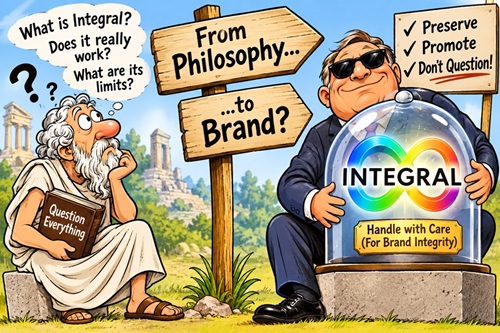 There was a time when the Integral movement presented itself as an intellectual adventure. Its ambition was enormous: to integrate knowledge from different disciplines, reconcile competing philosophical perspectives, transcend the limitations of established paradigms, and develop a more comprehensive understanding of reality. It invited people to think across boundaries, challenge conventional assumptions, and examine their own worldviews. At least, that was the promise. Today, however, something seems to have changed. Increasingly, Integral appears less like a philosophy that invites examination and more like a brand that requires protection. Its concepts have become familiar trademarks, its leading figures intellectual authorities, its institutions custodians of an established legacy, and its critics potential threats to the integrity of the enterprise. This transformation deserves attention. For a movement that prides itself on including, transcending, and integrating different perspectives, its apparent reluctance to subject its own foundations to sustained criticism is particularly ironic. How did a philosophy that promised to question everything become something that so often seems reluctant to question itself? From Intellectual Exploration to Doctrinal ArchitectureKen Wilber's contribution to contemporary philosophy should not be dismissed. His ambitious synthesis of developmental psychology, Eastern contemplative traditions, Western philosophy, systems theory, and religious studies provided an unusually comprehensive framework for discussing human development and the nature of reality. The AQAL model, with its four quadrants, developmental levels, lines, states, and types, offered a conceptual architecture through which an extraordinary variety of subjects could be approached. But there is a difference between developing a useful framework and establishing a system that becomes increasingly difficult to challenge. Initially, Integral Theory could be understood as a proposal: here is a way of looking at reality; examine it, test it, criticize it, improve it. But over time, the framework itself increasingly became the organizing authority. New developments were expected to find their place within the established architecture, while disagreements were sometimes interpreted as evidence that the critic had not sufficiently understood the system. The danger of such a development is obvious. A framework designed to organize knowledge can gradually become a framework that organizes objections to itself. Instead of asking whether the categories are correct, one asks which quadrant the objection belongs to. Instead of investigating whether a developmental hierarchy is empirically justified, one questions the critic's developmental perspective. Instead of examining whether spiritual evolution is actually occurring, one invokes higher stages of consciousness to explain why some people cannot recognize it. A theory that can accommodate every objection without ever having to revise its central assumptions risks becoming intellectually self-sealing. The Authority of the FounderAnother important transformation concerns the position of Ken Wilber himself. Integral Theory has always been closely associated with its principal architect. This is understandable: Wilber produced an enormous body of work, and his intellectual influence shaped the movement from its inception. But a movement built around a founder faces a familiar problem. At what point does intellectual respect become intellectual deference? Wilber's writings are frequently treated not simply as contributions to an ongoing discussion but as authoritative statements within an established worldview. His terminology becomes the preferred language of discussion, his developmental maps provide the accepted coordinates, and his later formulations are often used to interpret or correct his earlier ones. This creates an unusual asymmetry. Integral thinkers may be encouraged to question mainstream science, conventional religion, materialism, postmodernism, and established academic disciplines. Yet questioning Wilber's own assumptions can be a much more delicate affair. The result is a curious intellectual hierarchy: virtually everything can be subjected to Integral interpretation, except perhaps Integral Theory itself. A genuinely philosophical movement should be capable of applying its own critical standards to its founder. No thinker, however prolific or influential, should be exempt from scrutiny. Wilber's work deserves neither automatic acceptance nor automatic rejection. It deserves the same treatment as any other ambitious intellectual project: careful examination of its evidence, arguments, explanatory mechanisms, and limitations. The Branding of IntegralThe institutional development of Integral has reinforced this tendency. Integral Life, Integral Institute, the Institute of Applied Metatheory, and various post-Wilber initiatives have helped maintain the movement's visibility and provide platforms for discussion, education, and collaboration. There is nothing inherently wrong with institutionalizing an intellectual movement. Philosophical ideas need publishers, conferences, educational programs, websites, and communities. But institutions also have interests of their own. They need audiences, subscribers, members, funding, recognizable personalities, and a coherent identity. They need to communicate what makes their approach distinctive. They need to preserve continuity with the intellectual tradition from which they emerged. This creates a potential conflict between intellectual openness and brand preservation. A philosophy is free to change its mind. A brand has an identity to maintain. A philosophy can acknowledge that some of its foundational ideas were mistaken. A brand risks undermining its own selling proposition by doing so. A philosophy welcomes uncomfortable questions because they may lead somewhere unexpected. A brand tends to prefer conversations that reinforce its distinctive vocabulary and demonstrate the continuing relevance of its intellectual heritage. The more Integral becomes associated with a recognizable institutional identity, the greater the temptation to protect that identity. The danger is not that Integral has become organized. It is that organizational continuity may gradually take precedence over intellectual discovery. The Vocabulary of Transcendence as a Defensive MechanismOne of the most interesting aspects of this transformation is the way Integral terminology can sometimes function defensively. The language of stages, levels, transcendence, inclusion, and developmental complexity offers a sophisticated vocabulary for discussing differences in perspective. Properly used, it can illuminate genuine differences in cognitive development, values, and worldviews. But it can also become a convenient way of dismissing disagreement. A critic is said to be operating from an earlier developmental stage. A materialist is accused of reducing reality to the exterior dimensions of existence. A postmodernist is portrayed as trapped in relativism. A skeptic is considered insufficiently open to spiritual experience. In this way, criticism can be neutralized without its actual content being addressed. The problem is not that developmental differences are imaginary. The problem is that they cannot simply be presumed whenever someone disagrees with Integral Theory. If a critic argues that Wilber's concept of Eros does not explain the emergence of complexity, the appropriate response is to examine the explanatory claim. What is Eros? How does it operate? What evidence supports its existence? What does it predict that competing explanations do not? It is not sufficient to suggest that the critic has failed to appreciate a higher, more inclusive perspective. Likewise, if someone questions whether a particular developmental hierarchy is empirically established, the response should involve evidence, not an appeal to the very hierarchy under dispute. A philosophy that routinely converts objections into demonstrations of the objector's limitations is in danger of losing its capacity for self-correction. The Post-Wilber Generation: Innovation or Preservation?The emergence of post-Wilber thinkers and organizations offers an interesting test of whether Integral can escape this predicament. Some seek to modernize the framework, others to secularize it, and still others to develop a more rigorous metatheoretical foundation. The Institute of Applied Metatheory, for example, has emphasized the development of Big Theory and the integration of knowledge across disciplines. Such initiatives may represent genuine intellectual innovation. They should not be dismissed simply because they retain elements of the Integral inheritance. But an important question remains: are these projects prepared to reconsider the foundations of Integral Theory, or are they primarily attempts to update and preserve its intellectual architecture? There is a substantial difference. If the basic developmental assumptions, the privileged position of consciousness, the spiritual interpretation of evolution, and the architecture of the quadrants remain largely unquestioned, then we may be witnessing not a fundamental intellectual renewal but a sophisticated process of brand maintenance. Changing the terminology, introducing new disciplines, or developing more elaborate theoretical structures does not automatically constitute a paradigm shift. Sometimes the most radical intellectual advance is not to build a more comprehensive system but to discover that a particular assumption on which the system rests was never adequately justified. The Missing Ingredient: Genuine Self-CriticismThe irony is that Integral Theory possesses all the conceptual resources needed to recognize this problem. It celebrates perspective-taking, reflexivity, the transcendence of partial viewpoints, and the inclusion of previously neglected dimensions of reality. It emphasizes that every perspective is situated and that our understanding must remain open to further development. Why, then, should Integral itself be exempt from these principles? A genuinely reflexive Integral movement would ask whether its own developmental maps are adequately supported, whether its categories are genuinely comprehensive, whether its spiritual assumptions are justified, and whether its institutional structures encourage or discourage intellectual dissent. It would also distinguish between what has been demonstrated, what remains a plausible hypothesis, and what is essentially metaphysical speculation. For example, the claim that evolution produces increasing complexity is not equivalent to the claim that the universe contains an inherent spiritual drive toward higher consciousness. The first can be investigated through scientific research. The second requires additional philosophical and empirical justification. Conflating such claims under a grand narrative of evolutionary spirituality does not make them more convincing. Nor does calling a theory integral make it more comprehensive. Comprehensiveness is something to be demonstrated, not something to be awarded to a framework by definition. When Criticism Becomes DisloyaltyPerhaps the clearest indication of a movement's intellectual condition is how it treats its critics. A healthy intellectual community recognizes that criticism can be an expression of engagement rather than hostility. Someone who spends years examining a theory, identifying its strengths and weaknesses, and challenging its assumptions may be more deeply invested in its intellectual integrity than someone who simply promotes it. Yet movements organized around a shared intellectual identity can easily confuse criticism of their ideas with rejection of their community. This is especially problematic when the movement's identity is closely connected to a particular founder, vocabulary, or institutional history. The critic then becomes an outsider, a detractor, or someone who has failed to understand the system. But intellectual disagreement is not necessarily a failure of understanding. Sometimes it is the result of understanding a theory perfectly well and finding its arguments unconvincing. The difference matters. Integral should be able to accommodate people who appreciate its contributions while rejecting some of its central claims. It should welcome researchers who find its categories useful but regard its metaphysical commitments as unnecessary. It should allow former adherents to explain why they changed their minds without treating their departure as evidence of developmental regression. If it cannot do these things, its celebrated inclusiveness remains largely theoretical. My Own Intellectual DepartureMy own relationship with Integral Theory illustrates this tension. For many years, I regarded Wilber's project as an ambitious and potentially important attempt to reconcile scientific, philosophical, psychological, and spiritual perspectives. I invested considerable time in reviewing his books, discussing his arguments, and examining the intellectual movements that developed around his work. I was not simply interested in defending or attacking Wilber. I wanted to understand what was valuable in his synthesis and where it went wrong. Over time, however, my assessment changed. One particularly important shift concerned the spiritual interpretation of evolution. I once accepted, at least broadly, the idea that reason transcends myth but is itself eventually transcended by Spirit. Today I am much less convinced. Invoking Spirit, Eros, or a cosmic drive toward greater complexity does not explain the emergence of novelty. It merely gives that emergence a metaphysical name. The question is not whether reality contains mysteries or whether new forms of complexity emerge. Clearly, they do. The question is whether spiritual explanations contribute anything independently demonstrable to our understanding of these processes. I increasingly found that they did not. This did not require me to reject everything Wilber had written. His insistence on examining multiple perspectives, his attention to developmental differences, and his attempt to connect disciplines remain worthy of consideration. But appreciating these contributions does not require accepting his entire metaphysical architecture. My changing assessment also reinforced a more general conclusion: intellectual loyalty should never become an obligation to preserve a theory after its explanatory limitations have become apparent. Indeed, the freedom to change one's mind should be one of the most important values of any philosophical movement. Integral Needs Less Preservation and More ExaminationThe future of Integral does not depend on keeping Ken Wilber's intellectual legacy intact at all costs. Nor does it depend on maintaining the visibility of existing organizations, protecting established terminology, or ensuring that every new intellectual development can be incorporated into the AQAL framework. Its future depends on whether it can still generate genuinely critical thinking. That means allowing its foundational assumptions to be questioned without immediately classifying the questioner. It means distinguishing between empirical knowledge and metaphysical interpretation. It means recognizing that some of its most celebrated concepts may be useful metaphors rather than established explanatory principles. It also means accepting that intellectual development sometimes involves abandoning ideas rather than transcending and including them. There is no shame in discovering that a theory was partly right, partly wrong, and partly speculative. That is how intellectual progress normally works. The real failure would be to protect the theory from precisely the kind of critical examination it once promised to bring to other intellectual traditions. Conclusion: A Philosophy Must Be Willing to Risk Its Own SurvivalIntegral began with an extraordinary ambition: to overcome intellectual fragmentation and develop a more comprehensive understanding of reality. But a movement cannot remain intellectually alive merely by repeating its original ambitions. It must continually demonstrate that its ideas can survive independent scrutiny. The distinction between a philosophy and a brand is ultimately a distinction between two different priorities. A philosophy places truth above identity. A brand places identity in the service of continuity. A philosophy can welcome the discovery that its central assumptions were mistaken. A brand must find ways to preserve its recognizable identity despite changing circumstances. A philosophy invites criticism, even when that criticism is uncomfortable. A brand tends to distinguish between constructive feedback and threats to its reputation. Integral now faces a choice. It can remain a living philosophical enterprise, willing to examine its founder, its metaphysics, its developmental hierarchies, and its institutional culture. Or it can increasingly become a custodial movement, devoted to preserving an intellectual inheritance. The ultimate irony would be that a philosophy built around transcendence has become unable to transcend itself. If Integral really means what it says about the evolution of consciousness, it should begin by evolving beyond the need to defend Integral.
Comment Form is loading comments...
|