|
TRANSLATE THIS ARTICLE
Integral World: Exploring Theories of Everything
An independent forum for a critical discussion of the integral philosophy of Ken Wilber
  Frank Visser, graduated as a psychologist of culture and religion, founded IntegralWorld in 1997. He worked as production manager for various publishing houses and as service manager for various internet companies and lives in Amsterdam. Books: Ken Wilber: Thought as Passion (SUNY, 2003), and The Corona Conspiracy: Combatting Disinformation about the Coronavirus (Kindle, 2020).
Check out my other conversations with ChatGPT Adam Frank's Universe of LifeBeyond the Meat Computer, But Not Beyond Scientific ScrutinyFrank Visser / ChatGPT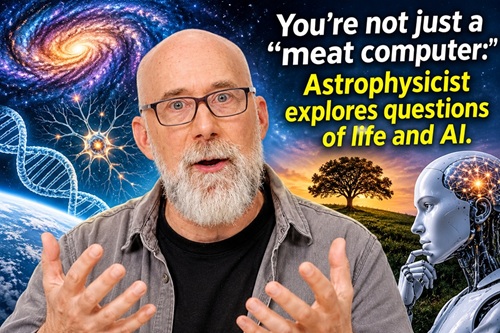 Astrophysicist and astrobiologist Adam Frank has a provocative message: human beings are not merely biological computers, life cannot be adequately understood as a machine, and artificial intelligence should not be confused with genuine intelligence. In a lengthy Big Think interview, You're Not Just a “Meat Computer: Astrophysicist Explores Questions of Life and AI, Frank attempts to challenge what he regards as a fundamental blind spot in modern science: its tendency to treat the universe as a collection of mechanical processes while overlooking the distinctive character of living systems. His argument is ambitious. It moves from the physics of agency and the self-organization of organisms to quantum mechanics, the philosophical assumptions underlying modern science, and ultimately the search for extraterrestrial life. Along the way, Frank invokes philosophers and complexity theorists, challenges the technological worldview of Silicon Valley, and suggests that understanding life may be the most important scientific undertaking of the twenty-first century. There is much to appreciate here. Frank is right to question simplistic reductionism, and his insistence that organisms must be understood in relation to their environments is scientifically and philosophically important. But his presentation also illustrates a recurring problem in contemporary discussions of complexity, consciousness, and emergence: the tendency to move from identifying the limitations of one explanatory framework to suggesting that an alternative framework has already solved the problem. It has not. 1. The Meat Computer Straw ManFrank begins by attacking the idea that human beings are essentially computers made of biological material. He calls this the meat-computer conception and associates it with the technological worldview of Silicon Valley billionaires who regard artificial intelligence as the next stage in the development of intelligence. His historical illustration is Descartes, who allegedly regarded animals as machines and interpreted their cries of pain as merely mechanical responses. There is a legitimate philosophical target here. Cartesian dualism created a notorious difficulty in accounting for animal consciousness, and mechanistic metaphors have sometimes encouraged people to underestimate the complexity of biological existence. But Frank's presentation risks attacking an exaggerated opponent. Modern neuroscience does not generally maintain that human beings are literally computers in the ordinary technological sense. The computational metaphor is a model for understanding certain aspects of information processing, not necessarily a complete ontology of the human organism. A computer analogy can be useful without implying that organisms are nothing but computers. Likewise, describing the brain as an information-processing system does not establish that consciousness is reducible to software. There is an important distinction between methodological reductionism and philosophical reductionism. The first investigates complex phenomena by studying their components and interactions. The second claims that the properties of the whole can ultimately be explained entirely in terms of those components. The former has been extraordinarily productive in biology and neuroscience. The latter remains a philosophical position requiring argument. Frank is right to challenge simplistic mechanistic thinking. But he should distinguish more carefully between the actual achievements of computational neuroscience and the exaggerated claims of technological enthusiasts. 2. Organisms Are Not ThermostatsOne of Frank's strongest arguments concerns the difference between externally programmed machines and self-organizing organisms. A thermostat responds to environmental conditions, but its purposes are externally assigned. A dog that feels hot and moves into the shade, by contrast, acts in accordance with its own biological needs. This distinction is important. Organisms maintain themselves, regulate their internal conditions, repair damage, and respond flexibly to changing environments. Their organization is not simply imposed from outside. Frank draws on the concept of autopoiesis, developed by biologists Humberto Maturana and Francisco Varela. An autopoietic system continually produces and maintains the components and organization that constitute it as a living system. This is a valuable contribution to the philosophy of biology. It shifts attention from what organisms are made of to what they continuously do to remain organisms. But does this establish that life is fundamentally different from physical processes? Not necessarily. Self-organization is not supernatural, nor does it require abandoning physics. Biological organisms are thermodynamically open systems that maintain their organization through exchanges of energy and matter with their surroundings. A cell is not a machine in the conventional engineered sense, but this does not mean that its processes are beyond physical explanation. The more interesting question is how far existing physical and chemical theories can explain the emergence and maintenance of biological organization. That is a legitimate scientific challenge, not evidence that life requires an entirely new ontology. Frank sometimes seems to confuse the inadequacy of a particular metaphor with the inadequacy of the scientific framework within which that metaphor operates. 3. The Embodied Mind: A Genuine AdvanceFrank's discussion of the brain-in-a-vat thought experiment introduces the work of philosopher Evan Thompson and the broader tradition of embodied cognition. The central point is that brains do not operate in isolation. Perception, cognition, and action depend on the organism's bodily organization and its continuous interaction with the environment. This is one of the most productive developments in contemporary cognitive science. The traditional picture of cognition as information processing occurring exclusively inside the skull is increasingly being supplemented by approaches emphasizing embodiment, situatedness, sensorimotor interaction, and environmental feedback. A brain requires a body, not merely as a biological support system but as part of the organization through which cognition takes place. However, Frank's criticism of the brain-in-a-vat scenario needs qualification. The thought experiment is not necessarily intended as a realistic proposal for constructing a functioning isolated brain. It is a philosophical device for exploring the relationship between experience, representation, and reality. Showing that a functioning brain depends on bodily processes does not automatically settle every philosophical question about consciousness or the possibility of artificial minds. Indeed, embodied cognition could also provide a research program for developing more sophisticated artificial agents. It does not establish that artificial intelligence must remain forever outside the domain of genuine cognition. The interesting question is not whether a brain needs a body, but what kinds of bodily organization and environmental interaction are necessary for different forms of intelligence. 4. Artificial Intelligence: Mimicry Is Not the Whole StoryFrank's criticism of contemporary AI is one of the most topical aspects of the interview. He regards today's systems as artificial mimics rather than genuine minds. They can produce impressive linguistic performances without possessing the self-maintaining organization, biological needs, and autonomous purposes characteristic of living organisms. There is an important distinction here. An AI system can generate meaningful-looking language without necessarily understanding it in the human sense. It can simulate emotional expression without having established that it experiences emotions. And it can solve complex problems without possessing the biological interests and vulnerabilities that shape human cognition. But Frank's argument needs another distinction: intelligence is not identical to life. Intelligence may have evolved within living organisms, but it does not follow that every possible form of intelligence must be biological. We should not define intelligence in such a way that only organisms can qualify. Nor should we assume that present-day AI represents the final limits of artificial cognition. Current systems are not autonomous organisms. They do not maintain themselves biologically, reproduce independently, or possess the integrated metabolic organization of living systems. But these observations do not prove that artificial systems could never acquire more extensive forms of agency. Frank is justified in resisting the inflated claims of AI evangelists. But the opposite exaggeration is equally problematic: dismissing artificial intelligence as mere mimicry without sufficiently specifying what would count as genuine understanding, agency, or intelligence. The philosophical question remains open. And there is a further complication: human intelligence itself involves imitation, pattern recognition, prediction, and the recombination of previously acquired information. These capacities do not become meaningless simply because artificial systems also exhibit them. The relevant question is what additional capacities distinguish human understanding from the statistical and computational abilities of present AI systems. 5. Autopoiesis and the Mystery of AgencyFrank develops his argument further through the concept of autonomous agency. Living organisms do not merely respond to external stimuli; they distinguish between what matters to their continued existence and what does not. This is sometimes described as relevance realization: the capacity of an organism to select what is significant in its environment. A bacterium moves towards nutrients and away from harmful conditions. A dog seeks shelter when cold. A human being evaluates an enormous variety of possibilities according to biological needs, learned experiences, and conscious intentions. Frank sees this capacity as fundamental to understanding life. Here he is entering territory that connects biology with phenomenology, enactivism, and theories of embodied cognition. The organism is not simply a passive object being pushed around by external forces. It is an active participant in its environment. But we should be careful about the language of agency. A bacterium does not need conscious deliberation to respond adaptively to its environment. Biological regulation can produce goal-directed behavior without requiring a conscious subject that explicitly formulates goals. There are degrees and different forms of agency. Metabolic self-maintenance, behavioral flexibility, nervous-system-mediated decision-making, and reflective human deliberation should not be casually conflated. The danger is that concepts such as agency, purpose, and relevance become increasingly expansive until they seem to explain everything. If every adaptive response is described as an expression of agency, what precisely have we learned? We still need mechanisms explaining how agency emerges, how it develops, and what distinguishes its different levels. 6. Quantum Mechanics: A Philosophical DetourThe second major part of the interview takes a surprising turn towards quantum mechanics. Frank discusses alternative interpretations of quantum theory, including the many-worlds interpretation and the work of physicist John Archibald Wheeler. He is particularly interested in approaches that take the role of the observer or agent seriously. This connects with the broader philosophical argument of his book The Blind Spot, written with Marcelo Gleiser and Evan Thompson. One of the most interesting alternatives discussed in this intellectual territory is QBism, or Quantum Bayesianism. It interprets quantum probabilities in relation to an agent's expectations about the consequences of their interactions with the world. This is not the same as claiming that human consciousness magically creates physical reality. Rather, it challenges the assumption that quantum probabilities can be understood entirely independently of the agents making predictions. There is something worthwhile in revisiting the philosophical assumptions behind quantum mechanics. The measurement problem remains a genuine interpretative challenge, and physicists disagree about what the mathematical formalism tells us about reality. But this is also where Frank's presentation becomes vulnerable to overinterpretation. Taking the observer seriously does not establish that consciousness is a fundamental ingredient of the physical universe. Nor does the existence of different interpretations of quantum mechanics demonstrate that physics needs to abandon its commitment to objective description. The many-worlds interpretation, QBism, and other approaches are competing attempts to understand the same mathematical framework. Their philosophical implications differ considerably. The existence of an observer in quantum theory should not be confused with the proposition that the universe requires living observers in order to exist. This distinction is particularly important because Frank's larger argument is concerned with overcoming the separation between subject and object. A philosophical preference for participatory descriptions of reality is not, by itself, a physical discovery. 7. The Blind Spot of Modern SciencePerhaps the most philosophically ambitious part of Frank's interview concerns what he calls the blind spot at the heart of modern science. His argument is that modern science has become extraordinarily successful by excluding subjective experience from its descriptions of nature. Beginning with the scientific revolution, and especially with Newtonian physics, scientists developed mathematical descriptions of the world that deliberately abstracted away from the human observer. This was an enormously productive strategy. It allowed scientists to formulate general laws independent of individual experiences, cultural assumptions, and personal perspectives. But Frank argues that this success came at a price. We developed a scientific worldview in which the objective universe appears complete in itself, while conscious experience becomes an unexplained addition to an otherwise lifeless mechanical reality. In his view, this is an intellectual blind spot. We cannot explain the world of experience by describing only the world as it appears from an abstract third-person perspective, because scientific knowledge itself begins with experiencing observers. This is an important philosophical observation, but it needs to be handled carefully. There is a difference between acknowledging that science depends on human observers and claiming that the scientific description of reality is fundamentally incomplete because it abstracts from subjective experience. The first proposition is almost trivial. Science is a human activity, conducted by conscious organisms using instruments, theories, and publicly testable procedures. The second is a much stronger philosophical claim. The fact that we need consciousness to investigate the universe does not necessarily mean that consciousness must be included as a fundamental ingredient in every scientific explanation of the universe. A mapmaker needs eyes, instruments, and a conceptual framework to construct a map. That does not mean that the landscape itself depends on the mapmaker. Frank is right that the relationship between experience and scientific knowledge deserves more attention. The hard problem of consciousness remains unresolved, and a purely third-person description of neural processes has not yet provided a generally accepted explanation of subjective experience. But we should not confuse the limitations of our present explanations with evidence that the universe itself is fundamentally participatory in the way Frank suggests. There is also a historical problem with his characterization of Newton. Newtonian physics did not simply eliminate the observer from reality. It established mathematical relationships that could be tested by observers. Its abstraction was a methodological achievement, not necessarily a metaphysical declaration that subjective experience does not exist. Science does not have to explain every aspect of human experience within the equations of classical mechanics to be scientifically successful. Indeed, the development of psychology, neuroscience, cognitive science, and evolutionary biology demonstrates that science has not simply ignored the experiencing organism. The real challenge is to integrate first-person experience with third-person investigation without confusing the two. 8. The Universe Is Not Necessarily DeadFrank's critique of the blind spot leads to an intriguing alternative vision of the cosmos. Rather than imagining the universe as fundamentally lifeless matter into which consciousness somehow appeared, he encourages us to consider life and experience as central features of the universe's history. This is not necessarily an argument for supernaturalism. Frank remains committed to scientific investigation and does not need a supernatural designer to explain biological organization. Nevertheless, his language occasionally suggests a philosophical orientation towards a universe in which life, agency, and experience are more fundamental than conventional physical descriptions acknowledge. There is a danger here of turning an epistemological insight into an ontological conclusion. The fact that we experience the universe does not establish that the universe is intrinsically experiential. The fact that life emerged from non-living matter does not demonstrate that the universe was somehow oriented towards producing life. Life is extraordinary. But extraordinary does not mean cosmically intended. We should also distinguish between the universe's capacity to produce life and the proposition that life is somehow built into the universe as a fundamental principle. The former is supported by the existence of terrestrial biology. The latter requires considerably more evidence. 9. Astrobiology: The Search for Life Beyond EarthThe final part of the interview returns to Frank's professional territory: astrobiology. Here the discussion becomes especially interesting because it moves from philosophical speculation to concrete scientific possibilities. Frank discusses the search for life on exoplanets, the development of increasingly powerful telescopes, and the possibility that the next few decades will provide compelling evidence about whether life exists elsewhere in the universe. He also introduces the idea of a technosphere and planetary intelligence: the possibility that technological civilizations might develop forms of planetary organization that regulate their relationship with their environment. These ideas connect with Frank's broader interest in the evolution of civilizations and the long-term sustainability of technological societies. The search for extraterrestrial life is one of the most fascinating scientific projects of our time. Even discovering microbial life elsewhere would transform our understanding of biology. It would demonstrate that life is not an isolated terrestrial accident, although the extent to which it is common would still remain an open question. However, there is a difference between finding evidence of life and confirming Frank's philosophical interpretation of life. A microbial fossil on Mars, evidence of biological activity beneath the ice of an extraterrestrial ocean, or a convincing atmospheric biosignature on an exoplanet would be an extraordinary discovery. But none of these findings would automatically establish that agency is a fundamental property of the universe, that consciousness is cosmologically significant, or that modern physics has overlooked some deeper principle. The scientific importance of extraterrestrial life should not be made dependent on a particular philosophy of nature. Frank's suggestion that we may discover whether we are alone within the next few decades is exciting. But the timescale is necessarily speculative. Detecting atmospheric signatures that might indicate biological activity is not the same as establishing their biological origin beyond reasonable doubt. The distinction between a promising biosignature and confirmed extraterrestrial biology will remain crucial. 10. Planetary Intelligence: A New Evolutionary Myth?One of the more speculative ideas in Frank's discussion is planetary intelligence. The concept suggests that a sufficiently developed biosphere, perhaps combined with a technological civilization, might acquire the capacity to regulate itself as an integrated planetary system. There is an interesting scientific background to this idea. Earth system science has demonstrated that biological and geological processes interact in ways that can produce large-scale regulation. The Gaia hypothesis, associated with James Lovelock and Lynn Margulis, explored how life influences the physical and chemical conditions of the planet. But the metaphor of planetary intelligence raises further questions. Does a planet actually possess intelligence, or are we projecting properties of individual organisms onto a much larger system? There is a significant difference between a system exhibiting self-regulating properties and a system possessing intelligence in the cognitive sense. Earth's climate system, for example, contains numerous feedback mechanisms. Some stabilize conditions, others amplify disturbances. These interactions do not necessarily imply a planetary subject making decisions. The same caution applies to the technosphere. Human technological systems increasingly influence planetary processes, but their existence does not establish that humanity is developing a unified planetary mind. Indeed, the current state of international politics suggests almost the opposite. Technological sophistication does not automatically produce collective wisdom, ecological responsibility, or long-term rationality. Planetary intelligence is an interesting research question, but it should not become an evolutionary destiny disguised as a scientific prediction. 11. The Problem of Emergence: What Does It Actually Explain?There is one philosophical issue connecting almost every part of Frank's presentation: emergence. Life emerges from non-living chemistry. Intelligence emerges from biological organization. Consciousness is associated with increasingly complex nervous systems. Technological civilization emerges from human social and cognitive capacities. These are remarkable developments. But the word emergence can easily become a substitute for explanation. Saying that consciousness emerges from matter does not explain consciousness. Saying that agency emerges from biological self-organization does not explain precisely how agency becomes possible. And saying that planetary intelligence emerges from the interaction of biological and technological systems does not establish that such intelligence actually exists. We need to distinguish between identifying an emergent phenomenon and explaining the mechanisms responsible for it. There is also a tendency in discussions of emergence to smuggle in an assumption of directionality. Because complex systems sometimes develop increasingly sophisticated forms of organization, it is tempting to imagine that evolution itself is directed towards greater complexity, intelligence, or consciousness. But biological evolution has no predetermined destination. It produces adaptations under particular environmental conditions, and it can also produce simplification, extinction, and evolutionary dead ends. Life is creative in the sense that evolution generates novelty. But novelty is not synonymous with progress, and complexity is not synonymous with improvement. Frank's emphasis on life's creative capacities is valuable. His argument becomes less convincing when that creativity is treated as evidence for a deeper cosmic principle. 12. A More Modest and More Powerful ConclusionWhat, then, should we take away from this interview? Frank deserves credit for bringing several important discussions together. The relationship between life and non-life, the embodied character of cognition, the philosophical assumptions of physics, the status of artificial intelligence, and the search for extraterrestrial biology are all legitimate subjects of scientific and philosophical investigation. He is particularly effective when challenging simplistic descriptions of organisms as passive mechanical objects. But the interview sometimes moves too quickly between different levels of explanation. From the inadequacy of the computer metaphor, Frank moves towards a richer conception of biological organization. From biological organization, he moves towards agency and relevance realization. From agency, he turns to quantum mechanics and the role of observers. From there, he develops a critique of modern science's supposedly lifeless universe. These subjects are related, but their relationship needs to be demonstrated rather than assumed. The central philosophical danger is that the rejection of reductionism becomes an invitation to embrace a vaguely defined alternative in which life, agency, experience, and creativity acquire almost cosmological significance. We have seen similar tendencies in various forms of philosophical holism, process philosophy, systems theory, and evolutionary spirituality. They often begin with a legitimate criticism: the world cannot be adequately understood by looking at isolated components alone. But the next step is where things become problematic. The limitations of reductionism are treated as evidence for a more expansive worldview, without sufficient attention to its own explanatory shortcomings. Frank does not need to make this mistake. A scientifically informed naturalism can acknowledge the extraordinary properties of living systems without treating them as evidence for a hidden cosmic purpose. It can recognize the importance of consciousness without assuming that consciousness is fundamental to the universe. And it can appreciate the novelty of biological evolution without interpreting novelty as proof of a universal creative drive. The scientific challenge is to explain how matter, under appropriate conditions, becomes organized into living systems capable of maintaining themselves, interacting with their environments, evolving, and eventually producing conscious experience. That is already an extraordinary story. We do not need to embellish it with metaphysical assumptions to make it interesting. Final Verdict: A Stimulating Interview with Some Unfinished ArgumentsAdam Frank's Big Think interview is intellectually stimulating, ambitious, and worth watching. His criticism of simplistic mechanistic thinking is welcome, his discussion of embodied cognition is valuable, and his enthusiasm for astrobiology is infectious. However, his philosophical argument is considerably less secure than his scientific enthusiasm. The distinction between living and non-living systems deserves serious investigation. So does the relationship between biological agency and artificial intelligence. And the blind spot associated with the exclusion of subjective experience from scientific descriptions is a genuine philosophical issue. But none of these questions has been resolved simply by invoking self-organization, autopoiesis, emergence, or the participatory character of observation. My principal objection is therefore not that Frank goes beyond conventional scientific materialism. Science should remain open to new conceptual frameworks. It is that he sometimes presents philosophical interpretations as though they were consequences of scientific findings. There is a middle position between the simplistic claim that humans are nothing but meat computers and the suggestion that life requires a fundamentally different understanding of the universe. We can regard organisms as extraordinarily complex, self-organizing physical systems without reducing them to ordinary machines. We can recognize the importance of embodied intelligence without declaring artificial intelligence forever incapable of understanding. And we can acknowledge the centrality of human experience in scientific inquiry without concluding that the universe itself must be fundamentally experiential. The real achievement would be to explain how these remarkable properties arise, what mechanisms sustain them, and what evidence might distinguish competing explanations. Frank is asking some of the right questions. But the most interesting questions are precisely those for which we should resist premature philosophical answers. Life is not merely a machine. But demonstrating that it is something more interesting is only the beginning of the scientific explanation, not its conclusion. Comment Form is loading comments...
|