|
TRANSLATE THIS ARTICLE
Integral World: Exploring Theories of Everything
An independent forum for a critical discussion of the integral philosophy of Ken Wilber
  Frank Visser, graduated as a psychologist of culture and religion, founded IntegralWorld in 1997. He worked as production manager for various publishing houses and as service manager for various internet companies and lives in Amsterdam. Books: Ken Wilber: Thought as Passion (SUNY, 2003), and The Corona Conspiracy: Combatting Disinformation about the Coronavirus (Kindle, 2020).
Check out my other conversations with ChatGPT Thomas NagelThe Limits of Scientific Materialism and the Temptation of Cosmic PurposeFrank Visser / ChatGPT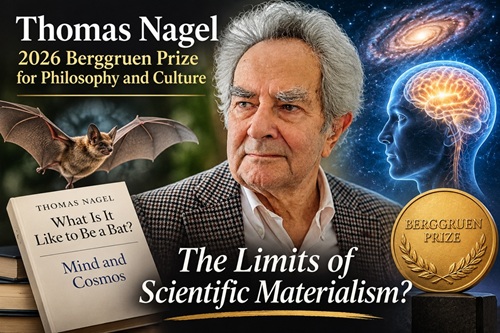 The announcement that American philosopher Thomas Nagel has received the 2026 Berggruen Prize for Philosophy and Culture is an occasion to revisit one of the most influential and controversial philosophical careers of the past half-century. The million-dollar prize, announced on November 17, recognizes Nagel's contributions to moral philosophy, political theory, metaphysics and, above all, the philosophy of mind. Nagel is perhaps best known for his celebrated 1974 essay "What Is It Like to Be a Bat?", which challenged the assumption that consciousness can be adequately understood through an exclusively objective, third-person scientific description. His subsequent work has repeatedly returned to the tension between subjective experience and the scientific picture of the universe. There is much to admire in this intellectual project. Nagel is a formidable analytical philosopher, a remarkably clear writer and an independent thinker who has never been particularly interested in following intellectual fashions. His insistence that consciousness, reason and moral experience deserve serious philosophical attention is entirely justified. Yet there is another side to Nagel's legacy. His dissatisfaction with scientific materialism has occasionally led him towards speculative metaphysical territory, most notably in his controversial 2012 book Mind and Cosmos: Why the Materialist Neo-Darwinian Conception of Nature Is Almost Certainly False.[1] Here, the critical question arises: When established scientific explanations appear incomplete, does that justify proposing a fundamentally different account of reality? Nagel's work is particularly interesting because it illustrates both the legitimate philosophical difficulties of reductionism and the dangers of treating those difficulties as evidence for a more expansive metaphysics. 1. The Bat That Changed PhilosophyNagel's 1974 essay, "What Is It Like to Be a Bat?", deserves its reputation. His central argument is deceptively simple. A bat experiences the world through echolocation, a sensory arrangement radically different from our own. We can investigate its nervous system, observe its behaviour, study its physiology and construct increasingly sophisticated models of its sensory processing. But do we thereby know what it is like to be a bat? Nagel argues that we do not. There is something essentially subjective about conscious experience that cannot simply be captured by an objective description of the organism. This is an important philosophical observation. Knowing everything about the physical processes associated with an experience does not automatically seem equivalent to knowing what that experience feels like. The distinction between third-person descriptions and first-person experience remains one of the central problems in consciousness research. However, Nagel's argument also has limitations. First, demonstrating that subjective experience cannot be translated without remainder into objective language does not demonstrate that subjective experience is nonphysical. It establishes an epistemological difficulty, not necessarily an ontological division. Second, our inability to imagine the subjective experience of another organism may tell us as much about the limitations of human imagination as it does about the nature of consciousness. Third, the fact that a scientific description does not reproduce an experience is hardly surprising. A description of digestion does not digest food, and a neurological account of pain does not itself hurt. The distinction between experiencing something and describing its physical basis is real. But it does not follow that the two belong to fundamentally different orders of reality. Nagel identified a problem that science cannot afford to ignore. He did not establish that science cannot eventually explain it. 2. The Problem with Mind and CosmosNagel's most controversial contribution is undoubtedly Mind and Cosmos (2012). Its subtitle is deliberately provocative: Why the Materialist Neo-Darwinian Conception of Nature Is Almost Certainly False. Nagel argues that the emergence of consciousness, rationality and moral understanding presents serious difficulties for conventional evolutionary explanations. He considers it implausible that these capacities could have emerged through the operation of physical processes alone, understood within the framework of contemporary evolutionary theory. Rather than accepting that consciousness and reason are accidental products of an essentially mindless universe, Nagel entertains the possibility that mind and value are fundamental features of reality. He also considers a form of natural teleology: the possibility that nature has an intrinsic tendency towards the emergence of increasingly complex forms of organization, eventually including conscious and rational beings. This is where his argument becomes problematic. Nagel is right to question whether our current scientific understanding provides a complete account of consciousness. He is also right that the origin of rationality and the emergence of moral values raise difficult philosophical questions. But he repeatedly moves from the limitations of existing explanations to the suggestion that an entirely different metaphysical framework may be necessary. The gap between these two positions is substantial. An incomplete explanation is not evidence for a particular alternative explanation. The fact that evolutionary theory does not yet provide a complete account of consciousness does not establish that nature possesses an intrinsic orientation towards consciousness. Indeed, the latter proposal introduces a new explanatory burden: what exactly is this teleological tendency, how does it operate, and what independent evidence supports its existence? Nagel recognizes that such a position would require a substantial revision of our understanding of nature. But recognizing the need for a new theory is not the same as providing one. 3. Teleology Without a Mechanism?The most interesting aspect of Nagel's argument is his willingness to reconsider teleology. Modern evolutionary biology generally explains the development of complex organisms through variation, inheritance, natural selection, genetic drift, developmental constraints and other evolutionary processes. These processes do not require evolution to have a predetermined destination. Nagel, however, considers whether the emergence of consciousness and rationality might be more than an accidental consequence of evolutionary history. Perhaps the universe possesses fundamental principles that make the emergence of such capacities more likely. This is a legitimate philosophical possibility to investigate. But it is also an extraordinarily difficult proposition to substantiate. What would count as evidence for it? If life emerges, teleology might be invoked as an explanation. If intelligence emerges, this could be presented as further confirmation. But if life fails to emerge elsewhere, or if evolution takes a radically different direction, how would the theory respond? Without independent criteria, teleology risks becoming a retrospective interpretation of whatever happens to have emerged. There is also a danger of confusing the fact that certain outcomes are possible with the claim that nature is somehow directed towards them. The emergence of human intelligence is remarkable. But its remarkable character does not establish that the universe was somehow predisposed to produce it. Nagel's proposal therefore encounters a familiar difficulty in the philosophy of science: how do we distinguish a genuinely explanatory principle from a metaphysical interpretation that merely redescribes the phenomenon? 4. Is Scientific Materialism Really So Inadequate?Nagel's critique of materialism is often presented as a challenge to the scientific worldview itself. But this risks creating a false opposition. Scientific materialism is not one unified doctrine. It encompasses different philosophical interpretations of the relationship between physical processes, consciousness and the natural world. Some philosophers defend reductive physicalism: ultimately, everything can be explained in terms of physical processes. Others defend nonreductive physicalism, emergentism, functionalism or various forms of naturalism that recognize the reality of consciousness without introducing supernatural entities. There are also approaches such as panpsychism, according to which consciousness, or something analogous to it, is a fundamental feature of matter. Nagel's dissatisfaction with reductionism does not automatically place him outside naturalism. Indeed, his search for a more comprehensive conception of nature is itself an attempt to remain within a naturalistic framework. This distinction matters. One can reject crude reductionism without rejecting evolutionary biology. One can acknowledge the explanatory difficulties of consciousness without assuming that Darwinian evolution is fundamentally mistaken. The real question is not whether current scientific theories answer every philosophical question. They plainly do not. It is whether Nagel has demonstrated that their limitations require the kind of metaphysical reconstruction he envisages. That remains doubtful. 5. The View from Nowhere: An Unattainable Ideal?Nagel's 1986 book The View from Nowhere is arguably his most comprehensive philosophical achievement. Its central concern is the tension between two perspectives on existence: the subjective standpoint from which each of us experiences the world and the objective standpoint from which we attempt to understand it independently of our individual position. We are simultaneously particular individuals with personal interests, desires and experiences, and observers capable of stepping back from those interests to consider the world impersonally. This tension has profound implications for ethics. Why should my interests count more than those of another person? Why should the fact that I happen to occupy a particular body, family, country or historical period determine the moral importance I assign to different individuals? Nagel explores the possibility of moving towards an increasingly objective understanding of morality without entirely eliminating the personal standpoint. This is an important contribution. It challenges both extreme individualism and the assumption that morality can be reduced to subjective preference. But the ideal of objectivity also deserves scrutiny. There is no guarantee that adopting a more detached perspective will automatically produce moral agreement. People can share a commitment to impartial reasoning while disagreeing profoundly about justice, equality, rights and obligations. Nor does the objective standpoint necessarily provide a final answer to moral conflicts. Nagel's philosophy is strongest when it identifies the tensions involved in human reasoning. It is less convincing when the possibility of objectivity appears to promise more philosophical resolution than it can actually deliver. The world may be viewed from increasingly comprehensive perspectives, but there is no reason to assume that these perspectives will eventually converge into one final, universally compelling standpoint. 6. Consciousness, Reason and the Evolutionary ChallengeOne of Nagel's recurring concerns is the relationship between the emergence of consciousness and the emergence of rationality. These are related but distinct problems. Consciousness concerns subjective experience: what it feels like to perceive, suffer, enjoy or think. Rationality concerns our capacity to form beliefs, assess evidence, recognize logical relationships and distinguish between better and worse arguments. Nagel questions whether an evolutionary process based entirely on physical causation can adequately explain the emergence of beings capable of discovering objective truths. His concern is that if our cognitive faculties are entirely the product of evolutionary pressures favouring survival and reproduction, why should we trust them to deliver knowledge about reality? This is an interesting philosophical challenge, but it is not a decisive argument against evolutionary explanations. Evolutionary pressures do not necessarily favour false beliefs over true ones. Organisms that accurately perceive their surroundings, recognize regularities and anticipate consequences can enjoy substantial survival advantages. Of course, evolution does not guarantee perfect reasoning. Human beings are susceptible to cognitive biases, irrational beliefs and systematic errors. But this is precisely why scientific methods, mathematical reasoning, experimentation and critical debate have become so important. Science is not simply the expression of evolved human intuition. It is a collective system for correcting the limitations of individual cognition. Nagel's argument also risks overlooking the possibility that rationality itself can be understood as an emergent capacity, developing gradually through biological, social and cultural evolution. The fact that a capacity emerges from earlier processes does not make it unreal or undermine its validity. A human being's ability to understand mathematics is not invalidated by the fact that mathematical reasoning depends on an evolved brain. The evolutionary origins of a cognitive capacity and the validity of the knowledge produced through that capacity are different questions. 7. Nagel and the Return of MetaphysicsThere is a broader intellectual significance to Nagel's work. For much of the twentieth century, philosophy was strongly influenced by scientific naturalism, logical analysis and the rejection of speculative metaphysical systems. Nagel has helped reopen questions that many philosophers considered either outdated or insufficiently grounded. What is consciousness? Is mind fundamental or emergent? Are moral values objective? Does the universe have an intrinsic direction? Can subjective experience ever be fully integrated into an objective understanding of reality? These are legitimate questions. They should not be dismissed simply because they are difficult. But the renewed interest in metaphysics also carries a danger: the tendency to fill explanatory gaps with increasingly elaborate philosophical constructions. This is particularly visible in contemporary discussions of consciousness, where physicalism, panpsychism, idealism, neutral monism and various forms of dual-aspect theory compete for attention. Nagel has shown sympathy for the possibility of a more unified metaphysics, including ideas with roots in Spinoza. His 2024 anniversary edition of "What Is It Like to Be a Bat?" revisits the relationship between subjective and physical reality in this context. The appeal of such approaches is understandable. They promise to overcome the apparent separation between mind and matter without simply reducing one to the other. But a unified metaphysical picture is not necessarily an explanatory achievement. Calling mind and matter two aspects of a deeper underlying reality does not tell us how consciousness emerges, how physical processes relate to subjective experience, or what empirical discoveries would support that interpretation. A philosophical framework can be intellectually attractive without being scientifically explanatory. This is a distinction that should be maintained throughout the contemporary debate. 8. The Difference Between an Unsolved Problem and a New OntologyPerhaps the most important criticism of Nagel concerns the standards of explanation he applies to competing worldviews. He is dissatisfied with the explanatory limitations of materialism. Fair enough. But what standards should we apply to the alternatives? A serious alternative theory should offer more than an evocative vocabulary. It should provide conceptual clarity, identify mechanisms where mechanisms are relevant, establish independent grounds for its central assumptions and ideally generate expectations that distinguish it from competing accounts. Nagel's natural teleology struggles with this test. If nature has an inherent tendency towards consciousness, what is the nature of that tendency? Is it a fundamental physical law, a metaphysical principle, a probabilistic bias or something else entirely? And how would we distinguish a universe possessing such a tendency from one in which consciousness emerges through ordinary evolutionary processes without any predetermined direction? These are not minor technical questions. They concern the very explanatory content of the proposal. There is a danger here of replacing one incomplete account with another that is even less developed. This criticism also applies to some contemporary philosophical and spiritual movements that invoke cosmic intelligence, universal consciousness, Eros, self-transcendence or intrinsic evolutionary purpose. They may identify genuine mysteries, but naming a mystery is not explaining it. Nagel is considerably more careful than many popular metaphysical writers. Nevertheless, his willingness to entertain teleological explanations illustrates how easily dissatisfaction with reductionism can encourage speculative alternatives. The appropriate response to an unresolved scientific problem is not to declare the scientific worldview defeated. It is to investigate the problem while remaining open to multiple possible solutions. 9. What the Berggruen Prize Actually RecognizesThe Berggruen Prize is not a scientific award for having solved the problem of consciousness. It recognizes philosophical contributions to human self-understanding and public culture. Nagel is a worthy recipient in that broader sense. His work has helped establish the philosophical importance of subjective experience at a time when the natural sciences have become increasingly powerful in explaining the physical world. He has also made significant contributions to ethics, political philosophy, equality, justice and the relationship between individual interests and public obligations. His intellectual independence is particularly commendable. He has been willing to challenge prevailing assumptions without simply adopting a religious or supernatural alternative. Yet the prize announcement also invites a closer examination of the intellectual culture surrounding consciousness. The Berggruen Institute describes Nagel's questions as relevant not only to contemporary philosophy but also to Vedic thinkers and potentially future artificial intelligences. This is an interesting attempt to connect different traditions of inquiry. However, such comparisons should not blur important distinctions between philosophical traditions, scientific hypotheses and metaphysical commitments. The fact that different traditions have pondered consciousness for centuries does not establish that they have arrived at compatible explanations. Nor does the unresolved nature of AI consciousness establish that machines will eventually possess subjective experience. Nagel himself has expressed strong scepticism about attributing consciousness to present AI systems and systems operating along similar lines. This is a position worth taking seriously, although the question remains open to scientific and philosophical investigation. His award therefore comes at an appropriate moment: consciousness has returned to the centre of intellectual debate, but the temptation to claim more knowledge than we actually possess is as strong as ever. 10. A Philosopher Worth Reading, but Not Necessarily FollowingThere is something refreshing about Nagel's intellectual temperament. He is neither a conventional scientific reductionist nor a religious apologist. He takes philosophical problems seriously, resists easy answers and is prepared to question assumptions shared by influential intellectual communities. His criticism of simplistic materialism deserves attention. His account of subjective experience remains indispensable to discussions of consciousness. His moral and political philosophy deserves to be read independently of his metaphysical speculations. But intellectual courage does not guarantee philosophical correctness. In particular, Mind and Cosmos demonstrates how a legitimate criticism of existing explanations can become an invitation to speculate beyond the available evidence. Nagel is right that consciousness presents a profound challenge to our understanding of nature. He is right that human rationality and moral awareness deserve more than dismissive evolutionary explanations. But he has not established that the universe possesses an intrinsic teleological tendency towards their emergence. The distinction between acknowledging an explanatory gap and filling it with a metaphysical hypothesis is crucial. Perhaps the most productive way to approach Nagel is therefore to separate his questions from his proposed answers. His questions are often excellent. His answers are sometimes considerably less convincing. Conclusion: Keeping the Mystery Without Inventing Its SolutionThomas Nagel's Berggruen Prize is well deserved as recognition of a lifetime of philosophical inquiry. Few contemporary philosophers have articulated the tension between subjective experience and objective understanding as clearly as he has. But his legacy should not be reduced to the popular interpretation that science cannot explain consciousness and therefore something beyond science must be involved. That conclusion does not follow. We should resist both extremes: the premature declaration that consciousness is nothing but neural activity and the equally premature declaration that it requires a fundamentally different ontology. There is a third possibility: that our present scientific and philosophical categories are inadequate, and that understanding consciousness will require conceptual developments we cannot yet anticipate. This is not an excuse for intellectual complacency. It is a reason to maintain rigorous standards of explanation. Nagel has made an important contribution by refusing to let the subjective dimension of existence disappear from philosophical discussion. But the next step is not necessarily to introduce cosmic purpose, teleology or a mind-like foundation of reality. It is to investigate what these proposals actually explain, what evidence supports them and how they compare with competing accounts. A mystery should stimulate inquiry, not become a licence for metaphysical invention. That, ultimately, is both the enduring value of Nagel's philosophy and the point at which his more speculative conclusions deserve the greatest scrutiny. Appendix: Thomas Nagel and Ken Wilber - An Unexpected Philosophical Affinity?At first sight, Thomas Nagel and Ken Wilber seem to belong to rather different intellectual worlds. Nagel is an academically established analytical philosopher, known for his rigorous arguments about consciousness, rationality and ethics. Wilber is an ambitious synthesizer of psychology, philosophy, spirituality and evolutionary thought, whose work has attracted a following in the Integral community. Yet there is an interesting philosophical affinity between them. Both are dissatisfied with a worldview in which objective physical reality is treated as the complete explanation of existence. Both regard consciousness as a fundamental philosophical problem rather than something that can simply be explained away by neuroscience. And both entertain the possibility that the evolution of the universe involves more than blind physical causation. This makes Nagel an interesting point of comparison for Wilber, particularly because Nagel arrives at some similar questions without adopting Wilber's elaborate spiritual framework. The resemblance, however, should not be exaggerated. Their philosophical ambitions, standards of argument and proposed solutions differ considerably. 1. The shared suspicion of reductionismNagel and Wilber both reject the idea that reality can be adequately understood by describing its externally observable physical properties alone. Nagel's argument is that consciousness, rationality and objective value cannot simply be fitted into a reductive materialist worldview. His Mind and Cosmos argues that a satisfactory conception of nature must account for the emergence of subjective experience and rational thought. Wilber makes a comparable argument through his distinction between the interior and exterior dimensions of existence. His four-quadrant model insists that subjective experience (I), intersubjective culture (We), objective behaviour (It) and social systems (Its) are irreducible perspectives on reality. Both therefore resist what Wilber calls Flatland: a worldview that recognizes only the exterior, measurable dimensions of existence. There is a genuine philosophical point of contact here. Neither thinker is satisfied with treating consciousness as an incidental by-product of an otherwise mindless universe. But there is an important difference. Nagel approaches this problem through analytical philosophy and the limitations of physical explanation. Wilber embeds it within a much larger metaphysical architecture that includes developmental stages, transpersonal consciousness and nondual Spirit. 2. Natural teleology versus Eros in the KosmosThe strongest affinity concerns evolution. Nagel entertains the possibility of natural teleology: an intrinsic tendency within nature towards the emergence of life, consciousness and eventually rationality. Wilber's corresponding concept is Eros in the Kosmos. According to Wilber, evolution is not merely the result of random variation and natural selection. There is an inherent creative drive in the universe towards increasing complexity, consciousness and depth.
Both are dissatisfied with an evolutionary account that lacks an intrinsic direction towards consciousness. Yet their differences are just as important. Nagel does not propose a spiritual force guiding evolution. His natural teleology is an attempt to expand naturalism, not replace it with a doctrine of cosmic Spirit. Wilber, on the other hand, explicitly interprets evolutionary creativity in spiritual terms. Eros is not merely a philosophical possibility but a central explanatory principle of his entire worldview. Nagel's proposal is speculative enough. Wilber takes the speculation considerably further. 3. The mind-body problem: A particularly revealing connectionThere is another interesting affinity concerning the relationship between mind and matter. Nagel has explored alternatives to both reductive materialism and traditional Cartesian dualism, including neutral monism and double-aspect approaches. Wilber has developed his own version of a double-aspect approach, which he calls pan-interiorism. Physical reality has an exterior dimension and an interior dimension, extending throughout the Kosmos. In Integral Psychology (2000), Wilber presented this as part of his attempt to address the mind-body problem. The similarity is worth exploring, but there is a substantial difference in explanatory ambition. Nagel carefully identifies the problem of how subjective experience relates to physical reality. Wilber incorporates the problem into a comprehensive metaphysical system in which Spirit is the ultimate ground of both dimensions. But does this actually explain the relationship? As I argued in my earlier essay, Biased toward the Marvelous?: Integral Reflections on Thomas Nagel's Mind and Cosmos, postulating a third underlying reality does not automatically explain how its mental and physical aspects relate.[1] Calling that underlying reality Spirit does not solve the explanatory problem. Nor does distributing interiority throughout the universe explain how complex conscious experience emerges from simpler forms of existence. Both thinkers identify an important philosophical difficulty. Neither provides a generally accepted solution to it. 4. Where Nagel stops and Wilber takes offPerhaps the most important distinction concerns intellectual restraint. Nagel is an atheist who explicitly resists the idea that dissatisfaction with materialism should lead us towards traditional religious explanations. He does not claim to possess a complete alternative worldview. Indeed, one of the interesting features of Mind and Cosmos is that Nagel acknowledges the speculative nature of his proposals. Wilber is much more ambitious. His Integral Theory attempts to incorporate virtually every major domain of human knowledge into one comprehensive framework. Evolution is interpreted as a spiritual process, consciousness develops through recognizable stages, and the entire Kosmos is understood as an expression of nondual Spirit. This creates a fundamental difference in their respective burdens of proof. Nagel asks whether materialism can adequately explain consciousness and whether natural teleology deserves serious consideration. Wilber goes further and presents a detailed account of what this cosmic development supposedly looks like. But the more elaborate the system, the greater the explanatory burden. Wilber's Eros, for example, needs to explain more than the mere existence of evolutionary complexity. It must account for its alleged directionality, its mechanisms and its relationship to established evolutionary science. In my critical examination of Wilber's relationship with evolutionary biology, I have repeatedly argued that this is precisely where Integral Theory falls short. Nagel's questions do not validate Wilber's answers. 5. Would Nagel have been a useful philosophical ally for Wilber?Interestingly, I raised precisely this question in my earlier essay What's It Like to Be a Super-Nova?, a critique of Wilber's approach to the mind-body problem.[2] I found it surprising that Wilber had not engaged more seriously with Nagel's work. Here was a highly respected analytical philosopher questioning reductive materialism, defending the irreducibility of consciousness and exploring alternatives to conventional physicalism. For Wilber, Nagel could have been a valuable intellectual interlocutor. But there is a complication. Nagel's criticisms of materialism do not amount to an endorsement of Integral Theory. Nor does his willingness to entertain natural teleology establish that Wilber's Eros hypothesis is correct. In fact, a serious encounter between the two might have been rather uncomfortable for Wilber. Nagel's philosophical approach would demand greater conceptual precision, a clearer distinction between hypothesis and established knowledge, and a more convincing account of how proposed principles actually operate. These are precisely the areas in which Wilber's evolutionary metaphysics has attracted substantial criticism. 6. The danger of turning philosophical affinity into confirmationThere is a broader lesson here for the Integral community. When an academically respected philosopher such as Nagel questions scientific materialism, it is tempting to present his work as independent confirmation of Integral Theory. But this would be an intellectual mistake. Nagel's arguments should be evaluated on their own merits. His philosophical objections to reductionism do not become stronger because they resemble Wilber's ideas. And Wilber's ideas do not become scientifically credible simply because a distinguished philosopher has independently entertained related possibilities. There is a difference between two thinkers arriving at similar questions and one thinker providing evidence for the other's answers. This distinction is particularly important when discussing Eros, cosmic purpose and evolutionary directionality. Philosophical resemblance is not empirical confirmation. Conclusion: An Alliance of Questions, Not of AnswersThomas Nagel and Ken Wilber share an important philosophical concern: how can consciousness, rationality and value be accommodated within our understanding of the natural world? Both reject simplistic reductionism. Both are dissatisfied with an exclusively external description of reality. Both entertain the possibility that the emergence of consciousness is not adequately explained by conventional materialist accounts. But their intellectual projects diverge considerably. Nagel is a philosopher exploring the limits of our present understanding. Wilber is a system-builder proposing a comprehensive spiritual interpretation of existence. The former leaves many questions open. The latter often presents answers that go considerably beyond what the available evidence warrants. For Integral Theory, Nagel represents an interesting potential ally, but also a challenge. His work could help sharpen the philosophical foundations of an integral understanding of consciousness. It could equally expose the speculative character of its evolutionary metaphysics. My conclusion is therefore somewhat paradoxical: Nagel lends intellectual respectability to some of the questions Wilber raises, but he does not provide the scientific or philosophical justification for Wilber's answers. That is a distinction the Integral community would do well to appreciate. NOTES[1] Frank Visser, Biased Toward the Marvelous? Integral Reflections on Thomas Nagel's Mind and Cosmos, April 2014. [2] Frank Visser, What's It Like to Be a Super-Nova?, Ken Wilber's Cosmic Approach to the Mind-Body Problem, May 2017. Comment Form is loading comments...
|