|
TRANSLATE THIS ARTICLE
Integral World: Exploring Theories of Everything
An independent forum for a critical discussion of the integral philosophy of Ken Wilber
  Frank Visser, graduated as a psychologist of culture and religion, founded IntegralWorld in 1997. He worked as production manager for various publishing houses and as service manager for various internet companies and lives in Amsterdam. Books: Ken Wilber: Thought as Passion (SUNY, 2003), and The Corona Conspiracy: Combatting Disinformation about the Coronavirus (Kindle, 2020).
Check out my other conversations with ChatGPT The Western Contrarians: How Can Anyone Still Support Putin?The Moral Bankruptcy of Anti-Western Contrarianism in the Ukraine WarFrank Visser / ChatGPT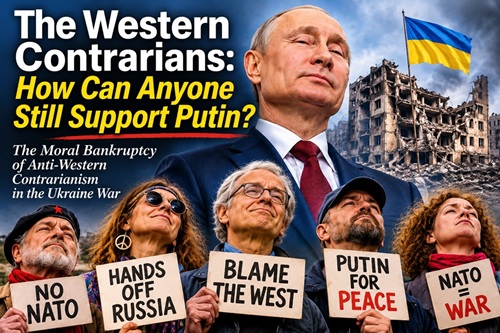 It is one of the most astonishing features of the Russian invasion of Ukraine that Vladimir Putin, a political leader responsible for enormous human suffering, widespread destruction, mass displacement and the deaths of countless people, can still count on enthusiastic defenders in Western intellectual, political and alternative-media circles. These are not necessarily people who have any particular affection for Russia, Russian culture or the Russian people. Many are simply united by something else: their opposition to the United States, NATO, liberal democracy, Western political institutions or what they perceive as Western ideological hegemony. But how does opposition to the West turn into apologetics for Putin? How can people who claim to be independent thinkers, critical intellectuals and opponents of imperialism become so accommodating toward an authoritarian ruler waging an imperialist war of conquest? The answer has much to do with the psychology of contrarianism, ideological tribalism, selective moral indignation and the peculiar intellectual satisfaction of believing that one sees through everything that supposedly ordinary people fail to understand. The problem is not criticism of Western foreign policy. Such criticism is often justified and necessary. The problem begins when criticism becomes a substitute for independent moral and political judgment. 1. When Opposition to the West Becomes Support for Its OpponentsWestern contrarianism is not a single political movement. It encompasses parts of the radical left, the populist right, anti-globalist movements, conspiracy-oriented media, certain nationalist intellectual circles and sections of the alternative spiritual and integral communities. Their political backgrounds differ considerably, but a recurring pattern connects them: the United States and its allies are regarded as the primary source of international instability, while countries opposing Western influence are treated with disproportionate sympathy. This produces a peculiar reversal of moral priorities. Russia's invasion becomes secondary to the supposedly more fundamental question of NATO expansion, American imperialism, Western hypocrisy or the decline of a US-dominated international order. Instead of beginning with the elementary question of what Russia has done to Ukraine, these commentators begin by asking what the West has done to Russia. That question is not illegitimate. Historical context matters. NATO enlargement, the collapse of the Soviet Union, Western interventions and the changing European security architecture deserve serious examination. But none of these subjects establishes a Russian entitlement to invade a sovereign neighbouring country. Explaining the historical circumstances of a conflict is not the same as justifying the actions of its aggressor. Unfortunately, this distinction is frequently lost in contrarian commentary. The result is an intellectual sleight of hand: the responsibility of the invading power is displaced onto the geopolitical environment in which it operates. 2. The Whataboutism TrapOne of the most persistent characteristics of pro-Putin Western commentary is whataboutism. Whenever Russian atrocities, attacks on civilian infrastructure, the destruction of Ukrainian cities, deportations or alleged war crimes are discussed, the response often follows a familiar script: What about Iraq? What about Libya? What about Afghanistan? What about American drone strikes? What about NATO's bombing of Serbia? What about Western support for Israel? These are legitimate subjects for criticism. The United States and its allies have committed serious violations of international law, and their political leaders should be held accountable. But why should these historical wrongs diminish Russia's responsibility for its own actions? If the invasion of Iraq was illegal, that does not make the invasion of Ukraine legal. If NATO committed mistakes or violations, that does not give Putin a licence to destroy Ukrainian cities. If Washington applies international law selectively, Moscow's selective application does not become morally defensible. Indeed, the logical conclusion should be the opposite: we should consistently oppose imperialism, aggression and violations of sovereignty, regardless of who commits them. The whataboutist does something different. Rather than applying a consistent standard, he uses one country's wrongdoing to reduce the significance of another country's wrongdoing. This is not moral consistency. It is moral bookkeeping. 3. The Illusion of Geopolitical SophisticationA particularly influential argument among Western contrarians is that they understand geopolitics better than ordinary commentators. They invoke realism, balance-of-power theory, spheres of influence, security dilemmas, historical grievances and great-power competition. They quote John Mearsheimer, criticize liberal internationalism and explain that small countries cannot simply choose their own geopolitical orientation without considering the interests of their powerful neighbours. There is a serious intellectual tradition behind geopolitical realism. States do pursue interests, security concerns influence foreign policy, and great powers frequently behave coercively. But realism is an analytical framework, not a moral exemption. Understanding why a powerful state regards a neighbouring country as strategically important does not establish that the powerful state owns that country. Nor does understanding the security calculations of an authoritarian ruler require accepting his preferred political outcome. There is also a remarkable asymmetry in some realist arguments. Russia's security concerns are treated as objective geopolitical necessities, while Ukraine's security concerns and national aspirations are dismissed as Western manipulation. Why should Russia's desire for strategic depth count more than Ukraine's desire for independence? Why should Moscow's historical anxieties determine the political future of Kyiv? The sovereignty of smaller countries cannot be reduced to the convenience of larger ones without effectively returning to a nineteenth-century conception of international politics. The sophisticated geopolitical explanation can therefore conceal a remarkably primitive political assumption: might makes right. 4. The Enemy of My EnemyAnother important psychological mechanism is political tribalism. For certain Western commentators, Putin has become valuable not because of what he represents positively, but because of what he opposes. He challenges Washington, criticizes liberal democracy, rejects Western cultural trends and presents himself as a defender of traditional values and national sovereignty. This makes him useful as a symbolic counterweight to everything these commentators dislike about contemporary Western society. The contradictions are considerable. Putin presides over an authoritarian political system characterized by the suppression of opposition, restrictions on independent media, political repression and the concentration of power. His government promotes nationalism, militarism and a hierarchical conception of international relations. Yet some Western anti-authoritarians find reasons to accommodate his authoritarianism. Some Western nationalists admire his nationalism. Some anti-imperialists defend his imperial ambitions. Some opponents of Western militarism excuse Russian militarism. The explanation is not necessarily that these people have abandoned their principles consciously. It is that their principles have become subordinate to a more powerful identity: opposition to the political camp they regard as their principal enemy. Once that happens, political judgment becomes tribal. The actions of one's opponents are scrutinized, while the actions of one's allies are rationalized. Putin benefits from this psychological arrangement. 5. The Strange Alliance Between Left and RightOne of the more remarkable developments of the Ukraine war is the convergence of otherwise incompatible political movements around pro-Russian narratives. On the radical left, some commentators interpret the war almost exclusively through the history of American imperialism and NATO expansion. They regard support for Ukraine as an extension of Western power politics. On the populist and radical right, admiration for Putin can be connected to nationalism, hostility toward liberal institutions, opposition to multiculturalism and the appeal of strongman leadership. These groups disagree about much of domestic and international politics. But they can converge around the proposition that the West is the principal culprit and that resistance to Western hegemony deserves sympathy. This convergence is not evidence of a coherent alternative political philosophy. It is a coalition of negative identities. What unites its members is often less a shared vision of a desirable international order than a shared list of enemies. The irony is that their positions can end up reinforcing one another. The radical left supplies the vocabulary of anti-imperialism, while the radical right supplies admiration for nationalist authoritarianism. Both can arrive at the same practical conclusion: Ukraine should not receive the support it needs to resist Russian aggression. For Ukrainians, the ideological differences between these Western camps offer little consolation. 6. The Conspiracy Mentality and the Search for Hidden MastersA further element is the attraction of conspiratorial explanations. The war is presented as something secretly orchestrated by Washington, NATO, the arms industry, global financial interests, neoconservatives or some combination of these actors. Ukraine itself becomes a puppet, its government a Western installation and its population an instrument in a larger geopolitical game. There may be Western interests involved in the conflict, and Western governments certainly pursue their own strategic objectives. But the existence of such interests does not demonstrate that Ukrainians lack political agency. This is an especially revealing feature of pro-Putin commentary: the Ukrainian people are repeatedly denied the capacity to make independent political choices. Their opposition to Russian domination is interpreted as the product of propaganda, manipulation or foreign interference rather than as an expression of national self-determination. The irony is profound. People who pride themselves on questioning dominant narratives accept, often uncritically, the Russian narrative that Ukraine is not a fully independent political community. The conspiracy framework also has a convenient feature: it is remarkably resistant to contrary evidence. Every development can be incorporated into the theory. Ukrainian resistance proves Western involvement; Russian setbacks prove NATO escalation; Western military assistance proves that the war was planned all along. A worldview that can explain every possible outcome risks explaining nothing. 7. The Selective Compassion ProblemPerhaps the most disturbing feature of Western pro-Putin commentary is its selective compassion. These commentators often express considerable concern about the deaths of Russian soldiers, the economic consequences of sanctions, the humiliation of Russia or the danger of escalation. These concerns are not inherently illegitimate. Russian soldiers are human beings, and the danger of a wider war is real. But where is the equivalent concern for Ukrainian civilians? Where is the sustained attention to the people driven from their homes, the families separated by the invasion, the children affected by deportations, the communities destroyed by bombardment and the population forced to live under the threat of further Russian attacks? Why does the suffering of Ukrainians so frequently become an incidental detail in geopolitical commentary? The answer is partly ideological distance. Ukraine's suffering does not fit the preferred narrative as conveniently as Western wrongdoing or Russian security concerns. There is also a disturbing tendency to treat Ukrainian resistance itself as the cause of continued suffering. If only Ukraine would negotiate, accept territorial losses or abandon its Western orientation, the argument goes, the killing could stop. But this reverses the moral sequence. It places the burden of ending the war on the victim rather than on the power that initiated the invasion. Peace cannot be reduced to the absence of resistance. A population can be forced into silence, occupation and submission, but that is not necessarily peace. 8. The Moral Equivalence FallacyWestern contrarians frequently insist that both sides are responsible, that neither side is innocent and that the truth lies somewhere in the middle. At one level, this is uncontroversial. No country is beyond criticism, and Ukrainian conduct should not be exempt from scrutiny. But the assertion that both sides have committed wrongs does not establish equal responsibility for the war. There is a fundamental distinction between a country invading another and a country defending itself against that invasion. The two parties do not occupy equivalent positions simply because both have military forces, political interests and propaganda systems. Nor does recognizing Ukrainian mistakes require minimizing Russian aggression. Moral equivalence can become a particularly sophisticated form of evasion because it presents itself as impartiality. Yet impartiality does not mean refusing to distinguish between aggressor and victim. A genuinely independent observer should be willing to make precisely that distinction. 9. The Test of ConsistencyThere is a simple way to test the principles of Western contrarians. Would they accept that the United States has the right to invade Mexico because it considers Chinese influence there a security threat? Would they accept that China can invade Taiwan because it regards the island as historically belonging to its sphere of influence? Would they accept that a powerful neighbouring country can determine the political orientation of a smaller one through military intimidation? If not, why should Russia receive an exemption? The principle of sovereignty cannot depend on which great power is exercising coercion. Nor can opposition to imperialism be restricted to Western imperialism. The test is not whether one supports Washington or Moscow. It is whether one applies the same standards to both. That is what intellectual independence should mean. 10. Contrarianism Is Not Critical ThinkingThere is a final point worth emphasizing. Being against the mainstream does not automatically make someone intellectually independent. Contrarianism can become just another form of conformity, with its own approved sources, authorities, vocabulary and taboos. The contrarian may believe he is resisting propaganda while absorbing a different propaganda system. Indeed, the feeling of possessing forbidden knowledge can be intellectually intoxicating. It offers a sense of superiority: while ordinary people are supposedly manipulated by mainstream media, the contrarian has discovered the hidden geopolitical truth. But critical thinking is not measured by how frequently one disagrees with established opinion. It is measured by the quality of one's evidence, the consistency of one's reasoning and one's willingness to revise conclusions when confronted with contrary facts. Sometimes the mainstream position is correct. Sometimes the alternative position is correct. Neither should be accepted or rejected merely because of its position in the political spectrum. The real test is whether the argument survives scrutiny. Conclusion: Beyond Anti-Western ReflexesThe Western defenders of Putin present a challenge not only to our understanding of the Ukraine war but also to our understanding of intellectual independence. They remind us that political judgment can be distorted by ideological loyalties even among people who consider themselves critical thinkers. They show how opposition to one form of imperialism can turn into accommodation with another, how geopolitical sophistication can obscure elementary moral distinctions, and how the language of peace can be used to justify the subordination of an invaded country. None of this requires uncritical support for the United States, NATO or the Ukrainian government. Western foreign policy deserves scrutiny. NATO's history deserves examination. Ukrainian political decisions can be debated. Negotiations should remain possible. But these considerations should not obscure the central fact: Russia launched a full-scale invasion of Ukraine in February 2022, violating its sovereignty and international law. The immense human cost of that decision cannot be dissolved into an abstract discussion of geopolitical chess. The most fundamental question is not whether one is pro-Western or anti-Western. It is whether one is prepared to defend the right of a nation to exist independently, even when doing so conflicts with the strategic preferences of a great power. A genuine critic of Western imperialism should have no difficulty condemning Russian imperialism. A genuine opponent of militarism should have no difficulty condemning Putin's war. And a genuine advocate of peace should understand that peace without freedom and security for the invaded population can amount to little more than the institutionalization of conquest. The tragedy of Western contrarianism is that some of its most vocal representatives have become so preoccupied with exposing Western hypocrisy that they have lost sight of the people actually being bombed. They wanted to see through Western propaganda. Some have ended up seeing through Ukrainian suffering as well. Comment Form is loading comments...
|