|
TRANSLATE THIS ARTICLE
Integral World: Exploring Theories of Everything
An independent forum for a critical discussion of the integral philosophy of Ken Wilber
  Frank Visser, graduated as a psychologist of culture and religion, founded IntegralWorld in 1997. He worked as production manager for various publishing houses and as service manager for various internet companies and lives in Amsterdam. Books: Ken Wilber: Thought as Passion (SUNY, 2003), and The Corona Conspiracy: Combatting Disinformation about the Coronavirus (Kindle, 2020).
Check out my other conversations with ChatGPT The New Axis of AuthoritarianismRussia, China, Iran and North KoreaWhat Holds These Regimes Together, and Where Do Their Interests Diverge?Frank Visser / ChatGPT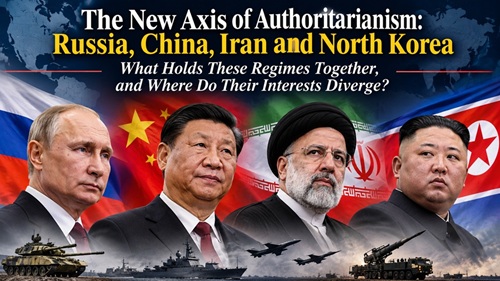 Introduction: An Alliance of ConvenienceA new geopolitical alignment is reshaping the international order. Russia, China, Iran and North Korea are increasingly cooperating in opposition to the Western-led international system. Their relationship is sometimes described as an emerging authoritarian axis, a coalition of dictatorships, or even a new version of the Axis powers of the Second World War. The comparison with Nazi Germany, Fascist Italy and Imperial Japan should not be taken literally. The contemporary grouping has no equivalent of a unified military command, no common ideology in the strict sense, and no comprehensive treaty binding its members into a single strategic enterprise. Nevertheless, something significant is happening. Four governments with different histories, political systems, ambitions and regional priorities are discovering that cooperation offers them advantages that they cannot easily obtain individually. Russia needs military supplies and diplomatic support for its war against Ukraine. China wants to weaken American predominance and reshape the international order without provoking a confrontation that could undermine its economic development. Iran seeks regional influence, regime survival and protection against American and Israeli pressure. North Korea wants economic assistance, advanced military technology, diplomatic recognition and greater freedom to pursue its nuclear ambitions. What unites these countries is not so much a shared vision of the future as a shared dissatisfaction with the present international order. They oppose Western sanctions, resist American influence, reject the universality of Western democratic norms and increasingly regard one another as useful strategic partners. But an important distinction must be made: an alliance against a common adversary is not necessarily an alliance for a common purpose. 1. Four Regimes, Four Different AgendasTo understand this alignment, we must first distinguish the political and geopolitical interests of its members. They are not interchangeable dictatorships pursuing an identical project. Russia: Restoring Great-Power StatusUnder Vladimir Putin, Russia has increasingly defined its international position in opposition to the Western political and security order. The Kremlin regards the expansion of Western institutions, particularly NATO and the European Union, as a threat to its influence in what it considers its traditional sphere of interest. The invasion of Ukraine in February 2022 accelerated this confrontation. Moscow expected a relatively quick military victory but instead found itself engaged in a prolonged war, facing extensive Western sanctions and growing international isolation. Russia's partnerships with China, Iran and North Korea have consequently become much more important. Iran supplied the Shahed drones that became a major component of Russia's attacks on Ukrainian cities and infrastructure. North Korea supplied enormous quantities of ammunition and ballistic missiles and subsequently deployed troops to support Russian operations. China became Russia's indispensable economic partner, purchasing energy and supplying industrial goods, electronics and dual-use components that help sustain its military-industrial complex. The relationship with Beijing is particularly important. Russia has become increasingly dependent on China, a reversal of the traditional relationship between the two communist powers during much of the twentieth century. Putin may present this cooperation as evidence of a multipolar world emerging from Western dominance. In reality, it also reveals Russia's growing dependence on countries that have their own strategic agendas. China: The Architect of a Different World OrderChina's position is fundamentally different. Under Xi Jinping, Beijing seeks to become the dominant power in East Asia and a leading global power, capable of challenging American economic, technological and military predominance. China does not necessarily want to destroy the international economic system. It has benefited enormously from globalization, international trade and access to Western markets. Its ambition is better understood as an attempt to reshape the existing order so that Chinese interests and political principles receive greater recognition. Beijing opposes American military alliances in its immediate neighborhood, supports Russia's objections to Western strategic dominance and rejects Western criticism of its domestic political system. Yet China is also cautious. It has little interest in being dragged into Russia's war against Ukraine or a direct military confrontation with the United States. Its economic prosperity depends on international stability, access to markets and technological development. This creates an important contradiction. China benefits from Russia remaining a strategic counterweight to the United States, but it does not necessarily benefit from a Russian defeat turning the country into a failed state, nor from an escalation that threatens global economic stability. China is therefore the most powerful member of this emerging alignment, but also the most calculating. It wants the advantages of cooperation without accepting all its risks. Iran: Regional Hegemony and Regime SurvivalIran's motivations are different again. The Islamic Republic is an ideological theocracy whose foreign policy combines revolutionary religious principles, regional power ambitions and the practical necessity of regime survival. Since the 1979 revolution, the Iranian leadership has regarded the United States and Israel as its principal adversaries. It has developed a network of regional partners and armed organizations to extend its influence and deter attacks against Iranian territory. Its relationship with Russia has become particularly important since the invasion of Ukraine. Both countries face Western sanctions, both have an interest in weakening American influence, and both have developed military cooperation. Iran also has a substantial economic relationship with China, particularly through energy exports. Beijing offers Tehran an important economic outlet, although China is careful not to sacrifice its broader Middle Eastern interests for the sake of the Iranian regime. Iran's position is nevertheless vulnerable. Its regional strategy has faced serious setbacks, its economy has suffered from sanctions and domestic mismanagement, and its confrontation with Israel and the United States has exposed the limitations of its military capabilities. For Tehran, the authoritarian alignment is primarily a means of survival and regional influence. It is not an end in itself. North Korea: The Opportunistic Nuclear StateNorth Korea under Kim Jong Un is perhaps the most isolated and unpredictable member of this grouping. Its central objectives are regime survival, nuclear deterrence, military modernization and the preservation of its independence from external pressure. Unlike China, North Korea has little to lose from a confrontation with the Western-led international system. Its economy is already severely isolated, and its leadership has made the maintenance of its political system its overriding priority. Russia's war against Ukraine has created an extraordinary opportunity for Pyongyang. By supplying Moscow with ammunition, missiles and military personnel, North Korea has obtained money, diplomatic support, battlefield experience and potentially valuable military technology in return. The 2024 comprehensive strategic partnership treaty between Russia and North Korea includes a mutual military assistance commitment in the event of an armed attack. This makes their relationship considerably more substantial than a simple exchange of weapons. North Korea may also benefit from Russian assistance with satellite technology, missile development and other advanced military capabilities. For Kim, however, the relationship with Moscow is not simply about supporting Russia. It is about improving North Korea's own strategic position, including its ability to threaten South Korea, Japan and American forces in the region. 2. What Holds Them Together?Despite their differences, several common interests explain the growing cooperation. Opposition to American PredominanceThe most important connecting factor is their opposition to American global leadership. All four governments see the United States as an obstacle to their strategic ambitions. They oppose American military alliances, sanctions, diplomatic pressure and the international institutions through which Washington exercises influence. This does not mean they have identical views of the United States. China regards America as its principal systemic competitor; Russia sees it as the leading obstacle to its ambitions in Europe; Iran considers it a major threat to the Islamic Republic; and North Korea regards American military power as the principal external danger to its survival. Their common denominator is the desire to reduce American influence and increase their own freedom of action. Regime Survival and Resistance to Democratic PressureA second connecting factor is the survival of authoritarian political systems. All four governments reject the idea that their domestic political arrangements should be subject to external democratic scrutiny. They regard Western criticism of political repression, censorship, human rights violations and electoral manipulation as interference in their internal affairs. Their preferred international order emphasizes state sovereignty and non-interference, although their own behavior frequently contradicts those principles when territorial expansion or regional intervention serves their interests. This is an important ideological connection. It is not a coherent political philosophy, but a shared defensive position against external pressure for political change. Economic and Military ComplementarityThe four countries also possess resources that can be exchanged. China provides economic opportunities, industrial capacity, technology and diplomatic influence. Russia supplies energy, military expertise and access to strategic resources. Iran offers drone technology, missile expertise and regional networks. North Korea provides ammunition, missiles and, increasingly, manpower. The Ukraine war has demonstrated how these complementary capabilities can be combined. What began as separate bilateral relationships has developed into a wider network of military and economic cooperation. The resulting system makes it more difficult for Western sanctions and diplomatic isolation to achieve their intended effects. Sanctions Evasion and Alternative Financial NetworksAll four countries have strong incentives to reduce their vulnerability to Western financial pressure. They have developed alternative trading arrangements, payment mechanisms, shipping networks and intermediaries. China is especially important because of its economic scale and its position in international manufacturing and trade. This does not mean that the four countries have established an entirely independent economic system. They remain connected to global markets, and China in particular has much to lose from a complete economic separation from the West. Nevertheless, their cooperation makes economic isolation less effective than it would otherwise be. 3. The Military Dimension: Cooperation Without a Unified CommandThe military dimension deserves particular attention because it is where the consequences of this alignment are most visible. Russia's war against Ukraine has become a laboratory for military cooperation between authoritarian states. Iranian drone technology, North Korean ammunition and missiles, Chinese industrial supplies and Russian battlefield experience have contributed to a sustained war effort. The cooperation is not merely symbolic. It involves weapons transfers, technological exchanges, military exercises, intelligence cooperation and the development of strategic partnerships. Yet it is important not to exaggerate its institutional coherence. The four countries do not possess a NATO-style integrated command structure. They have no common military doctrine, no unified strategic planning organization and no general mutual-defense treaty binding all four together. Their cooperation is predominantly bilateral or trilateral. The distinction is important. Russia and North Korea have a mutual-defense commitment. Russia and Iran have a strategic partnership agreement, but not an equivalent automatic military intervention clause. The Russian-Chinese relationship, despite its extraordinary closeness, also stops short of a formal mutual-defense alliance. The four countries may coordinate their activities when their interests coincide, but they retain considerable freedom to stay out of one another's conflicts. This flexibility is not necessarily a weakness. It allows them to cooperate without assuming the obligations and risks of a formal military alliance. It also makes their intentions less predictable. 4. Where Their Interests DivergeThe apparent unity of the authoritarian alignment conceals several important contradictions. China Does Not Want Russia to Become Its EqualThe relationship between Moscow and Beijing is increasingly asymmetric. Russia needs China more than China needs Russia. Beijing can purchase Russian energy at advantageous prices, gain access to strategic resources and benefit from Moscow's willingness to challenge American power. But China has little reason to accept Russian geopolitical ambitions as its own. It does not want to become responsible for Russia's military adventures, and it has no interest in sacrificing its economic relationships with Europe and the United States simply to rescue Putin from the consequences of his invasion of Ukraine. Russia, meanwhile, is unlikely to welcome a permanent junior position in a Chinese-dominated international order. Its great-power identity and historical ambitions are difficult to reconcile with long-term dependence on Beijing. Their partnership is therefore strong but structurally unequal. China and Iran: Strategic Friendship, Economic CautionChina's relationship with Iran illustrates the limitations of the alignment particularly clearly. Beijing wants access to Iranian energy and values Tehran as a strategic partner. But it also maintains important economic and diplomatic relationships with Saudi Arabia, the United Arab Emirates and other Gulf states. China's interests are therefore much broader than Iran's. It wants stability in the Persian Gulf, uninterrupted energy supplies and access to markets. It has no obvious interest in becoming militarily entangled in an Iranian confrontation with Israel or the United States. Tehran might expect more solidarity from Beijing than Beijing is willing to provide. Russia and Iran: Partners, but Also CompetitorsRussia and Iran have cooperated closely, particularly in Syria and Ukraine, but their interests are not identical. Both are major energy exporters and can compete for markets, especially when sanctions restrict their access to international customers. Their regional interests can also diverge. Russia has historically maintained relationships with Israel and several Arab states, while Iran has pursued an openly confrontational regional strategy. Moscow values Tehran's military assistance, but it does not necessarily share Iran's ideological hostility toward Israel or its ambitions for regional dominance. Their relationship is consequently pragmatic rather than based on deep ideological solidarity. North Korea Is Not a Dependable Junior PartnerNorth Korea's relationship with Russia may be the most transactional of all. Kim Jong Un has found an opportunity to exchange military supplies for economic benefits, diplomatic protection and technological assistance. But Pyongyang's overriding concern remains its own security. It will not automatically support Russian or Chinese objectives when these conflict with its immediate interests. Indeed, North Korea's nuclear ambitions and its unpredictable behavior can create serious problems for Beijing, which would prefer stability on the Korean Peninsula. China wants influence over North Korea, but it does not have complete control over Kim Jong Un. This is an important distinction between the authoritarian alignment and a disciplined alliance: the participants can cooperate while remaining deeply suspicious of one another. 5. The Strategic Danger: Opportunistic AggressionThe greatest danger of this emerging alignment may not be a coordinated attack by all four countries. It may be the possibility that their separate conflicts reinforce one another. Consider a hypothetical crisis in the Taiwan Strait. If China were to use military force against Taiwan, the United States and its allies would have to concentrate enormous diplomatic, military and economic resources on East Asia. Russia might see an opportunity to increase pressure on Europe or intensify its military operations against Ukraine. North Korea could exploit the distraction to escalate tensions on the Korean Peninsula. Iran could intensify its regional activities or threaten shipping routes in the Middle East. Such developments would not require a formal agreement between the four governments. Each could independently exploit the strategic distraction created by another's actions. This is sometimes called opportunistic aggression: the exploitation of a crisis in one region to pursue objectives in another. The reverse is also possible. A crisis involving Russia could create opportunities for China in East Asia, while an Iranian confrontation could divert American resources away from Europe or the Indo-Pacific. The resulting challenge for Western governments is considerable. They must prepare for the possibility of simultaneous or overlapping crises without assuming that the four authoritarian powers are operating under a single master plan. 6. The West's Strategic DilemmaHow should Western democracies respond to this development? The first mistake would be to treat the four countries as an indivisible bloc. Doing so risks exaggerating their unity and overlooking opportunities to exploit their differences. China is economically much more exposed to Western pressure than North Korea. Russia is heavily dependent on Chinese trade. Iran needs international economic connections to survive. North Korea, by contrast, has become accustomed to isolation. These differences create opportunities for differentiated policies. Deterrence and Military PreparednessWestern governments must strengthen their ability to deter aggression in several regions simultaneously. This means supporting Ukraine, maintaining NATO's defensive capabilities, strengthening cooperation with Japan and South Korea, and protecting freedom of navigation in strategically important waterways. The lesson of Ukraine is that military assistance to an aggressor's opponents cannot be considered a purely regional matter. What happens on the Ukrainian battlefield affects the military capabilities, calculations and ambitions of other authoritarian governments. Economic Pressure and Technological ControlsSanctions should be more effectively coordinated, particularly against companies and intermediaries supplying military-industrial components. China's role is especially important. Western governments must confront the reality that dual-use technology and industrial supplies can indirectly sustain Russian military operations. At the same time, a policy of indiscriminate economic decoupling from China would be counterproductive. It would impose enormous costs on Western economies and potentially strengthen Beijing's incentives to build a completely separate economic system. The challenge is to distinguish between legitimate economic interdependence and strategic dependencies that can be exploited. Strengthening Democratic CooperationPerhaps the most important response is political rather than military. The authoritarian powers benefit when Western democracies become divided, internally polarized and uncertain about their own international commitments. They can exploit disagreements between the United States and Europe, between individual European countries, and within democratic societies themselves. The West should therefore avoid reproducing the very weaknesses it criticizes in authoritarian systems: excessive nationalism, contempt for international law, political intimidation and the abandonment of democratic principles for short-term political advantage. The credibility of democratic cooperation depends on demonstrating that democracy is more than an instrument of geopolitical convenience. 7. Is This a New Cold War?The emerging authoritarian alignment invites comparisons with the Cold War, when the Soviet Union and its allies confronted the Western democratic world. But there are important differences. The contemporary world is much more economically interconnected. China is not the Soviet Union of the 1950s. It is a global economic power deeply integrated into international production and trade. Russia, despite its military capabilities and nuclear arsenal, is economically far weaker than the Soviet Union was at the height of its power. Iran and North Korea are regional or isolated powers rather than global superpowers. Nor is the Western camp as clearly defined as it was during the Cold War. Many countries in Africa, Asia and Latin America prefer strategic neutrality or maintain relationships with both Western and authoritarian governments. The competition is therefore not simply between two ideological camps. It is a struggle over the international distribution of power, the rules governing state behavior and the future of political systems. There is also a fundamental difference in the nature of the authoritarian alignment itself. During the Cold War, the Soviet Union possessed an extensive ideological, military and institutional bloc. Today's four countries have no comparable organization. The term CRINK (China, Russia, Iran and North Korea), increasingly used by security analysts, describes a network of strategic relationships rather than a fully integrated alliance. Indeed, a 2025 assessment by the US-China Economic and Security Review Commission identified China as the central economic and diplomatic enabler of this alignment, while emphasizing that cooperation remains based on expediency rather than binding loyalty. A 2026 assessment by the US intelligence community similarly cautioned against exaggerating the depth of their cooperation. 8. The Limits of Authoritarian SolidarityThere is an additional question worth considering: can authoritarian governments ever develop genuine trust? Their political systems are based on the concentration of power, the suppression of opposition and the personal authority of their leaders. Their international behavior often reflects similar principles: suspicion, strategic opportunism, coercion and the pursuit of spheres of influence. These characteristics do not prevent cooperation. They do, however, make lasting solidarity difficult. Putin may need Xi, but he cannot be certain that Chinese interests will always coincide with Russian ambitions. Xi may value Putin as a strategic partner, but he has little reason to risk China's prosperity for the sake of Russian territorial expansion. Iran may appreciate Russian military assistance, but it cannot assume that Moscow will defend its regional ambitions. Kim Jong Un may welcome Russian support, but his overriding priority is the survival of his own regime. The apparent solidarity of these governments is therefore partly theatrical. Public declarations of friendship and strategic partnership conceal relationships characterized by unequal power, competing ambitions and mutual suspicion. A particularly revealing example is the response to attacks on Iran in 2025. Neither Russia nor China provided the kind of direct military intervention that Tehran might have hoped for. Their diplomatic support did not translate into an obligation to fight on Iran's behalf. This illustrates the fundamental limitation of the authoritarian alignment: its members are prepared to help one another when doing so serves their own interests, but they are reluctant to assume unlimited responsibility for one another's security. Conclusion: An Axis Without a Common DestinationThe emerging relationship between Russia, China, Iran and North Korea represents a serious challenge to the existing international order. It is not merely a collection of diplomatic friendships. Military cooperation, weapons transfers, economic assistance, technological exchanges and sanctions evasion have given this alignment considerable practical significance. Yet it would be misleading to imagine a unified authoritarian superpower preparing a coordinated assault on the democratic world. There is no common political blueprint, no integrated military command and no general mutual-defense obligation. The four countries have different ambitions, different vulnerabilities and different calculations about the risks of confrontation with the West. What unites them is primarily negative: opposition to American predominance, resistance to Western political pressure and a shared interest in weakening international constraints on authoritarian power. Their cooperation is therefore best understood as an axis of convenience rather than an alliance of conviction. This distinction matters. Western democracies should take their combined capabilities seriously without exaggerating their unity. They should deter aggression, support countries threatened by expansionism, strengthen their own cooperation and exploit the differences between the authoritarian powers. There is also a broader lesson. The international order cannot survive merely by opposing authoritarian governments. It must demonstrate that the principles it claims to defend—national sovereignty, territorial integrity, political freedom and international law—are worth defending consistently. The authoritarian powers are not united because they have discovered a superior political vision. They are united because each sees advantages in challenging the existing order. Whether they can construct something more durable than this common opposition remains an open question. Their greatest strength is their willingness to cooperate. Their greatest weakness is that none of them can be entirely certain what the others ultimately want. Comment Form is loading comments...
|