|
TRANSLATE THIS ARTICLE
Integral World: Exploring Theories of Everything
An independent forum for a critical discussion of the integral philosophy of Ken Wilber
  Frank Visser, graduated as a psychologist of culture and religion, founded IntegralWorld in 1997. He worked as production manager for various publishing houses and as service manager for various internet companies and lives in Amsterdam. Books: Ken Wilber: Thought as Passion (SUNY, 2003), and The Corona Conspiracy: Combatting Disinformation about the Coronavirus (Kindle, 2020).
Check out my other conversations with ChatGPT Jim Jones and the Jonestown TragedyThe Anatomy of a Cult, the Corruption of Idealism, and the Failure of Critical ThinkingFrank Visser / ChatGPT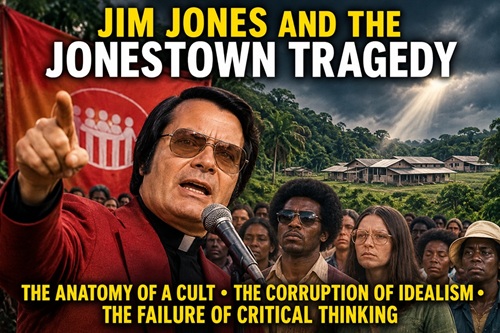 Introduction: The Road to JonestownOn November 18, 1978, one of the most horrifying episodes in modern religious history unfolded in the jungles of Guyana. More than 900 people died in the settlement of Jonestown, established by the American religious leader Jim Jones. Among the dead were hundreds of children, many of whom had no choice in the matter. The event became synonymous with the expression "drinking the Kool-Aid," although the substance used was actually a mixture containing cyanide and other drugs, administered in a mass killing orchestrated by Jones and his inner circle. The Jonestown tragedy is often presented as an extraordinary story about a deranged religious leader and his followers. That interpretation is not entirely wrong, but it is insufficient. The more disturbing question is how an apparently progressive religious movement, initially motivated by ideals of racial equality, social justice and communal solidarity, could deteriorate into an authoritarian organization whose leader ultimately demanded the deaths of his own followers. Jonestown was not simply a religious catastrophe. It was a political, psychological and organizational catastrophe. It demonstrated how emancipatory ideals can become instruments of domination when they are combined with charismatic authority, ideological certainty, social isolation and the systematic destruction of independent judgment. The tragedy deserves examination not merely as an episode of religious fanaticism, but as a warning about the dangers of surrendering critical thinking to a supposedly enlightened leader. Jim Jones: From Social Idealism to Authoritarian LeadershipJames Warren Jones (1931-1978) began his religious career in Indiana. He was deeply interested in racial equality and became involved in progressive causes at a time when racial segregation and discrimination remained widespread in the United States. His early ministry, which eventually developed into the Peoples Temple, attracted people who were dissatisfied with American society. Jones promoted racial integration, social equality, collective responsibility and assistance to disadvantaged communities. His congregation included substantial numbers of African Americans, and the movement offered practical support to people who often felt abandoned by mainstream institutions. These achievements should not be dismissed simply because of what followed. Some members genuinely experienced the Peoples Temple as a community of solidarity and social opportunity. Jones could be an effective organizer, and his opposition to racism was not merely an incidental feature of his public image. But his political and social commitments increasingly became inseparable from his personal authority. Jones presented himself as an exceptional figure who could identify injustice, expose hypocrisy and lead his followers toward a better society. Gradually, however, the movement became less about the ideals it professed and more about loyalty to the man who claimed to embody them. This was the crucial transformation. A movement that initially promised liberation increasingly demanded submission. The Charismatic Leader and the Psychology of ObedienceOne of the central lessons of Jonestown concerns charismatic authority. Jones was not simply a preacher who persuaded people through theological arguments. He cultivated an intense emotional relationship with his followers. He could offer affection, recognition, purpose and a sense of belonging. He also presented himself as a protector against a hostile outside world. This combination can be extraordinarily powerful. People do not necessarily join authoritarian movements because they are unintelligent, gullible or psychologically disturbed. They may join because the movement addresses genuine social needs. They find friendship, solidarity, meaning and a sense of participation in something larger than themselves. The danger arises when these legitimate needs become dependent on an increasingly unaccountable leader. In the Peoples Temple, loyalty gradually became a test of moral worth. Doubt could be interpreted as betrayal. Criticism became evidence of insufficient commitment. The leader's judgments increasingly replaced the independent moral and intellectual judgments of individual members. Jones also employed public humiliation, intimidation, surveillance and physical punishment. His authority was reinforced through fear as well as affection. This is an important distinction: Jonestown was not simply a community of people who believed too much. It was a community in which the freedom to question and eventually to leave had been systematically undermined. The Transformation of Utopia into a PrisonIn 1977, amid increasing scrutiny and criticism in the United States, Jones relocated the Peoples Temple's central community to Guyana. The settlement was named Jonestown after him. The project was presented as an alternative society: a communal experiment free from racism, capitalist exploitation and the inequalities of American life. For some members, moving to Guyana represented a genuine opportunity to build a better world. They had invested their savings, abandoned familiar surroundings and placed enormous trust in the movement. But the reality increasingly diverged from the promise. Jonestown was geographically isolated, economically dependent on the organization and controlled by its leadership. Members faced exhausting labor, restrictions on their movements, limited access to outside information and pressure to demonstrate their loyalty. Jones increasingly portrayed the outside world as dangerous and hostile. American institutions, journalists, former members and relatives were presented as enemies who threatened the community's survival. This produced a familiar authoritarian dynamic: the more oppressive the internal organization became, the more necessary it appeared to remain isolated from external criticism. The supposed utopia was becoming a prison. A community established in the name of human liberation had become an environment in which individual liberty was progressively extinguished. The Rehearsal of DeathPerhaps the most chilling aspect of the Jonestown story was that the final catastrophe did not emerge entirely without warning. Jones had organized so-called White Nights, during which members were told that the settlement faced an imminent threat. On some occasions, followers were instructed to rehearse drinking poison, supposedly as a demonstration of their willingness to die rather than surrender. These exercises normalized the idea of collective death. They also served a psychological function. By repeatedly presenting catastrophe as imminent, Jones kept his followers in a state of anxiety and dependence. The possibility of leaving was associated with betrayal, persecution and death. The rehearsals were not simply bizarre religious ceremonies. They were instruments of psychological conditioning. Once the idea of mass death had become part of the community's internal culture, the threshold separating symbolic threats from actual violence had been dangerously lowered. November 18, 1978: Murder in the Name of RevolutionThe immediate events leading to the tragedy began when US Congressman Leo Ryan visited Jonestown to investigate allegations of abuse and to meet concerned relatives and members. Several residents expressed a desire to leave with Ryan's delegation. This was an existential challenge to Jones. It demonstrated that his control was neither complete nor universally accepted. On November 18, Ryan and members of his delegation were attacked at the Port Kaituma airstrip by gunmen associated with the Peoples Temple. Ryan, three journalists and one former Temple member were killed. Others were wounded. Back at Jonestown, Jones assembled the community for what became the final mass gathering. The resulting deaths were not a voluntary mass suicide in any straightforward sense. Poison was administered to children and infants, and adults were subjected to extraordinary psychological pressure. Some members resisted, attempted to escape or were forced to participate. Armed guards were present. Jones and his leadership had created the circumstances in which the killing of hundreds of people could be presented as an act of collective political and moral necessity. The language of sacrifice, revolutionary resistance and persecution was used to rationalize mass murder. The final death toll was 918, including Jim Jones, although the exact circumstances of individual deaths varied. Many children were among the victims. Jones himself died from a gunshot wound to the head. The distinction between suicide and murder is essential. Calling the event simply a mass suicide obscures the coercion, the killing of children and the responsibility of the leadership. The Corruption of Progressive IdealsOne of the most uncomfortable aspects of the Jonestown tragedy is that it emerged from a movement that had attracted people through ostensibly admirable ideals. Racial equality, social justice, solidarity and opposition to exploitation are not inherently authoritarian principles. Indeed, they are essential components of democratic politics. But no political or religious ideal is immune to corruption. The problem arises when a movement claims that its goals are so important that ordinary standards of accountability, individual freedom and moral responsibility no longer apply. Once the leader is regarded as the indispensable instrument of historical progress, criticism can be reclassified as reactionary opposition. Once the community is regarded as the embodiment of a higher truth, individual rights can be sacrificed to collective purposes. This is precisely where idealism becomes dangerous. Jones exploited the moral vocabulary of liberation to establish personal domination. He presented obedience as solidarity, isolation as independence and sacrifice as revolutionary virtue. The lesson is not that progressive idealism inevitably leads to totalitarianism. It is that ideals without institutional safeguards, open criticism and individual rights can be appropriated by authoritarian personalities. A good cause does not guarantee good leadership. The Failure of Critical ThinkingJonestown also raises an important question about the role of critical thinking in religious and political communities. How could so many people accept the increasingly extreme demands of their leader? Why did they not collectively recognize the danger? There is no single answer. Social psychology offers several complementary explanations. First, there was the gradual escalation of commitment. People had invested years of their lives, their relationships, their money and their identities in the Peoples Temple. The more they invested, the more difficult it became to acknowledge that the project had gone disastrously wrong. Second, there was group conformity. When people are surrounded by others who appear to accept a particular worldview, dissent becomes increasingly difficult. The apparent consensus reinforces itself, even when many individuals privately harbor doubts. Third, there was information control. Isolation from alternative sources of information makes it harder to evaluate the claims of an authoritarian leader. When all criticism is presented as hostile propaganda, the community loses the ability to distinguish legitimate warnings from genuine attacks. Finally, there was the authority of Jones himself. He had cultivated a position in which his pronouncements increasingly took precedence over the observations and moral intuitions of his followers. These mechanisms are not unique to religious cults. They can also operate in political movements, ideological organizations, conspiracy communities and even intellectual circles. The central danger is the replacement of independent judgment by collective conviction. The Role of Fear and the Construction of EnemiesAn especially revealing feature of Jonestown was Jones's increasing dependence on external enemies. The United States was portrayed as an irredeemably hostile society. Former members were considered traitors. Journalists were threats. Relatives who questioned the movement's practices were presented as agents of persecution. This rhetoric served a double purpose. It helped explain away the growing discrepancy between the movement's ideals and its actual practices. It also strengthened the internal solidarity of the remaining community. The logic was circular: criticism demonstrated that enemies existed, and the existence of enemies demonstrated that the leader was right to demand greater obedience. This is a recognizable mechanism of authoritarian politics. Leaders who cannot tolerate criticism often construct a permanent state of emergency. They convince followers that the community is under existential threat and that extraordinary measures are therefore justified. In such an atmosphere, moderation becomes weakness, dissent becomes treason and obedience becomes a moral obligation. Jones's final appeal to revolutionary sacrifice was the ultimate expression of this mentality. Could Jonestown Have Been Prevented?The tragedy also raises questions about the responsibilities of institutions outside the Peoples Temple. Relatives had expressed concerns about coercion and abuse. Former members had provided disturbing accounts. Journalists had investigated the organization. Congressman Leo Ryan undertook his visit precisely because these allegations demanded attention. There were warning signs, but the organization was difficult to penetrate, and the authorities faced practical and legal limitations. The case demonstrates the difficulties democratic societies encounter when dealing with tightly controlled organizations that operate across national boundaries. Religious freedom and freedom of association are important rights. But they cannot become excuses for ignoring credible evidence of coercion, abuse, confinement or threats. The challenge is to protect freedom without unnecessarily criminalizing unconventional beliefs or communal experiments. Jonestown should not be used to stigmatize religious minorities or alternative communities generally. Most unconventional religious movements do not become violent authoritarian organizations. Nevertheless, the warning signs deserve serious attention: isolation, surveillance, financial exploitation, punishment of dissent, restrictions on leaving, leader worship and the normalization of violence. These are not merely eccentric organizational characteristics. Together, they can indicate a dangerous concentration of power. Jim Jones and Other Authoritarian LeadersIt would be misleading to regard Jones as an isolated psychological aberration. His methods reveal patterns that can be found in other authoritarian systems, both religious and secular. The leader presents himself as uniquely capable of understanding reality. He claims to represent the interests of the community better than its individual members. He identifies enemies who supposedly threaten the collective project. He discourages independent sources of information and treats criticism as evidence of disloyalty. The ideology may be religious, political, nationalist or revolutionary. The underlying organizational structure can nevertheless be remarkably similar. This is why Jonestown has relevance far beyond the history of American religious movements. It illustrates how authoritarianism can develop inside organizations that initially promise emancipation. It also demonstrates that the presence of noble ideals does not provide protection against the abuse of power. Indeed, the more morally elevated a movement considers its mission to be, the greater the temptation to excuse actions that would otherwise be regarded as unacceptable. A leader who claims to represent absolute truth is particularly difficult to challenge. The Intellectual Lesson: Never Outsource Your JudgmentThere is a broader philosophical lesson here. Human beings are social creatures. We depend on communities for identity, meaning and cooperation. We naturally admire people who appear more knowledgeable, courageous or morally committed than ourselves. There is nothing inherently wrong with this. Teachers, intellectual mentors, political leaders and spiritual figures can make valuable contributions to human development. The danger begins when admiration becomes submission. No individual should be regarded as beyond criticism. No ideology should be exempt from examination. No collective project should be allowed to override the basic dignity and autonomy of its members. This principle applies equally to religious teachers, political revolutionaries, intellectual celebrities and spiritual authorities. The capacity to question one's own movement is not a weakness. It is a fundamental condition of intellectual and moral independence. In this respect, Jonestown offers a particularly disturbing lesson for communities that claim to represent a higher stage of human consciousness or a more advanced form of social organization. Claims of superior insight do not establish superior moral judgment. A movement's rhetoric about enlightenment, evolution or transformation tells us very little about how power is actually exercised within it. The decisive questions are much more practical: Can members disagree? Can they leave? Can leaders be held accountable? Is information freely available? Are the rights of vulnerable individuals protected? If the answer to these questions is no, the movement's elevated ideals deserve little confidence. Conclusion: When Utopia Becomes TotalitarianThe Jonestown tragedy remains one of the most devastating examples of the corruption of collective idealism in modern history. Jim Jones did not initially attract his followers by promising mass death. He attracted them with a vision of racial equality, social solidarity and an alternative to an unjust society. Many people who joined him were motivated by genuine humanitarian concerns. That is precisely what makes the tragedy so instructive. The road to Jonestown was not simply a sudden descent into madness. It involved a gradual concentration of authority, the erosion of individual autonomy, the suppression of dissent, the manipulation of fear and the transformation of a community into an instrument of its leader's will. The final catastrophe was an act of mass murder presented as collective sacrifice. We should therefore resist two simplistic conclusions. The first is that the victims were merely foolish people who blindly followed a madman. This ignores the psychological, social and organizational mechanisms that made resistance increasingly difficult. The second is that Jonestown proves that idealistic social experiments or unconventional religious movements are inherently dangerous. That would be an equally mistaken lesson. The real lesson concerns power and accountability. Idealism needs criticism. Leadership needs limits. Community needs individual freedom. And no claim to moral, spiritual or political superiority should exempt an organization from ordinary standards of human decency. Perhaps the most important lesson of Jonestown can be expressed in a single sentence: Whenever a movement demands that its members surrender their capacity for independent judgment in the name of a supposedly higher truth, the promise of liberation has already begun to turn into its opposite. Appendix: Jonestown and Rajneeshpuram: Two Experiments in Utopia Gone WrongThe tragedy of Jonestown invites comparison with another controversial experiment in communal living: Rajneeshpuram, the settlement established by followers of the Indian spiritual teacher Bhagwan Shree Rajneesh (later known as Osho) in Oregon, United States, during the early 1980s. The two movements were not identical, and their outcomes were dramatically different. Jonestown ended in mass murder and the deaths of more than 900 people. Rajneeshpuram did not. Nevertheless, both provide fascinating examples of how charismatic spiritual leadership, communal idealism and concentrated organizational power can produce authoritarian environments. The comparison is particularly revealing because both movements began with promises of creating an alternative society, distinct from the perceived failures of the outside world. Two Charismatic Leaders, Two Utopian ProjectsJim Jones presented the Peoples Temple as a movement for racial equality, social justice and collective solidarity. Rajneesh presented his movement as an experiment in human freedom, spiritual transformation and liberation from conventional social morality. Their ideological vocabularies differed considerably. Jones increasingly emphasized revolutionary politics, collective sacrifice and opposition to capitalism. Rajneesh emphasized individual liberation, meditation, sexuality and the overcoming of traditional religious conditioning. Yet both movements revolved around extraordinary personal authority. In Jonestown, Jones increasingly became the unquestionable center of the community. In Rajneeshpuram, the spiritual master occupied a similarly elevated symbolic position, although the movement's actual administration was increasingly controlled by his personal secretary, Ma Anand Sheela, and her inner circle. This distinction matters. Rajneeshpuram developed a powerful administrative hierarchy, but its internal power structure cannot simply be equated with Jones's direct personal dictatorship. In both cases, however, the charisma of the founder helped legitimize an organizational structure in which ordinary members had limited influence over major decisions. Isolation as an Instrument of ControlBoth communities attempted to establish an alternative society separated, physically and psychologically, from mainstream America. Jonestown was built in the remote Guyanese jungle. Rajneeshpuram was established on a large ranch in rural central Oregon, where followers constructed an entire town with housing, infrastructure, businesses and agricultural facilities. Geographical separation was important to both experiments. It allowed the movements to organize daily life according to their own rules and values. But isolation also created tensions. Members increasingly depended on the movement for housing, employment, social relationships and access to information. The outside world could easily be portrayed as hostile, ignorant or morally inferior. The danger of such arrangements is that leaving becomes more complicated than simply changing one's religious affiliation. It can mean abandoning one's entire social world. The Construction of an EnemyBoth movements developed increasingly antagonistic relationships with their surroundings. Jones portrayed American society and its institutions as fundamentally hostile to the Peoples Temple. Opposition was interpreted as evidence of persecution and conspiracy. Rajneeshpuram entered into a bitter confrontation with its neighbors and local authorities in Oregon. Conflicts concerned land use, zoning, water rights, municipal incorporation, immigration and the movement's political influence. The local population increasingly regarded the settlement as a threat to its community and institutions. Rajneeshpuram, in turn, interpreted much of the opposition as religious intolerance and persecution. There were legitimate grievances on both sides, but the conflict became increasingly radicalized. One particularly important difference is that Rajneeshpuram's confrontation with the outside world eventually involved criminal operations by members of its leadership, rather than merely defensive rhetoric. The Abuse of Power: The 1984 Bioterror AttackThe most disturbing episode in the Rajneeshpuram story occurred in 1984. Members of the movement's leadership orchestrated a biological attack in The Dalles, Oregon, contaminating restaurant salad bars with Salmonella bacteria. More than 750 people became ill. The operation was intended to influence local elections by incapacitating potential voters. This was not an accidental consequence of an unconventional spiritual experiment. It was a deliberate criminal operation involving the misuse of biological agents against an unsuspecting civilian population. The contrast with Jonestown is striking. Jones ultimately directed the destruction of his own community. Rajneeshpuram's leadership resorted to organized criminal violence against the surrounding population in an attempt to preserve its political power. Both cases demonstrate how an organization that claims to pursue a higher purpose can become increasingly willing to violate the rights of people outside its ideological boundaries. The Cult of Personality and the Responsibility of the GuruAn especially interesting question concerns the responsibility of the spiritual master himself. Rajneesh later portrayed Sheela and her associates as having betrayed his vision. He claimed ignorance of their criminal activities and presented himself as a victim of their manipulation. Sheela, in turn, accused Rajneesh of knowing far more than he admitted. The precise extent of Rajneesh's knowledge and involvement remains a matter of historical and interpretative debate. He was not convicted of the bioterrorism attack. His criminal conviction in the United States concerned immigration fraud, and he agreed to leave the country in 1985. Nevertheless, the question of responsibility cannot be reduced to whether he personally ordered the attacks. A spiritual leader who creates an organization centered on his authority also has responsibilities for the institutional culture that develops around him. Rajneesh's prolonged withdrawal from public interaction, his dependence on Sheela's administration and the concentration of power within a small inner circle raise legitimate questions about leadership and accountability. Can a guru claim the benefits of unquestioned authority while disclaiming responsibility for the conduct of the organization that authority sustains? This is one of the central questions raised by Rajneeshpuram. Two Different EndingsThere is, however, a fundamental difference between the two tragedies. Jonestown ended in the deliberate killing of hundreds of adults and children. The community's leader orchestrated the final catastrophe, and the vast majority of those who died had no meaningful freedom to escape. Rajneeshpuram collapsed through criminal investigations, prosecutions, leadership defections, immigration proceedings and the eventual departure of its spiritual master. There was no equivalent mass killing. The comparison should therefore not be used to equate the two movements or their leaders. It is more useful to examine their common organizational vulnerabilities: charismatic authority, isolation, internal conformity, the demonization of critics and the absence of effective accountability. One movement ended in mass murder; the other in a spectacular political and criminal collapse. The Broader Lesson: Spiritual Enlightenment Is No Guarantee of Moral DevelopmentThere is a particularly important lesson here for the contemporary spiritual marketplace. Both Jones and Rajneesh attracted followers who believed they were participating in something extraordinary. Their movements promised forms of human transformation unavailable in ordinary society. But spiritual language can create an illusion of moral superiority. A person may meditate extensively, speak eloquently about consciousness, criticize conventional morality and claim to have transcended the limitations of ordinary human existence. None of these things establishes that the person is honest, compassionate, psychologically mature or capable of exercising power responsibly. Indeed, the notion that a spiritual master has transcended ordinary morality can become an especially convenient instrument of manipulation. Followers may interpret arrogance as wisdom, extravagance as detachment, secrecy as spiritual necessity and criticism as evidence of their own insufficient development. This is the danger of spiritual exceptionalism: the belief that an allegedly enlightened individual should be judged by standards different from those applied to everyone else. Jonestown and Rajneeshpuram demonstrate why this assumption deserves to be challenged. Conclusion: The Utopia TestThe most useful way to compare Jonestown and Rajneeshpuram is to ask a simple question: what happens when the people who promise liberation become the people from whom liberation is needed? Both movements began with promises of a radically different human existence. Both developed powerful charismatic hierarchies. Both became increasingly suspicious of outside criticism. And both demonstrated how easily collective idealism can become entangled with authoritarian control. But there is an additional lesson: spiritual development and moral development are not necessarily the same thing. A community can experiment with meditation, communal living, alternative sexuality or new forms of social organization without becoming authoritarian. The decisive issue is whether its members retain their autonomy and whether its leaders remain accountable. The ultimate test of a spiritual movement is not how elevated its teachings sound, how charismatic its master appears or how revolutionary its lifestyle may be. It is how it treats people who disagree, people who leave, and people who refuse to obey. That is the real test of enlightenment. Comment Form is loading comments...
|