|
TRANSLATE THIS ARTICLE
Integral World: Exploring Theories of Everything
An independent forum for a critical discussion of the integral philosophy of Ken Wilber
  Frank Visser, graduated as a psychologist of culture and religion, founded IntegralWorld in 1997. He worked as production manager for various publishing houses and as service manager for various internet companies and lives in Amsterdam. Books: Ken Wilber: Thought as Passion (SUNY, 2003), and The Corona Conspiracy: Combatting Disinformation about the Coronavirus (Kindle, 2020).
Check out my other conversations with ChatGPT The German Saviour FantasyDebunking Peter Hänseler's Geopolitical Wish ListFrank Visser / ChatGPT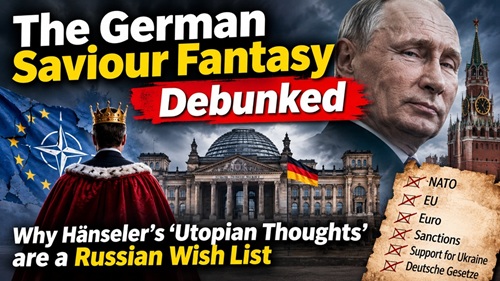 Introduction: A thought experiment with a dangerous premiseThe article by Peter Hänseler, published on 18 November 2026 under the title The Candidate Who Will Save Germany - Utopian Thoughts, is an interesting document. Not because it offers a convincing solution to Germany's problems, but because it brings together so many familiar elements of Russian geopolitical messaging in one place. The author imagines an exceptionally competent, morally impeccable German leader who would immediately withdraw Germany from NATO, expel American troops, restore relations with Putin's Russia, abandon the EU and the euro, reopen Nord Stream, dismantle 99% of German legislation, and fundamentally reverse German foreign policy. He would also sever diplomatic relations with Israel, confiscate Israeli assets, and subject Israelis living in Germany to political screening. This is presented as a thought experiment. But the thought experiment has a revealing feature: the hypothetical candidate is granted virtually unlimited powers, with the author explicitly invoking Adolf Hitler's Enabling Act of 1933 as a historical precedent. Hänseler assures readers that his candidate would not become another Führer. Unfortunately, that assurance does not solve the fundamental problem. A political system cannot safely depend on the assumption that an extraordinarily powerful leader will always be extraordinarily virtuous. The central weakness of this article is that it confuses German national sovereignty with alignment to Russian geopolitical interests. It identifies some genuine German problems but proposes solutions that would leave Germany economically, politically and strategically more vulnerable. Let's examine the argument. 1. Germany is not an American colonyOne of Hänseler's principal claims is that Germany has never regained full sovereignty after 1945. The presence of American troops supposedly demonstrates that Germany remains a colony of the United States. This is a fundamental misrepresentation of postwar German history. The 1990 Treaty on the Final Settlement with Respect to Germany, commonly known as the Two Plus Four Treaty, established the conditions for German reunification and restored Germany's full sovereignty over its internal and external affairs. Germany is a sovereign state. It has its own constitution, parliament, government, judiciary, foreign policy and armed forces. It can make decisions that conflict with American preferences, as it has done on numerous occasions. The presence of foreign military forces does not automatically negate sovereignty. American troops are stationed in Germany under agreements with the German government. Their presence reflects a negotiated security relationship, not colonial occupation. The author invokes Charles de Gaulle's withdrawal from NATO's integrated military command in 1966. But this example actually demonstrates the distinction between sovereignty and alliance membership. France remained a NATO member while withdrawing from its integrated military structure. It was not necessary to declare France a colony before making that decision. Germany could similarly debate its military relationship with the United States without adopting Hänseler's absurd colonial analogy. There is a legitimate discussion to be had about European strategic autonomy and the appropriate degree of dependence on Washington. But replacing American dependence with Russian dependence would hardly constitute emancipation. 2. NATO expansion did not cause Russia's invasionHere we encounter the familiar argument that NATO expansion was the principal cause of the Ukraine war. Hänseler describes the alliance as an American instrument designed to contain and ultimately confront Russia. He even claims that NATO should have been dissolved in 1990, alongside the Warsaw Pact. There are several problems here. First, NATO is not simply an American military occupation structure. Its members are sovereign states that voluntarily participate in a collective defence arrangement. Article 5 establishes mutual assistance in the event of an armed attack, while Article 1 commits members to peaceful dispute resolution and compliance with the UN Charter. Second, NATO enlargement cannot be understood without considering the preferences of the countries that sought membership. Poland, the Baltic states, and other former Soviet-bloc countries were not dragged into NATO against their wishes. They sought membership partly because of their historical experience with Russian and Soviet domination. Their security concerns deserve consideration just as much as Russia's. Third, the argument reverses the sequence of events. Russia invaded Georgia in 2008, annexed Crimea in 2014, and launched its full-scale invasion of Ukraine in February 2022. The UN General Assembly condemned the 2022 invasion in Resolution ES-11/1, adopted by 141 votes to five, with 35 abstentions. It demanded that Russia withdraw its forces from Ukrainian territory. NATO enlargement may be part of a discussion about Russian threat perceptions. It does not establish that Russia had to invade Ukraine. There is a crucial distinction between explaining a government's security concerns and justifying its decision to wage war against another sovereign country. Hänseler repeatedly erases that distinction. 3. Russia will not attack Europe: How does he know?Perhaps the most remarkable assertion in the article is that Russia will not attack Europe because it has no reason to do so. This is not an argument supported by evidence. It is an expression of confidence in Vladimir Putin's intentions. The author even suggests that Germany is effectively at war with Russia, while the absence of Russian missiles hitting Berlin is attributable to Putin's extraordinary patience and willingness to de-escalate. This is an extraordinary inversion of responsibility. Russia invaded Ukraine. Russia annexed Ukrainian territory. Russia has repeatedly threatened European countries and employed hybrid operations against European interests. One does not have to believe that Russia is planning an imminent invasion of Germany to recognise that Russian military aggression has fundamentally changed Europe's security environment. The relevant question is not whether Putin has announced plans to invade Germany. It is whether European countries should base their security on the assumption that his intentions will remain peaceful. History offers a particularly relevant warning here: Putin's government repeatedly denied that it intended to invade Ukraine shortly before February 24, 2022. The absence of an announced intention to invade is not evidence that an invasion will never happen. Hänseler's position amounts to an extraordinary strategic gamble: Germany should dismantle its security arrangements because the very government whose military actions have made those arrangements more important can supposedly be trusted not to threaten it. That is not realism. It is wishful thinking. 4. The historical argument about Russia is selectiveHänseler lists several historical invasions of Russia: Napoleon in 1812, the Crimean War, the First World War and Hitler's invasion in 1941. The implication is that Russia has historically been the victim of Western aggression and that contemporary Russian foreign policy should be understood against this background. But this is selective historical memory. Russia has also been an imperial and expansionist power. Consider:
One cannot construct a credible history of European security by mentioning Napoleon and Hitler while conveniently ignoring the Soviet invasions of Eastern Europe. There is another problem with Hänseler's reasoning. Even if Russia has legitimate historical grievances or security concerns, those concerns do not grant it a right to determine the foreign policy of neighbouring countries. The principle of national sovereignty cannot be applied selectively. It must apply to Ukraine, Poland, Germany and Russia alike. 5. Germany should leave NATO and immediately make peace with Moscow?The proposed foreign policy transformation is breathtaking. On his first day, the imaginary candidate withdraws Germany from NATO. He then travels to Moscow, lifts sanctions, restores economic relations and negotiates the reopening of Nord Stream. But what exactly would Germany gain? Leaving NATO would eliminate an important component of German security without providing an equivalent replacement. Germany would have to reconsider its defence planning, intelligence arrangements, military coordination and deterrence capabilities. It would also weaken the security of its European neighbours. There is a perfectly reasonable argument for Europe to become less dependent on American military capabilities. But that requires building European defence capacity, not dismantling existing arrangements before alternatives are available. Furthermore, NATO withdrawal is not something a German chancellor can accomplish merely by signing a document on the first day in office. Article 13 of the North Atlantic Treaty provides for withdrawal following one year's notice. And what would happen if Russia imposed conditions on the proposed German-Russian reconciliation? Hänseler casually acknowledges that Moscow would probably have conditions that Germany should be willing to meet. That is where the fantasy becomes particularly revealing. Would Germany accept Russian demands concerning Ukraine? Would it abandon Ukrainian sovereignty as a price for cheap energy? Would it accept a Russian sphere of influence in Eastern Europe? The author never seriously addresses these questions. His imagined Germany is sovereign in relation to Washington but apparently perfectly willing to accommodate Moscow. That is not strategic independence. It is a change of geopolitical patron. 6. The EU is not an American colonial administrationHänseler next attacks the European Union, portraying it as an authoritarian, undemocratic instrument through which Washington controls Europe. There is a kernel of legitimate criticism here. The EU suffers from democratic deficits, bureaucratic complexity, institutional tensions and disagreements over economic and fiscal policy. But describing it as an American colonial empire is political rhetoric, not institutional analysis. The EU is a treaty-based association of sovereign member states. Its institutions have defined powers, and its decisions are subject to legal and political procedures. The European Parliament is directly elected. The Council represents national governments. The European Commission is appointed through a process involving elected governments and the Parliament. One can criticise the balance of power between these institutions without pretending that European governments have no agency. Hänseler's description of Ursula von der Leyen and the EU leadership as unelected rulers is particularly misleading. The Commission President is not directly elected by European voters, but is elected by the European Parliament following nomination by the European Council. This is indirect democratic legitimacy, not an absence of democratic legitimacy. More importantly, the author fails to explain what Germany would replace the EU with. Would Germany negotiate new trade agreements with every European country? How would it handle supply chains, financial integration, cross-border labour mobility and common standards? Germany is deeply integrated into the European economy. Leaving that institutional framework would create enormous economic and political complications. The claim that economic opportunities outside the EU would automatically compensate for these losses is unsupported speculation. A serious economic programme would have to calculate those costs and benefits rather than simply promise a brighter future. 7. The euro and the misleading gold comparisonHänseler claims that the euro has lost approximately 93.3% of its value against gold since its introduction. This is presented as evidence of the currency's failure. But this is an elementary problem of economic measurement. Gold is not an absolute standard of value. Its market price fluctuates according to monetary conditions, investor demand, geopolitical uncertainty, central-bank purchases and other factors. A currency losing value against gold does not demonstrate that its purchasing power has declined by the same amount. To assess the euro, one would examine consumer-price inflation, purchasing power, exchange-rate movements, productivity, employment, investment and economic growth. The euro has genuine structural weaknesses. A common monetary policy across economies with different fiscal structures and economic conditions creates difficulties. The eurozone debt crisis demonstrated that these problems are serious. But this does not prove that the euro was a stillbirth or that Germany would prosper by abandoning it. Hänseler also invokes German TARGET balances as evidence that Germany has financed the rest of Europe. This confuses accounting balances within the Eurosystem with an ordinary government loan or an immediately payable bill. TARGET balances reflect cross-border payment flows and the settlement structure of the Eurosystem. They are not equivalent to a direct transfer of German taxpayers' money to other governments. The figures may deserve economic scrutiny, but the author's interpretation is misleading. 8. Nord Stream: Energy security through renewed dependenceThe author wants Germany to restore Nord Stream and rebuild its energy relationship with Russia. This proposal assumes that the prewar German-Russian energy relationship was fundamentally beneficial and that restoring it would solve Germany's economic difficulties. But the prewar arrangement also created a dangerous dependency. Germany developed an energy system that relied heavily on Russian gas. This was politically convenient and economically attractive for a long time, but it exposed Germany to the risk that Moscow could use energy relationships as an instrument of geopolitical pressure. The invasion of Ukraine demonstrated that this risk was not imaginary. The destruction of Nord Stream also raises difficult questions about responsibility, security and the future of the infrastructure. The article simply assumes that the remaining pipeline can be brought back into operation and the damaged infrastructure repaired as a joint German-Russian undertaking. Even if technically possible, why would Germany want to recreate the same strategic vulnerability? Energy diversification, renewable energy, storage, LNG infrastructure and interconnections with European neighbours are not ideological distractions. They are components of energy security. Germany certainly needs an effective and affordable energy policy. But returning to dependence on a government that has demonstrated its willingness to use economic relationships as geopolitical leverage is hardly an obvious solution. 9. The 99% solution: Abolish almost all legislationHere Hänseler moves from geopolitics to domestic policy. Germany supposedly has an unbearable regulatory burden. Tax legislation is too complicated, businesses are overwhelmed by bureaucracy, and civil servants have become an obstacle to economic progress. There is truth in parts of this diagnosis. Germany has serious problems with administrative complexity, slow digitalisation, planning procedures, infrastructure development and regulatory burdens. These issues deserve reform. But the proposed solution is to eliminate 99% of laws and regulations. This is not a serious legislative programme. What would happen to environmental protections, workplace safety, food standards, consumer rights, competition law, building regulations, financial supervision and social security? Would Germany abolish the laws that protect employees from exploitation? The regulations that prevent industrial pollution? The legislation that ensures that companies cannot simply disregard contractual obligations? The author does not distinguish between unnecessary bureaucracy and necessary public safeguards. The problem with excessive regulation is not solved by indiscriminately eliminating regulation. It requires careful evaluation: Which rules serve a legitimate purpose? Which duplicate existing requirements? Which impose disproportionate costs? Which can be simplified or digitalised? A functioning modern economy needs predictable rules. The idea that a single leader can eliminate 99% of legislation and somehow create a flourishing economy in the process is an example of magical thinking. 10. Freedom of expression: Article 5 already existsHänseler claims that freedom of expression must be restored in Germany. He quotes Article 5 of the German Basic Law, which guarantees freedom of expression, freedom of the press and freedom of information. But he conveniently omits the second paragraph of Article 5, which specifies that these rights are subject to limitations established by general laws, provisions protecting young people and the right to personal honour. This is not an exceptional German restriction. Constitutional democracies routinely balance freedom of expression against other fundamental rights. One can debate whether particular German laws concerning hate speech, extremism or online communication are too restrictive. That debate is legitimate. But the assertion that Germany has somehow lost its constitutional freedom of expression is an entirely different proposition. The Basic Law already protects that freedom. Its interpretation and enforcement can be challenged through democratic and judicial procedures. The author offers no systematic evidence that German citizens have lost the ability to criticise their government, publish controversial opinions or challenge prevailing political assumptions. Ironically, his own article is evidence that such criticism can be published. 11. The most disturbing section: Israel, Nuremberg and collective punishmentThe article becomes particularly troubling when Hänseler turns to Israel. He proposes that Germany should immediately sever diplomatic relations with Israel, confiscate Israeli assets, terminate business relationships and subject Israelis living in Germany to strict political screening. He also demands a new Nuremberg process against German politicians, journalists and media organisations that have supported Israel. This is no longer merely a foreign-policy proposal. It introduces an extraordinary principle of collective political responsibility. There are legitimate reasons to criticise the Israeli government, its military operations in Gaza, settlement policies and the humanitarian consequences of the war. Germany's historical responsibility should never prevent criticism of Israeli government policy. But criticism of a government is not the same as treating an entire population as collectively guilty. The proposal to screen Israeli residents according to their political opinions is particularly alarming. Would German citizens of Russian origin also be screened according to their opinions about Putin? Would Americans living in Germany be interrogated about Donald Trump's foreign policy? Would Palestinians be required to demonstrate their political positions before receiving ordinary legal protections? The principle is incompatible with equal citizenship and individual responsibility. Hänseler also claims that the overwhelming majority of Israelis support genocide. This is an enormous generalisation for which he provides no adequate evidence. Furthermore, the legal determination of genocide cannot simply be established by political declaration. The distinction between allegations, evidence, provisional judicial measures and a final legal determination matters enormously. The International Court of Justice's proceedings concerning the Genocide Convention are not equivalent to a final judgment that genocide has been legally established. There is also something deeply inappropriate about invoking Nuremberg as a political weapon against journalists and politicians whose positions the author dislikes. The Nuremberg trials dealt with individual responsibility for exceptionally grave crimes. They were not designed as instruments for punishing political disagreement. The comparison with Julius Streicher is especially inflammatory. It implies that contemporary journalists and politicians should face the same ultimate punishment as a convicted Nazi propagandist. This is not a serious application of international law. It is political demonisation. One can oppose Israeli government policies, demand accountability and defend Palestinian rights without abandoning the very principles of individual responsibility and equal protection that the postwar legal order was designed to uphold. 12. The Führer problem: The most revealing contradictionPerhaps the most important passage in the entire article is found in its introduction. Hänseler explicitly says that his imaginary candidate should be given the same kind of sweeping powers that Hitler received through the Enabling Act in March 1933. He immediately adds that his candidate would not abuse those powers. But this is precisely the problem with authoritarian political thinking. The author wants the advantages of dictatorship without its disadvantages. He wants a leader powerful enough to dismantle established institutions, bypass political opposition, transform foreign policy overnight and rewrite the legal system, but simultaneously assumes that this leader will possess impeccable moral character. There is no institutional guarantee of such a thing. Democracy is not based on finding a morally perfect leader. It is based on the recognition that political leaders are fallible, self-interested and potentially dangerous. That is why democracies have:
Germany's Basic Law even contains an especially important safeguard: Article 79(3), the so-called eternity clause, protects the fundamental constitutional principles of human dignity, democracy and the federal order against constitutional amendment. Hänseler's fantasy reverses this constitutional wisdom. Instead of improving institutions, he wants to find someone powerful enough to bypass them. And his historical example is particularly unfortunate. Hitler did not receive extraordinary powers because Germany had discovered a reliable method of producing benevolent dictators. He received them through the destruction of democratic safeguards, intimidation and political manipulation. The author appears to have learned the wrong lesson from German history. 13. What is really being offered here?There is a recurring pattern throughout this article. Germany has economic problems? Blame the EU, the euro and sanctions against Russia. Germany has security concerns? Blame NATO and American influence. Russia invades Ukraine? Blame Western geopolitical provocations. Germany needs energy? Restore Russian gas supplies. German legislation is complicated? Abolish 99% of it. Germany has disagreements over Israel? Put politicians and journalists on trial and screen Israeli residents. Every problem is reduced to a single geopolitical diagnosis: Germany must break with the West and accommodate Russia. This is not an independent analysis of Germany's predicament. It is an ideological programme disguised as a national rescue operation. It also conveniently ignores the costs of the proposed transformation. What would happen to German exports if its European economic relationships were seriously disrupted? What would happen to German security if it abandoned NATO without an alternative? What political concessions would Moscow demand in exchange for restored relations? How would Germany manage the economic consequences of leaving the EU and eurozone? Hänseler provides no serious answers. His imagined candidate simply announces the new direction, and everything is expected to fall into place. That is why the subtitle, Utopian Thoughts, is more appropriate than the author perhaps realises. 14. A more realistic rescue programme for GermanyGermany certainly needs reform. Its economic model has come under pressure from several directions. Its industrial competitiveness, energy costs, infrastructure, demographic development, digitalisation, defence capabilities and bureaucratic structures all deserve serious attention. But a credible reform programme would begin by distinguishing between domestic structural problems and foreign-policy grievances. Germany needs more investment in infrastructure, research, education and digital technology. It needs a more efficient planning and regulatory system, a competitive energy supply and a realistic industrial strategy. It should strengthen European defence capabilities while maintaining the ability to cooperate with the United States. It should pursue diplomatic relations with Russia without accepting Russian territorial ambitions or abandoning Ukraine's sovereignty. It should also maintain a consistent human-rights policy, criticising violations regardless of whether they are committed by Russia, Israel, the United States or any other government. And, above all, Germany needs democratic reform rather than an imaginary saviour. These are difficult political tasks. They require negotiation, compromise, institutional competence and public accountability. There is no shortcut through authoritarian wishful thinking. Conclusion: A Russian geopolitical wish list disguised as German salvationHänseler's article is useful because it reveals the intellectual structure of a particular strand of Western contrarianism. It begins with genuine grievances. Germany has economic difficulties. The EU has institutional weaknesses. American foreign policy can be self-interested. NATO's history deserves critical examination. German energy policy has made serious mistakes. Israeli government policies deserve scrutiny. But from these observations the author constructs an entirely different conclusion: Germany should abandon its Western alliances, restore its strategic relationship with Putin's Russia and entrust its future to an exceptionally powerful, supposedly virtuous leader. That conclusion does not follow from the premises. The article's most serious intellectual failure is its asymmetrical treatment of sovereignty. American influence is interpreted as domination, while Russian influence is presented as the route to independence. Ukrainian sovereignty becomes negotiable, while Russian security interests are treated as overriding. Democratic constraints are described as obstacles, while unlimited executive power is imagined as a solution. This is not geopolitical realism. It is geopolitical selectivity. And there is a final irony. Hänseler invokes Hitler to explain why Germany needs a powerful leader, while apparently failing to appreciate why postwar Germany was deliberately constructed around constitutional checks and balances. The lesson of German history is not that the country needs to discover a better Führer. It is that no country should ever again place its political future in the hands of someone who claims to be indispensable. Germany does not need a saviour. It needs competent democratic government, economic reform, European cooperation and a foreign policy based on principles rather than geopolitical subservience. That is considerably less utopian than Hänseler's proposal. Comment Form is loading comments...
|