|
TRANSLATE THIS ARTICLE
Integral World: Exploring Theories of Everything
An independent forum for a critical discussion of the integral philosophy of Ken Wilber
  Frank Visser, graduated as a psychologist of culture and religion, founded IntegralWorld in 1997. He worked as production manager for various publishing houses and as service manager for various internet companies and lives in Amsterdam. Books: Ken Wilber: Thought as Passion (SUNY, 2003), and The Corona Conspiracy: Combatting Disinformation about the Coronavirus (Kindle, 2020).
Check out my other conversations with ChatGPT Does Democracy Lead to Populist Dictatorship?The Ancient Greek Fear and Its Modern RelevanceFrank Visser / ChatGPT
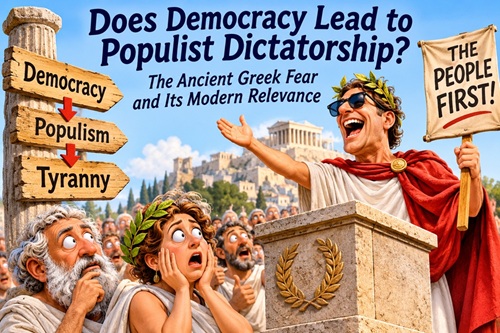 Introduction: Democracy's ParadoxDemocracy contains a paradox that has occupied political philosophers for more than two thousand years: can a political system based on popular sovereignty ultimately destroy the very freedoms it was designed to protect? The ancient Greeks were already familiar with this possibility. They feared that democracy, when corrupted by demagoguery, emotional manipulation and the pursuit of immediate popular gratification, could degenerate into tyranny. A charismatic leader might present himself as the champion of ordinary citizens, promise to defend them against corrupt elites, and gradually concentrate political power in his own hands. The people, having initially empowered him, might eventually discover that they had surrendered their freedom. This was not merely an abstract philosophical concern. It is one of the central problems of contemporary politics. From Donald Trump and Viktor Orbán to Recep Tayyip Erdogan and other populist leaders, we see political movements that claim to represent the authentic will of the people while challenging the institutions that make democratic government possible. But does democracy necessarily contain the seeds of its own destruction? Or did the Greeks identify a genuine danger without recognizing the institutional safeguards that could prevent it? 1. Plato's Warning: Democracy as a Road to TyrannyThe most famous ancient formulation of this problem appears in Plato's Republic, particularly Book VIII. Plato was deeply suspicious of Athenian democracy. His distrust was reinforced by the execution of Socrates in 399 BCE, which he regarded as a demonstration of the dangers of popular decision-making. A society that could condemn its greatest philosopher to death hardly seemed to Plato an ideal political arrangement. In his account of political degeneration, Plato describes a sequence in which aristocracy deteriorates into timocracy, oligarchy, democracy and finally tyranny. Democracy emerges when the poor overthrow the wealthy oligarchs and establish political equality. Initially, this appears liberating. Citizens enjoy considerable freedom, different lifestyles flourish, and traditional hierarchies lose their authority. But Plato sees a problem: freedom without sufficient discipline eventually becomes excessive. Citizens become unwilling to accept authority, social distinctions lose their legitimacy, and political life becomes increasingly dominated by competing desires. Into this situation enters the demagogue. The demagogue presents himself as the people's protector, denounces the wealthy and powerful, and promises to redistribute privileges. He cultivates popular resentment and identifies enemies who supposedly threaten the community. Eventually, he obtains extraordinary powers to defend the people against these enemies. The protector becomes the master. In Plato's analysis, tyranny is therefore not simply the opposite of democracy. It can emerge from democracy's own internal contradictions. His account is not a reliable historical law of political development, and his ideal alternative was itself profoundly authoritarian. Nevertheless, his central warning remains remarkably relevant: political freedom can be exploited by those who promise to defend it. 2. Aristotle: The Problem of DemagogueryAristotle offered a more empirically grounded analysis. Unlike Plato, he did not reject democracy as such. He distinguished between different forms of government and recognized that political arrangements could serve either the common good or the interests of a particular group. In his Politics, Aristotle criticized extreme democracy, particularly when popular assemblies and demagogues displaced the authority of established laws. His concern was that political leaders might flatter the population, appeal to immediate passions and encourage hostility toward wealthy or influential citizens. Instead of governing through general laws, they would increasingly govern through popular decrees designed to satisfy particular constituencies. The distinction between government by law and government by the shifting passions of a political majority is crucial. Aristotle understood that democracy requires more than counting votes. It also requires political moderation, institutional stability and respect for the common good. His preference for a mixed constitution, combining elements of oligarchy and democracy, was an attempt to prevent any single social group from dominating the political system. In this respect, Aristotle anticipated an important principle of modern constitutional democracy: majority rule needs institutional limitations. 3. Modern Democracy Is Not Ancient DemocracyWe should nevertheless be careful when transferring Greek political theory to contemporary circumstances. Athenian democracy was a direct democracy involving a relatively restricted citizen population. Women, slaves and resident foreigners were excluded from political participation. Modern democracies are generally representative systems, incorporating constitutional rights, independent courts, parliamentary institutions, professional administrations, political parties and regular elections. These arrangements introduce checks and balances that the ancient Greeks did not possess in their modern form. The central innovation is constitutionalism: the principle that even an elected government must operate within limits that it cannot simply abolish whenever convenient. Democracy therefore has two dimensions. The first is popular sovereignty: political authority ultimately derives from the people. The second is constitutional liberalism: individual rights, institutional independence, political pluralism and the rule of law constrain the exercise of that authority. These dimensions are complementary but not identical. A country can hold elections without being a liberal democracy. A majority can elect a government that subsequently weakens the institutions protecting minorities, opposition parties and independent journalism. This distinction is essential for understanding contemporary populism. 4. Populism: When the People Become an Ideological WeaponPopulism is often described as a political style that divides society into two supposedly homogeneous groups: the virtuous people and the corrupt elite. The populist leader claims to represent the authentic will of the people, frequently presenting established political institutions as obstacles to popular sovereignty. This creates an immediate difficulty. Who exactly are the people? In a pluralistic democracy, citizens have different interests, values, political preferences and cultural backgrounds. No political leader can legitimately claim to represent the entire population simply because he or she has won an election. Yet populist movements often make precisely this claim. Those who disagree with the leader are portrayed not as legitimate political opponents but as enemies of the people. This is a dangerous transformation. Political disagreement, which is essential to democracy, becomes evidence of disloyalty. Independent journalists become enemies of the nation. Judges become political conspirators. Civil servants become members of a hostile establishment. Electoral opponents are accused of undermining the country. The populist leader thus establishes a direct relationship with an imagined unified people while delegitimizing the institutions through which actual democratic pluralism operates. The paradox is striking: a movement that claims to restore popular sovereignty can end up weakening the very mechanisms through which citizens exercise it. 5. The Historical Evidence: How Democracies Can Be DestroyedHistory provides several examples of democratic or partly democratic political systems giving rise to authoritarian rule. Weimar GermanyThe collapse of the Weimar Republic is perhaps the most frequently cited example. Adolf Hitler did not become dictator through a straightforward democratic election victory. The Nazi Party became the largest party in the Reichstag in 1932, but never secured an absolute parliamentary majority in a free national election. Hitler was appointed chancellor by President Paul von Hindenburg in January 1933, following political maneuvering by conservative elites who believed they could control him. The Reichstag Fire Decree and Enabling Act then dismantled constitutional democracy. The lesson is not that democracy simply voted for dictatorship. Rather, democratic institutions proved vulnerable to economic crisis, political polarization, extremist mobilization and the disastrous decisions of established political elites. VenezuelaHugo Chávez was democratically elected in 1998, initially enjoying considerable popular support. His government subsequently weakened institutional checks, undermined political pluralism and concentrated power. His successor, Nicolás Maduro, continued and intensified this authoritarian trajectory. Venezuela illustrates how electoral legitimacy can be used to justify the gradual dismantling of democratic accountability. HungaryViktor Orbán and his Fidesz party came to power through democratic elections in 2010. Subsequently, constitutional changes, electoral restructuring, pressure on independent media and the weakening of institutional checks substantially altered the Hungarian political system. Orbán has openly advocated what he calls an illiberal state. Hungary demonstrates that democratic erosion does not necessarily require a violent coup or the immediate abolition of elections. It can happen through a series of legally enacted changes that progressively undermine the conditions for genuine political competition. These examples suggest that democracy is not automatically self-preserving. 6. Donald Trump and the American Democratic ExperimentThe United States offers a particularly revealing contemporary case. Donald Trump presents himself as the representative of ordinary Americans against a supposedly corrupt political establishment. His rhetoric frequently divides the country into loyal supporters and internal enemies. His political movement has repeatedly challenged the legitimacy of electoral outcomes, independent institutions and critical journalism. The events surrounding January 6, 2021, were especially significant. After losing the 2020 presidential election, Trump continued to promote false claims of widespread electoral fraud. His supporters subsequently attacked the Capitol while Congress was meeting to certify the election results. This was not merely an episode of political disorder. It was an assault on the constitutional process through which the peaceful transfer of power takes place. The important question is not whether Trump was democratically elected. He was. The question is whether electoral victory gives a leader unlimited authority to undermine the institutions that make future democratic elections meaningful. It does not. Democracy cannot be reduced to the proposition that whoever wins an election may do whatever he wants until the next one. That would turn elections into periodic opportunities to establish authoritarian power. 7. Why Do People Support Authoritarian Populists?The Greek philosophers emphasized the political dangers of excessive freedom and demagoguery. Modern political science allows us to identify additional mechanisms. Economic insecurity is one important factor. People who experience declining living standards, unemployment or a loss of social status may become receptive to leaders promising national restoration. Cultural displacement is another. Rapid social changes, immigration and globalization can produce feelings of insecurity and loss of control. Distrust of established political parties also plays a major role. When mainstream politicians appear ineffective, self-serving or disconnected from ordinary citizens, outsiders can present themselves as the only credible alternative. Finally, contemporary communication technology amplifies political polarization. Social media rewards emotionally charged messages, outrage and simplistic explanations. Conspiracy theories and misinformation can circulate rapidly, while political leaders can communicate directly with their supporters without relying on independent journalistic mediation. These factors do not mean that populist voters are necessarily irrational or authoritarian by nature. Many have legitimate grievances. The problem arises when legitimate dissatisfaction is converted into support for the destruction of democratic constraints. A leader may identify real political failures while offering remedies that are substantially worse than the original problems. 8. Is Majority Rule Enough?The fundamental weakness of an exclusively majoritarian understanding of democracy is that it overlooks the rights of those who lose. Imagine a political movement winning 60 percent of the vote. Does this give it the right to silence the remaining 40 percent, abolish independent courts, control the media and permanently alter electoral arrangements in its own favor? Obviously not. Democracy is not simply the dictatorship of the majority. It is a system in which political power remains contestable. Today's majority can become tomorrow's minority, and today's opposition must retain the freedom and institutional opportunity to become tomorrow's government. This requires certain principles that cannot legitimately be sacrificed to temporary electoral enthusiasm. These include freedom of expression, freedom of association, independent courts, fair elections, minority rights and the peaceful transfer of power. They are not obstacles to democracy. They are among its defining conditions. This is where constitutional democracy improves upon the political arrangements feared by Plato and Aristotle. It recognizes that the majority must govern, but not without limits. 9. The Weakness of the Greek SolutionThere is, however, another side to the ancient Greek argument. Plato's suspicion of democracy was partly based on his belief that political competence should determine who governs. He regarded ordinary citizens as insufficiently knowledgeable to make important political decisions. But who determines political competence? And who guards the guardians? The history of authoritarian governments demonstrates that supposedly enlightened elites can be just as corrupt, self-interested and incompetent as elected politicians. Technocratic expertise does not automatically produce political wisdom. Nor does social privilege guarantee superior judgment. The solution to democratic vulnerability cannot therefore be to replace popular sovereignty with rule by self-appointed intellectual, economic or political elites. Democracy has to be improved from within, not abandoned because it is imperfect. This requires civic education, independent journalism, political accountability, institutional resilience and a public culture that values evidence and reasoned disagreement. It also requires political leaders who understand that losing an election is not an existential catastrophe but a normal feature of democratic life. 10. Democracy as an Ongoing AchievementPerhaps the greatest mistake is to regard democracy as a political arrangement that, once established, will preserve itself indefinitely. Democracy is not a permanent achievement. It is an ongoing political practice. It depends on citizens who accept that political opponents are legitimate participants in the same political community. It depends on institutions that resist the temptation to serve the interests of whichever party happens to control them. And it depends on leaders who recognize that electoral victories do not confer unlimited political authority. Most importantly, it depends on a distinction between political legitimacy and political popularity. A government may be extremely popular and nevertheless behave illegitimately. Conversely, an unpopular government may still operate entirely within democratic constitutional principles. The popularity of a political leader is not a reliable measure of democratic health. Indeed, the most dangerous moment may occur when a leader becomes so popular among his supporters that they begin to regard any institutional resistance as an attack on democracy itself. At that point, the original democratic mandate can become an instrument of authoritarian consolidation. Conclusion: Democracy Does Not Have to Become Its Own ExecutionerDid the ancient Greeks correctly anticipate the possibility that democracy could degenerate into populist dictatorship? In an important sense, yes. Plato recognized the danger of the demagogue who exploits popular discontent and presents himself as the people's indispensable protector. Aristotle understood that democracy becomes unstable when political leaders replace the rule of law with the manipulation of popular passions. Their warnings remain relevant because democracy contains no automatic protection against its own misuse. But their pessimism should not be mistaken for political wisdom in its entirety. Modern constitutional democracy has developed institutional safeguards that offer a more convincing answer to the problem than rule by supposedly superior elites. The crucial distinction is between democracy as majority rule and democracy as a constitutional system of popular sovereignty, individual rights and institutional accountability. The former can indeed become a pathway to authoritarianism. The latter is designed to prevent precisely that outcome. The real danger is therefore not democracy itself, but a particular understanding of democracy: the belief that an electoral majority, embodied in a charismatic leader, represents the whole people and is consequently entitled to unlimited power. The ancient Greeks feared that democracy might produce a tyrant. Modern history shows that they were not entirely wrong. But the ultimate lesson is not that we should fear democracy. It is that we should fear those who claim to embody democracy so completely that they no longer recognize any legitimate limits on their own power. A democracy is not measured merely by how freely its people can choose their rulers. It is also measured by how effectively it prevents those rulers from becoming their masters. Comment Form is loading comments...
|