|
TRANSLATE THIS ARTICLE
Integral World: Exploring Theories of Everything
An independent forum for a critical discussion of the integral philosophy of Ken Wilber
  Frank Visser, graduated as a psychologist of culture and religion, founded IntegralWorld in 1997. He worked as production manager for various publishing houses and as service manager for various internet companies and lives in Amsterdam. Books: Ken Wilber: Thought as Passion (SUNY, 2003), and The Corona Conspiracy: Combatting Disinformation about the Coronavirus (Kindle, 2020).
Check out my other conversations with ChatGPT The Development Trap: Beyond Self-Improvement and Spiritual NarcissismA Critical Review of Joseph Dillard's Alternative to Integral DevelopmentFrank Visser / ChatGPT
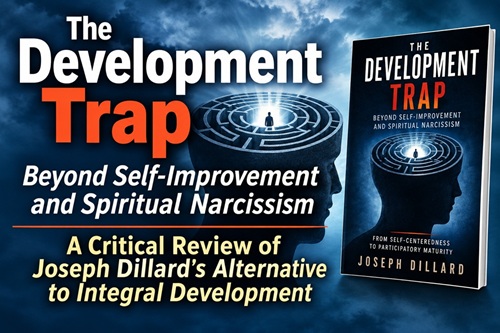 Joseph Dillard's book addresses a paradox that deserves serious attention: why do people who spend decades pursuing psychological development, spiritual awakening, therapeutic healing and higher consciousness not necessarily become wiser, more compassionate, ethically responsible or better equipped to deal with other people? His answer is that contemporary developmental culture has become trapped in its own central assumption. It continues to organize human growth around the improvement of the individual self, even when its declared objective is to transcend that self. This is an interesting and potentially important criticism, particularly because Dillard directs some of his fire at the Integral movement associated with Ken Wilber. Integral theory may offer increasingly sophisticated ways of mapping consciousness, developmental stages and perspectives without necessarily producing corresponding improvements in empathy, emotional maturity or ethical conduct. Dillard proposes an alternative called Integral Deep Listening (IDL). Rather than concentrating on the development, expansion or perfection of the individual, IDL emphasizes the ability to listen to, identify with and participate in multiple perspectives, including those that ordinarily remain outside conscious awareness. The central question for this review is whether Dillard successfully moves beyond the limitations he identifies in existing developmental systems, or whether IDL risks becoming another elaborate developmental framework that reproduces some of the very problems it seeks to overcome. 1. The self as the hidden center of developmentThe book's most important concept is what Dillard calls "psychological geocentrism". Human beings habitually assume that their waking identity is the central organizing authority of experience. Everything is interpreted in relation to the needs, fears, desires, preferences and expectations of that identity. Developmental systems frequently reinforce this arrangement, even when they claim to overcome it. A person becomes increasingly knowledgeable about psychology, spirituality and consciousness, but the knowledge itself becomes incorporated into an enhanced self-image. Dillard identifies several manifestations of this phenomenon. The individual becomes the person who has done the most therapeutic work, accumulated the most spiritual experiences, achieved the highest developmental stage or acquired the most sophisticated understanding of reality. The self has not disappeared. It has acquired a more impressive vocabulary. This is a convincing observation. It also has considerable relevance to the Integral movement. Ken Wilber's AQAL framework offers an elaborate conceptual architecture for understanding developmental stages, states, quadrants, lines and perspectives. Yet intellectual mastery of this architecture does not guarantee corresponding emotional or ethical maturity. Dillard makes an important distinction between two forms of multi-perspectivalism: Cognitive multi-perspectivalism: understanding and coordinating different perspectives intellectually. Empathetic multi-perspectivalism: actually entering into different perspectives, allowing them to challenge one's assumptions and potentially changing one's behavior. The distinction is particularly valuable. Someone can understand another person's worldview without genuinely empathizing with that person. Someone can explain why another developmental stage exists while simultaneously looking down upon those who supposedly occupy it. This is a substantial criticism of Integral culture, where developmental altitude can become a source of status and identity. Dillard is not dismissing the intellectual achievements of Integral theory. He acknowledges its contribution to cognitive multi-perspectivalism. His criticism is that conceptual integration has often received more attention than the development of genuine relational responsiveness. I find this one of the strongest arguments in the book. However, Dillard occasionally risks generalizing from the shortcomings of particular Integral communities to developmental theory as a whole. Developmental hierarchies do not necessarily imply superiority of human worth, and sophisticated stage theories can explicitly distinguish cognitive complexity from ethical conduct. His criticism is most persuasive when directed at the misuse of developmental models rather than their theoretical foundations. 2. Awakening, consciousness and the illusion of spiritual superiorityChapters 2 and 3 address two closely related misconceptions: that profound spiritual experiences automatically transform behavior and that some people permanently operate at superior levels of consciousness. Dillard correctly distinguishes between altered states, their interpretation and their actual integration into everyday life. A mystical experience may produce feelings of unity, timelessness, unconditional love or freedom from ordinary ego boundaries. But the experience does not automatically eliminate emotional conditioning, narcissism, aggression, dependency or unethical behavior. Indeed, the experience can become incorporated into an enhanced spiritual identity. This is particularly relevant to the history of charismatic spiritual teachers. Claims of enlightenment or higher consciousness can create authority structures in which ordinary standards of accountability are suspended. The supposedly awakened individual becomes increasingly difficult to criticize. Dillard's distinction between temporary states and relatively stabilized developmental structures is important here. Experiencing an extraordinary state is not the same as acquiring a lasting capacity to behave differently. His alternative is to replace developmental superiority with what he calls "perspective fluidity" and "dialogical humility". The argument is convincing, although not entirely new. Chögyam Trungpa's concept of spiritual materialism, John Welwood's spiritual bypassing and various critiques of guru narcissism have addressed similar problems. Dillard's contribution is to connect these observations to a more general theory of identity-centered development. 3. Beyond the dualism versus non-dualism debateChapters 4 and 5 are philosophically interesting because Dillard refuses to accept the conventional opposition between dualistic and non-dualistic understandings of reality. He criticizes dualism for treating distinctions generated by human perception, thought and language as absolute features of reality. But he also criticizes non-dualism when it treats distinctions as ultimately irrelevant. The latter can have serious practical consequences. If everything is ultimately One, what happens to the distinction between victim and perpetrator, responsibility and irresponsibility, consent and coercion, or compassion and exploitation? Dillard argues that metaphysical unity must never become an excuse for abandoning ethical discernment. He proposes what might be called functional non-duality: recognizing interdependence while preserving the practical significance of distinctions. This is a welcome correction to simplistic versions of non-dual spirituality. It also avoids the opposite mistake of treating every conceptual distinction as an absolute ontological division. There is, however, a qualification worth making. Not all non-dual traditions make the mistakes Dillard attributes to them. Madhyamaka Buddhism, for example, distinguishes conventional and ultimate truth without simply dismissing the ethical significance of conventional reality. Mahayana Buddhism also traditionally connects emptiness with compassion. Dillard recognizes some of these philosophical distinctions, but his criticism would benefit from more careful differentiation between classical non-dual philosophies and their contemporary popularized versions. Nevertheless, his central point is sound: whatever one's metaphysical convictions, relationships, actions and their consequences remain important. 4. The myth of moral and evolutionary progressChapters 6 and 7 contain some of the book's most consequential arguments. Dillard challenges the assumption that increasing complexity automatically produces moral maturity. Greater intelligence, organizational sophistication and technological development can support cooperation, but they can also facilitate exploitation, manipulation and organized violence. This is an important distinction, particularly for developmental theories that sometimes associate higher cognitive complexity with higher moral development. Cooperation is not synonymous with morality. Highly organized societies can be internally cooperative while remaining externally aggressive. Sophisticated institutions can efficiently coordinate activities that are profoundly destructive. Dillard also challenges the idea that evolution possesses a predetermined direction toward greater consciousness, unity or spiritual fulfillment. Evolution is not a moral project with humanity as its inevitable culmination. It involves variation, adaptation, stabilization, disruption and extinction. There is no guarantee that increasing complexity will produce a better world. This criticism has particular relevance to Wilber's evolutionary metaphysics, in which Eros and Spirit are frequently invoked to explain the apparent movement toward greater complexity and consciousness. Dillard's alternative is more naturalistic: evolutionary processes generate possibilities rather than guarantee purposes. I find this direction persuasive. It avoids turning biological evolution into a disguised religious narrative. There is one qualification, however. The absence of a predetermined evolutionary purpose does not mean that evolutionary processes cannot favor cooperation under particular conditions. Nor does it mean that moral development is impossible. Human beings have evolved capacities for empathy, reciprocity and social cooperation, alongside aggression and domination. Dillard acknowledges this. His strongest argument is therefore not that evolution has nothing to do with morality, but that evolution provides no automatic guarantee of moral progress. That distinction deserves wider recognition in Integral discussions. 5. Healing, authenticity and shadow work: when self-knowledge becomes self-absorptionChapters 8, 9 and 10 extend the central argument into therapeutic and psychological territory. Dillard does not deny the value of psychotherapy, trauma awareness or emotional healing. He explicitly recognizes their importance. His concern is that therapeutic culture can turn the individual into a permanent project of self-repair. The therapeutic self becomes occupied with monitoring symptoms, interpreting emotional reactions, regulating the nervous system and searching for the next unresolved trauma. Healing becomes another form of identity maintenance. His argument about authenticity is similarly interesting. Contemporary culture frequently assumes that expressing one's true feelings constitutes authenticity. But emotional expression does not automatically make someone honest, mature or ethically responsible. A person can use authenticity as an excuse for selfishness, aggression or the refusal to consider other people's needs. Dillard therefore proposes that authenticity should be understood less as loyalty to a supposedly fixed inner self and more as responsiveness to changing perspectives and circumstances. His criticism of shadow work is perhaps even more provocative. The conventional assumption is that integrating disowned psychological material produces greater wholeness. Dillard argues that shadow work can itself become an identity project. Individuals become fascinated with their wounds, darkness, trauma and psychological complexity. Instead of relinquishing identification, they acquire new things with which to identify. His expression "psychological colonialism" describes the tendency of waking identity to appropriate every emerging perspective as another part of itself. Here IDL offers an alternative: rather than immediately interpreting dream figures, emotional reactions and disturbing images as components of one's own personality, temporarily enter their perspectives and allow them to speak. This is an intriguing proposal, although it introduces a problem that deserves further examination: how do we distinguish genuinely unfamiliar perspectives from imaginative constructions that merely appear unfamiliar? Dillard's emphasis on spontaneity and surprise is not sufficient by itself to establish the independent status or objectivity of these perspectives. 6. Manifestation culture and spiritual narcissismChapter 11 is a particularly effective critique of manifestation culture. Dillard argues that the belief that reality reflects one's internal vibration or consciousness can become a particularly insidious form of psychological narcissism. If success reflects positive thinking and abundance consciousness, what does poverty signify? If health reflects energetic alignment, what does illness indicate? If suffering reflects insufficient consciousness, are victims implicitly responsible for their circumstances? Manifestation culture can therefore turn structural problems into personal failures. Economic inequality, historical injustice, collective trauma and environmental destruction disappear behind narratives of individual vibration and personal responsibility. Dillard also identifies the misuse of scientific terminology, particularly quantum physics, to give metaphysical claims an appearance of scientific legitimacy. This is a persuasive criticism of New Thought spirituality and contemporary prosperity culture. Chapter 12 extends the argument to spiritual communities themselves. Shared ideals do not automatically create ethical communities. Groups organized around love, awakening or liberation can develop authoritarian leadership, conformity, dependency, collective self-deception and abuse. Here Dillard makes an important sociological observation: spiritual agreement can become more important than independent judgment. The more a community identifies itself with possession of ultimate truth, the more threatening dissent becomes. The relevant measure of a healthy spiritual community is therefore not the intensity of its shared experiences but its openness to criticism, accountability and correction. 7. The attention economy: a welcome expansion of the argumentChapter 13 takes the discussion beyond individual psychology. Dillard argues that digital platforms increasingly organize human attention around stimulation, emotional reinforcement, identity confirmation and compulsive engagement. More information does not necessarily produce more awareness. Indeed, informational abundance can generate distraction, ideological reinforcement and increasingly repetitive patterns of thinking. This is an important extension of his criticism of self-development culture. The problem is no longer simply that individuals become preoccupied with improving themselves. Their attention is also continuously shaped by commercial systems that benefit from keeping them psychologically engaged. Dillard's distinction between "precipitation" and "sublimation" becomes important here. Precipitation refers to the stabilization and reinforcement of existing identity structures. Sublimation, in his terminology, involves processes that destabilize rigid self-organization and permit new perspectives and possibilities to emerge. His proposed alternative digital culture would encourage ambiguity, reflection, unfamiliar perspectives and less compulsive engagement. This is an appealing vision, although it remains more of a philosophical design proposal than a practical technological blueprint. How would algorithms distinguish genuinely corrective perspectives from misinformation, manipulation or merely contrarian content? How would such systems balance intellectual openness with factual reliability? These questions remain largely unanswered. Nevertheless, the chapter successfully connects individual developmental problems with broader economic and technological structures. 8. Integral Deep Listening: a genuine alternative?The final chapters introduce Dillard's proposed alternative more systematically. Integral Deep Listening is based on the idea that waking identity is only one perspective within a much larger field of experience. Dream figures, animals, objects, bodily symptoms, emotional states and even life problems can be approached as perspectives to be interviewed. The practitioner temporarily disidentifies from ordinary waking identity and identifies with the selected perspective. Rather than interpreting it immediately, the person speaks spontaneously from its position. The interview explores its characteristics, preferences, strengths, weaknesses and relationship to the person. Eventually, the perspective is asked how it would approach the person's actual life problems. The appendix provides a structured protocol. Importantly, Dillard does not intend the process to end with an interesting psychological conversation. The person selects a recommendation, operationalizes it through SMARTER goals and establishes an accountability structure. This practical element deserves appreciation. It introduces behavioral testing into a field frequently dominated by subjective experiences and metaphysical interpretations. But here we reach the book's most important unresolved question. What exactly is being interviewed? Dillard is careful not to describe these perspectives simply as objectively independent entities or ordinary parts of the self. He places them on a continuum between subjectivity and objectivity, emphasizing their relative autonomy. This is an interesting phenomenological position. However, the experience of autonomy does not establish independent agency. When someone speaks as a dream character, an animal or an object, the resulting dialogue is still generated through the person's own imaginative and cognitive processes. It may produce surprising insights, but surprise is not proof of access to an independent intelligence. The distinction matters. IDL could be valuable as a structured method of imaginative perspective-taking, similar in some respects to dialogical techniques used in psychotherapy. Its usefulness does not require the stronger assumption that dream figures possess autonomous intelligence. Furthermore, the protocol includes asking interviewed perspectives to score themselves from zero to ten in confidence, compassion, wisdom, acceptance, inner peace and witnessing. What is the psychometric status of these scores? Are they reliable? Do they predict subsequent behavior? Can different practitioners reproduce comparable results? The book does not adequately answer these questions. Dillard states that the validity of interpretations should be tested through personal and collective research. That is a sensible principle. But the book provides no substantial body of systematic outcome research demonstrating the effectiveness of IDL compared with established therapeutic or developmental approaches. For a methodology presented as an alternative to existing developmental systems, this is a significant limitation. 9. Does IDL escape the development trap?There is a deeper problem here. Dillard criticizes existing developmental systems for creating hierarchies, specialized vocabularies, professional identities and claims of superior understanding. Yet IDL has its own specialized vocabulary, its own developmental terminology, its own interviewing protocol and its own accreditation structure, with interviewer, coach, practitioner and trainer levels. It also employs numerical self-assessments of qualities such as wisdom and compassion. None of these features is inherently problematic. A methodology needs terminology, training and professional standards. But they create precisely the institutional conditions under which a new developmental identity can emerge. Could someone become an accomplished IDL practitioner while remaining trapped in developmental narcissism? Certainly. Could IDL itself become a new identity project, in which practitioners regard themselves as more participatory, empathetic or developmentally flexible than those who have not adopted the method? That possibility is not sufficiently explored. Dillard needs to demonstrate not merely that IDL can identify the limitations of other developmental systems, but that it possesses effective safeguards against reproducing those limitations. Otherwise, the development trap may simply acquire a new name. 10. An AI-assisted book about participatory intelligenceOne aspect of the book deserves special mention. Dillard openly acknowledges that ChatGPT played a significant role in organizing, expanding, refining and editing the manuscript. He describes AI as a dialogical partner rather than an author in the human sense. This is a welcome example of intellectual transparency. There is also an interesting relationship between this writing process and the book's central thesis. Dillard argues that intelligence is not exclusively individual but can emerge through dialogue among different perspectives and systems. His collaboration with AI provides an example of that proposition. At the same time, he correctly acknowledges that AI can produce superficial coherence, false confidence, conceptual inflation and persuasive nonsense. That warning is particularly relevant to this manuscript. The book is impressively comprehensive, but its recurring conceptual formulations sometimes create an impression of greater theoretical precision than has actually been established. Its chapters frequently revisit the same central argument using slightly different terminology. The repeated chapter conclusions, explanatory formulations and knowledge quizzes also give the book something of a teaching-manual character. A more rigorous editorial revision could have reduced repetition, clarified the relationship between the central concepts and provided more room for sustained engagement with opposing arguments. There are important ideas here, but they sometimes become buried beneath their own elaboration. Conclusion: A valuable diagnosis, an unfinished alternativeThe Development Trap is an ambitious and worthwhile contribution to contemporary criticism of spiritual and developmental culture. Its central insight is that development can become self-defeating when it remains organized around the enhancement of individual identity. People can become more psychologically sophisticated without becoming more compassionate, responsible or capable of cooperation. This is a particularly relevant criticism of Integral theory. The ability to understand multiple perspectives does not necessarily imply the ability to empathize with them. Knowledge of developmental stages does not establish moral superiority. Spiritual awakening does not guarantee psychological integration. And evolutionary complexity does not automatically produce ethical progress. Dillard is at his strongest when exposing these distinctions. His discussions of spiritual narcissism, non-dual bypassing, manifestation culture, therapeutic self-absorption and the attention economy are often perceptive. His rejection of automatic evolutionary teleology is also an important corrective to developmental metaphysics. However, the book is less convincing when it moves from diagnosing existing problems to presenting Integral Deep Listening as their solution. IDL offers an interesting methodology for exploring dreams, emotions, symptoms and alternative perspectives. Its emphasis on dialogue, disidentification and behavioral experimentation deserves serious consideration. But its theoretical assumptions about relatively autonomous perspectives require clarification, its effectiveness requires systematic evaluation, and its own institutional and developmental structures deserve critical examination. There is also a danger that Dillard's broad concept of narcissism becomes too encompassing. If nearly every form of self-improvement, authenticity, healing, shadow integration or spiritual practice can become narcissistic, the concept risks losing its discriminating power. We need clearer criteria for distinguishing healthy self-development from pathological self-preoccupation. Ultimately, I would distinguish between three achievements of this book. First, its diagnosis is stronger than its proposed remedy. Dillard has identified a genuine weakness in contemporary developmental culture, but has not yet demonstrated that IDL overcomes it. Second, its critique of Integral theory is more convincing than its implicit replacement of it. The distinction between cognitive and empathetic multi-perspectivalism is important, but it need not require abandoning developmental theory. It could instead become a corrective within a more critically self-aware Integral framework. Third, its most valuable contribution may be a change in the criteria by which we judge development. Rather than asking how spiritually advanced, psychologically integrated or intellectually sophisticated someone has become, we should ask how they actually behave when confronted with disagreement, vulnerability, uncertainty, competing interests and the needs of others. This brings us back to the paradox with which Dillard begins his book. Perhaps the problem with endless self-development is not that people have failed to develop themselves sufficiently. Perhaps it is that they have spent too much time developing themselves and too little time participating in the world. That is a proposition worth taking seriously. But there is one final question Dillard himself should be willing to entertain: Can Integral Deep Listening become so successful at teaching people to decentralize their identities that they eventually become identified with being people who have transcended identity? If so, the development trap has not been escaped. It has merely become more sophisticated. And that, ironically, would be the most important test of Dillard's own methodology. Appendix: If Development Involves Decentering, Doesn't That Solve the Problem?There is an important qualification to my criticism of Dillard's book. If development is understood not as the endless improvement of the individual self, but as the gradual decentering of that self, hasn't the central problem already been solved? In fact, this is precisely the alternative Dillard proposes. He is not arguing against development as such. He is arguing against development organized around self-centrality. This distinction matters. Development need not mean becoming increasingly sophisticated, conscious, healed, authentic, or spiritually advanced. It can mean becoming less identified with one's existing self-image, beliefs, emotional certainties, and preferred interpretations. The self does not disappear; it loses its privileged position. We become more capable of recognizing that our perspective is partial, that other perspectives may correct it, and that reality does not revolve around our personal development. Dillard's distinction between cognitive and empathetic multi-perspectivalism is particularly useful here. A person may understand numerous perspectives, construct elaborate systems, and even explain the limitations of their own worldview, while remaining emotionally defensive and behaviorally self-centered. Genuine decentering requires something more demanding: allowing other perspectives to affect us, challenge our assumptions, and change how we relate to others. It is not simply the ability to see through one's own limitations, but the willingness to be corrected by what lies beyond them. The Difference Between Decentering and Another AchievementYet a difficulty remains. Decentering can itself become a developmental achievement around which a new identity is constructed. One can become proud of being less self-centered, more open, more empathetic, or more participatory than other people. The old hierarchy of spiritual attainment can return in the language of having transcended spiritual attainment. The self has not disappeared; it has acquired a more sophisticated description. This is not merely a theoretical possibility. It is the very danger Dillard identifies throughout his book: the capacity of self-centeredness to reproduce itself in apparently more advanced forms. Consequently, claiming to have decentered is no evidence that decentering has actually occurred. Dillard is aware of this problem. His proposed corrective is to evaluate development behaviorally rather than by subjective states or claims of realization. Does a person respond differently to criticism? Can they acknowledge mistakes without immediately defending their identity? Are they more capable of listening to people with whom they disagree? Do they show greater reciprocity, accountability, flexibility, and cooperation? Can they remain engaged when their preferred interpretation is challenged? These are much better criteria than developmental self-assessments. They shift attention from how advanced someone feels to what happens in actual relationships and shared situations. Dillard's emphasis on service and participation is especially relevant: attention moves from the recurring question, "How am I developing?" toward the more outward-looking question, "What is needed here?" A Solution in Principle, a Test in PracticeSo, yes: decentering provides a convincing conceptual answer to the development trap. It preserves the possibility of genuine development while rejecting the assumption that development must culminate in a more impressive, complete, or spiritually elevated self. It also brings Dillard close to an important insight in developmental psychology: growth can involve making previously unquestioned identifications objects of reflection rather than remaining unconsciously organized by them. But this conceptual solution does not automatically validate Integral Deep Listening as the means of achieving it. The further question is whether IDL reliably produces greater decentering, and whether that change can be demonstrated in conduct over time. The book offers a detailed methodology and a persuasive rationale, but the case for its effectiveness would be strengthened by systematic outcome research and independent assessment of changes in behavior and relationships. The most defensible conclusion, therefore, is not that Dillard has failed to solve the problem he identifies. He has articulated a plausible solution: development as increasing responsiveness beyond the self. The remaining challenge is to demonstrate that his method achieves this, and that it does not turn decentering into yet another badge of developmental superiority. Perhaps the best test of development is ultimately a deceptively simple one: Are we becoming less preoccupied with how developed we are, and more capable of participating responsibly in a world that does not revolve around us?
Comment Form is loading comments...
|