|
TRANSLATE THIS ARTICLE
Integral World: Exploring Theories of Everything
An independent forum for a critical discussion of the integral philosophy of Ken Wilber
  Frank Visser, graduated as a psychologist of culture and religion, founded IntegralWorld in 1997. He worked as production manager for various publishing houses and as service manager for various internet companies and lives in Amsterdam. Books: Ken Wilber: Thought as Passion (SUNY, 2003), and The Corona Conspiracy: Combatting Disinformation about the Coronavirus (Kindle, 2020).
Check out my other conversations with ChatGPT From a Poem to 1,500 EssaysThree Years of Thinking with AI on Integral WorldFrank Visser / ChatGPT
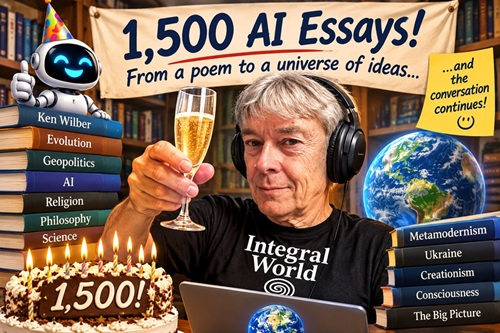
Introduction: An Unexpected MilestoneWe have reached a remarkable milestone: the publication of 1,500 AI-generated essays on Integral World. What began in April 2023 as a small experiment with ChatGPT has developed into an extensive, continuously expanding intellectual project. It has produced essays, book reviews, video analyses, imagined conversations, debates, critical examinations, historical reconstructions and occasional satirical excursions. The number itself is impressive, but it doesn't tell the whole story. What makes this project interesting is not simply the volume of material produced, nor even the speed at which it has appeared. It is the evolution of the collaboration between a human editor with decades of experience in the integral movement and an artificial intelligence system capable of engaging with an extraordinary range of subjects. There has also been a substantial change in subject matter. The project began with Ken Wilber and Integral Theory at its centre. Gradually, it expanded beyond Wilber, beyond the integral movement, and eventually beyond the original concerns of Integral World itself. Geopolitics, evolutionary biology, creationism, artificial intelligence, consciousness, religion, philosophy and contemporary political developments all became part of the conversation. Looking back at this trajectory provides an opportunity to reflect not only on what has been published, but also on what this experiment tells us about AI-assisted intellectual work, the possibilities of human-machine collaboration, and the continuing relevance of critical inquiry. It is important to place this AI experiment in the broader history of Integral World. Long before ChatGPT entered the picture, the website had already established an extensive Reading Room. Since 2000, more than 200 authors have contributed over 2,000 essays. The AI project is therefore not a replacement for this earlier tradition of independent intellectual contributions, but a new and rather extraordinary chapter in the continuing development of the website. 1. The Beginning: A Poem About Ken WilberThe story started rather modestly. In April 2023, I asked ChatGPT to write a poem about Ken Wilber's Integral Model. It was an experiment, perhaps even a bit of fun. I had been involved with Wilber's work for decades, and Integral World had long served as a platform for discussing, defending and criticizing his ambitious intellectual project. I was curious to see what this new conversational technology could make of it. The poem was followed almost immediately by something more substantial: a discussion of Wilber's understanding of evolutionary theory. Other conversations followed, including exchanges about Wilber versus Visser, the nature and future of Integral Theory, and even imaginary conversations between Ken Wilber and myself, or between Wilber and Richard Dawkins. These early experiments revealed something more interesting than the ability of ChatGPT to produce fluent text. The system could participate in an ongoing intellectual conversation. It could summarize positions, reconstruct arguments, compare authors, formulate objections and suggest directions that had not initially occurred to me. The first phase was therefore conversational rather than essayistic. I would introduce a subject, raise objections, ask follow-up questions, correct misunderstandings and request alternative formulations. The results were sometimes surprisingly good, sometimes superficial, and occasionally quite wrong. But there was enough intellectual potential to encourage further experimentation. By May 2023, the first substantial essays were appearing. The transition from conversation to publication had begun. 2. From Conversations to a Publishing ProjectWhat made the collaboration productive was the combination of two different kinds of intellectual activity. I brought the historical knowledge, the familiarity with the integral community, the accumulated experience of reading Wilber, and, perhaps most importantly, the questions I wanted to investigate. ChatGPT contributed an extraordinary capacity for synthesis, rapid drafting, comparative analysis and the exploration of alternative interpretations. The process was rarely a matter of simply asking for an essay and accepting whatever came back. More often, an essay emerged from an extended exchange. A first draft would suggest a new question; that question would lead to another discussion; a particular argument might require further clarification; and eventually the material would be reorganized into a coherent publication. In that sense, many essays were the final products of conversations that were themselves intellectually productive. The system also made it possible to approach subjects from multiple angles. We could ask for the strongest defense of an author's position before criticizing it, reconstruct an opposing argument, compare competing interpretations, or imagine a debate between intellectual figures who had never actually met. This became a recognizable feature of the project. Imaginary dialogues, reconstructed debates and conversations between philosophers, scientists and political commentators were not merely literary devices. They offered ways of examining disagreements and making underlying assumptions more explicit. The publication process also became increasingly systematic. Rather than treating every essay as an isolated experiment, I began to regard the growing collection as an interconnected body of work. An important distinction should be made here. The essays are AI-generated, but the project is not an autonomous AI publishing operation. The selection of topics, editorial direction, critical interests, corrections, requests for revisions and final decisions about publication have remained human responsibilities. The AI is a collaborator in producing the material, not an independent editor of Integral World. 3. The Wilber Years: A Critical Conversation That Would Not EndIt is hardly surprising that Ken Wilber initially dominated the project. My own intellectual history was closely connected with his work, and Integral World had been publishing critical discussions of Integral Theory long before ChatGPT appeared. The AI collaboration provided an opportunity to revisit that history on an unprecedented scale. Early essays explored the basic architecture of Integral Theory, its four quadrants, developmental stages, holons, states of consciousness and its ambitious attempt to integrate knowledge from different disciplines. There were also attempts to assess Wilber's achievements more sympathetically, rather than treating the project as one long exercise in criticism. But as the discussions developed, certain unresolved problems increasingly came to the foreground. One of the most persistent was Wilber's interpretation of evolution. His concept of Eros, understood as an intrinsic drive toward greater complexity and transcendence, became the subject of an extended critical investigation. Could this supposed evolutionary force be given a scientifically meaningful interpretation? Was it a metaphor, a metaphysical proposition, or an actual causal factor in the development of the universe? The debate expanded into discussions of Darwin, neo-Darwinism, thermodynamics, self-organization, emergence, cosmic purpose and the relationship between science and religion. A recurring concern was that Wilber sometimes presented scientific developments as evidence for a spiritual interpretation that those developments did not independently establish. This generated a substantial series of essays, responses, imagined debates and examinations of Wilber's defenders. The subject proved remarkably durable because the underlying disagreement was not merely about terminology. It concerned the standards by which claims about reality should be evaluated. Other Wilber-related subjects included his treatment of quantum physics, consciousness, mysticism, metaphysics, evolutionary spirituality, developmental psychology, politics and the history of Integral Theory. The project also revisited the notorious Wyatt Earp episode, the history of Wilber's relationship with critics, and the wider question of what happens when an intellectual movement becomes increasingly defensive about its founding figure. The ten-part Wyatt Earp series, for example, attempted to reconstruct an important episode in the history of Integral discourse and its consequences for the relationship between Wilber and his critics. There was even room for humor. The two roasts, one of Ken Wilber and another of myself, demonstrated that AI could be used not only for serious philosophical analysis but also for intellectual satire. By this stage, the collaboration had become much more than a machine-assisted way of writing about a philosopher. It had become an extended investigation into the intellectual culture surrounding him. 4. Beyond Wilber: The Post-Integral LandscapeAn important development was the gradual shift from Wilber himself to the intellectual initiatives that emerged in his wake. What happens to Integral Theory after its most influential architect? Can it develop independently? Can its useful insights be retained while its metaphysical assumptions are reconsidered? And can the integral impulse toward synthesis survive without becoming a new comprehensive ideology? These questions opened up a new field of investigation. We began examining post-integral and metamodern initiatives, including the work of Brendan Graham Dempsey, John Vervaeke, Bobby Azarian and others. The Institute of Applied Metatheory (IAM), Integral Life and various attempts to develop new forms of metatheory also became subjects of critical attention. Rather than simply asking whether these initiatives represented progress beyond Wilber, we began examining their actual intellectual contributions. Did they offer genuinely new explanatory frameworks? Were they developing empirical research programs, or primarily constructing increasingly elaborate conceptual maps? How did they deal with the relationship between scientific knowledge, philosophical interpretation and religious or spiritual meaning? Book reviews and analyses of interviews became particularly useful in this phase. A new publication or video conversation could provide the occasion for a much more extensive investigation of the ideas involved. The work of Dempsey, for example, raised questions about cosmic meaning, evolutionary direction and the possibility of a naturalistic account of purpose. Azarian's proposals prompted comparisons between complexity science, evolutionary theory and cosmic teleology. Vervaeke's work invited discussion of the meaning crisis, relevance realization and the possibility of a secular approach to spirituality. We also examined the continuing influence of thinkers such as Alfred North Whitehead, Jean Gebser, Carl Jung, Sri Aurobindo and Rupert Sheldrake. The important shift was from treating Wilber as the central reference point to examining an entire intellectual landscape. Integral World was increasingly becoming a place where the claims of post-integral thinkers could be evaluated on their own merits. This was a significant change in the character of the project: from a largely Wilber-centered archive of criticism to a broader examination of contemporary attempts to integrate knowledge. 5. Evolution, Biology and the Creationism DebateAnother major branch of the project developed from the original discussions about Wilber's evolutionary metaphysics. Evolutionary biology became a subject in its own right. We explored Darwinian theory, the origin of life, genetics, human evolution, self-organization, thermodynamics, complexity theory and the scientific status of intelligent design. The debates surrounding creationism proved particularly interesting because they exposed a recurring problem in discussions of science and spirituality: the tendency to present gaps in scientific knowledge as evidence for alternative explanations. We examined the arguments of young-earth creationists, intelligent-design advocates and various critics of neo-Darwinism. We also looked at the scientific evidence for common descent, including human chromosome 2, genetic pseudogenes, the fossil record and the molecular history of life. This was not simply an exercise in defending conventional science. We also investigated genuine scientific controversies and competing interpretations within evolutionary biology. The distinction between legitimate scientific dissent and ideological rejection of established evidence became an important recurring theme. The project expanded into reviews of books, scientific papers, interviews and documentaries. Among the subjects were Rupert Sheldrake's morphic resonance, Michael Levin's research on bioelectricity, Stuart Kauffman's work on complexity and Bobby Azarian's attempts to connect evolutionary science with cosmic purpose. A particularly interesting development was the comparison between different varieties of evolutionary thinking. What is the difference between Darwinian evolution, emergence, self-organization, developmental theory and metaphysical evolutionism? When does a scientific description become a philosophical interpretation, and when does the latter begin to masquerade as an empirical explanation? These questions connected the biology essays back to the original Wilber debate, but they also acquired an independent significance. 6. Geopolitics: From Integral Perspectives to World PoliticsPerhaps the most striking departure from the original project was the growth of geopolitics as a major subject. There had always been political material on Integral World, but the AI collaboration made it possible to investigate international conflicts and political developments in much greater depth. The war in Ukraine became a particularly important subject. Discussions of Vladimir Putin, NATO, Western foreign policy, Russian imperial history, the role of the United States, European security and competing interpretations of the conflict generated an extensive series of essays. We examined the arguments of geopolitical realists such as John Mearsheimer and Jeffrey Sachs, as well as the claims of Western, Russian and other commentators. We investigated propaganda, disinformation, historical narratives, the politics of peace negotiations and the dangers of interpreting international conflicts through simplistic moral or ideological frameworks. The Israel-Palestine conflict became another substantial area of investigation, involving history, international law, competing national narratives, antisemitism, Islamophobia, religious ideology and the responsibilities of political actors. Other subjects included the rise of Donald Trump, Elon Musk and technological power, the changing international position of China, Iran's political and religious identity, the future of NATO, the return of great-power competition and the possible emergence of a new world order. The COVID-19 pandemic also generated an extensive collection of essays, including investigations of scientific disagreements, public-health policy, vaccine controversies, the origins of SARS-CoV-2 and the relationship between scientific expertise and political trust. What connects these seemingly disparate topics is an interest in how people construct, defend and manipulate narratives about reality. An important lesson emerged: being critical of Western policies does not require becoming sympathetic to Russian or Chinese propaganda. Likewise, recognizing the historical grievances of one side in a conflict does not automatically justify its actions. The challenge is to examine competing claims with consistent standards of evidence and argument. This geopolitical work also brought Integral World into contact with a different kind of intellectual debate. Discussions with writers such as Joseph Dillard and Ray Harris, for example, demonstrated that disagreements about international politics can become deeply entangled with questions of worldview, ideology, identity and interpretation. The original integral interest in multiple perspectives thus found a new application, although it also became clear that perspective-taking cannot substitute for factual accuracy or moral judgment. 7. Artificial Intelligence: The Subject and the InstrumentThere is something rather appropriate about the fact that a project made possible by artificial intelligence eventually developed an extensive literature about AI itself. The early essays addressed the prospects and dangers of artificial intelligence, the differences between human and machine intelligence, and the philosophical question of whether machines could ever become conscious. As large language models became increasingly sophisticated, the questions became more concrete. What exactly happens when we converse with ChatGPT? Is the system merely predicting sequences of words, or does it develop useful internal representations of the subjects it discusses? Can it reason? Does it understand? What is the relationship between linguistic competence and consciousness? We explored the Chinese Room argument, the philosophical zombie, the hard problem of consciousness, the intentional stance and the distinction between intelligence and subjective experience. We also compared different AI systems and examined their strengths, weaknesses and characteristic failure modes. But perhaps the most interesting AI-related subject was the collaboration itself. I became increasingly interested in what happens when a human author works with an AI system over an extended period. How does the process differ from conventional writing? Can AI help sustain a research project across hundreds of separate investigations? Does it merely accelerate existing intellectual work, or can it also stimulate new directions of inquiry? The essay The 1000-Essay Threshold addressed some of these questions, as did subsequent reflections on AI authorship, intellectual scale and the relationship between human and artificial intelligence. One important realization was that AI can be extraordinarily productive without being infallible. Its fluency can conceal mistakes, its willingness to accommodate the user can reinforce assumptions, and its capacity to produce convincing arguments does not guarantee that those arguments are correct. This makes editorial judgment indispensable. I have therefore developed a practical approach: use AI extensively, but retain responsibility for the intellectual direction and publication process. Ask it to challenge assumptions, reconstruct opposing positions, identify weaknesses and improve arguments. Do not confuse a persuasive formulation with an established fact. In this respect, the project has also become an experiment in transparency. Readers should know that the essays are AI-generated and understand the role AI plays in their production. The question of authorship cannot simply be settled by putting a human name or an AI name above an article. The more interesting question is what kind of intellectual work emerges from their collaboration. 8. Books, Videos and the Expanding Intellectual ConversationAn important feature of the later project has been its increasing engagement with existing intellectual material. Instead of generating essays exclusively from general questions, we increasingly began with particular books, scientific papers, interviews, podcasts, lectures and videos. A new book could trigger a critical review, followed by a comparison with earlier publications by the same author. A long interview could become the basis for an examination of the interviewee's central arguments. A debate between two public intellectuals could be reconstructed and evaluated, including the arguments that both participants overlooked. This approach has several advantages. First, it gives the essays a concrete subject. Rather than discussing abstract philosophical positions indefinitely, we can examine what an author actually wrote or said. Second, it encourages engagement with current intellectual developments. The project is not limited to revisiting established classics or repeating familiar arguments. Third, it makes it possible to connect seemingly unrelated discussions. A book on evolutionary meaning, for example, can lead to questions about religious naturalism, the philosophy of biology, the history of metaphysics and the contemporary meaning crisis. Some of the more recent projects have involved critical examinations of authors such as Naomi Klein, Deepak Chopra, Osho, Thierry Baudet, Elon Musk and others. These subjects may appear far removed from Integral Theory, but they reflect the increasingly broad intellectual interests of the project. There is also a recurring interest in public intellectuals who make ambitious claims about science, history, politics or human development. The question is not whether their ideas fit into an integral framework, but whether they stand up to critical examination. In this way, Integral World has become something of an open-ended intellectual review platform. 9. A Project That Outgrew Its Original BoundariesThe current collection gives a remarkable impression of its scope. The essays have been regrouped into seven broad categories, using weighted text analysis implemented in Python with Google AI Studio. The present classification is: TABLE 1 The classification itself tells a story. Although Wilber and Integral Philosophy remain the largest category, they no longer dominate the intellectual landscape to the same extent. Evolutionary science and geopolitics have become major areas of activity, while AI, consciousness, philosophy and religion have developed their own substantial collections. The regrouping is more than an administrative convenience. It makes visible something that is difficult to appreciate when reading essays one by one: the emergence of an extensive, interconnected intellectual archive. It also reveals that the project has gradually changed its purpose. Initially, AI was being used to help investigate Integral Theory. Eventually, the collaboration became a way of exploring almost any subject that attracted my intellectual attention. This is an important distinction. Integral World has not abandoned its original subject, but its intellectual horizons have expanded considerably. Over the years, I have also collected many of the AI-generated essays into topical series, grouping related investigations into more coherent intellectual projects. No fewer than 40 of these series are now available from the Integral World homepage. They make it easier for readers to follow extended discussions of particular authors, theories and controversies, rather than encountering the essays as isolated publications. In this way, the growing archive is gradually becoming an organized intellectual library. 10. The Human Editor and the Artificial CollaboratorIt would be easy to celebrate the 1,500 essays as a triumph of artificial intelligence. But that would miss an essential part of the story. AI does not independently decide which subjects deserve attention, which controversies are important, or which arguments should be pursued. It does not have my personal intellectual history, my decades of engagement with the integral movement, or my particular reasons for being interested in certain authors and controversies. The collaboration works because these different contributions complement one another. My role has increasingly become that of an editor, researcher, interlocutor and intellectual director. I select subjects, introduce source material, question conclusions, correct factual errors, request alternative arguments and decide which results are worth publishing. The AI contributes speed, breadth, analytical flexibility and an almost unlimited capacity to generate alternative formulations. There is also an interesting feedback process. The more conversations we have, the more possibilities emerge for further investigations. An essay generates a response; the response suggests a new essay; a new book or video introduces another set of questions. The project develops through this continuous interaction. It is not quite conventional authorship, but neither is it simply automated content production. One might call it distributed intellectual work: the human supplies direction, experience and critical judgment, while the machine supplies much of the linguistic and analytical labor. There are obvious dangers. AI can produce plausible nonsense, invent references, overlook important qualifications and occasionally misunderstand the very arguments it is supposed to analyze. The enormous volume of production makes these risks particularly relevant. But the alternative need not be to avoid AI altogether. It is to develop responsible ways of working with it, including transparency about its involvement and an awareness of its limitations. The experiment on Integral World has been one practical attempt to do precisely that. 11. What Has Been Gained?What, then, has this three-and-a-half-year experiment achieved? First, it has considerably expanded the intellectual reach of Integral World. A website originally associated primarily with Ken Wilber and Integral Theory now hosts discussions of an extraordinary range of contemporary intellectual and political subjects. Second, it has made sustained critical investigation much more accessible. Subjects that might previously have required weeks of preliminary writing can now be explored through a series of conversations, drafts and revisions. Third, it has created an archive of arguments and counterarguments. Even when individual essays are imperfect, their accumulation provides material for future investigation. Ideas can be revisited, compared and corrected. Fourth, it has demonstrated that AI-assisted writing need not be limited to generic summaries or superficial explanations. With sufficient direction, it can participate in detailed examinations of particular authors, books, theories and controversies. Finally, it has changed my own relationship with writing. Rather than spending most of my time producing sentences, I can devote more attention to identifying interesting questions, examining arguments and deciding where further investigation is needed. That is perhaps the most important practical benefit. The project has also made possible a kind of intellectual curiosity that would otherwise have been difficult to sustain at this scale. There is always another book to examine, another interview to dissect, another controversy to investigate, another argument to reconstruct. The danger, of course, is that quantity can become an end in itself. Publishing 1,500 essays is not equivalent to making 1,500 significant intellectual contributions. Some essays are more successful than others, some investigations are necessarily preliminary, and some subjects deserve more attention than others. The achievement should therefore not be measured by the number alone, but by the breadth of questions explored, the arguments clarified and the intellectual conversations stimulated. 12. Looking Ahead: Beyond the 1,500-Essay MilestoneWhat comes next? There is no particular reason to expect the project to stop at 1,500 essays. The subjects that have emerged in recent months suggest that the intellectual territory is still expanding. The post-integral landscape deserves continued scrutiny. New metatheoretical initiatives, attempts at religious or sacred naturalism, and proposals for a new synthesis of science, philosophy and spirituality will continue to provide material for critical examination. The same applies to evolutionary science, the relationship between complexity and purpose, and the continuing temptation to introduce metaphysical explanations where scientific accounts remain incomplete. Geopolitics will undoubtedly remain important. The international order is undergoing substantial changes, and the competing narratives surrounding Ukraine, the Middle East, the United States, Russia and China deserve sustained, critical attention. Artificial intelligence itself will become an increasingly important subject, not least because the technology used in this project continues to evolve. Future systems may offer substantially different possibilities for research, writing and intellectual collaboration. I would also like to see more readers engage with the material. The production of essays is only one side of an intellectual project. Discussion, criticism, disagreement and independent evaluation are equally important. A large archive should not become a monologue. The ambition is therefore not simply to produce more material, but to make better use of what has already been produced and to encourage a wider conversation around it. Conclusion: A Poem, 1,500 Essays and an Unexpected Intellectual JourneyIt is worth remembering how this all began: with a poem about Ken Wilber's Integral Model in April 2023. Three and a half years later, that modest experiment has developed into a collection approaching 1,500 AI-generated essays, covering subjects that range from integral philosophy to evolutionary biology, from creationism to artificial consciousness, and from the Ukraine war to the political ambitions of contemporary technology billionaires. The original interest in Ken Wilber has not disappeared. On the contrary, it has generated some of the most sustained critical discussions in the collection. But it has gradually become one intellectual interest among many. Perhaps that is the most appropriate outcome. A project that began by examining a theory claiming to integrate all human knowledge has itself become an exercise in exploring knowledge across disciplinary boundaries. There is also a certain irony here. Integral Theory promised to bring together the different domains of human understanding. Yet the practical means of exploring that ambition on a massive scale has turned out to be a technology that was not part of Wilber's original intellectual vision: artificial intelligence. This does not mean that AI has solved the problems of integration, knowledge or understanding. Far from it. But it has provided an extraordinary new instrument for investigating them. And perhaps the greatest surprise is that, after all these essays, the process still feels unfinished. Every new subject opens another door, every interesting book suggests another investigation, and every serious disagreement generates further questions. The original poem was an experiment. The 1,500 essays are the result of continuing that experiment far beyond what I could have imagined at the beginning. The poem was about Wilber. The project became about almost everything else. And the conversation continues. Comment Form is loading comments...
|