|
TRANSLATE THIS ARTICLE
Integral World: Exploring Theories of Everything
An independent forum for a critical discussion of the integral philosophy of Ken Wilber
  Frank Visser, graduated as a psychologist of culture and religion, founded IntegralWorld in 1997. He worked as production manager for various publishing houses and as service manager for various internet companies and lives in Amsterdam. Books: Ken Wilber: Thought as Passion (SUNY, 2003), and The Corona Conspiracy: Combatting Disinformation about the Coronavirus (Kindle, 2020).
Check out my other conversations with ChatGPT Thucydides on the Strong and the WeakThe Brutal Logic of Power PoliticsFrank Visser / ChatGPT
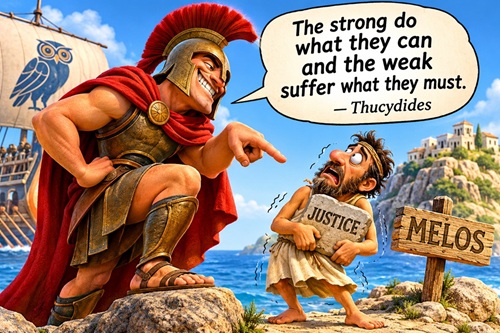
Introduction: A Maxim That Has Outlived Its AuthorFew statements in the history of political thought have proved as enduring, unsettling, and relevant as the famous observation attributed to the ancient Greek historian Thucydides: “The strong do what they can and the weak suffer what they must.” This sentence, usually associated with the so-called Melian Dialogue in Thucydides' History of the Peloponnesian War, has become one of the foundational expressions of political realism. It captures a fundamental problem of international relations: what happens when the interests of powerful states collide with the rights and wishes of weaker ones? Written more than 2,400 years ago, Thucydides' account of the confrontation between Athens and the small island of Melos still speaks to contemporary international politics. It invites us to examine the relationship between military power, political morality, national sovereignty, and the limits of international law. But the maxim deserves careful interpretation. Is Thucydides endorsing the ruthless exercise of power, merely describing how international politics works, or warning readers about the dangers of imperial arrogance? To understand its significance, we must return to the historical circumstances in which it was formulated. 1. The Historical Background: Athens and SpartaThucydides (c. 460-400 BCE) was an Athenian general and historian who chronicled the Peloponnesian War (431-404 BCE), the prolonged conflict between Athens and Sparta and their respective allies. The war represented a struggle between two competing Greek powers. Athens had developed an impressive maritime empire, supported by its powerful navy, commercial wealth, and political influence. Sparta, by contrast, was primarily a land-based military power with a conservative political system and a network of allies. The conflict was not simply a military confrontation. It involved competing political systems, strategic interests, alliances, fears, and ambitions. Thucydides famously suggested that the underlying cause of the war was the growth of Athenian power and the fear this generated in Sparta. This observation has become another cornerstone of political realism: rising powers can threaten established powers, generating insecurity and eventually war. The Melian episode took place in 416 BCE, during a period when Athens was still powerful and confident, although the war had not yet reached its conclusion. Melos was a small island in the Aegean Sea. Its inhabitants were descendants of Spartan settlers and wished to remain neutral in the conflict. Athens, however, demanded that Melos submit to its authority. When the Melians refused, Athens sent a military expedition to force their submission. 2. The Melian Dialogue: A Conversation Without EqualityThucydides presents the confrontation as a dialogue between Athenian representatives and the leaders of Melos. The Athenians insist that the discussion should not concern abstract questions of justice, morality, or historical legitimacy. They want to discuss what is practically possible under the existing balance of power. Their argument is brutally straightforward: justice matters only when the parties involved possess roughly equal power. When one side is overwhelmingly stronger, the question of justice becomes largely irrelevant to the outcome. The Athenians argue that the Melians should recognize their inferior position and surrender rather than expose themselves to destruction. The Melians resist this reasoning. They appeal to justice, fairness, their independence, and their expectation that the gods will support their cause. They also hope that Sparta, their ancestral ally, will eventually come to their assistance. The Athenians dismiss these expectations as unrealistic. They argue that Sparta will not risk its own security for a small and strategically insignificant island. The confrontation thus becomes a philosophical debate between two fundamentally different perspectives. The Athenians represent political realism: power determines what is possible, and survival requires an honest assessment of one's position. The Melians represent a moral and legal perspective: political independence and justice should not simply disappear because a stronger neighbor demands submission. The dialogue is particularly revealing because the two parties are not really negotiating as equals. The Athenians are not offering a mutually acceptable compromise. They are explaining the consequences of refusing their demands. 3. What Does the Famous Maxim Actually Mean?The famous sentence is often quoted in isolation: “The strong do what they can and the weak suffer what they must.” Its meaning is not that powerful states are morally entitled to do whatever they wish. Rather, it describes the absence of an effective authority capable of compelling powerful states to respect the rights of weaker ones. In domestic societies, governments establish laws, courts, and institutions to regulate relations between individuals. Even powerful citizens are theoretically subject to the same legal framework as everyone else. International politics is different. There is no universally effective world government capable of enforcing international law against every sovereign state, especially the most powerful ones. Consequently, states must often rely on their own military capabilities, diplomatic relationships, economic resources, and alliances to protect their interests. This creates a fundamental asymmetry. A small country may possess perfectly legitimate legal and moral claims, but these claims do not automatically translate into the ability to defend itself. The Melian Dialogue illustrates this uncomfortable distinction between what is right and what can actually be enforced. It also exposes a recurring problem in international politics: the difference between formal sovereignty and effective sovereignty. A country may be legally independent while remaining vulnerable to coercion by a stronger neighbor. 4. The Tragic Outcome of MelosThe Athenians eventually abandoned diplomacy and proceeded with military action. Melos was besieged and conquered. According to Thucydides, the Athenians killed the adult male population and enslaved the women and children. The island was subsequently settled by Athenian colonists. The outcome was a devastating demonstration of the power imbalance that had structured the dialogue from the beginning. The Melians had appealed to justice, divine protection, and Spartan solidarity. None of these considerations prevented their defeat. Yet the episode contains an additional irony. In 415 BCE, just one year after the destruction of Melos, Athens launched its disastrous Sicilian Expedition. The ambitious attempt to conquer Syracuse and extend Athenian influence in Sicily ended in military catastrophe. The Athenian expeditionary force was destroyed, and Athens suffered an enormous loss of manpower, ships, and resources. The empire that had appeared so invulnerable in its dealings with Melos was itself vulnerable to strategic miscalculation, overconfidence, and the limits of military power. Thucydides' larger historical narrative therefore complicates the apparent lesson of the Melian Dialogue. Power is real, but it is not unlimited or permanent. 5. Thucydides and Political RealismThucydides is frequently regarded as one of the intellectual ancestors of political realism, a tradition that emphasizes the central importance of power, security, national interests, and competition among states. Modern realist thinkers such as Hans Morgenthau, George Kennan, and Kenneth Waltz have approached international relations from different perspectives, but they share an interest in the constraints imposed by power politics. Realists generally reject the assumption that international relations can be governed entirely by moral intentions or universal principles. States operate in an environment characterized by uncertainty, competing interests, and the possibility of violence. Even governments with peaceful intentions must consider the military capabilities and intentions of other states. This does not necessarily mean that morality is irrelevant. Rather, realists argue that moral principles cannot be applied without considering the practical circumstances in which political decisions are made. The Melian Dialogue illustrates this tension particularly well. The Athenians are not interested in whether their demands are morally defensible. They are interested in whether they can impose them. Their reasoning is an extreme expression of realism because it effectively reduces international relations to the relationship between power and vulnerability. However, it would be a mistake to conclude that Thucydides himself simply endorses the Athenian position. His historical account allows readers to examine the consequences of Athenian arrogance and imperial ambition. The subsequent catastrophe in Sicily makes the limitations of such thinking impossible to ignore. Thucydides is therefore more interesting than a straightforward advocate of power politics. He is an analyst of its possibilities, temptations, and dangers. 6. The Relevance for Contemporary International RelationsThe Melian Dialogue continues to resonate because the fundamental problem it describes has not disappeared. International law recognizes the sovereign equality of states, irrespective of their geographical size, population, or military capabilities. The United Nations Charter prohibits the threat or use of force against the territorial integrity or political independence of states, subject to recognized exceptions, including self-defense and Security Council authorization. Yet the enforcement of these principles remains dependent on political circumstances. Powerful states can sometimes violate international law without facing consequences proportionate to their actions. Weaker states, meanwhile, may find themselves dependent on diplomatic support, military alliances, international institutions, and economic relationships. The contrast between legal equality and material inequality remains one of the defining features of international politics. Consider Russia's invasion of Ukraine in February 2022. Ukraine is confronted with a much larger neighboring power that has attempted to impose its political and territorial demands through military force. The Russian government's insistence on a privileged sphere of influence over neighboring countries reflects an essentially imperial conception of international relations: powerful states, according to this logic, should enjoy special rights over the strategic choices of weaker neighbors. This resembles the logic employed by Athens against Melos. But there is also an important difference. Contemporary international politics possesses an extensive legal framework that did not exist in ancient Greece. Ukraine's sovereignty is not merely a moral aspiration. It is protected by the United Nations Charter and the broader international legal order. The fact that these protections cannot always be enforced does not make them meaningless. Indeed, the international response to Russia's invasion demonstrates that weaker states are not necessarily helpless. Military assistance, economic sanctions, diplomatic coalitions, and international institutions can alter the balance of power and increase the costs of aggression. The Melian Dialogue should therefore not be interpreted as a timeless instruction to surrender whenever a stronger state makes demands. It is better understood as a warning about the consequences of extreme power asymmetries and the importance of building institutions and alliances capable of constraining aggression. 7. Is the International Order Simply an Expression of Power?One of the most important questions raised by Thucydides is whether international law and morality are anything more than instruments employed by powerful states. There is certainly a degree of hypocrisy in international politics. Governments frequently invoke universal principles when these support their interests and overlook them when they become inconvenient. Powerful countries may condemn violations of sovereignty by their adversaries while remaining silent about comparable violations committed by their allies. This selective application of principles undermines the credibility of the international legal order. However, the opposite conclusion—that international law is merely a disguise for power—is equally simplistic. International institutions, treaties, diplomatic conventions, and legal principles can genuinely constrain state behavior. They establish expectations, create reputational costs, facilitate cooperation, and provide weaker countries with arguments and mechanisms for resisting coercion. Even powerful states often find it useful to operate within an international framework because predictable rules benefit everyone. The international system is therefore neither a purely moral order nor a simple battlefield in which military strength determines everything. It is a combination of power relationships, legal commitments, institutional arrangements, economic interdependence, and political legitimacy. Thucydides helps us understand the first element, but contemporary international relations cannot be adequately understood through that element alone. 8. The Weak Are Not Necessarily PowerlessA further limitation of the Melian Dialogue is that it presents the relationship between strong and weak states in rather static terms. Military superiority is important, but it is not the only source of political power. Smaller states can develop alliances, exploit geographical advantages, mobilize international public opinion, use economic leverage, and increase the costs of occupation through sustained resistance. The history of international relations provides numerous examples of weaker countries surviving or even defeating stronger adversaries. Vietnam's resistance to the United States, Afghanistan's long history of frustrating foreign military interventions, and Ukraine's defense against Russia illustrate different aspects of this phenomenon. These examples do not establish that weaker states will necessarily prevail. They demonstrate that military superiority does not automatically translate into political control. Occupation can become prohibitively expensive. Resistance can undermine an aggressor's domestic legitimacy. International isolation can impose economic costs. Alliances can transform an unfavorable military balance. In other words, power is multidimensional. The Athenians understood military superiority, but their reasoning underestimated the possibility that the exercise of power could generate consequences beyond the immediate confrontation. The destruction of Melos demonstrated what Athens could do. The subsequent Sicilian disaster demonstrated what Athens could not do. 9. The Moral Problem: Does Might Make Right?Perhaps the most disturbing aspect of the Melian Dialogue is the apparent separation between power and justice. If the strong can impose their will on the weak, does this mean that their actions are justified? Clearly not. The ability to do something does not establish the right to do it. Military superiority is a fact about capabilities, not a moral argument. This distinction is essential because otherwise political realism can degenerate into the crude doctrine that whatever succeeds is justified. The Athenians may have possessed the military power to destroy Melos, but this did not make their actions morally legitimate. Their argument was strategically intelligible from the perspective of an expanding empire, but it was also an expression of imperial domination. The distinction between explaining political behavior and justifying it should never be abandoned. We can recognize that powerful states pursue their interests, sometimes ruthlessly, without accepting that their interests automatically override the rights of others. Indeed, the entire purpose of international law is to establish principles that are not supposed to depend exclusively on the relative strength of the parties involved. The challenge is to make those principles effective. 10. The Enduring Lesson of ThucydidesThe enduring importance of Thucydides lies in his ability to expose the uncomfortable realities of political life without reducing history to a simplistic morality tale. The Melian Dialogue demonstrates what happens when a powerful state treats its own interests as the only relevant consideration and regards the rights of weaker communities as obstacles to be overcome. But the larger history of the Peloponnesian War also demonstrates that power can be squandered through arrogance, excessive ambition, strategic miscalculation, and an inability to recognize one's limitations. Athens was not defeated because it was weak. It was defeated because its leaders failed to understand the limits of their strength. This is perhaps the most important qualification to the famous maxim. The strong may indeed be able to impose their will on the weak in particular circumstances. But they cannot assume that their power will remain unlimited, that their actions will be without consequences, or that military dominance guarantees lasting political success. For contemporary international politics, the lesson is twofold. Weaker states cannot afford to ignore the realities of power. They need credible defenses, reliable alliances, and effective diplomatic strategies. Powerful states, meanwhile, should recognize that the exercise of power without restraint can undermine the very international order from which their own security and prosperity benefit. The ultimate lesson of Thucydides is not that might makes right, but that right without power is vulnerable—and power without restraint is dangerous. That tension remains at the heart of international relations more than two millennia after the destruction of Melos.
Comment Form is loading comments...
|