|
TRANSLATE THIS ARTICLE
Integral World: Exploring Theories of Everything
An independent forum for a critical discussion of the integral philosophy of Ken Wilber
  Frank Visser, graduated as a psychologist of culture and religion, founded IntegralWorld in 1997. He worked as production manager for various publishing houses and as service manager for various internet companies and lives in Amsterdam. Books: Ken Wilber: Thought as Passion (SUNY, 2003), and The Corona Conspiracy: Combatting Disinformation about the Coronavirus (Kindle, 2020).
Check out my other conversations with ChatGPT Debunking the Pro-Russian MemeRussia Is Not 'Reclaiming Its Own Land'Frank Visser / ChatGPT
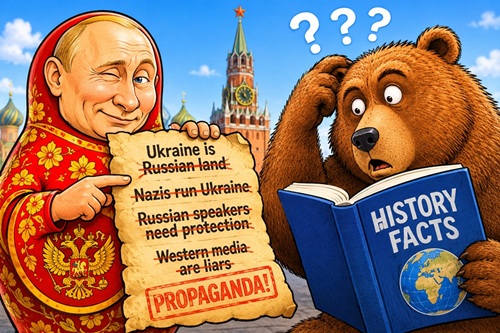
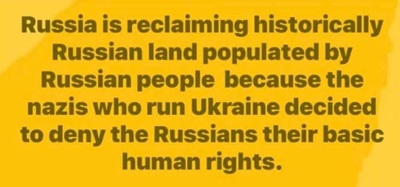
Meme posted by Joseph Dillard on Facebook
This meme is a compact example of Russian propaganda rhetoric. Its central argument is that Russia is not invading another country but merely reclaiming historically Russian territory in defence of an oppressed Russian population. Unfortunately for its author, almost every element of this argument collapses under examination. Let's take it apart. 1. Was Ukraine historically Russian land?This is the first historical sleight of hand. Parts of present-day Ukraine were indeed incorporated into the Russian Empire, and subsequently into the Soviet Union. But that does not make Ukraine historically Russian territory in any exclusive or permanent sense. The history is considerably more complicated. Kyivan Rus, the medieval political formation whose centre was Kyiv, predates the emergence of the modern Russian state. Both Ukrainian and Russian historical traditions draw on this medieval inheritance. It is therefore particularly misleading for contemporary Russian nationalism to treat Kyiv and its historical territories as the exclusive property of Moscow. Other parts of present-day Ukraine have histories involving the Polish-Lithuanian Commonwealth, the Habsburg Empire, the Crimean Khanate and the Ottoman Empire. Ukraine has a distinct linguistic, cultural and political history. More importantly, historical possession is not a legitimate contemporary title to territory. If it were, much of Europe would be entitled to redraw its borders through military conquest. There is also a decisive historical fact that the meme conveniently ignores. On December 1, 1991, Ukrainians voted overwhelmingly for independence. More than 90% of participating voters supported it. Crucially, independence received majority support in every region, including Crimea, Donetsk, Luhansk and the heavily Russian-speaking east and south. Russia itself subsequently recognized Ukrainian independence. Russia reaffirmed its commitment to respect Ukraine's independence, sovereignty and existing borders in the 1994 Budapest Memorandum. In other words, Russia itself recognized the territorial arrangement it now claims to be historically illegitimate. Historical nostalgia does not confer territorial ownership. 2. Are the Nazis running Ukraine?This is perhaps the most blatant falsehood in the meme. Ukraine has had far-right nationalist movements, including groups with extremist and neo-Nazi elements. They should not be excused or ignored. But the existence of such groups does not establish that they govern the country. Consider the electoral evidence. In the 2019 parliamentary elections, the far-right Svoboda party received approximately 2.15% of the proportional vote and secured just one seat. The party led by Volodymyr Zelensky, Servant of the People, won an outright parliamentary majority with 254 seats. Zelensky himself is Jewish. Members of his family were murdered during the Holocaust. One does not need to admire Zelensky or agree with every policy of his government to recognize the absurdity of describing Ukraine as a Nazi-run state. There is a further distinction worth making: Ukraine, like several European countries, has experienced far-right street movements, nationalist militias and extremist violence. The existence of these movements deserves scrutiny. Their political influence, however, should be measured rather than inflated into a fictional description of the entire government. The Russian propaganda narrative deliberately confuses the presence of extremists with control of the state. If the presence of far-right groups were sufficient grounds for military invasion, Russia would have to explain why it does not apply the same standard to countries where its own nationalist and neo-Nazi movements operate. The accusation of Nazism is not an analysis of Ukrainian politics. It is a political instrument used to delegitimize Ukrainian sovereignty. 3. Were Russian speakers denied their basic human rights?This is the most interesting part of the meme because it contains a kernel of truth, although the conclusion drawn from it is wildly disproportionate. Ukraine has had contentious language policies. Since independence, successive governments have struggled with the relationship between Ukrainian, the state language, and Russian, which has been widely spoken in many parts of the country. The 2017 Education Law and the 2019 State Language Law attracted criticism, including from the Council of Europe's Venice Commission. The Commission specifically warned that Ukraine had failed to strike an appropriate balance between strengthening Ukrainian and safeguarding minority linguistic rights. It criticized unequal treatment of different minority languages and recommended changes to the legislation. This is a legitimate subject for criticism of Ukrainian government policy. But three distinctions matter. First, promoting Ukrainian as the state language is not equivalent to banning Russian. The laws principally concern the use of languages in public administration, education, broadcasting and other public domains. They do not amount to a general prohibition on speaking Russian in private life. Second, linguistic discrimination is not the same thing as systematic persecution. There have been genuine complaints, instances of hostility and violations of minority rights. The UN human rights monitoring mission documented incidents of hate speech and threats against people perceived as pro-Russian because of their language or political opinions. These matters deserve investigation and correction. They do not establish that Russian speakers as a population were facing extermination, or that their existence required military protection by Moscow. Third, Russian-speaking Ukrainians are not automatically Russian citizens or people who want to be governed by Russia. This is a particularly important distinction. Language, ethnicity, citizenship and political allegiance are four different things. Many Ukrainians speak Russian as their first language while identifying strongly with Ukraine. Zelensky himself is a prominent example of a Russian-speaking Ukrainian. The meme simply assumes that speaking Russian creates a political entitlement for Russia to intervene. That is an imperial assumption, not a human-rights principle. 4. Was Russia protecting the people of Donbas?The conflict in eastern Ukraine began in 2014, following Russia's annexation of Crimea and the emergence of Russian-backed separatist movements in Donetsk and Luhansk. There was genuine suffering in Donbas. Thousands died during the ensuing conflict, and civilians on both sides experienced displacement, shelling and other violations. Ukraine's military and security forces were not beyond criticism. Nor were the separatist forces. The conflict deserves a serious and balanced historical examination. But the meme leaves out the most important question: who had the right to decide the future of this territory? The inhabitants of Donbas had legitimate political, linguistic and security concerns. Those concerns could have been addressed through negotiations, constitutional arrangements, minority protections and internationally supervised political processes. Instead, Russia supported armed separatism, intervened militarily and eventually proclaimed the annexation of the territories it claimed to be protecting. There is an obvious contradiction here: if Russia's objective was to protect the population, why did its intervention produce a vastly expanded war, mass displacement, destruction of cities and the occupation of territory far beyond the original separatist areas? The invasion of February 2022 was not a limited humanitarian operation in Donbas. It was a full-scale attack on Ukraine, including an assault on Kyiv. The UN General Assembly subsequently reaffirmed Ukraine's territorial integrity and called for Russia to withdraw its forces. Protection of minorities cannot be used as a blank cheque for military conquest. 5. The fundamental contradiction: Russia's own imperialismThere is an even deeper problem with the meme. It presents Russia as a country merely recovering territory that supposedly belongs to it historically. But this is precisely the logic of imperialism: the assumption that a powerful state has a right to determine the political future of neighbouring peoples on the basis of historical claims, ethnic connections or alleged cultural obligations. Apply the same reasoning elsewhere and the implications become absurd. Should Germany reclaim territories it once controlled? Should Turkey reclaim former Ottoman possessions? Should Britain recover parts of its former empire? Should China be entitled to absorb territories simply because they were once under Chinese imperial administration? Modern international relations are built on the principle that borders cannot simply be changed by military force. Russia signed up to that principle when it recognized Ukraine's independence and territorial integrity. It subsequently violated its own commitments. The UN General Assembly's 2014 resolution on Ukraine's territorial integrity explicitly rejected the validity of the Crimean referendum as a basis for changing the peninsula's status. It was adopted by 100 votes against 11, with 58 abstentions. The 2022 invasion made the contradiction even more glaring. Russia claims to oppose Western imperialism while attempting to impose its own geopolitical preferences on a neighbouring sovereign country. 6. What the meme deliberately leaves outPerhaps the best way to understand this propaganda is to examine what it excludes.
Conclusion: An imperial war disguised as humanitarian liberationThe meme is effective propaganda because it combines recognizable historical facts with misleading interpretations. Yes, Russian is widely spoken in Ukraine. Yes, Ukraine has had problematic language legislation. Yes, far-right movements exist in Ukrainian society. Yes, Western media deserve critical scrutiny. But none of these observations establishes that Ukraine is a Nazi state, that Russian-speaking Ukrainians constitute an oppressed population awaiting liberation, or that Russia has a historical right to annex Ukrainian territory. The most revealing omission is the democratic decision of Ukrainians themselves in 1991. They voted for independence, including in the very regions that Russia subsequently claimed to be liberating. What gives Russia the right to disregard that decision? The underlying assumption of the meme is that the wishes of Ukrainians matter less than Moscow's interpretation of Russian history. That is not anti-imperialism. It is imperialism dressed up as historical justice. And there is one final irony: a country that claims to be defending the right of Russian-speaking populations to determine their own future has denied precisely that right to the Ukrainian population as a whole. That is the central contradiction this meme cannot resolve.
Comment Form is loading comments...
|