|
TRANSLATE THIS ARTICLE
Integral World: Exploring Theories of Everything
An independent forum for a critical discussion of the integral philosophy of Ken Wilber
  Frank Visser, graduated as a psychologist of culture and religion, founded IntegralWorld in 1997. He worked as production manager for various publishing houses and as service manager for various internet companies and lives in Amsterdam. Books: Ken Wilber: Thought as Passion (SUNY, 2003), and The Corona Conspiracy: Combatting Disinformation about the Coronavirus (Kindle, 2020).
Check out my other conversations with ChatGPT Osho's Seven Bodies of DreamingA Critical Examination of Esoteric Psychology and the Manufacture of Higher RealitiesFrank Visser / ChatGPT
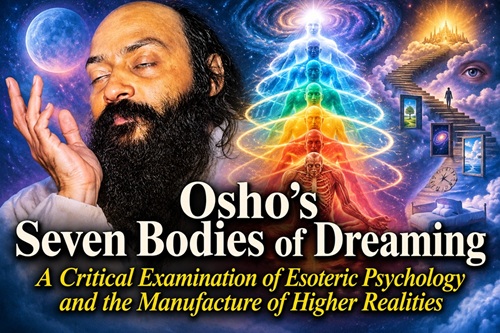 Introduction: When Dreams Become a CosmologyOsho's account of the seven levels of dreaming, presented in The Psychology of the Esoteric, is an ambitious attempt to construct a comprehensive psychology of consciousness.[1] It begins with an apparently reasonable observation: dreams are not all alike. Physical sensations, emotional preoccupations, memories, imaginative activity, and altered states of consciousness can all influence what we experience during sleep. But Osho takes this observation in a radically different direction. He proposes that dreams originate from seven distinct bodies, each corresponding to a progressively more subtle dimension of reality. The physical body produces physiological dreams; the etheric body permits out-of-body travel; the astral body accesses previous incarnations; the mental body penetrates the future; the spiritual body reveals universal creation myths; the cosmic body experiences the universe as consciousness; and the nirvanic body transcends even the distinction between existence and nonexistence. The result is an elaborate metaphysical hierarchy in which dreaming becomes a vehicle for exploring increasingly elevated realities. There is something initially attractive about this approach. Osho recognizes that dreaming is not simply random mental noise, and that subjective experience deserves more attention than a narrowly physiological account might suggest. He also emphasizes the importance of self-observation, awareness, and the transition between waking and sleeping. Yet his argument raises a fundamental question: Does the discovery of increasingly unusual subjective experiences justify the conclusion that we have discovered increasingly subtle dimensions of objective reality? This is where Osho's account becomes problematic. He repeatedly moves from phenomenological description to metaphysical assertion without providing the evidence needed to connect the two. His seven bodies are not established through psychological investigation. They are assumed as elements of an esoteric worldview, and dreams are subsequently interpreted through that worldview. The result is less a psychology of dreaming than a metaphysical system that presents itself as an expanded psychology. 1. The Seven Bodies: An Esoteric Classification Without Independent EvidenceOsho's classification consists of seven bodies:
Each body supposedly possesses its own mode of dreaming and corresponding level of reality. The higher the body, the closer dreaming approaches reality, until the distinction between the two eventually disappears. The first difficulty is immediately apparent. Osho presents these seven bodies as though they were established features of human constitution, comparable to the organs or physiological systems of the physical body. But what exactly constitutes an etheric body? Where does it begin and end? How would one distinguish it from an especially vivid mental representation? What independent evidence demonstrates its existence? The same questions apply to the astral, spiritual, cosmic, and nirvanic bodies. Osho does not provide operational definitions, independent measurements, reproducible observations, or criteria by which competing interpretations could be distinguished. Instead, he offers descriptions of experiences that are subsequently assigned to different metaphysical levels. This creates a circular procedure. If somebody experiences an unusual sensation during meditation, it may be classified as etheric. If the experience involves apparent memories of previous lives, it becomes astral. If it contains visions of the future, it belongs to the mental body. If it produces an experience of universal consciousness, it is assigned to the cosmic body. But these classifications do not establish the existence of the bodies. They merely organize experiences according to an already accepted metaphysical scheme. A classification system can be internally coherent without being empirically true. There is also a historical issue. Osho's seven-body model belongs to a broader esoteric tradition involving subtle bodies, chakras, planes of consciousness, and successive levels of spiritual realization. Such classifications have appeared in various forms in Hindu, Buddhist, Theosophical, and modern esoteric literature. Their similarities do not establish that they describe objectively existing structures. They may equally reflect the transmission and adaptation of shared religious concepts. Osho offers a synthesis of these traditions, not an independent discovery of seven previously unknown components of human existence. 2. The Physical Body: Where Osho Is Most ConvincingOsho's discussion of physiological dreaming is considerably more plausible. He correctly observes that bodily conditions can influence dream content. Hunger, thirst, discomfort, temperature, illness, and external stimulation can become incorporated into dreams. A pressure on the chest might be experienced as someone sitting on the dreamer, while an unpleasant sensation in the legs might become part of a dream about crossing water. These are reasonable observations, although Osho sometimes presents them too categorically. Modern sleep research confirms that sensory stimulation and bodily conditions can influence dream content. However, the relationship is not necessarily straightforward. External stimuli may be incorporated into dreams, ignored, or transformed in unpredictable ways. Osho's suggestion that dreams can reveal something about bodily conditions is also worth retaining. Paying attention to recurring dream themes, bodily sensations, and the circumstances surrounding sleep can provide useful information about one's physical and emotional state. His recommendation to observe the transition into sleep and awakening is similarly valuable. Contemporary research into sleep onset, hypnagogic imagery, and hypnopompic experiences has documented the unusual sensations and imagery that can occur during these transitional states. But notice what happens next. Osho takes a relatively sound observation about the relationship between bodily sensations and dreaming and uses it as the foundation for a much larger metaphysical construction. The plausibility of the first level lends an appearance of credibility to the remaining six. This is an important rhetorical feature of the chapter: empirical observations and esoteric assertions are presented within one continuous explanatory framework, without sufficiently distinguishing their different evidential status. 3. The Etheric Body: From Vivid Experience to Out-of-Body TravelThe second body introduces a much more ambitious proposition. According to Osho, the etheric body can leave the physical body during sleep and travel through space without being restricted by distance. Such experiences are supposedly not ordinary dreams but genuine journeys through another dimension. He further claims that mantras, sounds, perfumes, and colors can stimulate etheric dreams. He cites the Theosophist C. W. Leadbeater's search for a particular shade of blue that supposedly reproduced an etheric vision. There are several problems here. First, the experience of leaving one's body does not establish that anything has actually left it. Out-of-body experiences are well-documented subjective phenomena. They can occur during sleep paralysis, lucid dreaming, neurological disturbances, and certain altered states of consciousness. Research into bodily self-consciousness has shown that the brain constructs our ordinary sense of being located inside our bodies. Under unusual conditions, this representation can become distorted. People may experience themselves as floating above their bodies, observing themselves from another position, or moving through apparently independent environments. These experiences can be extraordinarily convincing. Their subjective intensity, however, does not establish their objective interpretation. Osho never supplies a convincing way of distinguishing an actual etheric journey from a vivid internally generated experience. His proposed distinction is particularly weak: genuine etheric travel supposedly happens while one is awake in the etheric body, whereas etheric dreaming occurs during sleep. But this merely relocates the problem. How do we establish that somebody has awakened in an etheric body rather than entered another altered state of consciousness? The same problem applies to his use of mantras, perfumes, and colors. These stimuli can certainly influence attention, mood, expectation, and imagery. But demonstrating that a stimulus induces a particular subjective experience is not equivalent to demonstrating that it activates a separate subtle body. Osho confuses the production of an experience with the discovery of the reality supposedly responsible for it. 4. The Astral Body: Past Lives and the Collective UnconsciousThe third body supposedly allows access to previous incarnations. Osho identifies this dimension with Jung's collective unconscious, although he also describes it as an individual's personal history extending backward through successive births, from amoeba to human being. This is a curious appropriation of Jung. For Jung, the collective unconscious was not a repository of an individual's previous incarnations. It referred to inherited structures of the psyche, expressed through archetypal patterns that appear in myths, dreams, fantasies, and religious symbolism. Jung's concept was already controversial, particularly regarding the precise nature and empirical status of archetypes. But it is not equivalent to Osho's astral body. Osho effectively transforms a psychological hypothesis about inherited symbolic structures into a metaphysical claim about personal reincarnation. The distinction matters. Dreams about ancient civilizations, unfamiliar historical periods, or apparently previous lives do not demonstrate that the dreamer has accessed memories from earlier incarnations. Such experiences can be understood through imagination, cultural exposure, cryptomnesia, memory reconstruction, and the brain's capacity to generate convincing autobiographical narratives. The fact that a dream contains information the dreamer does not consciously recognize also does not establish a supernatural source. Human memory and information processing are considerably more extensive than conscious recollection. Osho's treatment of mental illness is especially troubling. He suggests that people with psychological disorders may experience greater penetration between the first three bodies and therefore dream about previous incarnations. This is an unsupported interpretation of psychopathology. Unusual experiences associated with mental illness should not automatically be treated as evidence of access to hidden dimensions of reality. Indeed, the reverse possibility deserves consideration: the less reliably someone can distinguish imagination, memory, and external reality, the more cautious we should be about interpreting their experiences as revelations. Osho's framework risks turning psychological instability into a form of esoteric privilege. 5. The Mental Body: Precognition and the FutureThe fourth body introduces another extraordinary claim: the mental body can travel both backward and forward in time. Osho suggests that people sometimes receive information about future events through dreams, particularly during emergencies or when someone close to them is dying. He further maintains that advanced practitioners can consciously penetrate their own future. This is precognition in explicitly metaphysical language. There is no established scientific evidence that dreams provide access to future events through an independent mental dimension. Of course, people sometimes dream about events that subsequently occur. But this is not surprising when we consider the number of dreams people experience, the enormous range of possible dream contents, and the selective nature of human memory. We tend to remember apparent correspondences and forget the countless dreams that did not correspond to anything that happened. Retrospective interpretation also plays a major role. A dream that initially appears obscure can acquire an apparently prophetic meaning after an event has occurred. A convincing demonstration of precognition would require something much more demanding: specific predictions recorded before the relevant events, independently verifiable criteria for evaluating correspondence, appropriate controls, and reproducible results. Osho offers none of these. Interestingly, he also introduces a potentially important psychological observation: expectations and desires can influence what people experience during meditation and other altered states. His warning that practitioners may manufacture their own visions is quite sensible. He advises the seeker to become a witness rather than identify with the images produced by the mind. This is arguably one of the strongest practical insights in the entire chapter. But it undermines rather than supports his larger metaphysics. If the mind can generate convincing visions of gods, gurus, and blissful realities, why should we assume that visions of etheric travel, previous lives, or cosmic consciousness are any more trustworthy? Osho recognizes the problem of projection but does not apply his own skepticism consistently to the experiences that populate his seven-body system. 6. The Fourth Body and the Psychology of Spiritual HallucinationOsho's discussion of the mental body deserves particular attention because it contains an implicit critique of spiritual experience. He argues that fasting, isolation, darkness, and yogic or tantric practices can generate exceptionally vivid experiences. The mind becomes increasingly creative and is no longer constrained by ordinary external circumstances. Gods, gurus, ecstatic states, and apparently supernatural revelations may all be created by the mind itself. This is a valuable observation. Religious and mystical experiences are influenced by expectation, cultural conditioning, suggestibility, emotional needs, and the techniques used to induce altered states. A Christian mystic may encounter Christ, a Hindu practitioner Krishna, and a Buddhist practitioner a particular manifestation of Buddhist imagery. Such experiences can be psychologically profound without requiring the existence of the entities encountered. Osho's recommendation to maintain a witnessing attitude is therefore worth taking seriously. Mindfulness, metacognitive awareness, and the ability to recognize mental imagery as mental imagery can help prevent excessive identification with unusual experiences. But Osho introduces an inconsistency. He claims that the fourth body can create practically anything, including experiences more ecstatic and convincing than ordinary reality. Yet he simultaneously maintains that a sufficiently advanced practitioner can distinguish genuine reality from these mental creations. How? His answer is witnessing. If one remains completely detached, one supposedly knows what is real. But witnessing does not automatically establish the truth of what is witnessed. A person can observe an illusion without being able to determine whether it corresponds to an external reality. The ability to recognize that one is experiencing something is not the same as knowing what caused it. This distinction is fundamental to any serious psychology of altered states. 7. The Fifth Body: Universal Myths and the Problem of Shared ExperienceThe fifth, spiritual body introduces one of Osho's most ambitious claims. At this level, dreams supposedly become increasingly objective. Two or more people who have attained this dimension can experience the same dream simultaneously. This, he suggests, explains why creation myths from different civilizations exhibit remarkable similarities. Here Osho makes two questionable moves. First, he treats similarities between myths as evidence of access to a shared spiritual dimension. Second, he interprets the possibility of shared subjective experiences as evidence that those experiences have an independent objective existence. Neither inference is justified. Comparative mythology has produced numerous explanations for similarities between religious narratives. These include cultural transmission, historical contact, common environmental challenges, recurring social structures, and similarities in human cognitive and emotional organization. Flood stories, for example, are not particularly surprising in societies whose histories are closely connected to rivers, coastlines, and catastrophic flooding. Creation narratives also address recurring human questions: Where did the world come from? Why do we exist? What happens after death? Why is there suffering? What is the relationship between humanity and nature? Similar questions can generate similar symbolic answers without requiring a shared metaphysical source. There is also an important distinction between a genuinely shared dream and independently generated experiences interpreted as similar afterward. Osho provides no independently documented examples of simultaneous fifth-body dreaming. Nor does he explain how the participants could distinguish a genuinely shared experience from cultural expectation, prior communication, or retrospective reconstruction. The same problem applies to his account of universal creation myths. He assumes the conclusion that needs to be demonstrated: that similarities between human religious traditions reflect a higher spiritual reality rather than common human processes. His fifth body is therefore an explanation that introduces more assumptions than it resolves. 8. The Sixth Body: Cosmic Consciousness and the Reality of MayaThe sixth body is the cosmic dimension, where the distinction between matter and consciousness supposedly disappears. Osho associates it with the realization that everything is alive and conscious, including what we ordinarily call matter. The individual self has disappeared, but the cosmic whole remains. This is recognizable as a form of metaphysical idealism or cosmic consciousness. It also resembles certain interpretations of Advaita Vedanta, although Osho's terminology and developmental hierarchy are his own particular synthesis. There is nothing inherently unreasonable about investigating the experience of self-transcendence. Mystical experiences involving the dissolution of the subject-object distinction are well documented across religious and contemplative traditions. People sometimes report a profound sense of unity with nature, the universe, or existence as a whole. The question is what such experiences establish. An experience of unity is not proof that the universe itself is a unified consciousness. The disappearance of the subjective distinction between self and world does not demonstrate that matter has literally become consciousness. This is the familiar distinction between phenomenology and ontology. Phenomenology concerns how reality appears in experience. Ontology concerns what exists independently of our experience. Osho repeatedly crosses this boundary. Moreover, the sixth body introduces an interesting logical difficulty. If the individual has disappeared and everything has become part of the cosmic whole, who or what is having the dream? Osho anticipates the objection by suggesting that the cosmic mind continues dreaming after the individual dreamer has disappeared. But this is not an explanation. It is a personification of the universe. Calling the universe a dreamer does not establish that it possesses a mind, nor does it explain how cosmic consciousness operates. The concept of maya is similarly treated as though it were a discovery rather than an interpretation. Osho's claim that the universe is a dream of the cosmic whole is a metaphysical position, not an empirically established conclusion. 9. The Seventh Body: Nothingness as the Ultimate RealityThe seventh and final body is nirvanic. Here even the distinction between being and nonbeing supposedly disappears. There are no images, symbols, sounds, or thoughts. Only the formless remains. Osho calls this the realm of nothingness and associates it with seedless samadhi, nirbeej samadhi. His description is poetic, but philosophically difficult. He argues that positive existence must have boundaries and therefore cannot be infinite, whereas the negative has no boundaries. Consequently, nothingness is more infinite than existence. This argument is not convincing. The absence of a boundary does not automatically make something infinite. Nor does the fact that a concept is negative give it a special ontological status. There is a fundamental difference between nothingness as the absence of particular things and nothingness as some ultimate metaphysical reality. If nothing exists, there is no entity called nothingness that can possess properties, generate experiences, or serve as the foundation of the universe. If something does exist, however subtle or formless, then we are no longer speaking about absolute nothingness. Osho moves between these meanings without resolving their differences. His account also contains an intriguing contradiction. The seventh body supposedly has its own dreams, yet at the same time Osho insists that in this dimension dreaming is no longer possible. He eventually resolves this by declaring that dreaming and reality have become indistinguishable because only nothingness remains. But this is more a verbal dissolution of the problem than a genuine explanation. If there is no dreamer, no dream, and no reality distinguishable from the dream, what exactly has been discovered? One may reasonably regard such language as an attempt to express experiences that resist ordinary conceptual description. But ineffability cannot function as a substitute for argument. 10. Osho's Misrepresentation of Western PsychologyOsho repeatedly contrasts his seven-body model with Western psychology, particularly Freud and Jung. He claims that Freud misunderstood etheric dreams as expressions of suppressed desires, while Jung penetrated further into the astral dimension but failed to recognize its true nature. This is an extraordinarily simplified account of both thinkers. Freud's theory of dreams was certainly limited in important respects. His emphasis on wish fulfillment, repression, and disguised desire does not provide a comprehensive explanation of dreaming. Nevertheless, Freud did not claim that every dream could be reduced to a straightforward expression of suppressed physical desire. His account included manifest and latent content, dream-work, condensation, displacement, and symbolic transformation. More importantly, modern dream research has moved considerably beyond classical Freudian theory. Contemporary approaches investigate memory consolidation, emotional regulation, predictive processing, associative activation, threat simulation, and the relationship between dreaming and waking concerns. These explanations are not necessarily mutually exclusive, and the precise functions of dreaming remain debated. But Osho's suggestion that Western psychology is still trapped in Freud's initial framework is historically inaccurate. His treatment of Jung is equally problematic. Jung's collective unconscious is not simply a deeper layer of individual dream memory. It is a theoretical proposal concerning inherited archetypal structures, and its relationship to culture, biology, and psychological development remains contested. Osho takes Jung's terminology, inserts it into his own hierarchy, and then presents the result as though Jung had partially discovered the astral body. This is not a fair historical or conceptual comparison. There is a further irony here. Osho criticizes Western psychology for interpreting experiences through inadequate conceptual frameworks, but his own interpretation depends on a much more elaborate framework that is not subjected to equivalent empirical scrutiny. He demands that psychology expand its horizons while offering little justification for the particular direction in which it should expand. 11. The Central Epistemological Problem: How Do We Know What Is Real?Perhaps the most interesting part of the chapter is Osho's repeated concern with distinguishing dreams from reality. He recognizes that increasingly vivid experiences can become difficult to evaluate. He warns that beliefs, expectations, and desires can generate convincing internal experiences. His fifth-body discussion is especially revealing. He suggests that spiritual concepts can become mirrors in which people encounter only their own assumptions about the soul, immortality, and transcendence. This is an excellent observation about religious self-confirmation. Someone who believes in reincarnation may interpret a dream as evidence of a previous life. Someone who believes in angels may interpret an unusual visual experience as an angelic visitation. Someone who expects cosmic unity may interpret a transient feeling of interconnectedness as a revelation of ultimate reality. The experience is then taken as confirmation of the belief that helped shape it. Osho understands this danger but proposes a rather peculiar solution: progressively abandoning scriptures, philosophies, gurus, and concepts until the seeker becomes completely alone. This may reduce some forms of cultural conditioning, but it does not eliminate the problem of interpretation. Even a person without religious beliefs can experience hallucinations, dreams, and internally generated imagery. Nor does the absence of conceptual expectations guarantee that an experience corresponds to an external reality. In fact, the more unusual and compelling an experience becomes, the more important independent verification may be. Osho's ultimate criterion is essentially experiential: the advanced practitioner supposedly knows the real directly. But how could anyone distinguish direct access to reality from an especially convincing illusion? This is the central epistemological weakness of mystical absolutism. It treats the subjective certainty accompanying an experience as evidence of the objective truth of its interpretation. Yet subjective certainty is not a reliable measure of truth. People can be absolutely convinced of incompatible religious, metaphysical, and political beliefs. Their certainty does not establish that all these beliefs are simultaneously correct. A more adequate approach would distinguish at least three questions:
Osho is often perceptive about the first question, occasionally suggestive about the second, and largely speculative about the third. 12. The Rhetoric of Esoteric AuthorityThere is another feature of the chapter that deserves scrutiny: its rhetorical structure. Osho repeatedly announces that he knows dimensions of reality that ordinary psychology has failed to discover. He offers elaborate classifications, specific claims about the capacities of different bodies, and references to secret knowledge preserved by spiritual traditions. At the same time, he warns readers not to treat his account as a theory or system. This creates an interesting tension. On the one hand, Osho presents an extraordinarily detailed cosmology. He specifies which body can travel through space, which can travel through time, which can access previous births, and which can experience cosmic creation. On the other hand, when the reader might reasonably ask for evidence, he advises treating the account merely as a starting point for personal exploration. He also admits that he has deliberately left gaps in his explanation, claiming that these will be filled automatically by those who undertake the appropriate inner work. This is an epistemically convenient arrangement. The system is sufficiently detailed to establish the authority of the speaker, but sufficiently elusive to resist critical examination. If an experience confirms the system, it is evidence of progress. If it contradicts the system, the practitioner may not yet have reached the appropriate level. If the experience cannot be verified, it belongs to an inner dimension inaccessible to ordinary investigation. Such a framework is difficult to falsify. It also creates a hierarchy of spiritual authority. Those who have supposedly penetrated higher bodies possess knowledge unavailable to ordinary observers. Their claims are therefore protected from the very scrutiny that would be necessary to establish their credibility. Osho's insistence that seekers abandon gurus and scriptures is thus somewhat ironic. His own account establishes a new hierarchy of esoteric knowledge in which the speaker occupies the position of someone who knows the territory. 13. What Can Be Retained? A Naturalistic ReconstructionIt would be a mistake to dismiss the entire chapter simply because its metaphysical claims are unsupported. Osho is addressing a genuine subject: the extraordinary variety of human experiences associated with sleep, dreaming, meditation, imagination, and altered states of consciousness. A naturalistic reconstruction could preserve several of his insights without accepting the seven-body cosmology. First, dreaming is influenced by bodily conditions. Hunger, pain, illness, temperature, and sensory stimulation can shape dream content. Second, dreams are connected to emotional and psychological concerns. They may reflect memories, anxieties, desires, unresolved conflicts, and ongoing cognitive processes, although not necessarily through a universal symbolic code. Third, dreaming can involve unusually vivid experiences of space, identity, time, and bodily location. Lucid dreaming, sleep paralysis, and out-of-body experiences demonstrate how flexible and sometimes unstable ordinary self-consciousness can become. Fourth, meditation and contemplative practices can generate altered states involving changes in attention, self-awareness, emotional experience, and the perception of boundaries between self and world. Fifth, cultural expectations influence how such experiences are interpreted. Religious imagery, archetypal symbolism, and spiritual narratives can provide interpretive frameworks through which unusual experiences acquire meaning. Sixth, the distinction between an experience and its interpretation is indispensable. A person can genuinely experience something extraordinary without necessarily possessing accurate knowledge of its external cause. This reconstruction gives us a much richer psychology of dreaming than Osho's simplistic characterization of Western research allows. It also avoids multiplying metaphysical entities without sufficient evidence. There is no need to postulate seven independently existing bodies to investigate seven different classes of subjective experience. Nor is there a need to assume that the universe is dreaming in order to study experiences of cosmic unity. The experiences themselves are already interesting enough. 14. Conclusion: An Elaborate Map of Unverified TerritoriesOsho's The Psychology of the Esoteric is an intriguing document of modern spiritual thought. It combines elements of Eastern contemplative traditions, Theosophical subtle-body cosmology, Jungian terminology, and Osho's own interpretation of mystical development. Its greatest strength is its insistence that human experience is more varied than ordinary waking consciousness suggests. Osho recognizes the importance of dreams, transitional states, imagination, self-observation, and the capacity of the mind to generate extraordinarily convincing experiences. His warnings about spiritual projection are particularly valuable. The mind can manufacture precisely the visions and revelations that its owner most desires. Religious beliefs can become mirrors in which people encounter their own expectations rather than independent truths. Yet Osho fails to apply this insight consistently to his own metaphysical claims. The seven bodies are introduced as realities rather than hypotheses. Etheric travel, reincarnation, precognition, shared spiritual dreams, cosmic consciousness, and ultimate nothingness are presented with an assurance that far exceeds the available evidence. The chapter's fundamental mistake is to confuse different levels of subjective experience with different levels of objective existence. An experience can be more vivid, more emotionally powerful, more coherent, or more transformative than an ordinary dream without being more objectively real. A mystical experience can reveal something important about human consciousness without revealing the ultimate structure of the universe. And a dream can feel like a journey through eternity without having travelled anywhere at all. Osho's seven bodies are therefore better understood as a speculative map of spiritual experience than as a scientifically credible psychology. Even as a map, however, it requires considerable caution: the existence of increasingly elaborate territories cannot be established by drawing increasingly elaborate maps. The most valuable lesson in Osho's chapter may ultimately be one that undermines its own metaphysics: learn to observe your experiences without immediately believing the stories you tell yourself about them. That is sound psychological advice. It is also precisely the advice that Osho's readers should apply to Osho himself.
Appendix: Osho's Most Important Unresolved QuestionsThe chapter leaves several questions unanswered that would need to be addressed before its seven-body model could qualify as a serious psychological theory. 1. Independent existence: What evidence demonstrates that the etheric, astral, spiritual, and cosmic bodies exist independently of subjective experience? 2. Discrimination: How can one distinguish an actual etheric journey from a lucid dream or an out-of-body hallucination? 3. Verification: Can information supposedly obtained through astral travel or precognition be independently verified under controlled conditions? 4. Shared experience: Where are the documented cases of simultaneous fifth-body dreaming, and how were their contents independently compared? 5. Alternative explanations: Why should similarities between religious myths be attributed to a spiritual dimension rather than common human psychology and cultural transmission? 6. Epistemic reliability: Why should experiences of mystical certainty be considered more reliable than other intensely convincing subjective experiences? 7. Falsifiability: What conceivable observation would demonstrate that one or more of the seven bodies does not exist? Until questions like these receive satisfactory answers, Osho's seven levels remain an esoteric interpretation of consciousness rather than a demonstrated discovery about the architecture of reality. NOTES[1] Bhagwan Shree Rajneesh, The Psychology of the Esoteric, The New Evolution of Man, Harper Colophon Books, 1978 (first published in India as: The Inward Revolution, 1973 - though its content is not identical to the Harper edition).
Comment Form is loading comments...
|