|
TRANSLATE THIS ARTICLE
Integral World: Exploring Theories of Everything
An independent forum for a critical discussion of the integral philosophy of Ken Wilber
  Frank Visser, graduated as a psychologist of culture and religion, founded IntegralWorld in 1997. He worked as production manager for various publishing houses and as service manager for various internet companies and lives in Amsterdam. Books: Ken Wilber: Thought as Passion (SUNY, 2003), and The Corona Conspiracy: Combatting Disinformation about the Coronavirus (Kindle, 2020).
Check out my other conversations with ChatGPT Neuro-Linguistic ProgrammingBetween Promise, Pseudoscience, and the EvidenceA Critical Evaluation of NLP's Theories, Methods, Therapeutic Claims, and Research RecordFrank Visser / ChatGPT
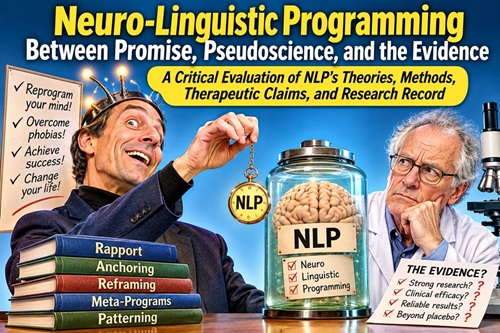 Neuro-Linguistic Programming (NLP) occupies an unusual position in the landscape of modern psychology. For more than five decades, it has attracted psychotherapists, business consultants, communication trainers, coaches, educators, motivational speakers, and personal-development enthusiasts. Its appeal is easy to understand: NLP promises that by understanding how people organize their subjective experience, we can change unwanted patterns of thought and behaviour, communicate more effectively, overcome psychological limitations, and achieve greater personal success. Yet NLP has also been persistently controversial. Its practitioners frequently describe it as a powerful technology of human change, while many academic psychologists regard its theoretical foundations as unsupported and its therapeutic claims as exaggerated. Between these positions lies a more complicated question: does NLP contain useful practical techniques despite its questionable theoretical assumptions, or is its apparent effectiveness largely attributable to psychological principles that were already known, better researched, and more clearly explained elsewhere? A fair evaluation requires separating several things that are often conflated: NLP's original theoretical propositions, its therapeutic interventions, its communication techniques, its applications in business and coaching, and the professional culture that has developed around it. The fact that a particular technique works does not automatically validate the theory used to explain it. Conversely, weaknesses in the original theory do not establish that every practice associated with NLP is useless. The central issue is therefore not whether NLP has enthusiastic practitioners or impressive testimonials. It is whether its distinctive claims survive empirical scrutiny, whether its methods outperform established alternatives, and whether its theoretical vocabulary contributes anything that cannot be explained more parsimoniously by conventional psychology. 1. The Origins: A New Psychology of Subjective ExperienceNLP emerged in the early 1970s from the collaboration between Richard Bandler, a student of psychology and mathematics, and John Grinder, a linguist at the University of California, Santa Cruz. A third figure, Frank Pucelik, also played an important role in the early development of the approach, although his contribution has often received less attention in popular accounts. Their initial ambition was to discover what made certain psychotherapists exceptionally effective. Rather than developing a new psychological theory through controlled experiments, they attempted to identify and reproduce the behavioural and linguistic patterns of successful practitioners. Three prominent figures became their initial models: Fritz Perls, founder of Gestalt therapy; Virginia Satir, a highly regarded family therapist; and Milton Erickson, the influential psychiatrist and hypnotherapist. Bandler and Grinder claimed that by carefully observing these practitioners, they could extract the underlying structures of successful communication and therapeutic intervention. These structures could then be taught to others, independently of the practitioners' personalities, theoretical commitments, or professional backgrounds. This approach became known as modelling. The resulting framework combined ideas drawn from linguistics, cybernetics, information theory, behavioural psychology, hypnosis, and humanistic psychotherapy. Its vocabulary included concepts such as representational systems, sensory predicates, anchoring, reframing, rapport, submodalities, and the meta-model. The name Neuro-Linguistic Programming reflects three proposed dimensions of human experience:
The appeal was considerable. Instead of treating psychological difficulties as complicated clinical problems requiring lengthy investigation, NLP suggested that relatively simple interventions could sometimes produce rapid and dramatic changes. But this ambition also created a fundamental scientific problem. The effectiveness of a therapist's methods does not establish that the observer has correctly identified the underlying mechanisms. Nor does successful imitation demonstrate that the proposed theory explaining that success is correct. NLP's subsequent history would be characterized by precisely this tension between practical ambition and theoretical validation. 2. The Central Theoretical ClaimsNLP is not a single, consistently formulated theory. Its different schools and practitioners disagree about its essential components. Nevertheless, several propositions have historically been particularly influential. Preferred representational systemsOne of the most distinctive claims concerns preferred representational systems (PRS). According to this proposition, individuals tend to organize their subjective experience predominantly through one sensory modality: visual, auditory, or kinesthetic. Some versions also include olfactory and gustatory modalities. A visual person supposedly thinks primarily in pictures, an auditory person in sounds and words, and a kinesthetic person in feelings and bodily sensations. Practitioners attempt to identify these preferences by observing language, behaviour, and eye movements. They may then adapt their communication accordingly. Someone who repeatedly says "I see what you mean" might be classified as visually oriented, whereas someone who says "That sounds right" might be classified as auditory. The proposed practical implication is that communication becomes more effective when the practitioner matches the client's preferred representational system. This sounds plausible at first. People certainly differ in their sensory experiences, and language contains abundant sensory metaphors. But the existence of such differences does not establish that individuals possess stable, dominant representational systems that can be reliably identified and therapeutically exploited. The research has been particularly disappointing on this point. Eye movements and internal processingA related proposition concerns eye-accessing cues. NLP practitioners have traditionally associated particular directions of eye movement with different forms of mental activity. Looking upward supposedly indicates visual processing, horizontal movements auditory processing, and downward movements feelings or internal dialogue. Certain directional distinctions have also been associated with remembering versus constructing experiences. These observations have sometimes been extended to claims about detecting deception. The problem is that ordinary eye movements are influenced by numerous factors, including attention, memory, context, individual habits, and cognitive demands. There is no established scientific basis for treating particular gaze directions as reliable indicators of specific mental processes or dishonesty. AnchoringAnchoring is the process of associating a particular stimulus with an emotional or psychological state. A person might, for example, repeatedly recall a confident experience while making a particular hand gesture. The gesture is subsequently used as a cue to recreate the desired state. This resembles classical conditioning, although NLP often presents the procedure as a more sophisticated and rapidly applicable technology. There is nothing inherently implausible about associative learning. Emotional responses can become linked to environmental cues, bodily sensations, words, and memories. However, the general existence of conditioning does not establish the effectiveness of NLP's specific anchoring procedures. ReframingReframing involves changing the interpretation of an experience without necessarily changing the experience itself. A setback can be understood as an opportunity for learning; an apparent weakness might be reconsidered as a strength in a different context. This is one of the more intuitively attractive NLP techniques. It also has clear parallels with established cognitive approaches, especially cognitive restructuring in cognitive behavioural therapy (CBT). Its usefulness, however, is not evidence for NLP's distinctive theoretical framework. The meta-modelThe NLP meta-model attempts to identify distortions, deletions, and generalizations in everyday language. A person saying "Nobody respects me" might be asked who specifically does not respect them. Someone claiming "I cannot succeed" might be asked what prevents them from succeeding. These questions can expose overgeneralizations, assumptions, and vague statements. They encourage people to examine the relationship between language and experience. This is arguably one of NLP's more defensible contributions as a practical communication framework. Yet its underlying techniques resemble established practices in psychotherapy, linguistic analysis, and critical questioning. Their usefulness does not require acceptance of the wider NLP theory. The important distinction throughout is between a potentially useful intervention and the theoretical explanation attached to it. 3. What Does the Research Actually Show?The scientific evaluation of NLP has a relatively long history. Its proponents sometimes suggest that critics simply have not studied it seriously enough. In reality, several decades of investigation have produced a substantial, if uneven, literature. Three research reviews deserve particular attention. Sharpley's reviews of preferred representational systemsIn 1984, Christopher Sharpley published a review in the Journal of Counseling Psychology, examining fifteen studies investigating preferred representational systems. His conclusion was distinctly unfavourable: there was little supportive evidence for NLP's claim that identifying a person's preferred sensory modality and matching one's language to it improved communication or counselling outcomes. Sharpley subsequently expanded his evaluation in 1987, examining a broader body of research. The results again raised serious doubts about the reliability of identifying preferred representational systems and the benefits of matching them. The significance of this research is that it tested one of NLP's central and most frequently advertised propositions rather than merely criticizing its terminology. Witkowski's thirty-five-year reviewIn 2010, Polish psychologist Tomasz Witkowski published an extensive assessment entitled Thirty-Five Years of Research on Neuro-Linguistic Programming: NLP Research Database. State of the Art or Pseudoscientific Decoration? Witkowski examined a database containing 315 publications and selected 63 studies published in journals included in the ISI Master Journal List. After excluding descriptive studies, he analyzed 33 studies addressing NLP's theoretical propositions. The results were:
Witkowski also argued that the studies supporting NLP tended to be methodologically weaker than those contradicting its propositions. This is important because simply counting positive and negative studies is insufficient. Research quality matters. A small, poorly controlled study should not carry the same evidential weight as a properly designed experiment. Witkowski's analysis was not a comprehensive modern meta-analysis of every possible NLP intervention, and its conclusions should not be generalized to every technique associated with NLP. Nevertheless, it provides a substantial historical assessment of the empirical difficulties facing the approach. Sturt and colleagues: the systematic health reviewPerhaps the most directly relevant assessment for therapeutic applications was published in 2012 by Jackie Sturt and colleagues in the British Journal of General Practice. Their systematic review examined the effectiveness of NLP interventions on health-related outcomes. The researchers searched 1,459 titles and eventually included ten experimental studies: five randomized controlled trials and five pre-post studies. The conditions investigated included anxiety disorders, weight maintenance, morning sickness, substance misuse, and claustrophobia associated with MRI scanning. The results were sobering. Four of the five randomized controlled trials found no statistically significant differences between NLP and their comparison groups. The fifth reported a positive result for NLP. Although several studies reported improvements within the NLP groups, the researchers identified substantial methodological weaknesses and high or uncertain risks of bias. Their conclusion was carefully qualified: there was little evidence that NLP interventions improved health outcomes. This reflected the limited quantity and quality of research rather than definitive proof that NLP could never have an effect. They consequently considered the evidence insufficient to justify allocating National Health Service resources to NLP outside research settings. This distinction deserves emphasis. The research does not demonstrate that every person who has benefited from NLP is mistaken. It demonstrates that the existing evidence does not adequately establish NLP as an effective therapeutic intervention. Passmore and Rowson: the coaching industryA particularly relevant review for NLP's commercial applications was published in 2019 by Jonathan Passmore and Tatiana Rowson in the International Coaching Psychology Review. Their article, Neuro-Linguistic Programming: A Critical Review of NLP Research and the Application of NLP in Coaching, examined the theoretical foundations of NLP, its research record, and its relevance to professional coaching. Their conclusion was that the distinctive practices of NLP were poorly supported by research evidence. The authors also distinguished between evidence for coaching generally and evidence for NLP specifically. This is an important distinction. Research suggesting that coaching can improve performance, goal attainment, or aspects of psychological well-being does not establish that NLP is responsible for those improvements. Their assessment questioned whether NLP has anything sufficiently distinctive to offer coaching as a separate and scientifically defensible methodology. 4. Testing the Most Famous NLP ClaimsSome of NLP's claims are particularly amenable to experimental investigation. Their evaluation illustrates the difference between an attractive anecdote and a reproducible scientific finding. Can eye movements reveal whether someone is lying?This claim became one of the most recognizable features of NLP. In 2012, Richard Wiseman, Caroline Watt, Leanne ten Brinke, Stephen Porter, Sara-Louise Couper, and Calum Rankin published a paper in PLOS ONE entitled The Eyes Don't Have It: Lie Detection and Neuro-Linguistic Programming. They conducted three studies. The first examined eye movements among people who were lying or telling the truth. The second tested whether knowledge of the NLP eye-movement hypothesis improved people's ability to detect lies. The third examined recordings of people making high-profile public appeals. None of the three studies supported the predicted eye-movement patterns. The findings were especially damaging because the research tested the claim directly rather than relying on general theoretical objections. There is no reliable scientific justification for treating a particular direction of gaze as evidence that someone is lying. Does matching sensory language improve communication?This is another central proposition that has repeatedly encountered difficulties. The argument sounds reasonable: if someone thinks visually, speak visually; if someone thinks in terms of feelings, use kinesthetic language. However, research has not reliably established that individuals can be assigned stable sensory preferences or that matching those preferences produces superior communication outcomes. People naturally use different sensory expressions depending on the subject under discussion. Someone might speak visually about a painting, auditorily about music, and kinesthetically about physical exercise. That does not mean that three different representational personalities are operating within the same person. The distinction between ordinary linguistic variation and a stable psychological classification is crucial. Can phobias be eliminated in minutes?Some NLP practitioners have advertised the Fast Phobia Cure as a remarkably rapid intervention. Bandler, in particular, has made very strong claims about the ability to eliminate phobias through brief procedures. It is entirely possible for learned fear responses to change through psychological interventions. Exposure-based therapies, for example, have a substantial empirical foundation. But claims of reliably eliminating phobias within minutes require controlled evidence, appropriate diagnostic assessment, and long-term follow-up. The existence of successful individual cases is insufficient. Without adequate comparison groups, we cannot determine whether improvements resulted from the specific NLP procedure, expectancy, suggestion, spontaneous fluctuation, or other therapeutic factors. Passmore and Rowson's 2019 review found the distinctive NLP evidence inadequate to substantiate the wider claims made for these interventions. 5. The More Recent Research: Has the Verdict Changed?It would be misleading to stop the investigation with the critical literature of the 1980s and 1990s. NLP has continued to be investigated, particularly in healthcare, organizational development, and coaching. Have more recent studies reversed the earlier conclusions? So far, they have not. Organizational applicationsIn 2018, Yasuhiro Kotera, David Sheffield, and William Van Gordon published a systematic review of NLP applications in organizational settings in Human Resource Development Quarterly. The review searched 952 titles and identified seven studies meeting its inclusion criteria. The researchers investigated outcomes such as self-esteem, perceived trustworthiness, organizational commitment, and occupational stress. Their findings were somewhat more encouraging than the clinical literature: some studies reported improvements in work-related psychological outcomes. However, the authors also identified considerable methodological limitations. Their overall assessment was that the benefits of NLP were both overpromised and undersupported. This is an important qualification. It would be wrong to say that no positive organizational findings exist. Equally, seven methodologically limited studies do not establish the effectiveness of an entire professional methodology. The 2024 clinical reviewA 2024 article entitled Neurolinguistic Programming: Old Wine in New Glass revisited NLP's therapeutic applications, particularly in relation to anxiety and other psychological conditions. The authors discussed the similarities between NLP techniques and established approaches such as CBT and Acceptance and Commitment Therapy (ACT). They also noted substantial heterogeneity in the research: different populations, interventions, treatment durations, and outcome measures make it difficult to establish what is actually responsible for any observed improvements. The article acknowledged the continuing lack of reliable evidence for several fundamental NLP propositions, including the identification of preferred representational systems. Its conclusion was cautious rather than dismissive: NLP continues to attract interest, but its therapeutic claims require substantially better research and comparison with established treatments. The 2024 debate about scientific gatekeepingAn especially interesting contribution appeared in 2024: Gatekeeping in Science: Lessons from the Case of Psychology and Neuro-Linguistic Programming. This paper addresses a different question: how should the scientific community deal with approaches such as NLP that develop largely outside mainstream academic psychology? It examines criticisms concerning NLP's theoretical incoherence, its weak empirical foundations, the quality of supporting studies, and the sometimes exaggerated claims made by practitioners. But it also raises questions about scientific gatekeeping. An approach should not automatically be excluded from serious investigation simply because it originated outside established academic institutions or has acquired an unfashionable reputation. This is a legitimate point. Scientific institutions can be conservative, and unconventional ideas should be evaluated through evidence rather than professional status. However, challenging the sociology of scientific acceptance does not establish the validity of the theory being challenged. The paper is therefore useful as a contribution to the philosophy and sociology of science, but it should not be mistaken for new experimental evidence demonstrating NLP's effectiveness. The overall picture remains remarkably consistent: there is some positive but limited research on particular applications, while the distinctive theoretical propositions of NLP remain poorly substantiated. 6. The Strongest Defence of NLPA balanced assessment should take the arguments of NLP practitioners seriously rather than simply repeating the conclusions of its critics. There are several reasonable points in its defence. First, NLP is a practical methodology, not necessarily a unified scientific theory. Some practitioners argue that NLP should be judged by whether its techniques help people rather than by whether every theoretical proposition is correct. A therapist might use anchoring, reframing, visualization, or carefully formulated questions without making any strong claims about representational systems or eye movements. This is a legitimate distinction. Many useful psychological interventions were developed before their underlying mechanisms were fully understood. Second, conventional psychology also uses techniques that overlap with NLP. Rapport-building, goal-setting, positive reinforcement, cognitive reframing, guided imagery, and attention to language are not exclusive to NLP. Indeed, many have substantial research support in other traditions. The fact that NLP practitioners use these techniques does not make the techniques ineffective. But neither does it establish NLP's intellectual originality. Third, individual experiences matter. A person who reports overcoming a longstanding fear after an NLP intervention should not be dismissed simply because the wider theory is controversial. Personal experience is relevant evidence about an individual's experience, although it cannot independently establish general effectiveness or causation. Fourth, research on NLP has limitations of its own. The 2012 Sturt review explicitly acknowledged that the limited quantity and quality of available studies did not constitute robust evidence of no effect. Furthermore, the heterogeneous nature of NLP makes it difficult to evaluate as a single standardized intervention. These are fair objections to overly sweeping dismissals. But they do not rescue NLP's strongest claims. If NLP is to be presented as a distinctive and powerful technology of psychological change, it must demonstrate advantages over existing methods, not merely point to similarities with them. 7. The Problem of Theoretical BorrowingOne of the most revealing features of NLP is the way it combines concepts from different intellectual traditions. Its founders drew inspiration from cybernetics, systems theory, linguistics, behavioural psychology, hypnosis, and psychotherapy. The resulting synthesis was presented as a new technology for understanding and modifying human experience. Yet borrowing terminology from established disciplines is not the same as integrating their scientific findings. Consider the following examples. The concept of anchoring resembles classical conditioning. Reframing resembles cognitive restructuring. Rapport-building is studied extensively in interpersonal communication and psychotherapy. Modelling has parallels in observational learning and social cognitive theory. The meta-model resembles established approaches to questioning assumptions and examining linguistic generalizations. These similarities suggest that NLP has sometimes repackaged existing psychological insights in a distinctive vocabulary. This does not necessarily make the repackaging worthless. A new terminology can make familiar ideas accessible to practitioners. But the burden of proof is on NLP to demonstrate what its particular synthesis contributes. Does it generate better predictions? Does it produce more reliable interventions? Does it improve outcomes beyond conventional methods? Can its theoretical concepts be operationalized and independently tested? The research record has not provided convincing answers. There is also a deeper problem with the word neuro in NLP. The terminology can give an impression of neuroscientific sophistication without corresponding evidence that its central propositions have been established through neuroscience. NLP is not a neuroscientific theory merely because it uses neurological vocabulary. A genuinely scientific account of human behaviour requires measurable constructs, clearly specified mechanisms, reproducible findings, and the willingness to revise or abandon unsuccessful hypotheses. NLP has struggled to meet these standards. 8. The Commercial Success of NLPThe contrast between NLP's scientific standing and its commercial success is striking. NLP became particularly influential in the worlds of management training, sales, leadership development, executive coaching, motivational speaking, and personal transformation. Its popularity is partly explained by its presentation. Rather than offering an abstract psychological theory, NLP promises practical skills that can supposedly be learned and applied immediately. The terminology is attractive: modelling excellence, mastering communication, overcoming limitations, changing beliefs, accessing resourceful states, and programming success. There is also an appealing democratic message. If successful people possess identifiable behavioural patterns, those patterns can supposedly be modelled and taught to anyone. This is an attractive proposition in a culture increasingly interested in self-improvement and personal effectiveness. But commercial popularity should not be confused with scientific validation. The same problem appears in many personal-development industries. A methodology can generate enthusiastic testimonials, substantial training revenues, and an international network of practitioners without demonstrating that its distinctive claims are true. NLP's professional training system also presents difficulties. Training standards, qualifications, and definitions vary considerably between organizations. There is no universally accepted scientific accreditation system establishing that an NLP practitioner has mastered a standardized, empirically validated therapeutic method. This does not mean that every NLP trainer is incompetent or commercially exploitative. Many are experienced professionals who sincerely believe in their work. The problem is structural: a largely self-regulating industry can perpetuate its own claims through training, certification, testimonials, and the professional advancement of its graduates. This creates a feedback loop in which popularity becomes evidence of effectiveness, and effectiveness is then used to justify further commercial expansion. Scientific validation requires a different kind of accountability. 9. What Actually Works? Separating NLP from Established PsychologyPerhaps the most productive way forward is to stop treating NLP as an indivisible package. Instead, its techniques should be examined individually and compared with established psychological knowledge.
This comparison reveals something important. Some of the activities promoted under the NLP label are perfectly compatible with established psychology. Others remain speculative, poorly operationalized, or unsupported. The sensible conclusion is not that NLP practitioners should abandon every technique they have learned. It is that they should distinguish between techniques supported by independent research and techniques whose effectiveness is primarily asserted within the NLP community itself. For clinical practice, this distinction is particularly important. Someone suffering from a serious anxiety disorder, trauma-related condition, or other psychological problem deserves interventions supported by appropriate evidence, delivered by suitably qualified professionals. An NLP certificate should not be treated as a substitute for professional clinical training. 10. The Fundamental Problem: What Exactly Is NLP?Perhaps the most persistent difficulty is that NLP lacks a stable and universally accepted definition. Different practitioners emphasize different components. Some concentrate on language and communication, others on hypnosis, others on coaching, and still others on rapid therapeutic change. Some defend NLP as a collection of practical techniques. Others present it as a comprehensive model of human psychology. Still others regard it as a methodology of modelling excellence that should not be judged by conventional scientific criteria. This diversity creates a serious evaluation problem. If an experiment fails to support preferred representational systems, practitioners can argue that these are not essential to NLP. If an intervention fails to produce the promised results, they can argue that it was incorrectly administered. If research challenges its theoretical assumptions, defenders can emphasize the practical benefits of individual techniques. Such flexibility makes the approach difficult to falsify. This is not simply a philosophical objection. A scientific methodology needs to specify what it claims, how those claims can be tested, and what findings would count against them. Without these conditions, NLP risks becoming an umbrella under which almost any successful communication or behavioural intervention can be retrospectively claimed as an example of NLP. As the 2024 discussion of scientific gatekeeping illustrates, the scientific community should remain open to unconventional approaches. But openness does not mean abandoning standards of evidence. Indeed, the more extraordinary the promises, the greater the responsibility to substantiate them. 11. NLP and the Psychology of PersuasionThere is one further dimension that deserves attention, particularly given NLP's influence in business, leadership training, and motivational speaking: its relationship with persuasion. NLP practitioners often present themselves as experts in understanding how people construct subjective reality and how communication can be adjusted to influence it. This raises an ethical question. When does helping someone change their perspective become an attempt to manipulate them? Rapport-building, reframing, emotional anchoring, and linguistic precision can all be used constructively. They can also be used to make sales pitches more persuasive, overcome resistance, encourage compliance, or create emotional dependency. The techniques themselves are not inherently unethical. Their ethical status depends on the purposes for which they are employed, the transparency of the practitioner, and the autonomy of the person being influenced. NLP's commercial applications have sometimes blurred the distinction between helping people achieve their own goals and teaching practitioners how to influence other people's behaviour. This is especially relevant in the motivational speaking industry. A speaker who promises to unlock hidden human potential through NLP may be offering a combination of conventional motivational psychology, theatrical presentation, persuasive storytelling, and techniques of emotional engagement. Such a performance may be effective. But its effectiveness does not establish the scientific validity of the NLP framework used to explain it. 12. Final Assessment: A Useful Toolbox Without a Reliable Theory?After examining its history, theoretical propositions, empirical research, therapeutic applications, and commercial development, a differentiated verdict is possible. NLP is neither simply an entirely worthless collection of practices nor the revolutionary psychology of human potential that some of its advocates suggest. Its strongest practical elements are largely recognizable from established psychological traditions. Rapport-building, cognitive reframing, goal-setting, visualization, questioning assumptions, and behavioural modelling can all be useful. But these practices do not validate NLP as a distinctive scientific system. Its most recognizable theoretical claims have fared considerably worse. The evidence for preferred representational systems is weak. The proposed eye-accessing patterns have failed direct experimental tests. Claims about rapid therapeutic transformations remain insufficiently supported. Systematic reviews have repeatedly identified problems with the quantity, quality, and consistency of the research. The distinction between the effectiveness of individual techniques and the validity of the overarching framework is therefore decisive. A practitioner might successfully help someone overcome a fear through visualization, suggestion, and cognitive reframing. But this does not demonstrate that NLP has discovered a previously unknown mechanism of psychological change. It may simply demonstrate that established psychological processes can be applied in an effective way. There is also a question of scientific originality. NLP frequently presents itself as a new synthesis of human psychology, yet much of its more defensible content can be traced to existing traditions. Its distinctive terminology has arguably contributed more to its commercial identity than to the advancement of psychological science. My overall assessment is therefore critical but not dismissive. NLP has been more successful as a commercial and professional movement than as a scientifically validated psychological methodology. Its practitioners would do well to retain whatever techniques prove useful, abandon unsupported theoretical claims, and acknowledge the established research traditions from which many of their practices derive. The real test should not be whether a technique carries the NLP label, whether a trainer has impressive credentials within the NLP community, or whether participants report transformative experiences. It should be whether the intervention produces measurable, reproducible improvements, whether it performs better than established alternatives, and whether its proposed mechanisms withstand independent investigation. That is not an unreasonable demand. It is the minimum requirement for any approach claiming to offer a reliable technology of human change. And perhaps that is the most important lesson of the NLP story: a persuasive account of how people change is not the same thing as a scientifically demonstrated explanation of why they change. Selected research literatureThe following publications provide a starting point for readers wishing to examine the evidence independently. 1. Sharpley, C. F. (1984). Predicate Matching in NLP: A Review of Research on the Preferred Representational System. Journal of Counseling Psychology, 31(2), 238-248. 2. Sharpley, C. F. (1987). Research Findings on Neurolinguistic Programming: Nonsupportive Data or an Untestable Theory? Journal of Counseling Psychology, 34(1), 103-107. 3. Witkowski, T. (2010). Thirty-Five Years of Research on Neuro-Linguistic Programming: NLP Research Database. State of the Art or Pseudoscientific Decoration? Polish Psychological Bulletin, 41(2), 58-66. 4. Stuart, J. et al. (2012). Neurolinguistic Programming: A Systematic Review of the Effects on Health Outcomes. British Journal of General Practice, 62, e757-e764. 5. Wiseman, R. et al. (2012). The Eyes Don't Have It: Lie Detection and Neuro-Linguistic Programming. PLOS ONE, 7(7), e40259. 6. Kotera, Y., Sheffield, D., & Van Gordon, W. (2018). The Applications of Neuro-Linguistic Programming in Organizational Settings: A Systematic Review of Psychological Outcomes. Human Resource Development Quarterly, 30(1), 101-116. 7. Passmore, J. & Rowson, T. (2019). Neuro-Linguistic Programming: A Critical Review of NLP Research and the Application of NLP in Coaching. International Coaching Psychology Review, 14(1), 57-69. 8. Kattimani, S., & Abhijita, B. (2024). Neurolinguistic programming: Old wine in new glass. Indian Journal of Psychiatry, 66(3), 304-306. 9. Dormandy, K., & Grimley, B. (2024). Gatekeeping in science: Lessons from the case of psychology and neuro-linguistic programming. Social Epistemology, 38(3), 392-412. Editorial observation: The most revealing feature of this literature is not that every study reaches a negative conclusion. It is that, after more than fifty years, NLP still lacks a convincing, cumulative body of research demonstrating that its distinctive theoretical propositions and interventions outperform established psychological alternatives. That is a much more consequential criticism than simply calling NLP pseudoscience.
Comment Form is loading comments...
|