|
TRANSLATE THIS ARTICLE
Integral World: Exploring Theories of Everything
An independent forum for a critical discussion of the integral philosophy of Ken Wilber
  Frank Visser, graduated as a psychologist of culture and religion, founded IntegralWorld in 1997. He worked as production manager for various publishing houses and as service manager for various internet companies and lives in Amsterdam. Books: Ken Wilber: Thought as Passion (SUNY, 2003), and The Corona Conspiracy: Combatting Disinformation about the Coronavirus (Kindle, 2020).
Check out my other conversations with ChatGPT Demonstrating for Gaza Is Not Supporting Terrorism or AntisemitismThe Moral, Political, and Intellectual Case for Defending Palestinian Rights Without ApologyFrank Visser / ChatGPT
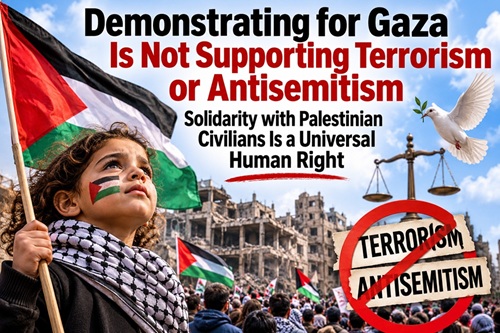 There is something deeply troubling about the suggestion that demonstrating for Gaza automatically amounts to supporting terrorism or expressing antisemitism. It represents not merely a confusion of political categories but a dangerous attempt to delegitimize legitimate moral protest by associating it with the worst possible motives. It turns solidarity with civilian victims into an accusation of complicity with their attackers, and criticism of Israeli government policy into evidence of hostility toward Jews. In doing so, it undermines the very principles of democratic debate, freedom of expression, and universal human rights that should be defended most vigorously in times of war. The central point should be obvious: one can oppose the destruction of Gaza without supporting Hamas, condemn Israeli military actions without hating Jews, and defend Palestinian rights without endorsing terrorism. These positions are not contradictory. They are entirely compatible, and indeed should be the starting point of any morally serious discussion. Yet this elementary distinction increasingly needs defending. 1. The Deliberate Confusion Between Palestinians and HamasOne of the most persistent problems in public debate about Gaza is the tendency to conflate the Palestinian population with Hamas. This is an extraordinarily convenient political shortcut, but it is also intellectually indefensible. Hamas is a political and militant organization with a history of terrorism, authoritarian rule, religious extremism, and deliberate attacks against civilians. Its October 7, 2023 assault on Israel, involving mass murder, sexual violence, hostage-taking, and other atrocities, deserves unequivocal condemnation. No legitimate concern for Palestinian rights requires minimizing or excusing these crimes. But Palestinians are not Hamas. The population of Gaza consists of millions of individual human beings, including children, women, elderly people, medical workers, teachers, journalists, and countless others who have no meaningful control over the organization governing their territory. Many were not even born when Hamas took power in 2007. Others have opposed Hamas, sometimes at considerable personal risk. Even those who once supported Hamas cannot simply be stripped of their civilian status or fundamental human rights. The distinction between a population and the organization claiming to represent it is fundamental to international humanitarian law. Civilians do not become legitimate military targets because an armed organization operates among them, governs their territory, or enjoys some degree of political support. If we abandon this distinction in the case of Gaza, we abandon one of the most important protections against collective punishment. Demonstrating for Gaza means, in its most basic and legitimate form, demonstrating for the lives and rights of Palestinian civilians. It means opposing mass displacement, destruction of homes, attacks on civilian infrastructure, restrictions on humanitarian assistance, and the devastation of an entire society. None of this constitutes support for Hamas. Indeed, the argument that solidarity with Palestinian civilians amounts to solidarity with Hamas reproduces precisely the collective logic that makes civilian suffering so easy to disregard. 2. Criticism of Israel Is Not AntisemitismA second confusion concerns the relationship between criticism of Israel and antisemitism. Antisemitism is real. It has a long and particularly murderous history in Europe, and it remains a serious contemporary problem. It must be confronted wherever it appears, including on university campuses, at demonstrations, in political movements, and across social media. But the seriousness of antisemitism is precisely why the concept should not be diluted by using it indiscriminately. Criticism of the Israeli government is not inherently antisemitic. Criticism of Benjamin Netanyahu is not antisemitic. Opposition to Israeli settlement policy, military operations, occupation, or the blockade of Gaza is not antisemitic. Demanding equal rights for Palestinians and Israelis is not antisemitic. Israel is a state, not a religion. Its government is a political institution, not the embodiment of Jewish identity. Its military is subject to scrutiny like every other military. Its policies can be criticized, its leaders can be condemned, and its actions can be judged against international law. To suggest otherwise would effectively place Israel beyond the normal standards of political accountability. That would be an extraordinary proposition. Consider the implications. Would opposition to Russian military operations in Ukraine constitute hostility toward Russians? Would criticism of Saudi Arabia's treatment of dissidents constitute hatred of Muslims? Would protesting American military interventions amount to hostility toward Americans? Obviously not. Political responsibility belongs to governments, institutions, and individuals who make decisions. It cannot automatically be transferred to entire religious, ethnic, or national communities. The same principle must apply to Israel. There is, of course, a genuine boundary. Criticism becomes antisemitic when it invokes anti-Jewish stereotypes, holds Jews collectively responsible for Israeli government actions, denies Jewish people the same basic rights afforded to others, or uses hostility toward Israel as a pretext for attacking Jewish individuals and communities. Antisemitic slogans, harassment of Jewish students, threats against synagogues, and attacks on Jewish institutions are unacceptable. They should be condemned without hesitation. But these are reasons to oppose antisemitism, not reasons to silence criticism of Israel. The existence of antisemitism does not invalidate legitimate criticism of Israeli policy, just as the existence of anti-Muslim prejudice does not invalidate criticism of Islamist movements or governments in Muslim-majority countries. 3. The Right to Protest Against Civilian SufferingPerhaps the most disturbing aspect of the debate is the suggestion that demonstrating against the destruction of Gaza is somehow an extreme or suspicious political activity. What exactly are people supposed to do when they witness the devastation of a civilian population? Remain silent? Wait until every political complication has been resolved? First produce an exhaustive analysis of Hamas, Israeli security concerns, the history of Zionism, the British Mandate, the Oslo Accords, and the failures of Palestinian leadership before expressing concern for people being killed? This is an absurd standard. People do not need to possess a comprehensive geopolitical theory before they can recognize human suffering. They do not need to approve of every Palestinian political organization before they can oppose the killing of Palestinian civilians. Nor must they demonstrate equal attention to every conflict in the world before their concern for Gaza becomes morally legitimate. Political demonstrations are not academic seminars. They are expressions of public conscience. The fundamental message of a Gaza demonstration can be very simple:
None of these demands is radical. They are expressions of principles that democratic societies claim to uphold. And they should apply regardless of the identity of the victims or the perpetrators. 4. International Law Is Not a Political Loyalty TestA particularly important distinction concerns the relationship between moral protest and international law. The laws of war do not operate according to the moral reputation of the parties involved. They are not suspended because one side has committed terrorism, nor are they optional because one country faces genuine security threats. Israel has legitimate security concerns. Israeli civilians have an absolute right to protection against attacks. The October 7 massacre was a horrific crime, and the Israeli government had both a right and a responsibility to protect its population. But the right to self-defense is not an unlimited license to wage war by any means necessary. International humanitarian law requires distinction between combatants and civilians, proportionality in attacks, and precautions to minimize civilian harm. It also prohibits collective punishment. These principles apply to every party to an armed conflict. Hamas's deliberate attacks on Israeli civilians are violations of these principles. Israeli military operations must be judged by the same legal standards, independently of Hamas's conduct. This is not a question of moral equivalence. It is a question of universal legal standards. One can recognize that Hamas bears responsibility for the atrocities it committed while also demanding that Israel comply with international law. One can acknowledge that Hamas operates in civilian areas without accepting that this makes the civilian population collectively responsible for its presence. Indeed, the entire purpose of international humanitarian law is to prevent the logic of retaliation from eliminating the distinction between combatants and civilians. If the suffering of one population is regarded as less worthy of concern because its attackers committed atrocities, then humanitarian principles have been replaced by political tribalism. And that is precisely what international law is supposed to prevent. 5. The Selective Application of Moral OutrageThere is another uncomfortable dimension to the accusation that Gaza demonstrations are inherently suspect: the selective application of moral standards. Public debate frequently treats expressions of solidarity with Israeli victims as entirely legitimate, while expressions of solidarity with Palestinian victims are subjected to additional ideological scrutiny. This asymmetry is difficult to defend. Condemning October 7 does not require qualifying one's condemnation with a simultaneous discussion of Palestinian suffering. But condemning the destruction of Gaza is often accompanied by demands that demonstrators first denounce Hamas, clarify their position on Israel's existence, condemn every controversial slogan, and distance themselves from every radical individual who might appear at a demonstration. Some of these questions may be legitimate in particular circumstances. Demonstrators should be prepared to reject antisemitism and terrorism. But why should the basic expression of compassion for Palestinians require a political examination that is not routinely demanded of people expressing solidarity with Israelis? The answer is often that Palestinian solidarity is treated as inherently contaminated by the presence of Hamas. This is an unfair burden. Imagine applying the same reasoning elsewhere. Would demonstrations against Russian attacks on Ukrainian cities be delegitimized because some Ukrainian nationalists hold extremist views? Would protests against the destruction of Syrian civilian communities be treated as support for jihadist organizations because some opposition factions were Islamist? Would demonstrations against American military abuses be dismissed as support for the Taliban? The absurdity becomes apparent immediately. A political movement should be judged by its actual demands, statements, and conduct, not by the worst possible interpretation of its participants' motives. There can certainly be antisemitic individuals at pro-Palestinian demonstrations. There can also be people who excuse Hamas's crimes, celebrate October 7, or reject Israel's right to exist. Such positions should be challenged openly. But their presence does not automatically define everyone else. A demonstration is not a single-minded ideological organism. It is a gathering of people who may have different motivations but share a particular political concern. The proper response to antisemitic expressions is to identify and challenge them, not to condemn an entire movement for Palestinian rights. 6. The Weaponization of the Antisemitism AccusationThere is a danger in treating accusations of antisemitism as a general-purpose instrument for discrediting political opposition. When legitimate criticism is routinely placed in the same category as racial or religious hatred, the concept of antisemitism loses some of its analytical precision. It becomes harder to distinguish genuine prejudice from political disagreement. This does not help Jewish communities. On the contrary, it risks weakening the credibility of accusations that should be taken extremely seriously. The distinction between antisemitism and anti-Zionism is sometimes complicated and deserves careful examination. Zionism itself encompasses different historical, religious, and political traditions. Not every criticism of Zionism is antisemitic, and not every position described as anti-Zionist is free of antisemitic assumptions. But one thing should be clear: opposing the policies of the present Israeli government, demanding an end to occupation, or advocating equal rights and political freedom for Palestinians does not automatically constitute antisemitism. Nor does the demand that Israel be held accountable under international law. If a government invokes the historical persecution of its people to shield its present policies from criticism, that invocation deserves scrutiny rather than automatic acceptance. Historical suffering cannot provide permanent immunity from political accountability. The Holocaust must never be forgotten, and its lessons should include a universal rejection of dehumanization, collective punishment, racial hierarchy, and the denial of human rights. Those lessons cannot logically apply only to one population. The moral significance of the Holocaust is not that Jewish suffering should matter more than Palestinian suffering. It is that the persecution and dehumanization of human beings must never again be accepted as normal. 7. Solidarity Is Not EndorsementA further confusion concerns the meaning of solidarity itself. To demonstrate for Gaza is not necessarily to endorse Palestinian nationalism in all its historical forms, much less every organization claiming to represent Palestinians. It does not require support for Hamas, Islamic fundamentalism, or the political elimination of Israel. Solidarity with a population is not the same thing as unconditional endorsement of its political leadership. One can support the rights of Palestinians while criticizing the Palestinian Authority. One can oppose Israeli occupation while rejecting Hamas's authoritarianism. One can demand Palestinian self-determination while insisting that Israeli civilians have an equal right to security and political independence. These positions are entirely coherent. Indeed, a genuinely progressive or humanistic position should reject both antisemitism and anti-Palestinian racism, both terrorism and indiscriminate military violence, both religious extremism and ethnic supremacy. It should also reject the notion that the suffering of one population somehow cancels out the suffering of another. This is not neutrality in the face of injustice. It is a refusal to make human rights dependent on political allegiance. The ultimate objective should be a political arrangement in which Israelis and Palestinians can live in security, freedom, and dignity. Whether that takes the form of two states, one state with equal rights, or another mutually negotiated arrangement is a matter of political debate. But any sustainable solution must recognize the humanity and legitimate rights of both peoples. A movement for Palestinian rights need not abandon this principle. On the contrary, it should insist on it. 8. The Moral Test: Would We Accept This Argument Elsewhere?Perhaps the simplest way to expose the weakness of the accusation against Gaza demonstrations is to apply it consistently. Would we accept the argument that demonstrating against the bombing of Ukrainian cities constitutes support for Russian aggression? Would we accept that protesting against the persecution of Uyghurs constitutes hostility toward Chinese people? Would we accept that demonstrating against the treatment of Rohingya civilians constitutes hostility toward Buddhists? Would we accept that protesting against the Saudi-led intervention in Yemen constitutes support for the Houthis? In each case, the answer should be no. The victims of a conflict do not become undeserving of solidarity because their political representatives are objectionable. Nor does criticism of a government imply hatred of the population it governs. Why should Gaza be different? The answer cannot simply be that Hamas is a terrorist organization. That fact is important, but it does not erase the distinction between Hamas and Palestinian civilians. Nor does it exempt the Israeli government from scrutiny. If anything, the more emotionally charged a conflict becomes, the more important it is to preserve distinctions that prevent political outrage from turning into collective hostility. A democracy should be capable of holding several truths simultaneously, even when they are politically inconvenient. Hamas committed atrocities on October 7. Israeli civilians deserve security and protection. Palestinian civilians deserve security and protection. Antisemitism must be opposed. Anti-Palestinian racism must be opposed. Israeli government policies are open to criticism. Palestinian political organizations are open to criticism. International humanitarian law applies to everyone. There is no contradiction here. The contradiction arises only when people insist that acknowledging one of these truths requires abandoning another. Conclusion: Defending Gaza Is Defending a Universal PrincipleDemonstrating for Gaza is not inherently support for terrorism, just as criticizing Israel is not inherently antisemitism. These are separate questions that should be evaluated on their actual merits. Of course, pro-Palestinian demonstrations should reject antisemitic slogans, harassment, threats, and expressions of support for attacks on civilians. There should be no ambiguity about this. Equally, those who invoke antisemitism should be careful not to turn a legitimate concept into a political weapon against dissent. The right to protest against civilian suffering is a fundamental democratic freedom. It cannot depend on whether the victims belong to a politically convenient population, whether their leaders are admirable, or whether their plight fits comfortably within prevailing political narratives. There is something profoundly wrong with a political culture in which expressing concern for Palestinian children can provoke suspicion about one's attitude toward Jews, while condemning Israeli military actions is treated as evidence of ideological extremism. It is equally wrong to suggest that the only acceptable expression of solidarity with Palestinians is one that begins with an elaborate disclaimer distancing itself from every possible objectionable association. People should not have to apologize for caring about civilian lives. The most important principle is also the simplest: human rights are universal, or they are not human rights at all. If we defend Israeli civilians against terrorism, we must defend Palestinian civilians against unlawful violence. If we condemn antisemitism, we must also condemn anti-Palestinian racism. If we insist that Hamas cannot invoke historical grievances to justify atrocities against Israelis, we must equally insist that Israel cannot invoke October 7 to justify violations of the rights of Palestinians. This is not a double standard. It is the opposite: the consistent application of one moral standard to everyone. Demonstrating for Gaza is therefore not an act of hostility toward Jews. At its best, it is an expression of solidarity with human beings whose lives, homes, families, and future have been devastated by war. And anyone who believes in universal human rights should be able to understand why that is not only legitimate, but necessary.
Comment Form is loading comments...
|