|
TRANSLATE THIS ARTICLE
Integral World: Exploring Theories of Everything
An independent forum for a critical discussion of the integral philosophy of Ken Wilber
  Frank Visser, graduated as a psychologist of culture and religion, founded IntegralWorld in 1997. He worked as production manager for various publishing houses and as service manager for various internet companies and lives in Amsterdam. Books: Ken Wilber: Thought as Passion (SUNY, 2003), and The Corona Conspiracy: Combatting Disinformation about the Coronavirus (Kindle, 2020).
Check out my other conversations with ChatGPT Ken Wilber and Rupert SheldrakeThe Metaphysics of MorphogenesisA Critical Examination of Wilber's Enthusiastic Endorsement of Morphic ResonanceFrank Visser / ChatGPT
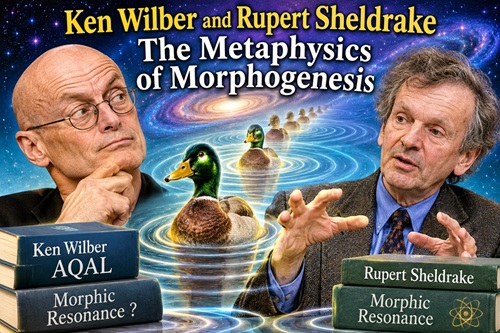 Ken Wilber's evaluation of Rupert Sheldrake's theory of morphogenesis is a revealing document in the intellectual history of the integral movement.[1] It shows Wilber at his most sympathetic toward an unconventional scientific hypothesis, but also exposes a recurring weakness in his approach to science: the tendency to move too quickly from a legitimate explanatory problem to a speculative metaphysical solution. Wilber does not merely introduce Sheldrake's theory or discuss it as an interesting possibility. He enthusiastically endorses its basic premises, attempts to improve its theoretical coherence, and eventually incorporates it into a larger metaphysical picture involving subtle energies, archetypal structures, and the evolutionary development of the cosmos. His essay is particularly interesting because Wilber recognizes several genuine philosophical problems in Sheldrake's proposal. Yet instead of subjecting the hypothesis to a sufficiently rigorous scientific examination, he frequently attempts to resolve its difficulties through additional metaphysical assumptions. The result is an intriguing philosophical discussion, but a much less convincing contribution to the scientific understanding of biological form. 1. The Problem of Biological FormWilber begins with a legitimate question: how do living organisms acquire their characteristic forms? Why does a developing embryo produce an organized organism rather than an arbitrary collection of cells? Why do proteins assume particular three-dimensional configurations? How do biological systems maintain their overall organization while individual components are continually replaced? These are important questions in developmental biology. They concern the relationship between genetic information, biochemical interactions, physical constraints, cellular communication, and the emergence of organized structures. Wilber frames the problem in rather stark terms: "No known physical laws can account for the form these systems take." This is already an unfortunate exaggeration. The fact that a complete explanation of morphogenesis is difficult does not mean that physical laws are incapable of accounting for it. Nor does the existence of higher-level organizational patterns demonstrate that something beyond physical processes must be introduced. Modern developmental biology investigates precisely how biological form emerges through interactions among genes, gene-regulatory networks, signaling pathways, mechanical forces, cellular differentiation, and environmental conditions. The distinction between describing the components of an organism and explaining their organization is important. But it does not follow that organization requires a separate, nonphysical causal agency. Wilber nevertheless presents the problem as a choice between mechanistic reductionism and various holistic alternatives. This framing is misleading. Contemporary science does not have to choose between isolated mechanical components and mysterious organizing fields. Complex systems can exhibit emergent organization through entirely physical interactions. The explanatory challenge is real. The metaphysical conclusion is not. 2. From Morphogenetic Fields to Morphic ResonanceWilber identifies three historical approaches to the problem. First, vitalism, associated with Hans Driesch, proposed that living organisms possess an organizing life-force or entelechy. Second, organismic theories, associated with C. H. Waddington and others, introduced the concept of morphogenetic fields. These fields were supposed to account for the overall patterns governing the development of organisms. Third, Brian Goodwin's approach invoked archetypal or timeless forms that become actualized in biological evolution. Wilber regards each approach as incomplete. Vitalism is too vague, morphogenetic field theory does not adequately explain the nature of its fields, and archetypal explanations threaten to eliminate genuine evolutionary novelty. Enter Rupert Sheldrake. Sheldrake's formative causation proposes that forms are influenced by similar forms that occurred in the past. Through morphic resonance, previous instances of a particular organization supposedly influence subsequent instances, even without direct physical contact. Wilber explains this using protein folding. The first occurrence of a particular protein configuration might be accidental. But once that configuration has occurred, subsequent instances of the same protein should become more likely to assume the same configuration. The more frequently a particular form occurs, the stronger its influence on subsequent occurrences. Wilber summarizes the idea as follows: "An original contingency has become, via repetition, a virtual necessity." This is an attractive formulation. It suggests that nature possesses a kind of cumulative memory, with regularities emerging through repetition rather than being entirely predetermined from the beginning. There is an interesting philosophical resemblance here to Charles Sanders Peirce's conception of natural laws as habits. It also recalls certain process-philosophical interpretations of evolution. But conceptual resemblance is not empirical confirmation. The crucial question is whether morphic resonance actually exists as an additional causal influence. Wilber appears impressed by the explanatory possibilities of the proposal before establishing that its central mechanism has been demonstrated. 3. The Missing MechanismOne of the most revealing passages occurs when Wilber considers the apparent dualism in Sheldrake's theory. Sheldrake's morphic fields are supposed to influence material processes without themselves being reducible to ordinary matter or energy. Wilber correctly recognizes the difficulty: "How can nonmatter affect matter?" This is a serious problem. If morphic fields are purely formal or abstract, how do they produce physical effects? What is the causal interface between the supposedly immaterial field and the material organism? Wilber's solution, however, is not to demand a clearer account of the mechanism. Instead, he suggests that morphogenetic fields probably possess some kind of subtle energy. He writes: "It is therefore possible—I would say probable—that morphogenetic fields are not completely formal but rather possess some sort of very subtle energy." He then connects this possibility with traditional notions of bio-energy and prana. This is a remarkable move. A problem within Sheldrake's theory becomes an opportunity to introduce an additional metaphysical entity. But what exactly is this subtle energy? How is it measured? What distinguishes it from ordinary electromagnetic, chemical, or mechanical processes? Does it obey conservation laws? Can its effects be independently detected? Wilber supplies no answers. The argument effectively moves from an unexplained causal relationship to another unexplained causal relationship. Instead of resolving the original difficulty, it relocates it into the language of subtle energies. There is also a conceptual confusion here. In physics, fields are not necessarily material substances or collections of energy. They are mathematical and physical structures whose properties and interactions can be specified and tested. The analogy with magnetic fields does not establish that biological morphogenetic fields must possess an additional subtle-energy component. Wilber's preference for an energetic interpretation therefore reflects his metaphysical commitments more than any demonstrated requirement of Sheldrake's hypothesis. 4. The Conservation of Form: A Metaphysical Rescue?Wilber develops another interesting argument concerning the persistence of forms. Suppose a flower is burned to ashes. Its mass and energy are conserved, but its recognizable form disappears. Yet if Sheldrake's theory is correct, the previous form must somehow remain available to influence subsequent flowers through morphic resonance. Wilber concludes that Sheldrake's theory implicitly requires a kind of conservation of form: "A form that was totally destroyed, that ceased to exist absolutely, could not have any effect whatsoever on subsequent form." This leads him to suggest that formative causation entails a subtle formal conservation, analogous to, but distinct from, energetic conservation. The argument is ingenious but not compelling. It assumes that causal influence requires the continued existence of the original form in some preserved repository. That is precisely what needs to be demonstrated. Ordinary causal processes do not generally require the preservation of their original configurations. A biological organism can leave traces in its environment, alter the conditions under which subsequent organisms develop, or transmit information through reproduction. None of this requires an additional cosmic archive of forms. If Sheldrake proposes a nonlocal influence that survives the disappearance of the original organism, he must explain how this influence is transmitted and what empirical consequences distinguish it from ordinary historical causation. Wilber instead turns the problem into a metaphysical principle: formal conservation. But naming a hypothetical principle does not explain how it operates. There is a further difficulty. The flower analogy conflates the disappearance of a particular physical configuration with the disappearance of all information about that configuration. The latter does not follow from the former. The structure of a flower can leave causal traces in seeds, genetic material, environmental conditions, photographs, descriptions, and countless other physical records. Wilber's argument overlooks these ordinary mechanisms of historical continuity. 5. The Nonlocality ProblemSheldrake's hypothesis becomes particularly controversial when he extends morphic resonance across space and time. Wilber describes the proposal in terms of nonlocal formative causation: once a particular form has been learned or established, similar systems elsewhere should acquire it more easily, without direct contact. He mentions two examples: the supposedly increased ease of crystallizing complex organic compounds after their first crystallization elsewhere, and the alleged ability of rats in different locations to learn a maze more rapidly after other rats have learned it. These examples are presented as circumstantial evidence for morphic resonance. But they raise obvious methodological questions. Were the experiments independently replicated? Were the experimental conditions adequately controlled? Could information have been transmitted through ordinary channels? Were the results statistically robust? Were alternative explanations excluded? Wilber does not investigate these questions in any detail. He does, however, make an important concession. Even if the nonlocal aspect of Sheldrake's hypothesis were disproved, morphogenetic fields might still operate through subtle local influences. This is an interesting distinction, but it also creates a problem of scientific demarcation. If the original hypothesis predicts nonlocal effects, and the failure of those predictions can be accommodated by proposing local subtle-energy fields, what exactly would count as evidence against the broader theory? A scientific hypothesis should expose itself to the possibility of failure. It should not continually migrate into less testable formulations whenever its more specific predictions encounter difficulties. Wilber praises Sheldrake for proposing falsifiable experiments, but he does not apply the same Popperian discipline to his own extensions of the theory. Indeed, his suggestion that morphogenetic fields probably possess subtle energies is not accompanied by a corresponding experimental proposal. 6. The Return of ArchetypesThe third objection Wilber raises concerns Sheldrake's rejection of timeless forms. Sheldrake emphasizes the historical and developmental character of nature. Forms are not simply given from eternity; they emerge and are subsequently reinforced through morphic resonance. Wilber appreciates this evolutionary emphasis but believes Sheldrake goes too far. He argues that certain fundamental categories must necessarily be present for Sheldrake's theory to make sense: energy, form, causation, development, and creativity. These categories, Wilber suggests, are themselves archetypal because they are invariant features of the universe. This is where the discussion becomes distinctly Wilberian. Wilber is prepared to accept evolutionary novelty at the level of particular forms, but he insists that deeper structures must remain timelessly given. His distinction between invariant deep structures and variable surface structures is characteristic of his larger philosophical project. It allows him to accommodate evolution while retaining an underlying metaphysical architecture. But the argument is less persuasive than it initially appears. Wilber moves between two different meanings of archetype. Sometimes he means a metaphysically existing, timeless form. At other times he means a general conceptual category that must be presupposed in any description of reality. The fact that we must use concepts such as form, energy, or causation to describe the universe does not establish that these categories exist as timeless archetypal structures within the universe. There is a difference between a conceptual necessity and an ontological necessity. Likewise, the fact that something is currently regarded as invariant does not demonstrate that it is metaphysically eternal. The status of physical laws, constants, and fundamental structures is itself a legitimate subject of scientific and philosophical investigation. Wilber's argument therefore risks converting the vocabulary of description into an inventory of cosmic entities. He has not demonstrated the existence of archetypes; he has demonstrated that certain concepts are indispensable to his own account of reality. 7. Creativity: An Explanation or an Exemption?Wilber eventually identifies what he considers a fundamental limitation of Sheldrake's theory. Sheldrake explains how existing forms might be replicated and reinforced, but he does not explain how genuinely new forms emerge in the first place. Wilber regards this as an unavoidable limitation because creativity itself is archetypal. He writes that Sheldrake's theory "does not and in fact cannot address the creativity of new forms simply because creativity itself is archetypal." This is a particularly revealing passage. Wilber has identified a legitimate distinction between the emergence of novelty and the subsequent stabilization or reproduction of existing patterns. These are different explanatory problems. But his solution is to declare creativity archetypal. What does this actually explain? If creativity is an irreducible feature of the universe, Wilber needs to explain what that assertion adds to our understanding of evolutionary processes. Otherwise, it simply assigns a metaphysical name to something that remains unexplained. There is no need to invoke timeless archetypes to recognize that evolution produces novelty. Variation, mutation, recombination, developmental constraints, environmental interactions, and selection provide a substantial scientific framework for investigating how new forms arise. These mechanisms do not necessarily explain every aspect of biological innovation, but their incompleteness does not establish Wilber's metaphysical alternative. More importantly, the emergence of a new form does not automatically require a cosmic principle of creativity operating independently of the physical processes through which that form emerges. Wilber's argument thus illustrates a familiar problem in his philosophy: explanatory gaps in scientific accounts are treated as invitations to introduce metaphysical principles rather than as opportunities for further empirical investigation. 8. The Uncritical Celebration of New Age ScienceThe most revealing aspect of the essay may be its conclusion. Wilber declares Sheldrake's work one of the most innovative, careful, and refreshing scientific presentations of the preceding decade. He praises its clarity, its opposition to reductionism, its philosophical sophistication, and its willingness to propose falsifiable experiments. He even suggests that Sheldrake represents the emergence of one of the first genuinely New Age scientists. There is something commendable about Wilber's willingness to engage with unconventional ideas rather than dismissing them simply because they challenge established assumptions. Scientific progress does require openness to unexpected possibilities. But openness is not the same as endorsement, and criticism of reductionism is not evidence for morphic resonance. Wilber's praise is especially problematic because he appears to conflate several distinct achievements: Identifying an interesting problem in developmental biology. Proposing a coherent philosophical interpretation of that problem. Formulating a novel causal hypothesis. Demonstrating that the proposed mechanism actually operates in nature. These are very different accomplishments. Sheldrake certainly deserves credit for proposing a distinctive hypothesis and identifying experiments that could, in principle, test it. But the existence of testable predictions does not make those predictions successful, and the philosophical attractiveness of a theory does not establish its empirical validity. Wilber's enthusiasm seems to derive partly from the fact that Sheldrake offers a scientific-sounding account of a worldview Wilber already finds attractive: a universe in which form, consciousness, creativity, and evolution are interconnected through deeper organizing principles. The hypothesis fits the metaphysics rather well. That is precisely why greater critical distance would have been necessary. 9. What Happened to the Scientific Hypothesis?There is an important historical perspective missing from Wilber's essay: what became of Sheldrake's proposed research program? Wilber wrote with considerable optimism that the proposed experiments would help establish whether morphic resonance was real. Yet the subsequent history has not produced the kind of convincing experimental confirmation that would justify incorporating morphic resonance into a scientific account of biological development. A particularly interesting retrospective appeared in 2021, when Alex Gomez-Marin published Facing Biology's Open Questions: Rupert Sheldrake's "Heretical" Hypothesis Turns 40 in BioEssays. Gomez-Marin is sympathetic to Sheldrake's intellectual ambitions and criticizes the dogmatic reception of his work. Nevertheless, he acknowledges that the experimental evidence for morphic resonance is not overwhelming and that most of the proposed experiments have never been performed. The hypothesis remains largely untested. This is an important qualification. We should distinguish between two propositions: Biology still contains fundamental explanatory problems concerning development, organization, and the emergence of form. Sheldrake's proposed mechanism of nonlocal morphic resonance provides a scientifically established explanation of those problems. The first proposition is entirely defensible. The second remains unsubstantiated. Sheldrake has published experimental work, including a study of conditioned aversion in chicks, but its interpretation was disputed by Steven Rose, whose laboratory hosted the experiment. The existence of such experiments deserves recognition, but it should not be confused with independent, robust replication. Wilber's essay is therefore best understood as an enthusiastic philosophical assessment of an emerging hypothesis, not as a reliable evaluation of an established scientific discovery. 10. Wilber's Integral ProblemThe deeper significance of this essay concerns Wilber's relationship with science. He is clearly dissatisfied with reductionist explanations of life. He wants a universe in which organization, development, creativity, and consciousness are not accidental by-products of supposedly more fundamental physical processes. This ambition is understandable. But Wilber repeatedly makes the same argumentative move: when an existing scientific explanation appears incomplete, he introduces a higher-order metaphysical principle to fill the gap. In this essay, those principles include morphogenetic fields, subtle energies, formal conservation, nonlocal causation, and timeless archetypes. The problem is not that these concepts are necessarily meaningless. It is that their explanatory status is never adequately established. Wilber's integral philosophy encourages him to regard different explanatory perspectives as complementary. But complementarity cannot substitute for empirical discrimination. A theory that makes claims about physical and biological processes must ultimately answer to the relevant empirical evidence. One cannot simply add a subtle-energy explanation to a physical explanation and call the result more integral. One must demonstrate that the additional explanatory principle contributes something that the existing scientific account cannot provide. This is especially important because Wilber praises Sheldrake for his Popperian willingness to expose his hypothesis to falsification. Yet Wilber himself is much less disciplined when extending the hypothesis into his own metaphysical framework. His subtle-energy interpretation, formal conservation principle, and archetypal account of creativity are not accompanied by comparable experimental specifications. There is an asymmetry here: Sheldrake is praised for being scientifically testable, while Wilber's own additions are largely exempted from that requirement. Conclusion: A Metaphysical Alliance Mistaken for Scientific ProgressWilber's essay on Sheldrake is historically interesting precisely because it reveals how integral philosophy negotiates the boundary between scientific explanation and metaphysical speculation. There are genuine questions here. Biological form is not adequately understood by merely listing the molecular components of an organism. Development involves complex interactions, emergent organization, feedback, and historical constraints. Science should remain open to new explanatory principles. But none of this establishes morphic resonance. Wilber's central mistake is to treat the inadequacy of certain existing explanations as indirect support for a preferred alternative. He is attracted to Sheldrake's hypothesis not simply because of its empirical promises, but because it offers a picture of nature that fits his own philosophical convictions. The resulting alliance is intellectually understandable but scientifically premature. Indeed, Wilber's attempt to improve Sheldrake's theory reveals the problem particularly clearly. Whenever a conceptual difficulty arises, he introduces another metaphysical ingredient rather than demanding a more precise causal account. The result is an increasingly elaborate ontology without a corresponding increase in empirical explanatory power. For an integral philosopher who frequently criticizes reductionism for confusing a partial description with a complete explanation, this is an ironic outcome. Wilber risks committing the opposite error: confusing a comprehensive metaphysical picture with a scientifically adequate explanation. The lesson is not that biological holism should be rejected, nor that every unconventional hypothesis deserves immediate dismissal. It is that explanatory ambition must be matched by evidential discipline. Morphic resonance may be an imaginative hypothesis, but Wilber's enthusiasm cannot turn it into a scientific discovery. Appendix: Wilber and Sheldrake in a 2008 DialogueIn January 2008, Ken Wilber and Rupert Sheldrake appeared together in a four-part video conversation published by Integral Life under the title "Morphic Fields, Memory, and the Creative Advance".[2] The dialogue is an interesting follow-up to Wilber's earlier enthusiastic evaluation of Sheldrake's theory of morphogenesis. It demonstrates that their intellectual relationship extended beyond a shared interest in biological form into a much broader discussion of evolution, consciousness, and the metaphysical nature of the universe. The four videos were published under the collective heading Everyone Is Right:
The first video is particularly relevant to our discussion. The central question is whether nature possesses a kind of cumulative memory. Sheldrake's morphic resonance proposes that previous instances of a particular form or pattern influence subsequent instances of similar forms. Wilber finds this idea congenial to his own evolutionary philosophy, in which the universe develops through an accumulation of previous achievements. The Integral Life introduction describes this process as a universe governed not simply by immutable physical laws but by evolving "Kosmic habits." Each new development builds upon what has happened before, making subsequent developments increasingly probable. The metaphor is that of an accumulating history of nature, extending from physics and chemistry to biology, psychology, and spirituality. This is an interesting convergence between Sheldrake's hypothesis and Wilber's metaphysics. Both are attracted to the idea that evolution involves more than the mechanical rearrangement of previously existing components. Both emphasize historical continuity, cumulative development, and the emergence of novelty. But their respective explanatory projects should not be confused. Sheldrake proposes a specific causal mechanism, morphic resonance, whereas Wilber places this proposal within a much more comprehensive metaphysical framework involving Eros, holons, interiority, and spiritual evolution. The second video, concerning the inner life of atoms and molecules, moves further into this territory. Here the discussion connects morphic units with the notion that every entity possesses both an exterior and an interior dimension. Wilber's familiar holonic cosmology provides the framework: atoms are wholes that participate in molecules, molecules in cells, and cells in organisms. Each has an exterior aspect and an interior aspect. This brings us to a crucial difference between an empirical hypothesis and a metaphysical interpretation. The proposition that atoms and molecules possess some form of interiority is not established by the existence of morphic resonance. Nor does the hypothesis that biological forms inherit patterns from previous instances provide evidence that consciousness, however minimally defined, is present at every level of physical reality. The third video, Matter, Consciousness, and Spirituality, makes this broader philosophical ambition explicit. The conversation moves beyond biological organization toward the relationship between matter and consciousness. Wilber's integral approach seeks to overcome the opposition between materialism and idealism by treating subjective and objective dimensions as equally fundamental. The fourth video, on Christianity, the Holy Trinity, and Kosmic Creativity, takes the discussion still further into Wilber's spiritual cosmology. Although interesting as an illustration of his worldview, it is no longer particularly relevant to evaluating Sheldrake's scientific hypothesis. From Morphic Resonance to Integral CosmologyWhat makes this four-part conversation worth mentioning is the intellectual expansion that takes place between Wilber's original evaluation of morphogenesis and their 2008 dialogue. Initially, Sheldrake's theory was presented as a possible explanation of biological form. By 2008, it had become part of a much larger discussion about the evolutionary character of the entire Kosmos. The Integral Life introduction even declares that there are no eternal Platonic Forms waiting to be actualized. Instead, the universe develops through an ongoing process of creativity, in which each new achievement becomes part of the conditions for subsequent development. This is an interesting philosophical position, but it also illustrates the danger of conflating different explanatory levels. A hypothesis about the historical transmission of biological forms does not automatically provide a theory of cosmic evolution, consciousness, or spirituality. Nor does the compatibility of two philosophical ideas establish the empirical validity of either. One further qualification is necessary: the Integral Life webpage provides an enthusiastic editorial introduction to the conversation, rather than a neutral scientific assessment. Its claims about the shared worldview of the two participants should therefore not be mistaken for independent confirmation that Sheldrake endorsed every aspect of Wilber's integral metaphysics. Nevertheless, the dialogue documents an important intellectual alliance. Sheldrake's morphic resonance offered Wilber a seemingly scientific mechanism for a universe characterized by cumulative memory and evolutionary creativity. Wilber, in turn, supplied Sheldrake's hypothesis with a much larger metaphysical setting. The unresolved question remains whether this alliance advanced our scientific understanding of nature or primarily reinforced a shared metaphysical outlook. NOTES[1] Ken Wilber, "Sheldrake's Theory of Morphogenesis", Journal of Humanistic Psychology, vol. 24, nr. 2, 1984. Reposted on Rupert Sheldrake's website. [2] Rupert Sheldrake and Ken Wilber, "Morphic Fields, Memory, and the Creative Advance", IntegralLife (members-only), January 28, 2008. REFERENCES in Wilber's paperBaldwin, J.M. (1902). Development and Evolution. New York: Macmillan. Bergson, H. (1911). Creative Evolution. London: Macmillan. Driesch, H. (1914). History and Theory of Vitalism. London: Macmillan. Goodwin, B. C. (1979). "On Morphogenic Fields." Theoria to Theory 13: 109-14. Popper, K. (1965). Conjectures rand Refutations. London: Routledge & Kegan Paul. Sheldrake, R. (1981). A New Science of Life. Los Angeles: J. P. Tarcher. Thorn, R. (1975). Structural Stability and Morphogenesis. Reading, Mass.: Benjamin. Waddington, C. (1975). The Evolution of an Evolutionist. Edinburgh: Edinburgh University Press. Whitehead, A. N. (1969). Process and Reality. New York: Macmillan.
Comment Form is loading comments...
|