|
TRANSLATE THIS ARTICLE
Integral World: Exploring Theories of Everything
An independent forum for a critical discussion of the integral philosophy of Ken Wilber
  Frank Visser, graduated as a psychologist of culture and religion, founded IntegralWorld in 1997. He worked as production manager for various publishing houses and as service manager for various internet companies and lives in Amsterdam. Books: Ken Wilber: Thought as Passion (SUNY, 2003), and The Corona Conspiracy: Combatting Disinformation about the Coronavirus (Kindle, 2020).
Check out my other conversations with ChatGPT Alan Watts and the Making of Ken WilberThe Zen of Nonduality and the Birth of Integral SpiritualityFrank Visser / ChatGPT
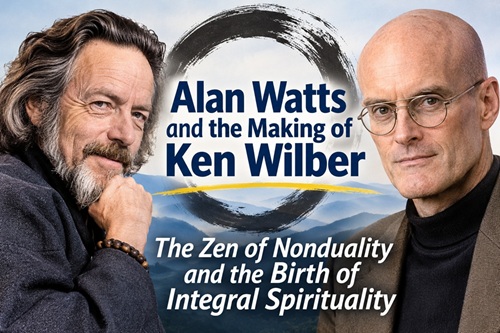
Introduction: The Man Who Helped Open the DoorFew twentieth-century popularizers of Eastern philosophy have had an influence comparable to Alan Watts (1915-1973). A gifted lecturer, writer, and interpreter of Asian religious traditions, Watts introduced generations of Western readers to Zen Buddhism, Taoism, Hindu philosophy, and the possibility of understanding consciousness beyond the familiar subject-object divide. He was not a systematic academic philosopher, nor did he aspire to construct an all-encompassing theory of reality. His particular talent was to make difficult philosophical insights intuitively accessible, often through humor, paradox, and memorable metaphors. Among those influenced by this intellectual and spiritual climate was Ken Wilber. Although Wilber would eventually develop a much more elaborate theoretical architecture than anything Watts proposed, the two share an important starting point: the conviction that ordinary human consciousness rests upon a fundamental misunderstanding of reality. The separate, isolated ego is not the ultimate truth of who we are. The apparent division between self and world is, at least in part, an artifact of consciousness itself. Watts helped popularize this nondual perspective in the West. Wilber would subsequently attempt to incorporate it into a comprehensive developmental, psychological, philosophical, and spiritual framework. Yet the relationship between the two is more interesting than a simple story of influence. Watts represents a relatively spontaneous, playful, and anti-systematic approach to spiritual awakening. Wilber represents the opposite tendency: the construction of an increasingly ambitious intellectual system intended to organize virtually every significant domain of human knowledge. The question, therefore, is not merely what Wilber learned from Watts, but what happened to Watts's insights when they entered the machinery of integral theory. 1. Alan Watts: Eastern Wisdom for Western EarsWatts's importance lay partly in his ability to translate Asian philosophical traditions without making them sound like obscure religious doctrines. He presented Zen, Taoism, and Vedanta as alternative ways of understanding existence, rather than simply as exotic belief systems. One of his central themes was the illusion of the separate ego. Western consciousness, he argued, tends to imagine that the individual is a self-contained subject confronting an external world. This creates an artificial opposition between human beings and nature, mind and body, and self and universe. Watts repeatedly challenged this picture. The individual is not an isolated entity accidentally placed in an alien universe. Human beings are expressions of the same natural process that produces trees, oceans, stars, and galaxies. His famous metaphor was that the universe is not something that happens to us. We are what the universe is doing. This idea has obvious affinities with Taoism and certain interpretations of Hindu nondualism. It also has an existential dimension: the attempt to control life from the standpoint of an allegedly independent ego is itself part of the problem. Watts's solution was not primarily a new philosophy or a more sophisticated conceptual map. It was a transformation in how one experiences oneself and the world. His lectures frequently employed humor to expose the absurdity of taking the ego too seriously. The spiritual seeker, he suggested, can become trapped in the very activity through which he hopes to escape: the desire to become enlightened. This anti-egoistic sensibility would become important in the spiritual atmosphere from which Wilber emerged. 2. Wilber's Early Intellectual Formation: Watts as a Writing TeacherThere is a particularly revealing detail about the relationship between the two men that deserves more attention than it usually receives. Wilber reportedly studied Alan Watts's books not merely for their philosophical content but also as models of literary composition. In an account of Wilber's early development, he describes how he copied Watts's books, sentence by sentence, to learn how to write clearly, construct paragraphs, and develop a readable style. He regarded Watts as an exceptionally clear and elegant writer. This is a remarkable admission. Watts was not simply one of the popular spiritual authors whom Wilber happened to read. He was, in a very practical sense, a writing teacher. The influence is worth remembering when comparing their respective styles. Watts could take an apparently profound philosophical problem and dissolve it through a simple analogy, a joke, or an unexpected turn of phrase. Wilber, by contrast, increasingly developed a vocabulary of technical distinctions, developmental sequences, categories, and conceptual hierarchies. The student eventually became a much more systematic thinker than his literary model. But the ambition to communicate difficult spiritual ideas to a broad readership, and the conviction that clarity need not mean superficiality, belong to a tradition in which Watts played an important role. There is also a more substantive intellectual connection. Wilber's earliest work, The Spectrum of Consciousness (1977), attempted to integrate Western psychology with contemplative traditions. Its central proposal was that apparently separate psychological schools describe different dimensions or levels of human consciousness. This was a more ambitious undertaking than Watts's popular expositions, but it developed within the same postwar encounter between Western psychology and Asian contemplative thought. Watts helped make that encounter culturally imaginable. Wilber tried to give it a theoretical structure. 3. The Nondual Foundation: From Watts to WilberThe most significant philosophical connection concerns nonduality. Watts repeatedly challenged the assumption that the individual ego is an independent entity. In his interpretation of Zen and Vedanta, the distinction between the observer and the observed is not ultimately absolute. The self is not a little entity hidden inside the body, looking out at an external universe. It is part of the very process it observes. Wilber adopted a comparable orientation. In his early writings, he described the ordinary sense of separate identity as a contraction of consciousness, a boundary-making process that produces the apparent division between self and world. His book No Boundary (1979) is particularly relevant here. Its central argument is that the boundaries separating the individual from the environment, the mind from the body, and the self from the world are not as absolute as ordinary consciousness assumes. The resemblance to Watts is unmistakable. Both authors employ the image of the wave and the ocean to explain how individual existence can be distinguished without being ultimately separate from the larger whole. A wave is real as a temporary configuration, but it is never something other than water. This is a powerful corrective to the metaphysics of isolated individualism. It also provides a philosophical foundation for ecological thinking: humanity is not an external observer or manager of nature but an expression of nature itself. Nevertheless, there is a difference in emphasis. Watts was primarily interested in helping people recognize the absurdity of their ordinary self-conception. Wilber was increasingly interested in explaining how this recognition fits into a developmental account of consciousness. That difference would become decisive. 4. From Spontaneous Awakening to Developmental HierarchyWatts's approach to enlightenment was often deliberately anti-systematic. He distrusted the idea that spiritual realization could be achieved by accumulating achievements, climbing a ladder of spiritual accomplishments, or constructing an increasingly elaborate conceptual system. Indeed, one of his recurring observations was that the desire to become enlightened can itself be an expression of the ego one is supposedly trying to transcend. Wilber's approach moved in another direction. He sought to distinguish developmental stages, levels of psychological organization, and varieties of spiritual realization. In his later AQAL framework, these distinctions became part of an enormous architecture encompassing quadrants, levels, lines, states, and types. There is a legitimate reason for this difference. The fact that nondual awareness may reveal the constructed character of certain boundaries does not mean that all forms of human consciousness are developmentally equivalent. A child's awareness, an adult's reflective consciousness, and a contemplative's nondual realization need not be interchangeable. Wilber's developmental perspective therefore addresses a question that Watts generally left aside: how does spiritual realization relate to the psychological, moral, cognitive, and cultural development of the person? But something is also lost in the transition. Watts's insistence on the immediacy of experience can become obscured when enlightenment is placed within an elaborate hierarchy of developmental achievements. The danger is that the conceptual map begins to occupy the territory. Instead of questioning the ego, the spiritual seeker may begin identifying with a supposedly higher developmental position. In that sense, Watts's humor provides a useful antidote to the more solemn tendencies of integral spirituality. The person who announces that he has transcended the ego by reaching a higher stage of consciousness may be displaying precisely the kind of spiritual self-importance that Watts delighted in exposing. 5. Watts's Anti-Intellectualism and Wilber's Intellectual AmbitionThere is a deeper tension between Watts and Wilber than their respective literary styles might suggest. Watts was suspicious of the tendency to confuse conceptual knowledge with direct experience. His presentations of Zen frequently emphasized the limitations of language, logical reasoning, and philosophical abstraction. One can understand the theory of enlightenment without having the slightest experience of what it describes. This is not an argument against intelligence. Watts was himself intellectually sophisticated. Rather, it is an argument against the assumption that intellectual sophistication necessarily brings one closer to existential understanding. Wilber shares this concern, at least in principle. He has repeatedly insisted that integral theory is a map rather than the territory and that studying spirituality is no substitute for spiritual practice. Indeed, in the foreword to my Ken Wilber: Thought as Passion (2003), he explicitly warned against confusing intellectual knowledge of spirituality with its actual realization. But there is an irony here. Wilber's enormous theoretical output can make it difficult to keep this distinction alive. His readers may become preoccupied with correctly identifying developmental levels, distinguishing states from stages, understanding the four quadrants, or determining whether a particular thinker occupies a conventional, modern, postmodern, or integral position. The result can be a new form of intellectual attachment: instead of identifying with the ordinary ego, one identifies with one's mastery of the integral map. Watts would probably have found this amusing. His challenge would be straightforward: has understanding the AQAL model actually changed the way you experience life, or have you merely acquired a more sophisticated vocabulary with which to describe yourself? This is not a refutation of Wilber's project. Conceptual maps can be useful, and developmental distinctions can prevent serious philosophical confusion. But Watts reminds us that the purpose of such maps should not be to produce an increasingly elaborate spiritual self-image. 6. The Important Differences: Watts Was Not an Integral TheoristIt would nevertheless be misleading to portray Watts as an early version of Wilber. Watts was an eclectic interpreter of Asian traditions, combining elements of Zen, Taoism, Vedanta, Western mysticism, Jungian psychology, and modern science. His objective was largely existential and therapeutic: to loosen the psychological knots that prevent people from experiencing themselves as part of nature. He did not attempt to construct a universal developmental psychology. Nor did he offer an elaborate theory of cultural evolution, epistemology, social systems, or the historical emergence of consciousness. Wilber's project was considerably more ambitious. His early work already attempted to integrate the psychological insights of Freud, Jung, Piaget, and other Western thinkers with the contemplative traditions of Asia. Later, he added developmental sociology, evolutionary theory, systems thinking, epistemology, and a comprehensive account of cultural perspectives. There is also a difference in their treatment of spiritual traditions. Watts often presented Zen, Taoism, and Vedanta as different expressions of a common recognition: the apparent separation of self and world is ultimately misleading. This made his work accessible, but it also invited the familiar criticism that he sometimes blended traditions whose historical, doctrinal, and practical differences deserve more attention. Wilber attempted to correct this problem through his perennial philosophy and developmental framework. He argued that spiritual traditions could share important insights while differing in their conceptual sophistication, cultural settings, and developmental achievements. This was an important contribution, but it introduced another problem: who determines which traditions or interpretations are more developed? And according to what independently defensible criteria? The danger is that a supposedly comprehensive framework may end up ranking traditions according to assumptions built into the framework itself. Watts was comparatively unconcerned with such questions. His strength was the experiential invitation; Wilber's was the theoretical ambition. Neither approach automatically resolves the limitations of the other. 7. The Problem with Watts: Romanticizing Eastern WisdomA critical assessment should not turn Watts into an unquestionable spiritual authority. His popular interpretations of Asian traditions were enormously influential, but they were also selective. He often emphasized the liberating, playful, and nondual dimensions of Eastern thought, sometimes giving less attention to its institutional, ritual, ethical, and doctrinal complexities. Zen Buddhism, for example, is not simply the recognition that everything is interconnected. It has specific historical lineages, meditation practices, monastic institutions, ethical commitments, and philosophical debates. Likewise, Taoism cannot be reduced to a generalized philosophy of going with the flow. Its classical texts contain political, cosmological, ethical, and metaphysical arguments that deserve attention in their own right. Watts's interpretation was therefore partly a creative reconstruction for a Western audience. That was not necessarily a bad thing. Intellectual translation always involves selection and reinterpretation. But readers should distinguish between what particular Asian traditions historically taught and what Watts himself made of them. This distinction matters when assessing Wilber's intellectual inheritance. Wilber inherited not simply Eastern philosophy, but also a twentieth-century Western interpretation of Eastern philosophy, mediated by popularizers, perennialists, transpersonal psychologists, and comparative religion scholars. The result is a complicated chain of transmission. What appears in integral theory as the timeless wisdom of the East has already passed through numerous modern intellectual filters. One should not confuse the Western perennialist interpretation with the historical consensus of Asian religious traditions. 8. The Unfinished Dialogue: What Wilber Could Have Learned from WattsPerhaps the most interesting way to revisit Watts's influence is to ask what his perspective might contribute to a critical reassessment of Wilber's later work. Three lessons stand out. First, spiritual insight should not be confused with theoretical sophistication. A more comprehensive conceptual system does not necessarily represent a deeper realization. Intellectual development and contemplative development are related but distinguishable matters. Second, the ego has an extraordinary capacity to appropriate spiritual ideas. Even the language of transcendence, nonduality, and integral consciousness can become material for self-aggrandizement. The claim to have transcended conventional consciousness may itself become a conventional egoic achievement. Third, the natural world deserves to be approached as something of which we are a part, not merely as a lower developmental level in a metaphysical hierarchy. Watts's ecological sensibility offers a valuable corrective to interpretations of spirituality that emphasize ascent, transcendence, and the movement beyond the material world. These are not trivial lessons. They challenge some of the more triumphalist tendencies within integral spirituality. At the same time, Watts could have benefited from Wilber's insistence on developmental differentiation. The recognition of nonduality does not eliminate the need to distinguish psychological maturity from immaturity, ethical responsibility from irresponsibility, or reliable knowledge from wishful thinking. A person can have an extraordinary mystical experience and remain psychologically immature or ethically irresponsible. Spiritual realization, whatever its precise nature, should not automatically confer authority in every other domain. Here the two thinkers can be read as complementary correctives. Watts reminds Wilber not to mistake the map for the territory. Wilber reminds Watts's admirers that the territory includes developmental, psychological, social, and historical differences that cannot simply be dissolved by invoking nonduality. 9. Conclusion: The Influence Behind the Integral SystemAlan Watts's influence on Ken Wilber deserves recognition, but it should be properly understood. The most directly documented influence is literary: Wilber studied Watts's books intensively, copying them sentence by sentence to learn the craft of writing. This is more than an anecdotal detail. It establishes Watts as an important formative influence on the young Wilber. Philosophically, the relationship is more complex. Both thinkers challenged the isolated ego, emphasized nondual awareness, and drew inspiration from Asian contemplative traditions. Yet Wilber's own account of his intellectual conversion gives particular importance to his encounter with the Tao Te Ching. We should therefore distinguish Watts's demonstrable influence on Wilber's writing from the broader philosophical environment they shared. In retrospect, Watts represents something that became increasingly difficult to find in Wilber's later work: a willingness to let spiritual insight remain playful, paradoxical, and resistant to intellectual possession. Wilber, meanwhile, developed something Watts never seriously attempted: a comprehensive framework for relating contemplative experience to psychological development, cultural evolution, scientific knowledge, and social organization. The question is whether this theoretical expansion always served the original spiritual impulse. There is a danger that the search for an all-encompassing philosophy can become an end in itself. The more elaborate the system, the greater the temptation to mistake intellectual comprehensiveness for existential wisdom. Perhaps the most appropriate tribute Wilber could pay to his former literary teacher would be to occasionally abandon his conceptual architecture and return to Watts's central question: what happens when we stop imagining ourselves as separate observers of a world that is fundamentally other than ourselves? But there is also a question Watts's admirers should take seriously: what happens after that recognition? How do we distinguish genuine insight from self-deception? How do we evaluate moral development, psychological maturity, scientific knowledge, and political responsibility? Nonduality does not answer all these questions. The enduring lesson of the Watts-Wilber relationship is therefore not that one thinker was right and the other wrong. It is that spiritual immediacy and intellectual comprehensiveness need each other, but neither should be allowed to impersonate the other. Watts opened a door. Wilber built an elaborate architecture around what lay beyond it. We should remain free to appreciate both achievements while remembering that no architecture, however impressive, can substitute for walking through the door. Appendix: Did Alan Watts Die of Alcoholism?Alan Watts died on November 16, 1973, at the age of 58, in his cabin at Druid Heights, California. The short answer is that he died after years of heavy drinking, but alcoholism was not officially established as the immediate cause of death. The distinction matters because Watts's personal life presents a rather uncomfortable contrast with the spiritual wisdom he communicated so eloquently. A Long-Standing Drinking ProblemWatts was a heavy drinker for many years. His alcohol consumption reportedly became particularly excessive during the final period of his life. Accounts from people who knew him describe a man whose drinking was increasingly difficult to control. The Buddhist magazine Tricycle, in its retrospective assessment of Watts, reports that fellow poet Gary Snyder recalled that Watts was consuming approximately a bottle of vodka a day towards the end of his life. Tricycle: The Buddhist ReviewHis alcoholism was not simply a rumor invented after his death. Friends and family had expressed concern about it, and biographical accounts describe serious health problems associated with his drinking. He had reportedly suffered from an enlarged liver and experienced delirium tremens. The German public broadcaster WDR, in its biographical program about Watts, also describes how his demanding schedule of lectures and public appearances became increasingly dependent on alcohol. What Actually Killed Him?Watts died in his sleep. He had reportedly been receiving treatment for a heart condition. Heart failure is commonly given as the cause of death, although the available biographical accounts do not establish precisely how his long-term alcohol consumption contributed to it. His body was cremated very shortly after his death, which also limits the possibility of subsequently establishing a definitive medical explanation. It is therefore more accurate to say that Watts died following years of serious alcohol abuse, with a heart condition reported at the time, rather than to state categorically that he died of alcoholism. The Spiritual ParadoxThis raises an interesting question about Watts's legacy. He spent much of his life explaining the liberation of consciousness from egoic attachments, the wisdom of non-resistance, and the art of living spontaneously. Yet he apparently struggled with an addiction that increasingly undermined his health and personal life. There is no need to turn this into a moralistic indictment. Spiritual insight does not automatically produce psychological integration, self-discipline, or freedom from addiction. Indeed, this is one of the most important distinctions to preserve when evaluating spiritual teachers. Someone can possess extraordinary intellectual and contemplative insight without embodying all the virtues that admirers might associate with enlightenment. Watts himself was reportedly quite conscious of this contradiction. His public persona was never entirely that of an ascetic or spiritual exemplar. He preferred to see himself as an entertainer and interpreter of Eastern wisdom rather than as a guru. What Does This Mean for Wilber?This biographical detail adds an interesting dimension to the preceding essay. Wilber's integral framework distinguishes different developmental lines and capacities. Intellectual sophistication, contemplative realization, emotional maturity, and moral development do not necessarily advance together. Watts's life offers a concrete illustration of why such distinctions matter. His extraordinary ability to communicate nondual philosophy did not guarantee that he could overcome his own personal difficulties. His drinking also cautions against confusing an attractive philosophy of life with its successful embodiment. There is perhaps an additional irony here: Watts taught that the separate ego was an illusion, but escaping the psychological and physical consequences of ordinary human existence proved considerably more difficult. The lesson is not that Watts's philosophy was invalid because of his alcoholism. It is that the validity of philosophical insight and the personal integrity of its exponent must be evaluated separately. That is a distinction integral spirituality would do well to remember.
Comment Form is loading comments...
|