|
TRANSLATE THIS ARTICLE
Integral World: Exploring Theories of Everything
An independent forum for a critical discussion of the integral philosophy of Ken Wilber
  Frank Visser, graduated as a psychologist of culture and religion, founded IntegralWorld in 1997. He worked as production manager for various publishing houses and as service manager for various internet companies and lives in Amsterdam. Books: Ken Wilber: Thought as Passion (SUNY, 2003), and The Corona Conspiracy: Combatting Disinformation about the Coronavirus (Kindle, 2020).
Check out my other conversations with ChatGPT The Shadow Side of the AI CrazeBetween technological emancipation, collective delusion, and the commercialization of intelligenceFrank Visser / ChatGPT
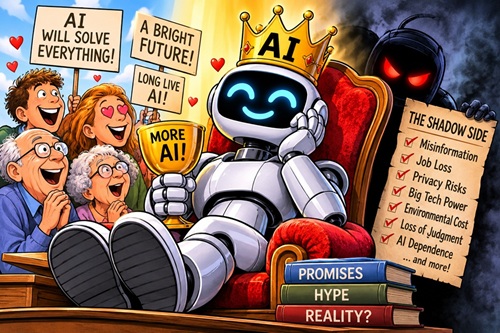 Artificial intelligence has become the defining technological obsession of our time. Barely a week passes without another spectacular announcement: a new language model, an increasingly autonomous agent, an astonishing scientific breakthrough, or a prediction that AI will soon transform virtually every aspect of human existence. Technology companies promise unprecedented productivity, economic abundance, medical breakthroughs, and perhaps even artificial general intelligence. Investors pour billions into the sector, governments scramble to secure a competitive advantage, and commentators speculate about a future in which machines may outperform humans in practically every intellectual domain. There are good reasons for this excitement. Modern AI systems really are remarkable achievements. Large language models can synthesize enormous amounts of information, assist with scientific research, generate sophisticated computer code, translate languages, and help people accomplish intellectual tasks that previously required considerable expertise. Their usefulness is not imaginary, and dismissing them as merely statistical parrots misses much of what makes them interesting. Yet every technological revolution has its shadow side. The extraordinary enthusiasm surrounding AI deserves scrutiny precisely because its genuine achievements make it easier to overlook its limitations, external costs, economic consequences, and ideological assumptions. The danger is not simply that AI might fail to deliver on its promises. It is that society might reorganize itself around those promises before adequately examining what it stands to lose. 1. The great technological hype machineThe first shadow is the enormous discrepancy between technological capability and promotional rhetoric. AI companies operate in a highly competitive environment in which attracting investment, increasing market share, and establishing technological dominance are essential. Consequently, announcements about forthcoming capabilities often blur the distinction between demonstrated achievements and speculative possibilities. A system that performs impressively on selected benchmarks becomes evidence of approaching general intelligence. A prototype becomes a revolution. A research demonstration becomes a prediction about the future of civilization. This creates a peculiar feedback loop. Companies make ambitious predictions, investors respond with enormous valuations, journalists amplify the announcements, and public expectations rise accordingly. The resulting excitement becomes an economic asset in its own right. The problem is not that technological optimism is necessarily misplaced. Previous technological revolutions have also been accompanied by exaggerated expectations, and some of those expectations eventually became reality. The problem is that commercial incentives systematically reward overstatement. We should therefore distinguish three things that are frequently conflated: what AI systems can demonstrably do today, what they might plausibly accomplish in the near future, and what remains speculative technological mythology. The distinction matters. Otherwise, we risk confusing the successful commercialization of AI with the arrival of a fundamentally new form of intelligence. 2. Intelligence without understanding?One of the most persistent questions concerns the nature of intelligence itself. Large language models can produce remarkably convincing explanations, arguments, and interpretations. They can discuss philosophy, criticize scientific theories, write essays, and participate in conversations that sometimes appear indistinguishable from human intellectual exchange. But what exactly is happening? These systems learn statistical and structural relationships from enormous quantities of training data. Through their architecture and training processes, they develop sophisticated internal representations that enable them to generate contextually appropriate responses. Their capabilities extend well beyond simple memorization or the reproduction of isolated sentences. Nevertheless, their fluent performances should not automatically be equated with human understanding, conscious experience, or independent judgment. A language model can construct an excellent argument without possessing a human-like commitment to its truth. It can explain a scientific theory without having performed the experiments that support it. It can discuss moral responsibility without experiencing the consequences of its recommendations. This distinction becomes particularly important when AI is treated as an intellectual authority rather than an intellectual instrument. The danger is not that AI cannot produce knowledge. It demonstrably can assist in producing and organizing knowledge. The danger is that users may mistake the appearance of understanding for the reliability of judgment. In this respect, the current AI revolution presents an interesting paradox: we are developing increasingly powerful intellectual instruments while simultaneously becoming less attentive to the conditions under which their outputs deserve our confidence. 3. The industrialization of misinformationAnother shadow concerns the erosion of our already fragile information environment. Generative AI makes it extraordinarily easy to produce convincing text, images, audio, and video. This has legitimate applications in education, entertainment, communication, and artistic experimentation. But the same capabilities can be used to manufacture misinformation at unprecedented scale. Political propaganda, fabricated news reports, fraudulent advertisements, impersonation, fake academic material, and synthetic evidence can all be generated with relatively little effort. Traditional propaganda required organizations, money, and considerable human labor. AI dramatically lowers these barriers. The consequences extend beyond the circulation of individual falsehoods. We may be entering an information environment in which the very possibility of establishing authenticity becomes increasingly difficult. Real photographs can be dismissed as artificial, while fabricated material can appear entirely convincing. This produces what might be called an epistemological pollution problem. The issue is no longer simply that people encounter false information. It is that confidence in the distinction between authentic and fabricated information gradually deteriorates. When everything can be fabricated, nothing can be trusted easily. And when nothing can be trusted, people become increasingly dependent on institutions, platforms, and authorities that claim to distinguish truth from falsehood. That is a potentially dangerous concentration of epistemic power. 4. The appropriation of human creativityThe controversy surrounding copyrighted material used to train AI systems reveals another fundamental tension. AI companies have trained their models on enormous collections of human-produced material: books, journalism, academic publications, artwork, photographs, music, and countless other cultural products. These materials constitute much of the accumulated intellectual and artistic heritage of humanity. The legal and ethical questions are far from settled. There is an important distinction between learning from existing cultural material and reproducing protected expression. Human beings also learn through exposure to the creative achievements of others. No writer, artist, or scientist begins from an intellectual vacuum. However, this analogy has limits. Human learning takes place within social relationships, educational institutions, cultural traditions, and systems of attribution and compensation. AI companies have industrialized the acquisition of cultural material, often without obtaining meaningful consent from its creators, while developing commercial products that may compete directly with them. The question is therefore not simply whether machine learning constitutes theft. It is whether the economic benefits of this enormous collective cultural inheritance are being distributed fairly. The irony is considerable: AI companies celebrate the emergence of systems capable of generating human-like creativity, while the human creators whose work helped make those systems possible frequently struggle to obtain recognition, compensation, or even control over the use of their material. 5. The displacement of human laborThe economic implications are equally substantial. AI promises productivity gains by automating tasks previously performed by educated professionals. Writing, translation, programming, customer service, administration, research assistance, graphic design, and various analytical activities are already being affected. Some of these developments will undoubtedly be beneficial. Dangerous, repetitive, or tedious tasks can be delegated to machines. Professionals may become more productive, and smaller organizations may gain access to capabilities previously available only to large institutions. But the familiar promise that technological progress will ultimately create more jobs than it destroys should not be accepted as an automatic guarantee. Previous industrial revolutions unfolded over generations, allowing labor markets and educational institutions considerable time to adjust. The current transformation may proceed much faster in certain occupations, particularly those involving routine intellectual production. Moreover, productivity gains do not automatically translate into broadly shared prosperity. They may instead accrue disproportionately to companies controlling the infrastructure, data, computing resources, and intellectual property. The fundamental question is therefore political and economic rather than merely technological: who owns the machines, who benefits from their productivity, and who bears the costs of displacement? A society in which machines produce an increasing proportion of economic value is not necessarily a society in which human beings enjoy greater freedom. That outcome depends on how the resulting wealth and opportunities are distributed. 6. The environmental billThe immaterial appearance of digital intelligence can obscure its very material foundations. AI requires enormous computing infrastructure. Data centers consume electricity, require cooling, depend on water resources, and involve the production of increasingly sophisticated hardware. The manufacturing and replacement of specialized chips also entail mining, transportation, industrial processing, and electronic waste. The environmental impact varies considerably between models, applications, and energy sources. It would be misleading to assume that every AI interaction carries an enormous ecological cost. Equally, it would be misleading to imagine that the expansion of AI infrastructure is environmentally neutral. The current race toward ever-larger models and more powerful computing systems creates an important contradiction. AI is frequently promoted as a tool for solving humanity's greatest challenges, including climate change and resource management. Yet its own expansion requires substantial material and energetic resources. There is also a question of priorities. Should enormous amounts of energy and capital be devoted to increasingly sophisticated conversational systems when many existing social and environmental problems remain inadequately addressed? The answer need not be an either-or choice. But the environmental costs should be included in any serious assessment of AI's overall benefits. 7. The concentration of powerPerhaps the most consequential shadow of the AI revolution concerns the concentration of technological and political power. Although AI is often described as democratizing intelligence, the infrastructure required to develop frontier systems is concentrated in a relatively small number of corporations and institutions. Access to advanced chips, enormous computing facilities, proprietary datasets, engineering expertise, and investment capital creates formidable barriers to entry. This produces an uncomfortable paradox. AI may democratize access to intellectual capabilities while simultaneously centralizing control over the infrastructure through which those capabilities are delivered. Users can ask questions, generate images, write code, and conduct research with unprecedented convenience. But they remain dependent on privately controlled platforms whose pricing, operating rules, access policies, and technological priorities they do not determine. The consequences extend into geopolitics. The United States and China increasingly regard AI as a strategic technology with implications for economic competitiveness, military capabilities, intelligence gathering, and national security. The resulting technological arms race risks subordinating broader human interests to national competition. Instead of asking which AI developments would most benefit humanity, governments may increasingly ask which developments will give their country a decisive advantage over its rivals. That is hardly a guarantee of responsible technological progress. 8. The outsourcing of human judgmentA subtler danger concerns our intellectual habits. AI can make us more productive, but it can also make us intellectually passive. When an answer is immediately available, the incentive to investigate the question independently may diminish. When an essay can be generated in seconds, the motivation to struggle with difficult ideas may weaken. When a machine can summarize an argument, fewer people may bother to read the original. There is nothing inherently wrong with intellectual assistance. Books, libraries, calculators, search engines, and computers have always extended human cognitive capacities. But there is a difference between using a tool to strengthen one's thinking and using it to avoid thinking altogether. This distinction is particularly important in education. Students who use AI to explore difficult subjects, compare interpretations, and test arguments may benefit enormously. Students who simply outsource their assignments may acquire the appearance of competence without developing the underlying intellectual abilities. The same applies to professional and academic environments. A society that increasingly delegates writing, analysis, and decision-making to AI may gradually lose some of the very capacities that made these technologies useful in the first place. The paradox is that the more powerful our intellectual instruments become, the more important independent human judgment becomes. 9. The emotional and psychological dimensionAI is also entering domains that were traditionally occupied by human relationships. Conversational systems can provide companionship, encouragement, emotional support, and seemingly attentive dialogue. For people experiencing loneliness or social isolation, these interactions may offer genuine comfort. Yet there is a potential downside. AI companions can simulate attentiveness without participating in the reciprocal obligations of human relationships. They can be endlessly available, accommodating, and responsive. They need not become tired, disagree for personal reasons, or demand the compromises that characterize relationships between independent human beings. This may encourage emotional dependency, particularly when users begin to prefer the predictability of artificial companionship to the complexity of actual social interaction. There is also the problem of commercial incentives. Companies providing emotionally engaging AI services have an interest in maintaining user involvement. The boundary between helpful companionship and commercially optimized attachment deserves careful scrutiny. The broader question is whether technological convenience is gradually replacing forms of human interaction that, despite their difficulties, remain essential to psychological and social development. 10. The mythology of artificial superintelligenceThe most spectacular dimension of the AI craze concerns predictions of artificial general intelligence and eventual superintelligence. Some researchers and entrepreneurs anticipate that AI will soon reach or exceed human-level intelligence across virtually all domains. Others imagine an intelligence explosion in which increasingly capable systems improve themselves, potentially escaping meaningful human control. These possibilities deserve serious investigation. They should neither be dismissed automatically nor treated as established facts. The difficulty is that discussions of future AI frequently combine legitimate scientific questions with highly speculative narratives. The concept of intelligence itself remains contested. Human intelligence is not a single, neatly measurable quantity. It includes reasoning, perception, embodiment, social understanding, practical judgment, emotional regulation, and the capacity to act responsibly in complex environments. An AI system may surpass humans in particular intellectual tasks without thereby becoming a superior general-purpose agent in every meaningful sense. Likewise, greater computational capability does not automatically imply greater wisdom, moral understanding, or responsible agency. The popular narrative of an approaching technological singularity sometimes resembles an updated form of religious eschatology: humanity is approaching a decisive historical transformation, an unprecedented intelligence will emerge, and the future will be fundamentally different from everything that came before. For some enthusiasts, this future is utopian. For others, it is apocalyptic. Both narratives can obscure the more immediate questions of governance, ownership, accountability, and social consequences. We should be careful not to replace critical technological assessment with secularized salvation stories. 11. The neglected question of human developmentThere is one further issue that deserves particular attention: what does the AI revolution mean for human development? Technological progress is frequently equated with human progress, but the two are not identical. A society can become technologically sophisticated while remaining politically authoritarian, economically unequal, culturally impoverished, or intellectually superficial. It can develop extraordinary computational capabilities without becoming more compassionate, more democratic, or more environmentally responsible. From an integral perspective, this distinction is especially relevant. Developments in technological capabilities do not automatically produce corresponding developments in individual consciousness, collective values, or institutional structures. An increasingly powerful technological infrastructure can coexist with egocentric politics, consumerist lifestyles, institutional short-termism, and profound failures of collective responsibility. Indeed, AI may amplify precisely those tendencies. If the prevailing economic system rewards attention capture, surveillance, advertising, competitive advantage, and endless consumption, increasingly powerful AI systems may become instruments for extending these activities rather than transcending them. The important question is therefore not simply how intelligent our machines will become, but what kind of society will deploy them and toward what ends. Technological evolution does not guarantee moral evolution. 12. Beyond both AI enthusiasm and AI pessimismNone of these criticisms requires us to reject artificial intelligence. That would be an equally simplistic response. AI can contribute enormously to scientific discovery, medical research, education, accessibility, environmental monitoring, and countless other fields. It can help individuals overcome limitations of knowledge, time, and expertise. It can make intellectual resources more widely available and enable forms of collaboration that were previously impractical. The appropriate response is neither uncritical enthusiasm nor generalized technological pessimism. What we need is a more discriminating understanding of AI's capabilities, limitations, and social consequences. This requires independent evaluation rather than reliance on corporate announcements. It requires meaningful transparency concerning training data, system limitations, and commercial interests. It requires public debate about ownership, intellectual property, labor displacement, environmental costs, and accountability. And it requires educational institutions to teach people how to work critically with AI rather than merely how to operate it. Above all, we must resist the assumption that whatever can be automated should be automated. Some human activities are valuable precisely because they involve the exercise of human capacities. Thinking, writing, creating, teaching, debating, and forming relationships are not merely inefficient production processes waiting to be optimized. They are constitutive elements of human life. Conclusion: Who is serving whom?The current AI craze contains a remarkable historical irony. Humanity has developed machines capable of extending its intellectual powers to an extraordinary degree. Yet the public discussion increasingly revolves around what machines will be able to do, how quickly they will improve, and whether they will eventually surpass us. Much less attention is devoted to the question of what we actually want these machines to accomplish. The danger is that technological development becomes an autonomous process, driven by competition, investment, corporate ambition, and geopolitical rivalry, while society struggles to formulate meaningful collective goals. We may end up with increasingly intelligent machines operating within institutions that remain remarkably short-sighted. The central issue is therefore not whether AI will become intelligent enough to transform civilization. It already possesses sufficient capabilities to do so. The question is whether human beings will develop the institutional, ethical, and intellectual maturity required to manage that transformation responsibly. Perhaps the most important distinction of the coming decades will not be between natural and artificial intelligence, or even between human and superhuman intelligence. It will be between intelligence that serves human flourishing and intelligence that serves the interests of those who control it. The AI revolution may indeed become one of humanity's greatest achievements. But without critical scrutiny, democratic oversight, and a broader conception of human well-being, it could also become one of its most consequential exercises in collective self-deception. The real test of artificial intelligence may ultimately be whether it makes us more intelligent about ourselves.
Comment Form is loading comments...
|