|
TRANSLATE THIS ARTICLE
Integral World: Exploring Theories of Everything
An independent forum for a critical discussion of the integral philosophy of Ken Wilber
  Frank Visser, graduated as a psychologist of culture and religion, founded IntegralWorld in 1997. He worked as production manager for various publishing houses and as service manager for various internet companies and lives in Amsterdam. Books: Ken Wilber: Thought as Passion (SUNY, 2003), and The Corona Conspiracy: Combatting Disinformation about the Coronavirus (Kindle, 2020).
Check out my other conversations with ChatGPT AI: Theft or Learning?The Copyright Battle over the Origins of Artificial IntelligenceFrank Visser / ChatGPT
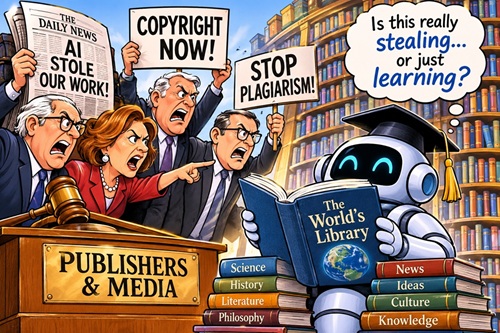 There is something historically paradoxical about the current legal battle between large media companies and artificial intelligence developers. For centuries, human knowledge has advanced through the accumulation, circulation, imitation, criticism and transformation of what previous generations have produced. Every writer learns from other writers, every scientist builds on earlier discoveries, and every intellectual tradition depends on the transmission of ideas. Yet when artificial intelligence companies use enormous collections of human-produced texts to develop language models, some of the largest owners of intellectual property suddenly describe this process as theft on an unprecedented scale.rThe question deserves more careful examination than either side's public relations campaigns generally provide. Are AI companies stealing the intellectual property of journalists, authors and publishers? Or are they doing, in a technologically different form, something that human beings have always done: learning language, absorbing information, recognizing patterns and developing the capacity to produce new expressions? The answer is not simply one or the other. There are genuine copyright issues here, but the metaphor of theft can obscure important distinctions between copying, learning, understanding, remembering and reproducing. Conversely, invoking human learning as an analogy cannot automatically exempt commercial AI developers from copyright obligations. The real controversy concerns where legitimate learning ends and unauthorized commercial exploitation begins. The publishers' revolt against AIThe conflict has grown considerably beyond the original lawsuit brought by The New York Times against OpenAI and Microsoft in December 2023. By 2026, publishers, authors and media organizations have initiated or joined numerous lawsuits against companies developing generative AI. The allegations include unauthorized scraping of websites, copying books and journal articles, using material obtained from pirate libraries, removing copyright information and producing AI outputs that compete with the original publications. Recent examples illustrate the breadth of the dispute. In May 2026, five major publishers — Elsevier, Cengage, Hachette, Macmillan and McGraw Hill — together with author Scott Turow, sued Meta over the alleged use of millions of copyrighted books and academic publications to train its Llama models. They alleged that Meta had obtained material through unauthorized sources, including pirate libraries. In July, publishers and authors brought another major case against Google concerning its Gemini models. In September, The Seattle Times and Newsday sued OpenAI and Microsoft, alleging that their journalism had been incorporated into AI training datasets without authorization. They also argued that AI systems could reproduce or closely paraphrase their reporting, potentially undermining subscriptions and website traffic. And in November, The New York Times and other newspapers brought copyright claims against the browser company Brave, alleging unauthorized use of their journalism in connection with AI systems. These are serious allegations, not established findings of guilt. Much of the litigation remains unresolved. Nevertheless, the publishers are raising legitimate questions about who owns the economic value generated from their work. There is also a larger economic conflict beneath the legal arguments. Newspapers and publishing houses have invested heavily in producing the material that makes their publications valuable. Their business models depend on selling access to that material, whether through subscriptions, advertising or licensing agreements. AI companies, meanwhile, are building products that can summarize, reorganize and explain information without necessarily directing users to the original publications. The possibility that AI could become an intermediary between the public and the original producers of knowledge is understandably alarming to publishers. But this economic concern should not be confused with the more fundamental question of whether learning from copyrighted material is itself an infringement. What does it actually mean for an AI to learn?To understand the controversy, we first need to distinguish between the material from which an AI system learns and the capabilities that emerge from that learning. A large language model is trained on enormous quantities of text. These can include books, newspaper articles, academic papers, websites, discussions, literary works and many other forms of written communication. During training, the system processes sequences of words and learns statistical relationships between them. It adjusts billions of internal numerical parameters, commonly called weights, to improve its ability to predict what comes next in a sequence. This process produces something more interesting than a searchable collection of documents. A trained language model does not ordinarily retrieve an entire article from a database every time it answers a question. Rather, it generates responses through patterns encoded in its learned parameters. It has acquired statistical representations of vocabulary, grammar, style, concepts, factual associations and relationships between ideas. This distinction matters enormously. Consider a human being learning to write. We read thousands of books, articles and conversations. We absorb vocabulary, grammatical constructions, rhetorical techniques, factual knowledge and conceptual frameworks. We eventually develop the capacity to produce sentences and arguments that we have never encountered before. We do not normally pay royalties to every author whose writing has contributed to our intellectual development. Nor would we regard the ability to imitate a particular literary style, explain a scientific concept or write an essay about evolution as evidence that someone has stolen the books they have read. In this functional sense, AI training resembles learning. It transforms exposure to existing material into a capacity for producing new material. But the analogy has limits. Human beings generally encounter texts through perceptual and cognitive processes. They do not need to make and retain millions of complete digital reproductions of copyrighted books in order to learn from them. AI training, by contrast, involves extensive computational copying, storage and processing of source material. Moreover, human learning takes place within a biological organism with a lifetime of experiences, motivations and social interactions. A language model develops its capabilities through a mathematical optimization process. We should therefore distinguish between functional similarity and identical mechanisms. AI learning is not human learning. But neither does its difference from human learning automatically make it illegitimate. The important question is whether the particular copying involved is legally permissible and whether the resulting commercial exploitation unfairly appropriates the economic value of other people's work. The crucial distinction: copying versus learningOne of the weaknesses of the public debate is that the word copying is used as though it settles the entire question. It does not. Copyright protects particular expressions, not ideas, facts, knowledge or general linguistic capabilities. A newspaper can copyright its particular reporting and presentation of an event. It cannot copyright the event itself, the facts surrounding it, or the general knowledge that readers acquire from the article. Similarly, a novelist owns the copyright to the particular expression contained in a novel, not to its themes, ideas, characters as abstract concepts, or literary techniques in general. This distinction is fundamental to intellectual freedom. If reading a scientific paper and subsequently explaining its findings in one's own words constituted copyright infringement, science itself would become impossible. If learning from an author's writing meant acquiring an obligation to pay royalties whenever one used the knowledge gained, education would become a licensing industry. Yet AI companies do make digital copies of copyrighted works during training. This creates a genuine legal question that cannot simply be dismissed by comparing AI to a human reader. There are at least three different activities that need to be distinguished. First, acquiring and storing copyrighted material. Was it obtained legally? Was it copied from a legitimate source, or downloaded from a pirate archive? Was permission required? Second, processing the material during training. Does the transformation of copyrighted expression into statistical parameters constitute permissible fair use, or does it require authorization or licensing? Third, generating outputs. Does the resulting AI system reproduce protected passages, imitate particular works too closely, or produce material that substitutes commercially for the originals? These are separate questions. A legal justification for one does not automatically justify the others. An especially revealing example comes from the 2025 case Bartz v. Anthropic. A US federal judge ruled that Anthropic's use of lawfully acquired books to train its language models qualified as fair use, describing the transformation involved as fundamentally different from the original purpose of the books. However, the judge distinguished this training activity from Anthropic's acquisition and retention of pirated books in a central digital library. That separate conduct was not protected by the ruling. The distinction is important: a company may have a legitimate transformative purpose while still using illegitimate means to acquire its source material. That is a much more precise way of framing the issue than simply declaring all AI training to be theft. What have the courts actually decided?The early American court decisions have not established a universal legal principle that AI companies may freely use copyrighted works. Two particularly important cases illustrate the uncertainty. In Bartz v. Anthropic (2025), Judge William Alsup considered the use of copyrighted books for training Claude. He found that training using the books was transformative and constituted fair use under the circumstances before him. However, he did not extend that protection to Anthropic's acquisition of pirated books for its permanent library. In Kadrey v. Meta (2025), Judge Vince Chhabria ruled in Meta's favor in a case brought by thirteen authors. But his decision was more qualified than some AI-industry interpretations suggested. He emphasized that the plaintiffs had failed to provide sufficient evidence of the market harm that could potentially make their case successful. He explicitly cautioned that the ruling did not establish that all AI training with copyrighted material was lawful. These decisions point toward an important legal distinction between the transformative purpose of training and the economic consequences of particular uses. The situation in Europe is somewhat different. Under the EU's copyright framework, text and data mining exceptions exist, but rights holders can reserve their rights against commercial text and data mining under specified conditions. The EU AI Act also establishes transparency obligations for providers of general-purpose AI models concerning their copyright compliance policies and training content summaries. In other words, the law is struggling to accommodate a new technological reality without abandoning the legitimate interests of creators. That is a reasonable objective. But it should not be confused with the proposition that every unauthorized use of copyrighted material is automatically equivalent to stealing the intellectual content contained in it. The uncomfortable position of the media industryThere is another dimension to this conflict that deserves more attention: the position of the media companies themselves. Large publishers are not merely guardians of intellectual culture. They are commercial enterprises with substantial financial interests. Their objections to AI are partly about copyright, but also about control over distribution, advertising revenue, subscriptions, licensing markets and their position as intermediaries between information producers and consumers. For decades, newspapers and publishing houses have benefited from the work of journalists, photographers, researchers and authors. Their commercial success has depended on aggregating and distributing intellectual contributions produced by others. Now a new generation of technology companies is doing something structurally similar: aggregating information from numerous sources and making it available through a different distribution system. The difference is that AI does not merely reproduce or distribute existing material. It can transform information into new answers, summaries, explanations and arguments. This threatens the traditional media business model. Imagine asking an AI system to summarize the major arguments in ten newspaper articles about a geopolitical conflict. Instead of visiting ten websites, navigating ten advertising systems and perhaps encountering ten paywalls, a reader can obtain a synthesized overview in a single conversation. From the reader's perspective, this is an enormous convenience. From the publishers' perspective, it is potentially a serious loss of traffic and revenue. There is an obvious conflict of interest here. Publishers want the public to regard their content as indispensable intellectual property, while simultaneously wanting their material to remain discoverable and influential in the information ecosystem. Their complaints cannot simply be dismissed as protectionism. Journalism is expensive. Investigative reporting, foreign correspondence, fact-checking and original research require resources. If AI companies systematically appropriate the economic value of this work while weakening the institutions that produce it, the consequences could be damaging. Indeed, there is a paradox: AI systems need a continuing supply of high-quality human knowledge. If their commercial success undermines the economic conditions under which that knowledge is produced, they may eventually damage their own foundations. The concern is not imaginary. It deserves serious consideration. But it also raises a question that publishers would rather not confront: why should the existing commercial arrangements governing the distribution of information have an automatic claim to determine how humanity's accumulated knowledge may be used in new technological systems? The hypocrisy question: Who gets to learn from whom?There is an additional irony in the current controversy. The media industry has spent decades digitizing, aggregating and commercially exploiting information produced by others. Search engines, databases, news aggregators and recommendation systems have all built enormous businesses around the collection and processing of information. Publishers have also increasingly embraced AI themselves. OpenAI, for example, has entered commercial partnerships with numerous established media organizations, including News Corp, Axel Springer, Condé Nast and others. These arrangements demonstrate that the issue is not necessarily opposition to AI as such. It is also a struggle over who gets access to valuable content, on what terms, and who receives the resulting revenue. There is nothing inherently wrong with publishers negotiating licenses. If they can establish that their content has commercial value for AI development, they are entitled to seek compensation. But there is a difference between negotiating a commercial agreement and claiming ownership over the general intellectual capabilities that emerge from exposure to human knowledge. Imagine a world in which every author could demand royalties whenever a student used something learned from their books. Imagine scientific researchers claiming exclusive rights over every subsequent discovery that drew upon their publications. We would have created an intellectual property regime that increasingly obstructed the very process of cultural and scientific development it was originally intended to encourage. Copyright was never supposed to establish permanent ownership over knowledge itself. The danger is that the AI controversy could be used to extend commercial control over the accumulated intellectual resources of humanity far beyond what is necessary to protect individual creators. Is AI merely imitating us?There is another objection worth considering. Some critics argue that AI does not really learn anything. It merely predicts words based on statistical correlations. It has no genuine understanding of what it says, no lived experience and no independent consciousness. There is some truth in this criticism, but it does not settle the copyright question. We should distinguish between the nature of an information-processing mechanism and the capabilities it produces. A calculator does not understand mathematics as a human mathematician does, but it can perform mathematical operations. A chess program does not experience the strategic significance of a game, but it can develop sophisticated playing strategies. Similarly, a language model need not possess human consciousness to acquire sophisticated linguistic capabilities. Its ability to formulate arguments, explain scientific theories, compare philosophical positions and produce original combinations of ideas is not negated by the fact that these abilities emerge through statistical learning. Indeed, the distinction between human and artificial learning makes the copyright debate more interesting, not less. Human intelligence itself is deeply dependent on accumulated cultural knowledge. Language is not invented independently by every generation. We inherit vocabularies, concepts, metaphors, theories and explanatory frameworks. Our intellectual autonomy develops through the appropriation and transformation of what came before us. AI systems participate in a technologically different version of this cumulative process. That does not make them equivalent to human minds. Nor does it establish that their training practices are legally or ethically justified. But it does challenge the idea that their linguistic capabilities should be regarded as nothing more than stolen fragments of other people's writing. What would a fair settlement look like?The choice between unrestricted corporate appropriation and an excessively restrictive copyright regime is a false dilemma. A sensible settlement would recognize several principles. First, AI developers should be transparent about their training practices. There should be meaningful information about the sources and categories of material used, together with mechanisms for identifying unlawful acquisition and addressing legitimate rights reservations. Second, companies should not be permitted to disguise piracy as technological innovation. Downloading copyrighted books from known pirate repositories and retaining unauthorized copies is a different matter from processing lawfully acquired material for transformative purposes. Third, copyright protection should focus on actual protected expression. AI systems that reproduce substantial passages of copyrighted works, generate close substitutes for particular publications or otherwise exploit protected expression should face appropriate legal scrutiny. Fourth, compensation mechanisms deserve serious consideration, particularly where identifiable creative industries suffer demonstrable economic harm. Collective licensing arrangements might provide a more workable solution than requiring individual negotiations with every author whose work has contributed to a training corpus. Fifth, we should resist the temptation to turn copyright into a general-purpose veto over technological learning. Facts, ideas, knowledge, linguistic conventions and general intellectual capabilities must remain part of the common cultural resources from which future generations can learn. This last principle is particularly important. The public interest in the development of artificial intelligence should not automatically override the rights of creators. But neither should the commercial interests of established publishers automatically override the public interest in technological and intellectual progress. Conclusion: Humanity cannot copyright its own intellectual inheritanceThe current litigation raises legitimate questions about copyright, economic exploitation and the future of journalism. AI developers are powerful commercial organizations, not innocent students sitting in a library. They have a responsibility to acquire and use their training material lawfully, and to avoid turning other people's creative work into competing products through straightforward reproduction. Nevertheless, the rhetoric of theft needs to be examined critically. There is a fundamental difference between stealing a book, copying a book, learning from a book and producing something new through knowledge acquired from that book. These activities are related, but they are not identical. The fact that AI training involves copying copyrighted material does not by itself establish that the resulting linguistic capabilities are stolen. The transformation of existing material into generalized statistical representations and new generative capacities is precisely what makes the technology interesting. Nor should we romanticize the human-learning analogy. AI developers operate at an industrial scale, make commercial investments and sometimes deliberately obtain material through questionable channels. Their conduct deserves scrutiny. But the broader intellectual principle remains: learning from humanity's accumulated knowledge is not the same as stealing humanity's intellectual property. There is a deeper historical irony here. The very media organizations now defending their proprietary content have themselves benefited from centuries of cumulative cultural development. Journalism, literature, science and scholarship are all products of an enormous collective intellectual inheritance. No newspaper invented language. No publishing house invented knowledge. No author writes without drawing upon concepts and linguistic resources inherited from others. AI is the latest technological participant in this process. The real challenge is to establish rules that protect the people who produce valuable new knowledge without allowing established commercial interests to monopolize the accumulated knowledge of humanity. We should protect authors against plagiarism. We should protect journalists against the unauthorized reproduction of their reporting. We should protect publishers against demonstrable commercial exploitation of their copyrighted works. But we should also protect the freedom to learn, synthesize, reinterpret and create. Otherwise, in our understandable effort to prevent AI from stealing from humanity, we may end up allowing the owners of yesterday's knowledge to restrict the possibilities of tomorrow's intelligence. And that would be a rather peculiar way of defending human creativity.
Comment Form is loading comments...
|