|
TRANSLATE THIS ARTICLE
Integral World: Exploring Theories of Everything
An independent forum for a critical discussion of the integral philosophy of Ken Wilber
  Frank Visser, graduated as a psychologist of culture and religion, founded IntegralWorld in 1997. He worked as production manager for various publishing houses and as service manager for various internet companies and lives in Amsterdam. Books: Ken Wilber: Thought as Passion (SUNY, 2003), and The Corona Conspiracy: Combatting Disinformation about the Coronavirus (Kindle, 2020).
Check out my other conversations with ChatGPT Big Theory, Bigger Claims?Critical Examination of IAM's New Integrative AmbitionFrank Visser / ChatGPT
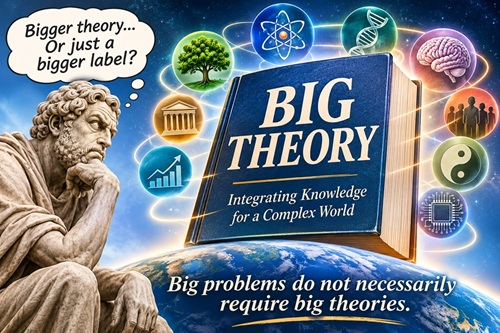 Introduction: The return of the grand synthesisThe Institute of Applied Metatheory (IAM) has announced a new initiative called Big Theory, presenting it as an ambitious intellectual response to some of the most pressing problems of our time. Ecological breakdown, technological disruption, political fragmentation, and the crisis of meaning, we are told, are interconnected phenomena whose complexity exceeds the explanatory capacities of existing disciplinary approaches. The proposed remedy is correspondingly ambitious: develop a comprehensive theoretical framework capable of integrating philosophical foundations with scientific knowledge across different domains of reality. There is an immediately attractive idea here. Many contemporary problems really are interconnected. Climate change cannot be understood through climatology alone; it involves economics, political institutions, technological infrastructures, cultural values, and collective psychology. Artificial intelligence raises questions that cannot be answered by computer science alone. Even the meaning crisis involves psychological, sociological, philosophical, and historical dimensions. The fragmentation of knowledge is a genuine problem, and attempts to overcome it deserve serious consideration. But there is also a familiar danger. The ambition to integrate knowledge can easily become the ambition to construct a theory of everything. And the latter does not follow automatically from the former. IAM's announcement therefore deserves to be examined at two levels: first, whether Big Theory identifies a genuine intellectual problem; second, whether its proposed solution offers anything sufficiently distinctive, methodologically convincing, and empirically productive to justify the creation of a new intellectual field. The distinction matters. Recognizing the need for integration is one thing. Demonstrating that a particular integrative framework can actually deliver it is quite another. 1. The legitimate problem: disciplinary fragmentationIAM's starting diagnosis is difficult to dispute. Scientific specialization has produced extraordinary knowledge, but it has also created institutional and conceptual divisions. Economists, biologists, psychologists, political scientists, physicists, and philosophers often approach the same phenomena with different assumptions, vocabularies, and standards of explanation. The problem is not simply that these disciplines fail to communicate. Sometimes they genuinely disagree about the nature of the phenomena they investigate. What counts as causation in physics is not necessarily what counts as causation in sociology. Biological explanations cannot simply be translated into psychological ones, and neither can be reduced without remainder to economic explanations. IAM correctly recognizes that interdisciplinary collaboration alone does not solve this problem. Putting specialists around the same table does not automatically produce an integrated understanding. One needs to clarify the relationships between their explanatory approaches, distinguish compatible from incompatible assumptions, and identify where different levels of explanation genuinely complement one another. This is arguably the strongest aspect of the Big Theory proposal. But it raises an important question: why should the solution be another overarching theory rather than a better methodology for negotiating differences between existing theories? The distinction is fundamental. We might need better coordination between disciplines without needing a single philosophical framework to govern them all. Indeed, intellectual pluralism may be a more productive starting point than the expectation of eventual theoretical unity. 2. Big Theory: a new name for an old ambition?IAM describes Big Theory as an accessible public identity for what academics have traditionally called integrative metatheory. Its ambition is to examine the philosophical foundations of different theories, evaluate their contributions and limitations, and develop more coherent accounts of reality. The announcement explicitly calls the project an exercise in developing "integrative metatheory 2.0." This raises an obvious question: what exactly was wrong with version 1.0, and what will version 2.0 do differently? The aspiration to construct an integrated account of reality is hardly new. It runs through the history of philosophy, from Aristotle and Hegel to contemporary systems theory. In more recent decades, it has been pursued by Big History, general systems theory, cybernetics, complexity science, critical realism, and, of course, Ken Wilber's Integral Theory. Wilber's AQAL model was itself presented as an attempt to integrate the major dimensions of human knowledge: interiors and exteriors, individuals and collectives, and different developmental levels and lines. IAM is clearly familiar with this tradition. Integral Theory is explicitly among the frameworks being considered for the new synthesis. But renaming integrative metatheory Big Theory does not, by itself, constitute an intellectual breakthrough. The important question is not whether the project sounds sufficiently ambitious. It is whether it can demonstrate an actual improvement over its predecessors. What conceptual problems in existing metatheories have been resolved? Which explanatory contradictions have been overcome? Which empirical findings can now be understood better? Which predictions or practical interventions become possible that were previously unavailable? Until such questions receive concrete answers, Big Theory remains more a research ambition than an established intellectual achievement. 3. The problem of integrating incompatible frameworksIAM identifies a number of approaches that will participate in its collaborative synthesis: critical realism, complex thought, Integral Theory, the Unified Theory of Knowledge, metamodernism, process philosophy, visionary realism, complex integral realism, universal development theory, integral grammatology, and archdisciplinary inquiry. This is an impressive collection of intellectual traditions. But it also presents a formidable challenge. These frameworks do not necessarily share the same philosophical commitments. They differ in their ontologies, epistemologies, conceptions of causation, understandings of development, and attitudes toward scientific explanation. Some are primarily philosophical, others developmental, others concerned with complexity, and still others with the organization of knowledge itself. Their differences cannot simply be resolved by placing them within a larger conceptual container. Consider the relationship between critical realism and Integral Theory. Critical realism emphasizes the stratified nature of reality, causal mechanisms, and the distinction between what exists and what we know about it. Integral Theory introduces a comprehensive perspective-taking framework that includes interior experience, exterior behavior, individual and collective dimensions, and developmental differentiation. There may be considerable compatibility between these approaches, but compatibility is not identity. Their respective claims must be evaluated individually. The same applies to process philosophy, complexity theory, and developmental theories. They may illuminate different aspects of reality without necessarily being reducible to one another. IAM acknowledges this difficulty. Its announcement promises to preserve consequential disagreements rather than force artificial agreement. It also recognizes that some inherited concepts may need revision or replacement. That is encouraging. But it also means that the success of Big Theory should not be measured by how many perspectives it manages to include. It should be measured by how successfully it distinguishes their genuine contributions from their questionable assumptions. A synthesis that incorporates everything risks explaining nothing particularly well. 4. The danger of philosophical imperialismThere is another problem with comprehensive metatheories. Who decides which theories are compatible, which concepts are fundamental, which explanatory levels are most important, and which assumptions need to be discarded? The moment somebody proposes a higher-order framework for evaluating other frameworks, that framework itself becomes an object of scrutiny. This is an unavoidable problem of metatheoretical authority. A supposedly neutral integrative framework can quietly privilege its own philosophical assumptions while presenting itself as the impartial arbiter of competing perspectives. Wilber's Integral Theory offers a useful cautionary example. Its four quadrants, developmental hierarchies, and conception of increasing complexity provide an organizing structure for interpreting knowledge. But the framework's comprehensiveness does not establish the truth of every interpretation made within it. One can recognize the usefulness of perspective-taking without accepting every developmental hierarchy or metaphysical assumption associated with the model. The same critical distance should be applied to Big Theory. IAM's commitment to reciprocal criticism is welcome, but the real test will be whether participants are prepared to challenge the foundations of the proposed synthesis itself, including its preferred terminology, developmental assumptions, and conception of reality. A genuinely open metatheory must be capable of being transformed by the theories it seeks to integrate. Otherwise, integration becomes assimilation. 5. The missing ingredient: empirical accountabilityPerhaps the most important question concerns the relationship between theoretical integration and scientific evidence. IAM correctly insists that philosophy and science should inform each other. Philosophical inquiry clarifies the assumptions behind knowledge production, while scientific findings can challenge and transform philosophical positions. This reciprocal relationship is essential. However, there is a danger that metatheoretical discussions can become increasingly sophisticated without producing corresponding advances in empirical understanding. A framework may offer an elegant account of how physics, biology, psychology, and sociology relate, yet fail to generate a single new scientific finding. It may classify existing knowledge without increasing its explanatory power. This distinction is particularly important because Big Theory is presented as a response to urgent practical problems. Consider ecological breakdown. We already possess substantial scientific knowledge about climate change, biodiversity loss, resource consumption, and the economic structures contributing to environmental degradation. What precisely would Big Theory add? Would it identify causal mechanisms overlooked by existing environmental sciences? Would it improve climate-policy design? Would it help distinguish effective interventions from politically attractive but ineffective ones? Would it generate measurable improvements in ecological outcomes? These are reasonable expectations for an initiative that calls itself applied metatheory. The same questions should be asked about political fragmentation, education, economic organization, and the meaning crisis. A comprehensive framework that merely redescribes these problems in more sophisticated philosophical language would be of limited practical value. Big Theory must eventually demonstrate that its theoretical integration produces explanatory or practical gains. 6. Big History and the temptation of cosmic extrapolationIAM uses Big History as an important point of departure. Big History connects cosmic evolution, biological evolution, and human history in a single narrative extending from the origins of the universe to contemporary civilization. This is a worthwhile intellectual undertaking. It encourages us to understand humanity as part of a much larger natural history rather than as an isolated phenomenon. But the transition from Big History to Big Theory requires considerable care. The fact that physical, biological, and cultural processes belong to one continuous history does not establish that they are governed by one overarching explanatory principle. The emergence of life from nonliving matter, consciousness from biological organization, and cultural institutions from human interaction involves different kinds of explanatory problems. Continuity does not eliminate novelty. Nor does the discovery of recurring patterns across different domains necessarily establish universal laws operating identically in all of them. This is where integrative philosophies sometimes become vulnerable to overgeneralization. Concepts such as emergence, complexity, self-organization, evolution, and development can be useful across disciplines, but their meanings and explanatory functions must be specified in each context. A general vocabulary is not yet a general theory. The challenge for Big Theory is to establish where genuine explanatory continuity exists, where different mechanisms operate, and where entirely new conceptual resources are required. This is a much more demanding task than constructing a grand narrative of increasing complexity. 7. Big Data, artificial intelligence, and the new metatheoretical challengeOne of the more interesting aspects of IAM's announcement concerns artificial intelligence. The Institute argues that the increasing availability of data does not automatically produce understanding. AI systems can generate apparently coherent syntheses across enormous bodies of information, but their outputs may contain conceptual conflations, unsupported assumptions, and unresolved theoretical disagreements. This is entirely correct. AI can combine information without necessarily understanding whether the underlying concepts are compatible. It can produce fluent explanations that conceal important disagreements or give speculative propositions the appearance of established knowledge. A metatheoretical approach could therefore be useful in evaluating AI-generated research. But here we encounter an interesting paradox. If Big Theory is supposed to provide the philosophical and methodological foundations for evaluating AI-generated syntheses, who evaluates Big Theory itself? AI-assisted comparison cannot establish that the framework doing the comparing is correct. Nor does a more comprehensive conceptual vocabulary guarantee better reasoning. This is especially relevant to IAM's development of Alethic AI, which is intended to simulate aspects of integrative thinking and help users construct realist causal maps of complex problems. The proposal is potentially interesting. Yet constructing a causal map is not the same as establishing that its causal relationships are correct. Such maps require evidence, independent validation, and comparison with alternative explanations. There is also a risk that an AI system trained or structured around one preferred metatheory will reproduce that framework's assumptions while presenting its conclusions as comprehensive analyses. This would be particularly problematic if users mistake philosophical consistency for empirical reliability. The best application of metatheory to AI might therefore be to make competing assumptions and interpretations more visible, rather than to install one supposedly superior worldview as the system's organizing intelligence. appliedmetatheory.org+1 8. The question of an emerging integrative worldviewThere is another aspect of IAM's project that deserves attention. On its website, the Institute describes its work as contributing to an integrative worldview emerging beyond previous meaning-making structures. Its broader program includes research into worldview development, the cultural complexity index, faith development, and the evolution of meaning. Institute of Applied Metatheory This is potentially more consequential than the announcement of Big Theory itself. It suggests that IAM is not merely interested in improving interdisciplinary research. It also sees itself as contributing to a broader cultural and intellectual transition. But this introduces a developmental assumption that should not go unquestioned. Is humanity actually moving toward an integrative worldview? If so, what evidence supports this proposition? Are contemporary societies becoming more capable of integrating different perspectives, or are they simultaneously experiencing increasing polarization, fragmentation, and ideological radicalization? And how would we distinguish a genuinely more adequate worldview from one that simply incorporates a larger vocabulary of perspectives? There is a danger of confusing intellectual comprehensiveness with developmental superiority. A worldview that claims to transcend earlier worldviews may still retain their blind spots, or introduce new ones. Historical development does not guarantee epistemic progress in every domain. Nor should the adoption of an integrative vocabulary be mistaken for the achievement of integrative understanding. This is particularly important when developmental theories are used to classify competing worldviews. Such classifications themselves require empirical justification and independent scrutiny. IAM should be as willing to question the supposed emergence of an integrative worldview as it is to question the assumptions of the traditions it hopes to synthesize. 9. From intellectual movement to academic discipline?The institutional ambitions of Big Theory are also noteworthy. IAM is developing a collectively authored book, tentatively scheduled for completion by the end of 2027. It has renamed its journal Integration: The Journal of Big Theory, established the Integration Society, and organized a collaborative synthesis laboratory at Lake Tahoe in September 2026. These are substantial field-building activities. There is nothing inherently wrong with establishing a new intellectual discipline. Academic fields need publications, conferences, research communities, educational programs, and institutional continuity. But institutionalization can create its own incentives. Once an organization has invested in establishing a new field, it acquires an interest in demonstrating that the field is necessary, distinctive, and intellectually successful. This can subtly reverse the proper order of things. Instead of establishing the intellectual need for an initiative and subsequently building institutions around its achievements, institutions may begin to define the intellectual agenda and measure success through their own expansion. The name Big Theory is certainly memorable and potentially effective as a public identity. But it also carries an enormous burden of expectation. What would qualify as a contribution to Big Theory? What distinguishes it from systems science, philosophy of science, interdisciplinary research, or existing metatheoretical traditions? What are its standards of evidence and argument? How will disagreements be adjudicated? What would count as a failed integration? These questions should be answered before Big Theory can reasonably claim the status of an emerging academic discipline. IAM says that the field's vitality will depend on independent research, competing approaches, and sustained intellectual exchange. This is precisely the right aspiration. The crucial question is whether its organizational practices will make room for criticism that challenges the project at its foundations, rather than merely contributing to its further development. 10. What would a genuinely successful Big Theory look like?Rather than dismissing the initiative, I would propose several criteria by which its eventual achievements could be evaluated. First, it should demonstrate conceptual clarity. Its fundamental concepts must be defined precisely enough to prevent the same terminology from acquiring different meanings in different disciplines. Second, it should demonstrate epistemological pluralism. Different forms of knowledge should be integrated where possible without assuming that they can all be evaluated by one universal standard. Third, it should demonstrate empirical accountability. Its philosophical propositions should be distinguishable from scientific findings, and its claims about the world should remain answerable to evidence. Fourth, it should demonstrate explanatory added value. The resulting synthesis should explain something that its component theories, taken separately or in collaboration, cannot explain as adequately. Fifth, it should demonstrate practical effectiveness. Applications to ecological regeneration, education, governance, and other social problems should be assessed against measurable outcomes rather than the enthusiasm of their proponents. Finally, it should demonstrate institutional openness. Independent researchers must be able to challenge its assumptions without first accepting its preferred philosophical vocabulary or developmental orientation. These are not unreasonable demands for an initiative that presents itself as a response to the world's most complex problems. Indeed, they are precisely the standards that would distinguish a genuine intellectual advance from another ambitious exercise in philosophical synthesis. Conclusion: Bigger theory is not necessarily better theoryIAM's Big Theory initiative addresses a legitimate problem. Knowledge is fragmented, complex problems cross disciplinary boundaries, and our ability to collect information has outpaced our ability to integrate and interpret it. The ambition to develop better methods for comparing, evaluating, and combining different explanatory frameworks is therefore welcome. I am particularly encouraged by IAM's stated willingness to preserve disagreements, revise inherited concepts, and subject its emerging synthesis to reciprocal criticism. But I remain unconvinced that the creation of a new overarching theoretical framework is necessarily the best answer to the problems identified. The history of integral and systems-oriented thinking contains many ambitious attempts to construct comprehensive accounts of reality. Their recurring weakness has not generally been a lack of perspectives to integrate. It has been the difficulty of demonstrating that the resulting synthesis actually explains more, predicts better, or produces more reliable practical results. There is also a fundamental distinction between integrating knowledge and integrating worldviews. The former is an important intellectual undertaking. The latter can easily become a philosophical or even ideological project in which the preferred worldview determines how all other perspectives are interpreted. Big Theory must avoid that trap. Perhaps its greatest contribution would not be to produce the biggest possible theory, but to develop a more rigorous understanding of the limits of theoretical integration itself. Not everything that belongs to reality necessarily belongs to one explanatory framework. Not every disagreement can be resolved through a higher-order synthesis. And not every increase in conceptual comprehensiveness represents an increase in knowledge. The ultimate test is therefore quite simple: Does Big Theory help us understand the world better, or does it merely give us a bigger vocabulary with which to describe it? IAM has announced an ambitious research program, not yet demonstrated a successful synthesis. The proposed collective book, the journal, and the practical applications will provide opportunities to establish whether this ambition can be realized. I would welcome such an achievement. But I would also suggest a slightly different motto for the project: Big problems do not necessarily require big theories. They require good explanations, wherever those explanations may come from. And sometimes the most important intellectual achievement is not to integrate more perspectives, but to discover precisely where integration should stop. Editorial note: This is not an argument against metatheory, integral thinking, or interdisciplinary research. It is an argument against allowing the ambition of comprehensiveness to outrun the standards of evidence and explanation. Big Theory should be judged by what it can demonstrate, not by the size of the intellectual territory it claims to cover.
Comment Form is loading comments...
|