|
TRANSLATE THIS ARTICLE
Integral World: Exploring Theories of Everything
An independent forum for a critical discussion of the integral philosophy of Ken Wilber
  Frank Visser, graduated as a psychologist of culture and religion, founded IntegralWorld in 1997. He worked as production manager for various publishing houses and as service manager for various internet companies and lives in Amsterdam. Books: Ken Wilber: Thought as Passion (SUNY, 2003), and The Corona Conspiracy: Combatting Disinformation about the Coronavirus (Kindle, 2020).
Check out my other conversations with ChatGPT The American Political EarthquakeThe Democrats' Historic Victory and Its Consequences for the United States and the WorldFrank Visser / ChatGPT
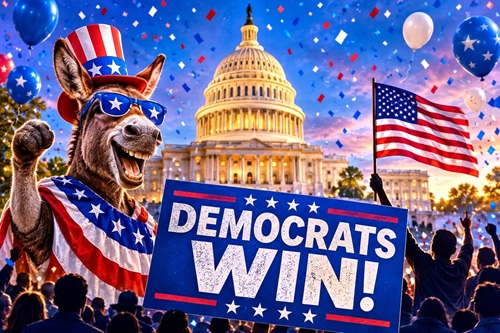 A turning point in American politics?The American midterm elections of November 3, 2026, may well mark a turning point in the political history of the United States. In a result that few anticipated on this scale, the Democratic Party has won control of both chambers of Congress, the House of Representatives and the Senate, wresting control from President Donald Trump's Republican Party. The victories extend well beyond the traditional Democratic strongholds and include several states that have been considered reliably Republican for decades. This is more than an ordinary midterm setback for a sitting president. It represents a substantial electoral rejection of the political direction taken by the Trump administration during its second term. It also changes the balance of power in Washington and introduces a new political reality for the remaining two years of Trump's presidency. According to the Associated Press and Reuters, Democrats made particularly striking gains in Texas, Kansas, South Carolina, Ohio and North Carolina. Texas, where Democrat James Talarico won a Senate seat, is especially significant: the state had not elected a Democratic senator in 38 years. Kansas also elected a Democratic senator for the first time since 1932. These results demonstrate that the electoral shift was not confined to the usual battleground states. The elections also produced several historic firsts in political representation. Georgia elected Keisha Lance Bottoms as the first Black woman governor in American history, while Texas elected Gina Hinojosa as its first Latina governor. The Senate will also welcome Abdul El-Sayed, who is set to become its first Muslim member. The scale of the Democratic gains invites a larger question: what exactly have American voters rejected, what have they endorsed, and what might this mean for the future of American democracy and its position in the world? 1. A referendum on Donald TrumpMidterm elections are traditionally interpreted as a referendum on the sitting president. The party occupying the White House frequently loses congressional seats, sometimes substantially. But the 2026 results appear to go beyond this familiar pattern. Trump himself had made the election a personal test of political support, repeatedly encouraging voters to treat the congressional contests as a judgment on his presidency. The electorate appears to have taken him at his word. Three issues stand out in the available reporting: economic dissatisfaction, the unpopular war with Iran, and concerns about corruption and the conduct of government. Exit polling reported by Reuters indicates that half of voters regarded the elections as an opportunity to rebuke the president, while approximately 70 percent wanted Congress to exercise stronger checks and balances on presidential power. The cost of living is particularly important. Political movements may mobilize voters through ideological appeals, cultural conflicts and national identity, but everyday economic circumstances remain powerful determinants of electoral behavior. When voters feel that their economic situation is deteriorating, grand promises about national greatness become less persuasive. The Iran war has added another dimension. A military conflict that brings substantial costs, uncertainty and international risks can become a domestic political liability, especially when voters question its necessity, objectives or likely outcome. The election therefore suggests that a considerable part of the American electorate wants a change in priorities. It does not necessarily mean that every Democratic policy proposal has received an endorsement. Rather, it indicates that the Republican administration has lost the degree of political confidence necessary to maintain unified control of the federal legislature. That distinction matters. An electoral rejection of one government is not automatically an endorsement of every alternative offered by its opponents. 2. The return of congressional checks and balancesPerhaps the most immediate institutional consequence is the restoration of divided government. For the first two years of Trump's second presidency, Republicans controlled the presidency and both chambers of Congress. This gave the administration considerable freedom to pursue its legislative priorities, with relatively limited resistance from its own congressional party. That situation is now changing. The Democratic majorities will have several important instruments at their disposal. They can organize congressional investigations, summon administration officials, issue subpoenas, scrutinize government spending and challenge executive decisions. The Senate majority will also control the legislative agenda and exercise considerable influence over presidential appointments. Hakeem Jeffries, the Democratic House leader, is positioned to become the first Black Speaker of the House. His proposed priorities include addressing the cost of living and intensifying congressional oversight of the administration. This could have considerable consequences for Trump. Investigations into the administration's conduct, its financial dealings, the implementation of immigration policies and the use of executive authority could occupy much of the congressional agenda. Even when investigations do not result in legislation, they can generate public scrutiny, expose contradictions and create political pressure. However, it would be premature to assume that the Democrats can simply reverse Trump's policies. The president retains his executive powers and can veto legislation. Overriding a veto requires a two-thirds majority in both chambers, which Democrats do not possess. Furthermore, much of American foreign policy and executive administration remains under presidential control. The result is therefore not a transfer of presidential power, but a significant redistribution of political power within the federal government. It could also produce legislative paralysis. If the two parties cannot agree on budgets, taxation, immigration or other major issues, the government may find itself increasingly preoccupied with institutional confrontation rather than policy-making. Yet this confrontation has another meaning: the American constitutional system is demonstrating that congressional elections can substantially alter the political constraints under which a president operates, even in the middle of a presidential term. 3. What does the result mean for American democracy?The election has implications beyond the immediate fortunes of the Democratic and Republican parties. One important question concerns the resilience of American democratic institutions. During Trump's second presidency, controversies surrounding executive power, federal institutions, immigration enforcement, political appointments and the relationship between the presidency and independent institutions have generated considerable concern. The Democratic victory does not resolve these controversies. But it creates a stronger institutional counterweight to the executive branch. The electorate has demonstrated that control of Congress is not permanently guaranteed to the party occupying the White House. Even states that have supported Trump in previous elections have shown themselves capable of changing political direction. This is particularly relevant because Trump's political strategy has frequently involved presenting himself as the indispensable representative of the American people. The midterm results demonstrate the limitations of that claim. American voters are not a single political constituency, and electoral support can be withdrawn. There is also a warning for the Democrats themselves. Their victory should not be interpreted as evidence that the country has suddenly become uniformly progressive or that the Republican electorate has disappeared. The United States remains deeply polarized. Many millions of Americans continue to support conservative positions on immigration, taxation, religion, abortion, gun ownership and the role of government. Moreover, some Republican candidates have continued to win important races. Florida, for example, elected Byron Donalds as its first Black Republican governor. The election has therefore not eliminated Republican political influence, even as it has substantially weakened the party's position in Washington. The challenge for Democrats will be to turn an electoral protest into a constructive political program. If their congressional activity consists primarily of opposing Trump, investigating his administration and celebrating Republican failures, they may squander the opportunity. Voters will eventually want measurable improvements in their daily lives. The affordability crisis, healthcare, housing, employment, energy prices and the quality of public services will be particularly important tests. 4. The implications for American foreign policyFor the rest of the world, the election may be almost as consequential as it is for the United States itself. Trump's second presidency has been characterized by a foreign policy that has frequently departed from established American diplomatic practices. His approach to alliances, international trade, military intervention and relations with traditional partners has generated considerable uncertainty. A Democratic-controlled Congress will not automatically reverse this approach. Nevertheless, it introduces new constraints and political pressures. The most immediate issue is the war with Iran. The Iran warThe conflict has become an important factor in American domestic politics. Its economic consequences, particularly rising energy prices and disruptions to international shipping, have affected not only American consumers but also the wider world economy. Democrats have repeatedly challenged the administration's handling of the conflict. Their control of Congress gives them greater influence over military appropriations, oversight and legislation concerning the authorization of military operations. Reuters and other reporting indicates that congressional control could increase pressure on Trump to seek a diplomatic exit from the conflict. This is important for Europe and Asia alike. The Strait of Hormuz is a critical passage for international energy supplies. Prolonged disruption affects oil and gas prices, inflation, transportation costs and economic stability far beyond the Middle East. A congressional majority seeking greater scrutiny of the war could therefore have international economic consequences. But there is a qualification: the president remains commander-in-chief. Congress can use funding restrictions and oversight to constrain military operations, but it cannot simply assume operational command or dictate every diplomatic decision. The election creates pressure for a change in approach, not a guarantee that such a change will occur. Ukraine and RussiaFor European observers, the implications for the war in Ukraine are especially important. Trump's approach to Russia and Ukraine has been a source of uncertainty for America's European allies. His willingness to pressure Kyiv into negotiations, his treatment of European security commitments and his sometimes accommodating rhetoric toward Moscow have raised questions about the durability of American support for Ukraine. The Democratic victory could strengthen congressional resistance to policies perceived as excessively favorable to the Kremlin. There are several possible mechanisms. Democrats can promote additional military and financial assistance to Ukraine, support sanctions legislation, investigate decisions concerning Russia and scrutinize the administration's implementation of existing sanctions. There may also be bipartisan support for some of these initiatives. Not all Republican politicians share Trump's approach to Russia, and congressional concern about Russian aggression has not disappeared. Nevertheless, the practical limits are substantial. Trump retains considerable authority over diplomacy and military assistance. Even when Congress appropriates money, the administration's willingness to implement and release it can become a separate point of conflict. European governments should therefore distinguish between a more favorable congressional environment for Ukraine and an actual change in American executive policy. The former has now emerged. The latter remains uncertain. For Ukraine, the election may improve the political prospects of congressional support, but it does not remove the need for Europe to develop its own military and strategic capabilities. Israel, Gaza and the changing politics of American supportOne particularly important consequence of the Democratic victory concerns the future of American support for Israel, especially in the aftermath of the devastating war in Gaza. For decades, support for Israel was largely a bipartisan consensus in Washington. That consensus has increasingly fractured, particularly within the Democratic Party, where younger voters, progressives and an expanding number of elected representatives have become critical of Benjamin Netanyahu's government, its military conduct in Gaza and the continuation of American military assistance without meaningful conditions. In July 2026, more than half of House Democrats voted in favor of an unsuccessful amendment to remove $3.3 billion in military aid to Israel, illustrating how dramatically the political climate has changed. The new Democratic congressional majority could therefore bring greater scrutiny of arms transfers, military assistance and American diplomatic protection of Israel in international institutions. It may also increase pressure for a more explicit distinction between Israel's legitimate security interests, including protection against Hamas, and the policies of Netanyahu's government, particularly regarding Palestinian civilian casualties, territorial occupation and the future of Gaza. Trump's announcement on election day that American military aid to Israel would end after 2026 adds another complication, although its implementation and legal implications remain unclear. The election should not be interpreted as an American rejection of Israel's existence or security, nor does it establish a unified Democratic position on Palestine. But it does suggest that unconditional support for Netanyahu is becoming increasingly difficult to defend politically in Washington. For Israel, the emerging danger is not the disappearance of its American ally, but the gradual transformation of a traditionally bipartisan relationship into a more conditional and politically contested one. For Palestinians, this could create additional diplomatic opportunities, although translating congressional criticism into concrete improvements in Gaza's humanitarian and political situation will be a much harder task. NATO and the European UnionThe election also matters for NATO. European governments have spent considerable time adjusting to Trump's demands for greater European defense expenditure and his questioning of aspects of the traditional transatlantic relationship. A Democratic Congress could provide a more sympathetic environment for traditional Atlanticist positions. Many Democrats have emphasized the importance of NATO, collective security and cooperation with European democracies. But it would be misleading to assume that the Democrats' victory will restore the transatlantic relationship to its previous condition. European governments have learned that American foreign policy can change considerably between administrations. The possibility that a future Republican president might revive or intensify Trump's approach remains a structural consideration. Europe therefore faces a double task: maintaining close cooperation with Washington while reducing its excessive dependence on American political decisions. The election may make diplomatic cooperation easier, but it does not eliminate the underlying strategic problem. China and international tradeChina will also be watching the consequences of the election. Trump's tariff policies have affected international trade relations, creating uncertainty for American companies, trading partners and global supply chains. A Democratic Congress could challenge some aspects of the administration's economic policy, but the president retains considerable executive authority over trade measures. Indeed, analysts have pointed out that congressional control alone may not be sufficient to reverse tariffs already imposed through alternative legal mechanisms. The larger question is whether the United States can develop a more predictable approach to international economic relations. American economic power depends not only on its domestic market but also on the confidence of international partners. When trade policy becomes unpredictable, other countries have incentives to diversify their markets and reduce their dependence on American decisions. China may benefit from such uncertainty, although it also faces its own economic and geopolitical difficulties. A Democratic electoral victory does not imply a fundamental change in the American strategic rivalry with China. Competition over technology, military influence, trade and regional security will remain important under either party. What may change is the manner in which that competition is conducted. Climate and international cooperationAnother area worth watching is climate policy. Trump's approach to environmental regulation and international climate cooperation has diverged sharply from that of the Democratic Party. Democratic congressional leadership could strengthen legislative resistance to environmental rollbacks and create opportunities to protect clean-energy investment. Internationally, this could be welcomed by governments that have struggled to reconcile their climate commitments with an increasingly unpredictable American position. Reuters reported that political leaders in Spain and Norway interpreted the Democratic victory as a signal of changing American public attitudes, including on climate and international cooperation. However, congressional control does not automatically restore American participation in every international climate initiative. Executive authority, legislation, judicial decisions and the political balance in future elections will all matter. The larger lesson is that global environmental problems cannot be addressed effectively if the policies of one of the world's largest economies fluctuate dramatically with each change of administration. 5. How is the rest of the world interpreting the result?The international reaction has been revealing. According to Reuters, several European political leaders interpreted the election as evidence that American public opinion is moving away from aspects of Trump's political and economic agenda. Spanish Prime Minister Pedro Sánchez welcomed the result as a rejection of policies he associated with economic hardship, discrimination and climate denial. Norwegian Prime Minister Jonas Gahr Støre described it as a powerful political signal of changing American attitudes, particularly concerning climate, foreign policy and development assistance. These reactions illustrate something important: the American elections are not merely an internal political matter. The United States remains sufficiently influential that changes in its domestic political balance affect expectations and calculations throughout the world. For America's traditional allies, the result offers some reassurance that Trump's policies do not necessarily represent an enduring American consensus. For governments that have benefited from Trump's more confrontational approach to international relations, the result may be less welcome. Russia, in particular, will have to consider the possibility of stronger congressional resistance to policies that accommodate its interests. Iran may see an opportunity for a diplomatic settlement, although it cannot assume that a Democratic Congress will automatically produce a more favorable American policy. China, meanwhile, will be assessing whether the political confrontation in Washington creates opportunities for greater diplomatic and economic influence. There is also a broader lesson for international observers: American political institutions remain capable of producing significant changes in direction, even when a president exercises considerable personal influence over his party. 6. The road to 2028 begins nowAlthough the next presidential election is still two years away, the political consequences of November 3 will immediately influence the preparations for 2028. For Democrats, the victory provides an opportunity to rebuild their national political profile and develop a new generation of leadership. Hakeem Jeffries will become a particularly important figure if he assumes the speakership. The party will also have to decide how to balance its progressive and moderate constituencies. The election victories of candidates with different ideological backgrounds suggest that the Democratic coalition is broader than any single faction. For Republicans, the result raises difficult questions about the future of the MAGA movement. Trump has dominated the party for years, but his electoral influence is no longer sufficient to guarantee Republican victories, even in traditionally conservative territory. His personal involvement in candidate selection and campaigning may now become a subject of greater internal debate. Vice President JD Vance and other potential Republican presidential contenders will have to consider how to position themselves in a political environment where loyalty to Trump may no longer be an uncomplicated electoral advantage. However, the Democrats should be careful not to confuse the rejection of Trump's administration with an unconditional mandate for their own political program. The 2028 presidential election will be a separate contest, shaped by economic developments, international crises, the performance of the new Congress and the candidates themselves. The next two years will therefore be an important test of whether the Democratic Party can translate its electoral success into a durable political realignment. 7. A victory for democracy, but not yet a resolution of America's problemsIt is tempting to describe the election as a restoration of American democracy. There is some justification for that interpretation, particularly if one emphasizes the importance of electoral accountability and institutional checks and balances. But a more cautious assessment is warranted. American democracy has not suddenly overcome its structural problems. Political polarization remains intense. Economic inequality, social fragmentation, institutional distrust and the influence of money in politics have not disappeared. Nor does the Democratic Party represent a unified alternative to everything associated with Trump. It contains competing political philosophies, economic interests and conceptions of America's international responsibilities. The election is therefore better understood as an important democratic correction than as a definitive resolution of the American political crisis. There is a difference between rejecting a particular political direction and agreeing on what should replace it. That distinction will become increasingly important as the Democrats assume congressional responsibility. Conclusion: An American correction with global consequencesThe Democratic victory of November 3, 2026, is historic not simply because the party has regained control of both chambers of Congress, but because of the geographical breadth of its success. The results demonstrate that Trump's political coalition is vulnerable, that traditionally Republican states are not permanently Republican, and that the American electorate remains capable of imposing substantial political constraints on a president. Domestically, the immediate consequences will be stronger congressional oversight, greater resistance to executive initiatives and renewed debate about the limits of presidential power. Internationally, the consequences are more complicated. Ukraine may find a more receptive Congress. European governments may find stronger support for traditional transatlantic cooperation. The administration may face greater pressure to reconsider its approach to the Iran war. Climate diplomacy and international development assistance may receive renewed attention. But none of this should be confused with an immediate transformation of American foreign policy. Trump remains president, retains substantial executive authority and can veto legislation. The new Congress will not take office until January 2027. For the rest of the world, the most important message may therefore be a psychological one: the United States is not politically identical to its current president. This is particularly important for countries that have spent the past two years wondering whether American political commitments can still be trusted. The election suggests that there are competing visions of America's place in the world, and that the current administration's vision does not enjoy universal domestic support. There is, however, a final irony. Trump has repeatedly presented himself as the political figure capable of restoring American greatness, strength and international influence. Yet the policies pursued in his name have contributed to economic dissatisfaction, international friction and a substantial electoral backlash. The Democrats have now been given an opportunity to demonstrate that another approach is possible. Whether they can seize that opportunity remains to be seen. The American electorate has delivered its verdict on the first two years of Trump's second presidency. The next test is whether the country's political institutions can turn that verdict into a more stable, effective and internationally responsible form of government. Editorial note: This essay is based on election reporting available on November 4, 2026. Some individual races and final vote totals are still subject to completion and certification. The international implications discussed here are possibilities and institutional consequences, not predictions of guaranteed policy changes.
Comment Form is loading comments...
|