|
TRANSLATE THIS ARTICLE
Integral World: Exploring Theories of Everything
An independent forum for a critical discussion of the integral philosophy of Ken Wilber
  Frank Visser, graduated as a psychologist of culture and religion, founded IntegralWorld in 1997. He worked as production manager for various publishing houses and as service manager for various internet companies and lives in Amsterdam. Books: Ken Wilber: Thought as Passion (SUNY, 2003), and The Corona Conspiracy: Combatting Disinformation about the Coronavirus (Kindle, 2020).
Check out my other conversations with ChatGPT Manufacturing Integral ConsentHow the Integral Movement Produces Its Own Consensus RealityFrank Visser / ChatGPT
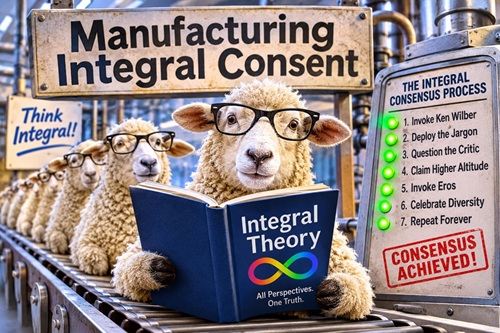 Introduction: From Manufacturing Consent to Manufacturing Integral ConsentIn their influential book Manufacturing Consent: The Political Economy of the Mass Media (1988), Edward S. Herman and Noam Chomsky developed a propaganda model explaining how mass media can manufacture public consent without requiring direct censorship or centralized control. Through institutional filters, ideological assumptions, economic dependencies, source selection, and the marginalization of dissent, media organizations can produce a remarkably narrow range of acceptable public opinion while maintaining the appearance of open debate. Could a similar process operate within the Integral movement? There are good reasons to think so. The Integral movement, particularly the intellectual and spiritual community that developed around Ken Wilber, has its own mechanisms for producing consensus, establishing intellectual authority, defining legitimate knowledge, and marginalizing inconvenient criticism. These mechanisms do not necessarily involve deliberate manipulation. They can emerge through shared assumptions, institutional loyalties, charismatic authority, intellectual dependencies, and the social rewards of belonging to a community that considers itself more evolved than the surrounding culture. We might call this process manufacturing integral consent. The central question is not whether Integral thinkers are allowed to disagree. They obviously are. The question is whether the movement's internal intellectual environment systematically encourages certain conclusions while making other conclusions difficult to formulate, publish, or take seriously. An intellectual community can celebrate openness, complexity, and pluralism while quietly developing powerful mechanisms of conformity. 1. The Authority Filter: Ken Wilber as the Principal Reference PointThe first filter is the authority of Ken Wilber himself. Wilber has produced an extensive body of work, developed an ambitious theoretical framework, and attracted a following that regards his contribution as a major intellectual and spiritual achievement. His influence extends far beyond his books into Integral Life, conferences, online communities, educational initiatives, and the work of numerous interpreters and successors. This creates an unusual intellectual situation. A movement ostensibly committed to integrating the best knowledge from different disciplines has developed around the theoretical architecture of one exceptionally influential individual. Wilber's framework consequently becomes more than a theory to be examined. It becomes the organizing reference point through which other theories, authors, disciplines, and experiences are interpreted. When a scientific finding supports Wilber's model, it can be presented as confirmation of Integral Theory. When it appears to contradict the model, the contradiction can be explained away through distinctions between levels, quadrants, developmental stages, or different kinds of knowing. The danger is not the use of a comprehensive framework. All theoretical frameworks organize knowledge. The danger arises when the framework becomes sufficiently authoritative that it is no longer subjected to the same critical scrutiny as the knowledge it claims to integrate. The result is an asymmetrical relationship: other thinkers must demonstrate their compatibility with Wilber, while Wilber's own claims are frequently protected by the flexibility of his framework. 2. The Jargon Filter: Speaking IntegralA second mechanism is the specialized vocabulary of Integral Theory. AQAL, holons, quadrants, levels, lines, states, types, altitudes, the pre/trans fallacy, the Great Nest of Being, Eros, and Spirit-in-action constitute a conceptual language that gives Integral discourse its distinctive character. Such terminology is not inherently problematic. Specialized disciplines need specialized vocabularies. However, jargon can also function as a boundary-maintenance mechanism. To participate in an Integral discussion, one is often expected to understand not merely the relevant subject matter but also its interpretation within Wilber's conceptual vocabulary. A biologist discussing evolution, for example, may find that evolutionary processes are being reinterpreted through the language of holarchy, self-transcendence, and increasing complexity. A psychologist may discover that competing theories are classified according to developmental altitude. A critic of spiritual metaphysics may be told that the criticism overlooks subtle or causal dimensions of reality. In this way, disagreements that might otherwise be investigated empirically are translated into disagreements about whether somebody understands the Integral framework correctly. The vocabulary can therefore become self-protective. Rather than allowing external disciplines to challenge the framework, it can absorb their findings into its own interpretive system. The more comprehensive the vocabulary becomes, the easier it is to mistake conceptual inclusion for empirical confirmation. 3. The Developmental Filter: Who Is Qualified to Disagree?Perhaps the most interesting mechanism concerns developmental psychology. Integral Theory distinguishes different stages of human development and associates them with different worldviews, cognitive capacities, and moral perspectives. In principle, this is a useful reminder that people interpret the world differently depending on their developmental history. But what happens when these distinctions are applied to intellectual disagreement? A critic may be described as operating from an earlier developmental altitude, unable to appreciate the complexity of a more encompassing perspective. Someone questioning spiritual metaphysics may be accused of reductionism. A materialist may be classified as trapped in a flatland worldview. A critic of Wilber's evolutionary philosophy may be said to lack access to the higher spiritual dimensions from which the theory supposedly becomes intelligible. This creates a peculiar epistemological problem. Instead of answering a criticism on its merits, one can question the developmental qualifications of the person making it. The critic is no longer simply wrong. The critic is developmentally limited. This is particularly problematic because the developmental classification itself may be based on the very theoretical framework under dispute. Wilber's model becomes both the proposition being defended and the instrument used to disqualify its critics. There is an obvious asymmetry here. If Integral thinkers can classify their critics developmentally, are critics equally entitled to classify Integral thinkers as insufficiently critical, overly dependent on spiritual authority, or insufficiently familiar with scientific methodology? More importantly, neither classification substitutes for examining the actual arguments. Developmental psychology should help explain differences in perspective, not provide an intellectual escape route from criticism. 4. The Spiritual Experience Filter: Privileged Access to RealityA fourth filter concerns spiritual experience. Integral communities often give considerable importance to meditation, contemplative practice, mystical experiences, altered states of consciousness, and claims about higher dimensions of reality. These experiences can be personally significant and deserve serious investigation. They may reveal important features of human consciousness that conventional psychology has insufficiently explored. But a distinction needs to be made between experiencing something and establishing what that experience means. A person may experience unity, transcendence, timelessness, or an apparent encounter with an absolute reality. The experience itself is a psychological fact. Its metaphysical interpretation is another matter. Integral discourse sometimes blurs this distinction. Reports of spiritual experience can acquire the status of evidence for ontological claims about Spirit, subtle energies, cosmic consciousness, or the evolutionary direction of the universe. When a critic questions these interpretations, the response may be that the critic has not undertaken the necessary contemplative practices or lacks the relevant experiential access. This creates another closed epistemological circuit: those who have the experience are considered qualified to interpret reality, while those who question the interpretation are told that they lack the experience. But first-person certainty does not automatically establish third-person truth. A genuinely integral approach should distinguish phenomenological evidence, psychological interpretation, cultural conditioning, and independently verifiable claims about the external world. 5. The Institutional Filter: The Integral EcosystemIdeas do not circulate in a social vacuum. Integral Life, conferences, online platforms, educational programs, publishing networks, and various post-Wilber initiatives create an ecosystem in which particular thinkers and interpretations receive visibility. These institutions can provide valuable opportunities for intellectual exchange. They can also develop recognizable centers of authority and networks of mutual reinforcement. A movement built around a charismatic intellectual figure naturally attracts interpreters, advocates, teachers, students, and entrepreneurs whose professional or intellectual identities become associated with the movement. This does not mean that their arguments are insincere. It does mean that criticism of the central theoretical framework can have consequences beyond the intellectual merits of the disagreement. A person who questions foundational assumptions may find fewer opportunities for collaboration, publication, or recognition within the relevant community. Meanwhile, authors who extend, elaborate, or creatively reinterpret the established framework may find a more welcoming intellectual environment. This is a structural possibility rather than an accusation of coordinated censorship. The important question is whether the movement's institutional arrangements encourage independent criticism to the same extent that they encourage theoretical development and spiritual advocacy. A community can be formally open to disagreement while remaining practically selective about which disagreements receive attention. 6. The Eros Filter: Evolution as a Predetermined Spiritual StoryOne of the most revealing examples of manufactured integral consent concerns the interpretation of evolution. Wilber's account of evolution is not merely a description of biological change. It is embedded in a larger metaphysical narrative in which reality supposedly possesses an inherent tendency toward increasing complexity, consciousness, and self-transcendence. Wilber calls this tendency Eros. In his more recent writings, including Finding Radical Wholeness (2024), Eros is presented not simply as a metaphor for evolutionary creativity but as an actual force in the universe, comparable in ontological status to familiar physical forces. This raises a straightforward scientific question: what does Eros explain that established evolutionary mechanisms do not? Natural selection, mutation, genetic drift, developmental constraints, ecological interactions, and other evolutionary processes have been extensively investigated. They provide mechanisms through which biological complexity and adaptation can emerge without requiring a cosmic purpose. Integral thinkers are entitled to propose additional metaphysical interpretations. But such proposals need to establish what explanatory work they perform. If Eros is invoked whenever complexity increases, while periods of evolutionary stasis, extinction, simplification, and regression are treated as secondary complications, the theory risks becoming unfalsifiable. A related problem arises when biological evolution is interpreted as a manifestation of a universal spiritual drive. The existence of increasingly complex organisms does not independently establish that the universe is directed toward consciousness or spiritual realization. Yet within an Integral environment, this evolutionary narrative can become an unquestioned background assumption. Once the narrative is accepted, scientific findings are often interpreted as illustrations of an already established spiritual philosophy rather than as independent evidence that might challenge it. The result is a subtle reversal of the relationship between science and metaphysics: instead of allowing scientific discoveries to test spiritual claims, spiritual assumptions determine how scientific discoveries are understood. 7. The Consensus Filter: Mutual Reinforcement and Selective CriticismA further mechanism is the tendency of intellectual communities to reinforce their shared assumptions. Integral thinkers frequently cite, interview, review, recommend, and debate one another. Such interaction can generate a productive intellectual network. But it can also produce an echo chamber in which the same foundational assumptions circulate repeatedly. A new author extends Wilber's framework. Another author praises the extension. A third interprets it as evidence of the continued development of Integral Theory. A fourth proposes a new synthesis that incorporates the preceding contributions. The resulting intellectual activity can be impressive in quantity without necessarily producing a corresponding increase in critical scrutiny. One can spend considerable time debating how to extend a theory without asking whether its most fundamental propositions are correct. This is particularly visible in post-Wilber initiatives that promise to advance Integral Theory beyond its original formulation. Some introduce new terminology, others emphasize metatheory, developmental psychology, cognitive science, or spiritual naturalism. The relevant question is not whether these developments are intellectually interesting. It is whether they subject inherited assumptions to genuinely independent examination. A movement can become increasingly sophisticated in its internal discussions while remaining remarkably conservative about its foundational commitments. 8. The Dissent Filter: How Critics Are ReclassifiedManufacturing consent becomes particularly visible when dissent appears. In an intellectually healthy community, a serious criticism should initiate an examination of the disputed claim. The relevant evidence should be considered, counterarguments formulated, and conclusions revised where necessary. But in a self-protective intellectual culture, dissent can be reclassified in several ways. The critic may be described as reductionist, materialistic, insufficiently developed, hostile to spirituality, unable to appreciate complexity, or motivated by personal animosity. Some of these descriptions may occasionally be justified. Critics are not automatically correct, and criticism can be unfair or poorly informed. The problem arises when such classifications substitute for engagement with the substance of the criticism. There is also a more subtle mechanism: ignoring the criticism altogether. An essay can challenge a foundational Integral assumption, document errors in its treatment of science, or expose contradictions in its metaphysical reasoning without receiving a substantive response from the people most invested in the theory. Silence is not proof that a criticism is correct. But persistent avoidance of uncomfortable questions can help preserve a consensus that might otherwise be destabilized. The result is a peculiar situation in which a movement celebrates its capacity to include multiple perspectives while limiting the practical influence of perspectives that challenge its own intellectual foundations. 9. The Integral Paradox: A Theory of Everything with a Blind SpotHere we encounter the central paradox. Integral Theory presents itself as an exceptionally inclusive framework. It seeks to transcend narrow disciplinary perspectives by incorporating subjective, intersubjective, objective, and interobjective dimensions of reality. It also emphasizes the importance of multiple perspectives and the dangers of reductionism. Yet the movement surrounding this framework can exhibit precisely the kind of reductionism it claims to overcome: reducing criticism to the developmental limitations of the critic, reducing empirical questions to matters of interpretive perspective, and reducing intellectual disagreement to differences in spiritual realization. The theory's ambition to include everything can become a justification for excluding challenges to its own architecture. This is especially ironic because an integral approach should be capable of applying its own principles reflexively. If every perspective is partial, then Wilber's perspective is partial too. If every theory is historically and culturally situated, Integral Theory is no exception. If intellectual development requires transcending previous assumptions, then the Integral movement must also be prepared to transcend some of its own. Otherwise, integral thinking becomes a sophisticated form of intellectual self-confirmation. 10. Toward an Unmanufactured Integral DiscourseWhat would an intellectually healthier Integral movement look like? First, it would distinguish the historical importance of Ken Wilber from the validity of individual claims in his work. His framework should be treated as a theoretical contribution, not as an authoritative map against which all other knowledge must be measured. Second, it would establish a clear distinction between empirical evidence, philosophical argument, contemplative experience, and metaphysical speculation. These forms of knowledge can inform one another, but they should not be treated as interchangeable. Third, it would abandon developmental labeling as a substitute for argument. The altitude of a critic does not determine whether the criticism is correct. Fourth, it would encourage independent engagement with scientific disciplines. Biology should be allowed to challenge Integral interpretations of evolution. Neuroscience should be allowed to question assumptions about consciousness. Sociology should be allowed to investigate the actual functioning of Integral communities. Fifth, it would institutionalize criticism. A movement that genuinely values multiple perspectives should give its most serious critics opportunities to challenge its foundational assumptions, rather than merely inviting them to contribute to discussions whose basic conclusions have already been settled. Finally, it would recognize that intellectual progress sometimes requires abandoning cherished ideas. A framework that can only grow by incorporating new terminology, but cannot discard old assumptions, is not necessarily developing. It may simply be becoming more elaborate. Conclusion: The Consent of the Integral CommunityThe manufacturing of integral consent does not require a conspiracy, a central propaganda office, or deliberate suppression of dissent. It can emerge from ordinary social and intellectual processes: charismatic authority, shared vocabulary, developmental hierarchies, spiritual credentials, institutional dependencies, selective recognition, and mutual reinforcement. The result is a community in which people may experience considerable intellectual freedom while remaining constrained by assumptions they rarely question. This is not unique to the Integral movement. Religious communities, political ideologies, academic schools, and scientific paradigms all develop mechanisms for maintaining intellectual consensus. Integral thinkers are therefore not uniquely susceptible to conformity. But they face a particularly interesting contradiction because their theoretical framework explicitly claims to transcend partial perspectives and integrate competing forms of knowledge. That ambition should impose an unusually demanding standard of intellectual self-criticism. The decisive test of Integral Theory is not how many perspectives it can accommodate within its conceptual architecture. It is whether it can accommodate perspectives that seriously challenge the architecture itself. Can Integral thinkers criticize Wilber without being classified as developmentally deficient? Can they question Eros without being accused of reductionism? Can they reject spiritual metaphysics without being dismissed as trapped in materialism? Can they recognize that some scientific explanations do not need an additional spiritual dimension? And can the Integral movement accept that its own preferred interpretation of reality may be mistaken? These are not peripheral questions. They go to the heart of what it means to be genuinely integral. An intellectual movement that claims to transcend conventional thinking should be especially careful not to manufacture its own conventional thinking. Otherwise, the Integral movement risks becoming an example of precisely what it was supposed to overcome: a community that mistakes agreement for understanding, inclusion for openness, and intellectual sophistication for intellectual freedom.
Comment Form is loading comments...
|