|
TRANSLATE THIS ARTICLE
Integral World: Exploring Theories of Everything
An independent forum for a critical discussion of the integral philosophy of Ken Wilber
  Frank Visser, graduated as a psychologist of culture and religion, founded IntegralWorld in 1997. He worked as production manager for various publishing houses and as service manager for various internet companies and lives in Amsterdam. Books: Ken Wilber: Thought as Passion (SUNY, 2003), and The Corona Conspiracy: Combatting Disinformation about the Coronavirus (Kindle, 2020).
Check out my other conversations with ChatGPT How Life WorksPhilip Ball's Challenge to the Mechanical View of BiologyFrank Visser / ChatGPT
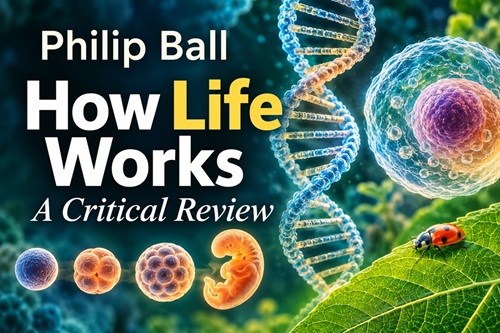 Beyond the Gene-Centred Picture of LifePhilip Ball's How Life Works: A User's Guide to the New Biology (2023) is an ambitious attempt to rethink some of the most deeply entrenched assumptions in modern biology. Its central argument is that we have been looking at life through an overly narrow conceptual lens. For much of the twentieth century, biology was dominated by a relatively mechanical picture: DNA contains the instructions, genes determine the characteristics of organisms, proteins execute the instructions, and natural selection gradually modifies the resulting machinery. Ball believes this picture, although enormously productive, is inadequate. Living organisms are not simply genetic programs unfolding according to predetermined instructions. They are dynamic, self-organizing systems in which genes, cells, tissues, organisms and environments interact continuously. Biological development is not merely the execution of a genetic blueprint but an emergent process involving feedback, regulation, physical constraints, chemical interactions and environmental influences. This is an important corrective. But does Ball offer a genuinely new understanding of life, or does he sometimes risk replacing one grand explanatory narrative with another? The book deserves serious attention precisely because it raises that question. The Decline of Genetic DeterminismOne of Ball's principal targets is the popular conception of DNA as a master control system. The discovery of the molecular structure of DNA and the subsequent development of molecular genetics encouraged the idea that the genome contains a comprehensive set of instructions for constructing an organism. This metaphor has been remarkably successful. It has also become misleading. Genes do not operate independently, nor do they dictate the final characteristics of an organism in a straightforward manner. Their expression depends on cellular conditions, regulatory networks, chemical signals, developmental history and environmental circumstances. The same genome can produce different outcomes under different conditions. Ball draws attention to epigenetics, gene regulation, cellular signalling, developmental plasticity and the remarkable capacities of biological systems to organize themselves. The genome is not a complete architectural plan. It is part of a much larger biological system. This is not an argument against genetics. It is an argument against genetic reductionism. Here Ball is on particularly solid ground. The history of molecular biology has demonstrated the extraordinary explanatory power of genes, but also the limitations of treating them as autonomous causal agents. Genes participate in networks, and their effects depend on the biological contexts in which they operate. The distinction matters. Rejecting genetic determinism does not require rejecting the central role of genes in evolution and development. Cells Are Not Merely Genetic MachinesA particularly interesting aspect of Ball's account concerns the agency and organizational capacities of cells. Cells are not passive containers in which genetic instructions are executed. They actively respond to their surroundings, exchange signals, regulate their internal environments and coordinate their activities with other cells. They possess capacities for sensing, adaptation and regulation that cannot be adequately described by a simple top-down model of genetic control. Development is consequently a collective achievement. The formation of tissues, organs and entire organisms involves interactions among components operating at multiple levels. This perspective also challenges the traditional distinction between instructions and execution. In a computer, instructions are supplied by an external programmer. In living systems, however, the mechanisms responsible for producing biological organization are themselves products of evolutionary history and ongoing interaction. The organism is not simply following a program. It is continually participating in the processes through which its own organization is maintained and transformed. That is a useful conceptual shift, although it should not be mistaken for the discovery of some entirely new biological principle. Developmental biology, systems biology and embryology have investigated such interactions for decades. The Organism as an Active ParticipantPerhaps the most provocative dimension of Ball's book is his treatment of biological agency. The word agency traditionally suggests an organism capable of making choices and acting intentionally. Ball explores a more elementary form: the capacity of biological systems to respond to circumstances, regulate their behaviour and modify their own internal states. Cells can detect chemical gradients, coordinate movements, alter gene expression and participate in collective patterns of organization. Embryonic development provides particularly striking examples. Cells interact locally, yet their collective behaviour can produce remarkably ordered structures without a central controller specifying every detail. This raises an intriguing possibility: biological organization is not exclusively imposed from above by genes, but arises through reciprocal interactions among components. Ball approaches the controversial territory of cellular cognition. If cells can sense, process information, retain aspects of their history and respond adaptively, in what sense might they be described as cognitive agents? This is a fascinating research direction, but it also requires conceptual discipline. Sensing is not necessarily cognition, information processing is not necessarily understanding, and adaptive behaviour is not necessarily conscious agency. There is a danger of importing psychological language into molecular biology without establishing precisely what the terminology means. Calling a cell intelligent may be illuminating as a metaphor, but it becomes problematic if it suggests that cells possess anything resembling human awareness. We should distinguish increasingly sophisticated biological responsiveness from subjective experience. The former is well established; the latter remains a much more difficult philosophical and scientific question. Emergence: An Explanation or a Description?The concept of emergence occupies a central position in Ball's argument. Living systems exhibit properties that cannot be straightforwardly predicted by examining their individual components in isolation. A protein molecule does not constitute an organism, nor does a collection of isolated cells automatically explain the development of a functioning organ. Organization, interaction and context matter. This is familiar territory in complexity theory and systems biology. It is also an important corrective to simplistic reductionism. But emergence is a concept that can easily become a rhetorical stopping point. To say that a property emerges from interactions among components is not yet to explain how it emerges. We need to identify the interactions, mechanisms, constraints and conditions responsible for the resulting organization. For example, the emergence of a particular anatomical structure may involve chemical gradients, mechanical forces, cellular adhesion, gene-regulatory networks and feedback mechanisms. Once these processes are identified and experimentally investigated, emergence becomes scientifically productive. Without such specification, however, it risks becoming a sophisticated synonym for we do not yet understand. Ball generally provides considerably more than this empty version of emergence. His strength is precisely his willingness to describe the underlying biological processes. Nevertheless, readers should resist treating emergence as an alternative causal force that somehow explains what its constituent mechanisms cannot. The question is not whether biological wholes have properties that their components lack. Clearly they do. The question is how those properties arise and how they can be experimentally investigated. Has Reductionism Been Defeated?Ball's criticism of conventional biological metaphors raises a larger philosophical issue. Is biology moving beyond reductionism, or is it simply developing more sophisticated forms of reductionist explanation? There is an important distinction here. Methodological reductionism involves investigating complex phenomena by studying their constituent mechanisms. It has produced extraordinary advances in molecular biology, genetics, biochemistry and medicine. Ontological reductionism makes the stronger claim that biological reality is ultimately nothing but its physical and chemical constituents, and that higher-level descriptions are therefore dispensable. Ball's arguments challenge the second position more convincingly than the first. There is no reason why a biologist should abandon molecular explanations because an organism exhibits properties that cannot be understood at the molecular level alone. Higher-level organization does not make lower-level mechanisms irrelevant. Conversely, molecular explanations do not eliminate the need to study developmental, physiological and ecological processes. The most productive position is therefore not an anti-reductionist revolution but an explanatory pluralism: different levels of biological organization require different investigative approaches, which must nevertheless remain compatible with one another. A gene is not an organism, but neither is an organism independent of its genes. This qualification matters because popular presentations of the new biology sometimes portray the history of genetics as a prolonged intellectual mistake. That would be an exaggeration. The molecular revolution was not wrong; it was incomplete. The same applies to the gene-centred perspective in evolutionary biology. The Evolutionary QuestionOne of the more important limitations of Ball's presentation concerns the relationship between his developmental and systems-oriented perspective and evolutionary theory. The book is primarily concerned with how organisms work, develop and maintain themselves. It is less comprehensive as a reconstruction of how evolutionary change occurs. This distinction is essential. Showing that genes do not independently determine phenotypes does not demonstrate that genetic variation and natural selection have lost their central importance in evolutionary explanation. Natural selection operates on phenotypic differences, and the production of those differences depends on developmental systems, environmental conditions and genetic variation. The interesting question is how these processes interact. Organisms are not merely passive vehicles through which genes compete. Their developmental organization, behaviour and environmental interactions influence which variations are produced, expressed and transmitted. Phenotypic plasticity, developmental constraints, niche construction and evolutionary feedback all deserve consideration. Yet none of this requires abandoning Darwinian evolution. Indeed, the more we understand developmental processes, the better equipped we become to investigate how evolution generates novelty and how natural selection subsequently shapes it. Tim Beardsley, reviewing Ball's book in BioScience, identifies a pertinent weakness: Ball gives relatively little attention to the implications of his arguments for evolutionary theory. In particular, the relationship between developmental flexibility and adaptation through mutations favoured by natural selection remains an important unresolved issue. This is a fair reservation. A new account of how organisms develop is not automatically a new account of how species evolve. The Problem with Biological MetaphorsBall is particularly good at exposing the limitations of familiar metaphors. DNA is not a blueprint in the ordinary architectural sense. Cells are not little factories. Proteins are not always neatly designed molecular machines. The brain is not simply a computer. Such comparisons can be useful teaching devices, but they become misleading when taken literally. The metaphor of DNA as a computer program, for example, suggests a separation between programmer, instructions and execution. Biological systems do not have this arrangement. The genome is interpreted within a cellular environment that is itself a product of developmental and evolutionary processes. Similarly, the machine metaphor tends to emphasize components and their functions while neglecting the extraordinary plasticity, adaptability and historical contingency of living systems. Ball's discussion of language is especially suggestive. A dictionary does not determine the meaning of a novel, just as a collection of genetic sequences does not independently determine the characteristics of an organism. Context and relationships matter. However, metaphors should not simply be discarded because they are imperfect. They are tools, and different tools illuminate different aspects of reality. The danger lies in confusing the model with the phenomenon being modelled. Ball's contribution is to encourage readers to become more critical and flexible in their use of biological metaphors. What Does This Mean for Medicine?Ball's perspective has implications extending well beyond theoretical biology. If organisms are dynamic, context-sensitive systems, then medical interventions cannot always be understood as correcting isolated molecular defects. The same genetic variant may have different consequences in different biological contexts. Disease can involve interactions among genetic predispositions, developmental histories, immune responses, environmental conditions and physiological feedback. This does not mean that genetic medicine is misguided. On the contrary, it suggests that genetic interventions need to be understood within a more comprehensive picture of the organism. The implications for cancer research are particularly interesting. Cancer is not simply a matter of a few defective genes producing uncontrolled cells. It involves interactions between cells, tissues, immune systems and their surrounding environments. Understanding these interactions may offer therapeutic opportunities that cannot be identified through an exclusively gene-centred approach. The same applies to developmental disorders and individual differences. A biological variation should not automatically be interpreted as a defective version of some supposedly ideal genetic blueprint. There is, however, a qualification. Recognizing biological diversity does not mean that every developmental outcome is harmless or that disease can be reduced to a difference in perspective. The challenge is to understand the mechanisms and consequences of biological variation without imposing simplistic notions of normality. From Understanding Life to Engineering LifeBall also points towards the possibilities opened up by this new biology. If biological systems possess greater plasticity and organizational flexibility than conventional models suggest, then the possibilities for manipulating them may be considerably broader. Synthetic biology, regenerative medicine, tissue engineering and developmental interventions all stand to benefit from a deeper understanding of how biological organization actually works. But this introduces an interesting paradox. The better we understand the complexity of living systems, the less confident we may become about our ability to control them through straightforward interventions. A biological system is not a machine in which replacing one component necessarily produces a predictable result. Altering one component can affect multiple interconnected processes, sometimes with unexpected consequences. This is not an argument against biological engineering. It is a reminder that intervention requires understanding the system as a whole, including its capacity to compensate, reorganize and respond. Ball's vision is therefore both scientifically exciting and appropriately cautionary. Is This Really a New Biology?Here I would introduce a more substantial reservation. Ball occasionally presents his perspective as part of a profound transformation in biology. There is certainly something happening in contemporary life sciences, but the historical framing deserves qualification. Developmental biology has never been exclusively gene-centred. The importance of cellular interactions, environmental influences, feedback and self-organization has been recognized by generations of researchers. Systems biology, embryology, evolutionary developmental biology (evo-devo) and ecological approaches have long challenged simplistic genetic determinism. Nor is the recognition of multiple levels of causation particularly revolutionary. Scientists have always needed to move between molecular, cellular, physiological and ecological explanations. What has changed is the growing body of experimental evidence, computational techniques and molecular tools that allow researchers to investigate these interactions in unprecedented detail. Ball is therefore best understood as synthesizing and popularizing developments across several disciplines rather than announcing the discovery of an entirely new biological paradigm. That distinction does not diminish the achievement. A good synthesis can be intellectually important even when its constituent insights are not individually new. It does, however, discourage the temptation to divide biological history into an obsolete genetic era and an enlightened post-genetic future. An Unexpected Philosophical TemptationThere is one further issue worth considering. Whenever scientists challenge simplistic reductionism and emphasize emergence, self-organization, agency and complexity, their arguments can attract philosophical interpretations that go considerably beyond the scientific evidence. Some readers may see Ball's account as support for panpsychism, vitalism, biological idealism or other philosophies that attribute mind-like properties to nature. Such conclusions would be premature. The fact that cells exhibit sophisticated responsiveness does not establish that matter is conscious. The fact that organisms self-organize does not demonstrate the existence of a universal organizing intelligence. And the fact that biological wholes exhibit emergent properties does not require the introduction of an additional, nonphysical principle. There is no need to invoke a mysterious life force to explain biological organization. At the same time, a strictly mechanical vocabulary may be insufficient to describe the extraordinary capacities of living systems. The challenge is to develop better concepts without smuggling metaphysical assumptions into scientific explanations. Ball generally maintains this distinction, although his interest in cellular agency and cognition invites further philosophical questions. For readers familiar with contemporary discussions of complexity, emergence and naturalistic accounts of meaning, this is perhaps the most stimulating dimension of the book. It opens philosophical possibilities without necessarily settling them. Final Assessment: Biology Without a BlueprintPhilip Ball has written an ambitious, informative and intellectually stimulating book. Its greatest achievement is to loosen the grip of simplistic genetic determinism and encourage a more comprehensive understanding of biological organization. Life is not a genetic blueprint unfolding mechanically. It is a historically evolved, dynamically organized process involving interactions across multiple levels. Genes matter, but so do cells, tissues, organisms and environments. Biological causation is distributed, context-dependent and reciprocal. The book's main weakness is not its scientific orientation but its occasional tendency to frame an important expansion of biological understanding as a more decisive break with the past than history warrants. Its treatment of evolutionary theory could also have been more developed. There is a danger that the language of emergence and agency, while illuminating, may sometimes create the impression of explanatory progress where more detailed mechanistic accounts are still required. Nevertheless, these reservations do not detract from the book's considerable value. Perhaps the most important lesson is that rejecting genetic determinism does not mean rejecting genetics, just as rejecting mechanical metaphors does not mean rejecting physical explanations. We need a biology that can move comfortably between levels of organization without reducing one to another or treating their interaction as mysterious. Ball's book is a welcome contribution to that project. Life does not follow a blueprint. It builds, maintains and transforms itself through an immense network of interactions that evolution has gradually assembled. Understanding those interactions, rather than searching for a single master instruction, is the real challenge of modern biology. Appendix: What Ball's New Biology Does—and Does Not—EstablishIt is useful to distinguish several propositions that can easily become conflated.
The distinction between these claims is important. The strongest case for Ball's book rests on the first four propositions, not on the more speculative interpretations sometimes attached to them. The real revolution is not the discovery that genes do not matter. It is the realization that genes never worked alone. Overall verdict: A highly worthwhile book, particularly for readers interested in the relationship between genetics, evolution, complexity and emergence. Its strongest contribution is corrective rather than revolutionary.
Widget is loading comments...
|