|
TRANSLATE THIS ARTICLE
Integral World: Exploring Theories of Everything
An independent forum for a critical discussion of the integral philosophy of Ken Wilber
  Frank Visser, graduated as a psychologist of culture and religion, founded IntegralWorld in 1997. He worked as production manager for various publishing houses and as service manager for various internet companies and lives in Amsterdam. Books: Ken Wilber: Thought as Passion (SUNY, 2003), and The Corona Conspiracy: Combatting Disinformation about the Coronavirus (Kindle, 2020).
Check out my other conversations with ChatGPT Yalta 2.0Are the United States, Russia, and China Heading for a New Division of the World?Spheres of Influence, Great-Power Bargaining, and the Future of the International OrderFrank Visser / ChatGPT
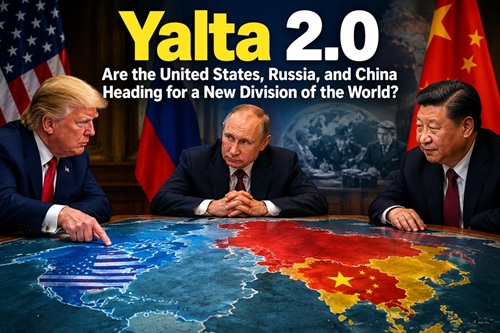 Introduction: The Return of Nineteenth-Century GeopoliticsThe prospect of a new Yalta is no longer merely a historical analogy or a geopolitical thought experiment. As the United States reassesses its global commitments, Russia pursues its ambition to dominate its immediate neighborhood, and China expands its economic and military reach, the possibility of a world divided into competing spheres of influence deserves serious consideration. What once seemed an outdated relic of imperial diplomacy is returning as a potential organizing principle of international politics. The historical reference is the Yalta Conference of February 1945, when Franklin D. Roosevelt, Winston Churchill, and Joseph Stalin met to discuss the postwar settlement of Europe. The conference did not simply divide the world into three neat territorial blocs, as popular accounts sometimes suggest. Yet the subsequent emergence of an American-led Western bloc and a Soviet-dominated Eastern bloc reflected the realities of military occupation, strategic bargaining, and the unequal distribution of power. The fate of smaller nations was often determined less by their own wishes than by the calculations of the great powers. A Yalta 2.0 would be different in its details but potentially similar in its underlying logic. Washington, Moscow, and Beijing might increasingly treat the world as a collection of regions in which each major power possesses privileged interests and expects its rivals to exercise restraint. The United States would seek to preserve its primacy in the Western Hemisphere and maintain its alliances in Europe and Asia; Russia would demand a dominant position in its former Soviet neighborhood; and China would seek regional predominance in East Asia, including a resolution of the Taiwan question on its own terms. The critical question is not whether these three powers will sign a document explicitly dividing the planet. That is unlikely. It is whether their actions, negotiations, and mutual accommodations will gradually produce a similar result in practice. The Immediate Warning Sign: A Summit of Three Great PowersThe possibility has acquired a strikingly concrete dimension. On October 19, 2026, reports emerged that Vladimir Putin had floated a trilateral summit with Donald Trump and Xi Jinping to discuss a settlement of the war in Ukraine. The reported proposal raised the possibility that Ukraine's future could be discussed by three powerful leaders without Ukraine itself at the table. No agreement has been reached, and the proposal should not be mistaken for an established plan to partition the world. Nevertheless, the symbolism is unmistakable: the leaders of three major powers discussing the fate of a smaller country could become an emblem of a new great-power order. The significance lies not simply in the proposed meeting, but in the diplomatic principle it might embody. If the United States and Russia were to negotiate the future of Ukraine over the heads of Ukrainians, they would implicitly treat Ukrainian sovereignty as a negotiable asset rather than a right. If China were included as a co-arbiter of the settlement, the meeting could also signal that the management of global conflicts belongs to a small club of powerful states. That is the logic of a Yalta-style arrangement. It does not require a signed map of the world. It requires only that the major powers increasingly recognize one another's privileged claims and become willing to sacrifice the interests of smaller states to secure a broader accommodation. The crucial uncertainty is whether Washington actually wants to grant Moscow and Beijing such privileges, or whether it merely wants to reduce the costs of American global engagement. Those are not the same thing. A president seeking to disengage from expensive commitments may inadvertently create spheres of influence without having designed a coherent system for managing them. Why a New Yalta Is Becoming ThinkableThree developments make this scenario plausible: the relative decline of uncontested American dominance, the return of territorial revisionism, and the weakening of confidence in the international rules that emerged after the Second World War. For several decades after the Cold War, the United States enjoyed a position of extraordinary global influence. It maintained alliances across Europe and Asia, commanded formidable military capabilities, and helped sustain an international economic order built around trade, finance, and multilateral institutions. This arrangement was never entirely benevolent or universally accepted. American power was exercised selectively, and Washington itself sometimes violated the principles it promoted. Nevertheless, the system provided many smaller countries with a degree of strategic protection and diplomatic space that a straightforward balance-of-power system might not have afforded them. That order is now under pressure from several directions. China's economic and military rise has narrowed America's relative advantage. Russia has challenged the territorial settlement of post-Cold War Europe through its invasion of Ukraine. Meanwhile, American political divisions have made the continuity of US foreign policy less predictable. Allies can no longer assume that commitments made by one administration will necessarily be honored with the same conviction by the next. The result is not simply a transition from unipolarity to multipolarity. It is a crisis of expectations. When countries cease to trust the durability of international commitments, they begin to hedge, arm themselves, seek alternative partners, and contemplate accommodations with stronger neighbors. Such behavior can make the world less stable even when every government claims to be acting defensively. A recent analysis by the European Council on Foreign Relations describes the emerging situation as an interregnum: the old order is fading, but no coherent successor has emerged. That is precisely the kind of environment in which a Yalta-style arrangement becomes conceivable. The American Sphere: The Western Hemisphere FirstThe most consequential change may be taking place in Washington itself. An America that increasingly prioritizes its own hemisphere, demands that allies shoulder more of their defense costs, and questions the value of distant commitments could gradually retreat from the role of global guarantor. The historical analogy is the Monroe Doctrine of 1823, which asserted that European powers should not extend their political domination into the Americas. In its modern, more aggressive interpretation, this principle can become a claim that the United States is entitled to decisive influence over the political and economic orientation of countries throughout the Western Hemisphere. The implications extend beyond Latin America. If Washington insists on an exclusive sphere in the Americas while becoming less willing to defend the existing European security order, it could encourage Moscow to make a similar claim over parts of Eastern Europe. If Washington also decides that a confrontation with China over Taiwan is not worth the risk, Beijing could gain greater freedom of action in East Asia. This is the central danger of a spheres-of-influence doctrine: each concession to one great power can become the justification for a corresponding demand by another. There is, however, an important qualification. An American administration can pursue regional dominance without accepting Russian dominance in Europe or Chinese dominance in Asia. Indeed, Washington may seek to consolidate its own position precisely because it wants to compete more effectively with its rivals. Recent American policy cannot simply be reduced to a deliberate plan to hand the world to Putin and Xi. The question is whether a narrower conception of American interests will have consequences that exceed the intentions behind it. The Russian Sphere: Ukraine as the Test CaseFor Vladimir Putin, Ukraine is much more than a neighboring country. Its geopolitical orientation bears directly on Russia's conception of its status as a great power, its military security, and its historical identity. The Kremlin has repeatedly challenged the proposition that Ukraine can freely determine its international alignment independently of Russian preferences. A Yalta 2.0 would offer Moscow the prospect of converting military aggression into diplomatic recognition of a privileged Russian sphere. Even if Russia failed to conquer all of Ukraine, a settlement that permanently restricted Ukrainian sovereignty, excluded the country from meaningful Western security arrangements, or rewarded territorial conquest could represent a strategic victory for the Kremlin. The precedent would be more important than the precise boundary of any ceasefire. It would suggest that a powerful state can invade a neighbor, sustain the costs of war, and eventually obtain international acceptance of at least part of its demands. Other governments might conclude that the prohibition against acquiring territory by force is conditional on the outcome of great-power bargaining. Such an outcome would also threaten the security of countries beyond Ukraine. Moldova, Georgia, and other states in Russia's neighborhood could face increased pressure to accommodate Moscow's preferences. NATO's eastern members would have to consider whether the alliance remained willing and able to defend them. Yet Russian ambitions should not be confused with Russian capabilities. Russia has suffered substantial military and economic costs from its war, and its ability to dominate all of Eastern Europe is limited. Moscow also depends increasingly on its relationship with China, a partnership that contains its own inequalities. Russia may aspire to an independent sphere, but it risks becoming the junior partner in a larger Eurasian power arrangement. The central issue is therefore not whether Russia will recover the Soviet Union's former sphere in its entirety. It is whether Western governments will accept a principle that gives Moscow a veto over the strategic choices of neighboring states. The Chinese Sphere: Taiwan and the Asian BalanceChina's ambitions present a different but equally consequential challenge. Beijing seeks to increase its regional influence, reduce the ability of the United States to intervene in East Asia, and bring Taiwan under its control. It also claims extensive maritime interests and seeks a regional order in which neighboring governments are less able or willing to oppose Chinese preferences. For Xi Jinping, an American recognition of Chinese primacy in East Asia would be a major strategic achievement. It could weaken the confidence of Japan, South Korea, the Philippines, and other regional partners in American security guarantees. Taiwan would be particularly vulnerable if Beijing concluded that Washington had effectively accepted the island's incorporation into the Chinese state. But a Chinese sphere of influence would not necessarily resemble the old Soviet bloc. China's economic power gives it means of influence that go well beyond military occupation. Trade dependence, infrastructure investment, industrial supply chains, technology standards, and access to its enormous market can all create incentives for neighboring governments to accommodate Beijing. This could produce a sphere that is formally independent but increasingly constrained in practice. Countries might retain their flags, governments, and seats at the United Nations while discovering that certain foreign-policy choices carry prohibitive economic or military costs. There is a major obstacle to this scenario, however. China does not operate in an empty geopolitical space. Japan is a formidable economic and technological power; India has its own ambitions; and many Asian governments want both economic relations with China and continued American involvement in regional security. A Chinese sphere would have to contend with these countries' interests rather than simply absorb them. Nor is Washington's acceptance of Chinese dominance inevitable. The United States might instead strengthen its Asian alliances, increase military preparedness, and seek to deter any attempt to settle the Taiwan question by force. A Yalta-style accommodation would be one possible outcome of the competition, not its predetermined conclusion. The Three Powers Do Not Necessarily Want the Same WorldIt is tempting to imagine Washington, Moscow, and Beijing as three leaders who share a common interest in dividing the world among themselves. Their authoritarian or nationalist tendencies, their distrust of universal rules, and their emphasis on national power can make that picture attractive. But it oversimplifies their relationship. Russia and China have drawn closer together in opposition to American predominance. Their partnership provides Moscow with important economic and diplomatic support, while Beijing benefits from a strategic partner that occupies American attention and resources. Yet the two countries are not equal. China possesses a far larger economic base, and Russia risks becoming increasingly dependent on its more powerful neighbor. The United States, meanwhile, faces a strategic dilemma. It might prefer an arrangement that reduces the costs of defending Europe and Asia while preserving American economic and military advantages. But granting China a dominant position in East Asia could ultimately weaken American influence far beyond the region. Similarly, allowing Russia to dominate Eastern Europe might encourage other powers to challenge American commitments elsewhere. The three powers therefore have overlapping but not identical interests. They might agree to limit certain forms of interference in one another's affairs while continuing to compete fiercely over trade, technology, resources, military access, and political influence. A Yalta 2.0, if it emerges, would consequently be less likely to resemble a harmonious directorate of three cooperating empires than an unstable bargain among suspicious rivals. Each would seek to restrict the others' freedom of action while expanding its own. That distinction matters. A world divided into spheres of influence is not necessarily a world at peace. It may simply be a world in which the great powers negotiate the terms of their rivalry while smaller countries bear the consequences. Europe: The Potential Loser at the TableEurope is particularly exposed to this possibility because its security architecture has depended heavily on the United States. NATO is not merely a military organization; it is the institutional expression of an American commitment to prevent European security from being determined exclusively by the balance of power among European states. If Washington becomes less reliable, Europe faces an uncomfortable choice. It can develop the military capabilities and political cohesion needed to defend itself, or it can accommodate Russian demands in the hope of avoiding a wider conflict. The second option might appear pragmatic to those who believe that Ukraine's security cannot justify an indefinite confrontation with Moscow. But accommodation can become appeasement when it rewards aggression and leaves the aggressor better positioned to threaten its neighbors. There is also a deeper problem. Europe is not a single sovereign state capable of making a unified strategic decision. Its members disagree about defense spending, relations with Russia, the future of NATO, and the degree to which they should depend on American protection. These divisions make it harder for Europe to resist pressure from a great power that can exploit differences among its members. Yet European weakness is not inevitable. The possibility of American retrenchment could provide the impetus for greater defense cooperation, more coordinated arms production, stronger support for Ukraine, and a foreign policy less dependent on Washington's electoral cycles. The choice is not simply between American protection and Russian domination. A third possibility exists: a Europe that assumes greater responsibility for its own security and acts as an independent center of power. That would not guarantee peace, and European rearmament would bring its own political and economic costs. But it would make a settlement imposed by Washington and Moscow considerably more difficult. The Fatal Flaw in the Yalta Analogy: Smaller Countries Have AgencyThe original Yalta analogy can obscure a crucial difference between 1945 and the present. The world is more economically interconnected, politically diverse, and institutionally complex than the world emerging from the Second World War. Military power remains decisive in some circumstances, but it does not automatically translate into uncontested political control. Ukraine has demonstrated that a country much smaller than its adversary can resist an invasion at enormous cost to the aggressor. Taiwan has developed substantial economic importance and defensive capabilities. European countries possess significant collective economic and technological resources. India, Brazil, Turkey, Saudi Arabia, and other regional powers pursue interests that cannot simply be assigned to one of three global camps. These countries are not merely squares on a geopolitical chessboard. Their governments have domestic constituencies, national histories, strategic ambitions, and competing relationships with external powers. Their populations may reject the bargains made in their name. A settlement that ignores these realities may look attractive to leaders seeking an immediate diplomatic success, but it may prove impossible to enforce over the long term. A government installed or protected through external pressure can encounter persistent resistance. A coerced alliance may become unstable when the balance of power shifts. An agreement that leaves a population convinced that its independence has been sacrificed can plant the seeds of the next conflict. This is one of the paradoxes of spheres-of-influence politics: an arrangement designed to reduce uncertainty among great powers can increase insecurity everywhere else. The more a great power demands unquestioned obedience from its neighbors, the more those neighbors have reason to seek external protection, develop military capabilities, and resist its influence. The attempt to establish a secure sphere can therefore produce the very hostility that the sphere was intended to prevent. Is a New Yalta Actually Likely?The answer depends on what we mean by Yalta 2.0. Three different scenarios should be distinguished. Three possible futures 1. An explicit global partition - Least plausibleThe United States, Russia, and China formally agree to allocate regions to their respective spheres and to refrain from challenging one another's predominance. Such an arrangement would require an improbable degree of trust and agreement among powers whose interests remain fundamentally competitive. 2. An informal spheres-of-influence order - PlausibleNo comprehensive treaty is signed, but the United States reduces its commitments in selected regions, Russia secures de facto control or veto power over some of its neighbors, and China gains greater freedom of action in East Asia. A series of regional bargains gradually produces a divided world without a master plan. 3. A fragmented and contested multipolar order - Also plausibleThe existing international order weakens, but no stable partition replaces it. The great powers compete across multiple regions, middle powers resist subordination, alliances shift, and crises continue because no one can establish universally accepted boundaries to its influence. The second scenario is the one that deserves the greatest attention. It does not require a grand conspiracy or a secret agreement among the three leaders. It could emerge through a sequence of seemingly separate decisions: reduced American support for Ukraine, a settlement that leaves Russia with strategic advantages, diminished American willingness to defend Taiwan, and increasingly forceful assertions of American dominance in the Western Hemisphere. Each decision might be defended on its own merits. Taken together, however, they could establish a new international principle: the strongest powers enjoy greater freedom to determine what happens in their respective neighborhoods. There are countervailing forces. The United States may continue to resist Russian and Chinese expansion; European governments may develop greater strategic independence; and Asian allies may deepen their security cooperation. Russia and China may also discover that their ambitions conflict in Central Asia or elsewhere. These obstacles make a stable three-power condominium less likely than an uneven and contested transition. The most important distinction is between an intentional partition and an emerging reality. A new Yalta might never be announced, even if its consequences become increasingly visible. Why Spheres of Influence Do Not Guarantee PeaceDefenders of spheres of influence often appeal to realism. Since no world government can reliably enforce international rules, they argue, peace depends on acknowledging the distribution of power. Great powers have security interests, and attempting to deny those interests can produce unnecessary confrontation. Acknowledging limits and negotiating compromises may therefore be preferable to pursuing universal principles at any cost. There is a serious argument here. Diplomacy requires compromise, and no international order can function indefinitely without taking account of the interests and capabilities of powerful states. A negotiated settlement can save lives, reduce escalation risks, and create space for future political change. But realism becomes dangerous when it transforms a description of power into a justification of domination. The observation that Russia can threaten Ukraine does not establish Russia's right to control Ukraine. China's capacity to coerce Taiwan does not establish its entitlement to determine Taiwan's future by force. America's military superiority in the Western Hemisphere does not automatically confer a moral right to dictate the political choices of its neighbors. Nor does the existence of spheres necessarily eliminate conflict among their architects. Great powers disagree about where one sphere ends and another begins. Their claims overlap, their ambitions expand, and their assessments of their rivals' intentions change. An agreement that appears balanced today may seem intolerable tomorrow. The original Cold War illustrates this ambiguity. The division of Europe helped prevent a direct military confrontation between the superpowers, but it did not produce universal peace. It institutionalized the subordination of Eastern European societies, encouraged arms races, and shifted competition into proxy wars and interventions elsewhere. The system provided a degree of strategic predictability at the cost of the freedom of millions of people. A new spheres-of-influence order could reproduce that bargain under different conditions. It might reduce some risks of direct confrontation while intensifying coercion, regional instability, and the vulnerability of states outside the favored club. Peace among the great powers is not the same thing as peace for the world. The Moral Question: Who Gets to Decide?At the heart of the Yalta 2.0 debate lies a conflict between two principles of international order. The first is the principle of great-power management: because the most powerful states possess the greatest capacity to wage war, their agreement is indispensable to international stability. The second is the principle of sovereign equality: smaller countries are entitled to determine their own political and strategic futures, rather than having those futures dictated by stronger neighbors. Neither principle can simply be ignored. An international order that disregards the interests of powerful states may become dangerously unstable. But an order that treats the interests of powerful states as superior to the rights of smaller ones abandons the very purpose of international law. The problem is not that the United States, Russia, and China might negotiate. They should negotiate. The problem arises when negotiations become a means of disposing of the sovereignty of countries that are not represented. Ukraine's future cannot legitimately be treated as a private transaction between Washington and Moscow. Taiwan's future cannot be settled solely by a bargain between Washington and Beijing. Nor should countries in Latin America, Africa, or Central Asia be expected to accept whatever arrangement the strongest powers find convenient. The relevant distinction is between negotiating with smaller countries and negotiating over them. The former is diplomacy; the latter is imperial management. This is why the reported prospect of a Trump-Putin-Xi summit concerning Ukraine deserves scrutiny. If such a meeting advances a settlement accepted by Ukrainians and backed by credible security arrangements, it could contribute to peace. If it instead establishes that Ukraine's political future is a matter for three external powers to decide, it would embody the more troubling logic of Yalta 2.0. The diplomatic format alone does not determine the outcome. The decisive question is whether the countries whose futures are at stake retain a meaningful voice in determining them. Conclusion: A New Yalta Without the Conference?We may be heading toward a Yalta 2.0, but probably not in the form of a single historic conference at which three leaders draw lines on a map. The more plausible danger is a gradual normalization of spheres of influence, as the United States, Russia, and China increasingly prioritize their own regional dominance and become less willing to defend the autonomy of countries outside their immediate interests. The process would be uneven. Washington might demand strategic freedom in the Americas while trying to contain China in Asia. Moscow might secure concessions in Ukraine without achieving its broader ambitions. Beijing might expand its influence through economic dependence rather than territorial conquest. Europe and other middle powers might resist, adapt, or pursue their own forms of strategic autonomy. The result would not necessarily be a neatly divided world. It could instead be a world of overlapping spheres, shifting bargains, regional arms races, and recurrent crises. The greatest risk is not that the three powers will agree on everything. It is that they will increasingly agree on one underlying proposition: that the preferences of the powerful count for more than the rights of the less powerful. That proposition would represent a fundamental reversal of the postwar aspiration to establish international rules that constrain the use of force. It would replace the ideal of sovereign equality with a hierarchy of states whose freedom depends on their position in the global balance of power. Whether this transition occurs will depend not only on the ambitions of Trump, Putin, and Xi, but also on the responses of their allies, adversaries, and potential victims. Europe must decide whether it is willing to assume greater responsibility for its own security. Asian powers must decide how to preserve their strategic autonomy. Countries facing regional hegemons must find ways to cooperate rather than confront them in isolation. And the United States must decide whether its interests are best served by an international order sustained through alliances and rules, or by a narrower pursuit of regional dominance that may eventually leave it facing two increasingly powerful rivals. A Yalta 2.0 is not inevitable. But the conditions that could produce one are becoming harder to dismiss. The final irony would be that a world supposedly divided to prevent another global war might create the conditions for the next one. A system that leaves smaller countries insecure, encourages territorial revisionism, and rests on the personal bargains of competing leaders may deliver temporary accommodation without durable peace. The challenge is not to deny the reality of great-power politics. It is to prevent that reality from becoming a license for great-power impunity.
Comment Form is loading comments...
|