|
TRANSLATE THIS ARTICLE
Integral World: Exploring Theories of Everything
An independent forum for a critical discussion of the integral philosophy of Ken Wilber
  Frank Visser, graduated as a psychologist of culture and religion, founded IntegralWorld in 1997. He worked as production manager for various publishing houses and as service manager for various internet companies and lives in Amsterdam. Books: Ken Wilber: Thought as Passion (SUNY, 2003), and The Corona Conspiracy: Combatting Disinformation about the Coronavirus (Kindle, 2020).
Check out my other conversations with ChatGPT France in FlamesThe Causes and Consequences of a Social ExplosionThe cost-of-living crisis, youth disillusionment, political paralysis, and the limits of state authorityFrank Visser / ChatGPT
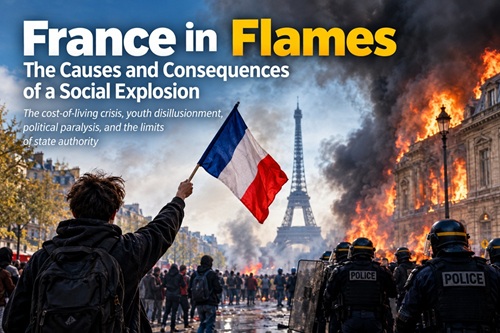
France is once again confronting a crisis that goes beyond the immediate spectacle of burning buildings, looted shops, clashes with riot police, and angry crowds in the streets. The unrest of October 2026 has brought together student protests, opposition to rising living costs, frustration over deteriorating public services, and a more general disillusionment with political leadership. What began as demonstrations over school conditions and teacher shortages has developed into a nationwide confrontation between sections of the population and the state. The scale of the violence is serious. Following the riots of October 17, President Emmanuel Macron appealed for calm, while the government promised to hold those responsible for arson, looting, and attacks on public buildings accountable. Reuters reported on October 18 that hundreds of thousands of people had participated in demonstrations, while the authorities reported thousands of arrests and extensive damage to businesses and public property. The historic town hall in Limoges was badly damaged by fire. Yet the central question is not simply why some demonstrators resorted to violence. It is why France has reached a point at which such large numbers of people are willing to take to the streets, and why the political system appears so poorly equipped to translate their grievances into a credible programme of reform. The answer requires distinguishing three things that are often conflated: the underlying causes of the protests, the behaviour of the people who participated in them, and the political consequences that may follow. 1. The immediate trigger: schools, prices, and public servicesThe present unrest did not emerge from nowhere. According to reporting by Le Monde, the student movement began in mid-September, initially around school conditions, teacher shortages, and educational funding. The protests subsequently broadened as students and other demonstrators connected these complaints to inequality, public spending, and the cost of living. This progression is important. A dispute over education can become a much larger political confrontation when it is interpreted as evidence of a society that no longer offers its younger members convincing prospects for the future. Schools are particularly revealing institutions. They embody the promise that effort, education, and social participation will enable the next generation to build a better life. When students experience overcrowded classrooms, inadequate resources, or a shortage of teachers, that promise becomes less credible. These problems are especially politically sensitive in working-class communities, where public education is an important route to social mobility. Rising living costs intensify the frustration. Even when headline economic indicators suggest relative stability, households can experience a very different reality through rent, food, transport, and energy bills. For people with limited financial reserves, small increases in essential expenses can have substantial consequences. The broader complaint is therefore not merely that individual services are underfunded or particular prices are too high. It is that the relationship between economic effort and a tolerable standard of living appears to be deteriorating. That perception can unite groups whose interests are otherwise quite different: students, teachers, workers, trade unionists, lower-income households, and citizens who feel increasingly disconnected from the political establishment. However, participation in a common protest does not mean that everyone shares the same diagnosis or wants the same solution. A movement can unite around dissatisfaction long before it develops a coherent political programme. 2. The deeper causes: a social contract under strainThe deeper problem is the growing distance between the promises of the French social model and the lived experience of many citizens. France has historically placed considerable emphasis on public services, social protection, workers' rights, and the idea that the state should protect citizens against the insecurities of the market. These institutions remain important, but maintaining them requires resources, effective administration, and political legitimacy. Three tensions are particularly significant. First, the conflict between public expectations and fiscal constraints. France faces persistent difficulties with public finances and elevated government borrowing costs. Reuters reported before the latest demonstrations that French borrowing costs had risen substantially, highlighting the difficulty of reconciling demands for better services with pressure to control public expenditure. The political dilemma is real. Cutting spending can intensify public dissatisfaction, while expanding spending without a credible financing strategy can increase fiscal pressure. But the existence of a fiscal constraint does not determine which services should bear the burden, who should pay more, or whether the distribution of sacrifices is fair. Those are political choices, not merely technical necessities. Second, the problem of perceived inequality. Citizens are more likely to accept hardship when they believe that burdens are distributed fairly and that political institutions respond to their concerns. They become more resentful when they suspect that those with wealth and influence can protect themselves while ordinary households absorb the costs. The Yellow Vest movement of 2018-2019 illustrated this dynamic. What began with anger over fuel taxation expanded into a broader revolt against purchasing-power pressures, perceived metropolitan elitism, and the feeling that national policy was designed without sufficient regard for people outside privileged social circles. The current demonstrations echo that earlier conflict. Reuters describes a convergence of students, trade unionists, and participants associated with the Yellow Vest movement, united by concerns about living costs and the condition of France's social model. Third, declining political trust. When citizens believe that governments respond to demonstrations with police deployments, public-relations statements, and delayed concessions rather than meaningful engagement, the legitimacy of ordinary political channels can weaken. This does not mean that every complaint is justified or that every government decision is wrong. Nor does it mean that distrust automatically leads to violence. It means that a government facing widespread distrust has less room for manoeuvre when a crisis occurs. In such circumstances, an incident involving a school, a police intervention, or an unpopular economic measure can become a symbol of a much larger grievance. 3. Why the protests turned violentAn essential distinction must be made between the mass of demonstrators and the people who engage in rioting, arson, and looting. The protests of October 17 involved hundreds of thousands of participants across France. Many marched peacefully. Violent groups, however, attacked police, damaged businesses, and targeted public buildings. The destruction of the Limoges town hall became one of the most striking examples of the escalation. Why does this happen? Mass demonstrations create situations in which very different motivations coexist. Some participants want specific reforms. Others wish to express general anger. Still others regard confrontation with the police or the destruction of property as a political statement. Criminal opportunists may exploit the disorder for entirely different reasons. A crowd can therefore be politically diverse without possessing a common strategy or even a common understanding of what it is protesting against. The presence of violent groups does not invalidate the grievances of peaceful demonstrators. Equally, the existence of legitimate grievances does not justify violence against uninvolved citizens, shopkeepers, public employees, or emergency workers. There is also a potential escalation mechanism. Confrontational policing, injuries, arrests, and allegations of disproportionate force can deepen hostility toward the state. That hostility can then be used to justify more aggressive demonstrations, prompting further police intervention. France has particular reasons to take this possibility seriously. The authorities have already faced scrutiny over police tactics during the current protests. Earlier in October, the government suspended the use of stun grenades during student protests following an incident in which a teenager lost a hand. This does not establish that police conduct caused the latest riots. It does, however, show why questions about the proportionality of force and the accountability of law enforcement cannot simply be dismissed. The state has a duty to protect public safety. It also has a duty to distinguish peaceful dissent from criminal conduct and to use force proportionately. 4. Macron's dilemma: order without legitimacy?President Emmanuel Macron faces a difficult political predicament. His presidency has become associated with a series of conflicts over economic reform, pensions, public spending, and the responsiveness of government. The present unrest adds another crisis as France approaches its 2027 presidential election. On October 18, Macron condemned the violence while acknowledging that peaceful protesters had legitimate concerns. On October 19, Reuters reported that he had rejected Interior Minister Laurent Nuñez's offer to resign and called for scrutiny of failures in the authorities' preparation for the unrest. The government's immediate challenge is to restore public order. Its longer-term challenge is to restore confidence that political institutions can address the problems underlying the demonstrations. These are related but distinct tasks. A stronger police response may deter looting, protect public buildings, and reassure residents and business owners. Yet it cannot, by itself, remedy inadequate educational provision, household financial pressures, or distrust of political decision-making. Conversely, concessions to demonstrators cannot substitute for enforcing the law. If violence produces the impression that destruction is an effective way to extract political concessions, it can undermine democratic accountability and encourage future escalation. Macron therefore faces a two-sided test: whether the state can restore order without unnecessarily aggravating the social conflict, and whether the government can move beyond condemnation to credible measures addressing public concerns. His decision to reject the interior minister's resignation also has competing interpretations. It can be read as an attempt to maintain continuity during a crisis, but it leaves the government accountable for any shortcomings in intelligence, preparation, and policing. The government's own framing of the unrest as the work of the radical left and criminal groups may describe some participants accurately. But it is not, by itself, a sufficient explanation of why the demonstrations attracted such broad participation. Attributing violence to identifiable groups and explaining the wider social conditions in which violence occurs are different analytical exercises. A government that confuses the two risks treating the visible symptoms while neglecting the underlying problem. 5. The political beneficiaries: left, right, and anti-establishment movementsThe unrest is unfolding against the background of the 2027 presidential election. That gives the events implications beyond public order. Marine Le Pen's National Rally has criticised the government's handling of the crisis and argued for a tougher response to disorder. Jean-Luc Mélenchon's France Unbowed has emphasised the grievances of students and workers while publicly distinguishing political protest from looting and destruction. Both have used the crisis to challenge Macron's leadership, although their proposed remedies differ substantially. The far right can benefit politically when disorder reinforces perceptions that the state has lost control. Images of burning buildings and looted shops can strengthen demands for tougher policing, greater executive authority, and a politics centred on national security. But the left can also gain support if voters interpret the unrest as evidence of economic exclusion, deteriorating public services, or a government that responds more readily to disorder than to social demands. Neither outcome is automatic. Public reaction depends on whether voters primarily blame the government for the conditions that produced the protests, the demonstrators for the destruction, or both. There is also a danger that the political debate becomes polarised into two simplistic narratives. The first portrays the riots as proof that the country needs a much stronger law-and-order response. The second treats the violence as an understandable expression of social desperation. Both contain elements that require examination, but neither is adequate on its own. The first can overlook structural grievances; the second can obscure the agency and responsibility of those who commit violent acts. A functioning democracy must be able to recognise social injustice without romanticising disorder, and defend public order without treating dissent as inherently illegitimate. 6. The European dimensionFrance's crisis has implications for Europe because the underlying pressures are not uniquely French. Across European democracies, governments face demands for affordable housing, reliable public services, better economic prospects for younger generations, and protection against rising living costs. These demands coexist with constraints on public budgets, demographic pressures, economic competition, and geopolitical instability. France is particularly significant because of its tradition of mass mobilisation and the central role of the state in its social model. When the French political system encounters a crisis of legitimacy, the consequences can extend beyond the country itself. The Yellow Vest movement demonstrated how a specific economic grievance can evolve into a broader revolt against political elites. The present protests suggest that this pattern remains relevant, although the immediate circumstances and participating groups differ. There are at least three possible implications for Europe. First, governments may become more reluctant to implement unpopular economic reforms, especially when the distribution of their costs is politically contentious. Second, parties advocating stronger executive authority may gain support by presenting disorder as evidence that existing institutions are ineffective. This could intensify the tension between public security and civil liberties. Third, governments may face increasing pressure to demonstrate that fiscal discipline and social protection can coexist. If voters believe that economic restraint consistently means declining services for ordinary citizens, support for established political parties may weaken. These are plausible political risks, not guaranteed outcomes. The French unrest does not prove that Europe is approaching a general breakdown of democratic government. It does show how economic grievances, institutional distrust, and confrontational politics can reinforce one another. 7. The economic consequences of disorderThe economic costs of the riots are immediate and visible: damaged shops, destroyed public infrastructure, interrupted business activity, emergency policing, and the diversion of municipal resources from other priorities. Reuters reported that numerous businesses had been damaged or looted, with some retailers facing losses in the tens of millions of euros. Local authorities have also had to assess damage to public buildings and arrange emergency assistance. But the indirect costs may matter just as much. Small businesses operating on narrow margins can struggle to recover from a period of closures, vandalism, and lost revenue. Workers may lose income when workplaces are inaccessible. Residents may face disruptions to transport and public services. Municipal budgets must absorb repair costs, insurance complications, and additional security expenses. These effects can fall disproportionately on the very communities in which economic insecurity is already a concern. There is an additional political-economic paradox. A movement that begins by protesting the deterioration of living standards can, through destructive tactics, damage the local economic activity on which those living standards partly depend. That does not mean that economic damage should be used to dismiss the original grievances. It means that the methods employed by a movement can undermine its own objectives and reduce public sympathy for its cause. The government faces a parallel paradox: an excessive reliance on repression can increase the social costs of the crisis, while a failure to protect people and property can weaken confidence in the state. 8. What would a meaningful response look like? France needs both an effective public-order response and a credible political response. One cannot substitute for the other. A serious response would begin by separating the different issues that have converged in the streets. Educational grievances require specific attention to staffing, school conditions, and the distribution of resources. Economic grievances require transparent discussion of living costs, wages, taxation, and the distribution of fiscal burdens. Complaints about policing require independent scrutiny of alleged misconduct, clear operational standards, and accountability where rules have been breached. At the same time, arson, assault, and looting must be investigated through ordinary legal procedures. Responsibility should be established on the basis of evidence rather than collective blame. The political system must also make it possible for citizens to see a connection between expressing grievances and obtaining a serious response. That does not mean every protest demand should be accepted. It means governments must explain their decisions, acknowledge genuine problems, and demonstrate that public participation is not merely a ritual without consequences. There are no easy solutions. Public finances impose real constraints, and different groups disagree about who should bear the costs of reform. But avoiding those choices is itself a political decision, often one that allows dissatisfaction to accumulate. The central test is whether the government can turn a crisis of public order into an opportunity for institutional correction rather than merely a temporary restoration of control. Conclusion: A crisis of authority, trust, and social expectationsThe riots of October 2026 reveal a France in which economic insecurity, dissatisfaction with public services, youth frustration, and distrust of political leadership have converged in an unusually destructive episode of unrest. The violence must be judged on its own terms. Arson and looting harm people who may have little influence over the policies being protested. They can endanger lives, destroy livelihoods, and weaken the legitimacy of a broader movement. Understanding the conditions in which violence emerges is not the same as excusing it. But a purely punitive response would also be inadequate. The fact that violent groups exploited the demonstrations does not explain why hundreds of thousands of people were prepared to march, nor does it resolve the grievances that initially brought students and workers into the streets. France's deeper challenge is to reconcile three demands: economic sustainability, social protection, and democratic legitimacy. These objectives can conflict, but a political system that treats them as mutually exclusive risks making its own difficulties more severe. The coming presidential election will provide a major arena in which these conflicts are contested. It will not, by itself, resolve them. Whether the present crisis strengthens the established political order, benefits anti-establishment parties, or produces a more fragmented electorate will depend on how events develop and how citizens interpret the government's response. The lesson extends beyond France. A democratic state cannot survive on coercive capacity alone, just as a protest movement cannot build a durable political alternative through destruction alone. Public authority requires both the capacity to enforce the law and the credibility to persuade citizens that the system serves legitimate collective purposes. When those two foundations weaken simultaneously, the result is more than a riot. It is a warning that the relationship between society and the state requires urgent repair.
Comment Form is loading comments...
|