|
TRANSLATE THIS ARTICLE
Integral World: Exploring Theories of Everything
An independent forum for a critical discussion of the integral philosophy of Ken Wilber
  Frank Visser, graduated as a psychologist of culture and religion, founded IntegralWorld in 1997. He worked as production manager for various publishing houses and as service manager for various internet companies and lives in Amsterdam. Books: Ken Wilber: Thought as Passion (SUNY, 2003), and The Corona Conspiracy: Combatting Disinformation about the Coronavirus (Kindle, 2020). Frank Visser, graduated as a psychologist of culture and religion, founded IntegralWorld in 1997. He worked as production manager for various publishing houses and as service manager for various internet companies and lives in Amsterdam. Books: Ken Wilber: Thought as Passion (SUNY, 2003), and The Corona Conspiracy: Combatting Disinformation about the Coronavirus (Kindle, 2020).
Check out my other conversations with ChatGPT The Naturalistic Religion SummitVervaeke, Azarian, Dempsey, Hedlund, Wilber - and the Secularism They Want to OutgrowFrank Visser / ChatGPT
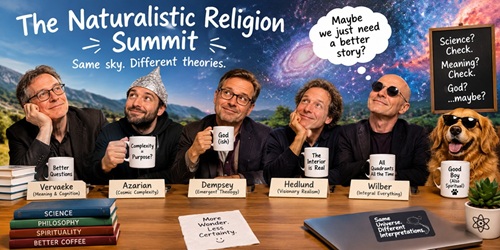 Something rather remarkable is happening in the contemporary search for a response to the “meaning crisis” and the “metacrisis.” A number of otherwise very different thinkers are converging on a similar solution. John Vervaeke wants to recover spirituality without supernaturalism. Bobby Azarian proposes a cosmic worldview of emergence and increasing complexity that can give human life objective significance. Brendan Graham Dempsey wants to reconstruct spirituality after modernity and postmodernity, moving toward a metamodern theology. Nicholas Hedlund proposes a “Visionary Realism” in which interiority becomes an ontologically real dimension of nature and spiritual experience becomes a legitimate domain of inquiry. Ken Wilber has spent decades constructing an integral framework in which evolution, consciousness, development and Spirit are woven into a single cosmic narrative. Their vocabularies differ. Their philosophical commitments differ. Their conclusions differ. But they share a suspicion of the secular settlement. The secular worldview, they suggest, has left modern humanity disenchanted, fragmented, nihilistic, alienated and without a compelling account of why anything matters. And so comes the rescue operation. Not traditional religion. That would be intellectually impossible. Not straightforward secularism. That would supposedly leave us empty. Instead: naturalistic spirituality, metamodern religion, emergent theology, visionary realism, cosmic evolution, integral spirituality, or some other form of religion after religion. This is an intellectually fascinating development. It is also riddled with ambiguities. The central question is simple: Are these thinkers discovering something that secular naturalism cannot explain—or are they rediscovering perfectly natural human capacities and then giving them religious names? That question needs to be asked before we start rebuilding the temple. The Meaning Crisis as a Cultural DiagnosisLet us begin by granting the diagnosis as much as possible. Vervaeke's analysis of the meaning crisis is one of the most sophisticated contemporary attempts to explain why modern people can possess enormous amounts of information while experiencing fragmentation, alienation and loss of significance. He connects meaning to cognition, relevance realization, wisdom and modes of knowing rather than simply complaining that modern people no longer believe in God. Dempsey explicitly builds on this diagnosis. He argues that traditional religion and the modern Progress Myth have both reached their limits, producing a breakdown in collective meaning-making that requires a new spiritual framework. Azarian similarly describes a contemporary crisis of meaning and proposes a new scientific worldview intended to provide purpose and direction. His “paradigm of emergence” is explicitly naturalistic, but he argues that its implications are spiritual because life may have “cosmic significance.” Hedlund's Visionary Realism likewise presents itself as a response to the meaning crisis and larger metacrisis, seeking to combine critical realism, integral theory, radical empiricism and other approaches into an expanded framework for studying interiority and spirituality. So there is clearly a family resemblance. But the first question is whether the meaning crisis is actually a crisis of secularism. That is much less obvious. People can experience meaninglessness under Christianity. They can experience it under Buddhism. They can experience it under Marxism, nationalism, capitalism, existentialism or consumer culture. Conversely, people can experience profound meaning while being secular. The existence of existential distress therefore does not identify its cause. Nor does the disappearance of a traditional worldview demonstrate that a replacement worldview is required. That is the first logical gap in the argument. From Diagnosis to CosmologyA subtle but important transition occurs in these projects. It begins innocently enough: Human beings need meaning. Fair enough. Then: Modern institutions and worldviews often fail to provide adequate meaning. Also plausible. Then: We therefore need a new worldview capable of integrating science, meaning, values and spirituality. Perhaps. But then comes the dangerous leap: The universe itself must therefore possess some structure that grounds meaning, value, development or transcendence. Why? That conclusion does not follow from the premises. The psychological need for meaning does not establish cosmic meaning. The social usefulness of a worldview does not establish its truth. The transformative power of spiritual practices does not establish a spiritual ontology. And the fact that complexity increases in some domains does not establish that the universe as a whole is aiming at complexity. This is where the naturalistic religion project repeatedly becomes ambiguous. The argument begins as psychology, becomes philosophy, then quietly turns into cosmology. Azarian and the Romance of Cosmic ComplexityBobby Azarian is particularly revealing because his project begins with science. His “paradigm of emergence” seeks a unifying worldview based upon the increasing organization and complexity of nature. He argues that life may have cosmic significance because life and intelligence can participate in the universe's further evolution. The resulting worldview, he says, can provide purpose and direction while remaining completely naturalistic. This is an attractive story. It is also precisely where we should slow down. There is an enormous difference between: Complexity emerges in nature and Nature is fundamentally organized toward increasing complexity. The first is an empirical claim about particular physical and biological processes. The second is a claim about the direction of cosmic evolution. And then there is a third proposition: Increasing complexity is objectively valuable. Now we have moved from description to normativity. Azarian's own formulation makes the progression explicit: if biologically based intelligence is a primary driver of cosmic evolution, then life acquires “objective significance” and something resembling a cosmic purpose. But why should complexity be the good? Why should intelligence be the good? Why should cosmic influence be the good? Why should becoming more complex be preferable to becoming simpler? Evolution does not answer these questions. Natural selection explains differential reproduction. Thermodynamics explains energetic constraints. Complex systems theory describes emergent organization. None of these, by themselves, tells us that the universe ought to become more complex. The danger is that an empirical tendency is transformed into a cosmic value. The old teleology has returned wearing a lab coat. Dempsey and the Metamodern GodDempsey's development makes the same issue even clearer. His earlier formulation called for a “new religious imaginary” capable of preserving the motivational and existential strengths of religion while incorporating modern and postmodern insights. That is already a fascinating project. But Dempsey's 2026 DEPTH model goes considerably further. He now proposes a metamodern theology in which God is understood as mutable and immanent but also ontologically real in his own right, while presenting the framework as naturalistic. Here the vocabulary itself becomes the philosophical problem. What does “God” mean if God is naturalistic? If “God” means the universe, then we have pantheism or poetic naturalism. If God means the emergence of increasingly complex forms, then “God” is a name for a process. If God means the highest values toward which humanity aspires, then God is an ideal. If God means an emergent property of complex systems, then God is a scientific hypothesis about emergence. But if God is ontologically real in his own right, we seem to have returned to the old question: What is this entity? What does it do? How could we distinguish its existence from the human concepts, practices and values through which we encounter it? The word “emergent” does not answer these questions. Nor does “participatory.” Nor “immanent.” Nor “developmental.” These words describe a possible conceptual framework. They do not establish the ontology. Vervaeke's More Modest—but More Interesting—ProposalVervaeke may actually have the strongest position precisely because he is less interested in adding cosmic entities. He explicitly describes himself as committed to naturalism and rejects a “fundamental two-worlds mythology.” His distinctive move is to reinterpret spirituality in terms of human cognition, wisdom, transformation and relevance realization. In his account, relevance realization itself can be understood as spiritual because it is fundamental to agency, identity and our relationship with the world. This is considerably more defensible. But then the question becomes: Why call it spiritual? Perhaps because “spiritual” captures dimensions of human existence that conventional scientific language tends to neglect. Fair enough. But then spirituality becomes a vocabulary of human depth, not evidence for a spiritual realm. That distinction should be defended rather than blurred. There is nothing wrong with saying that contemplation changes cognition, that wisdom transforms the agent, that participation differs from detached observation, or that human beings require more than propositional knowledge. But none of this requires us to posit a new metaphysical domain. Vervaeke's naturalism can survive without religion. Indeed, it may become clearer once religion is treated as one historical collection of technologies for achieving the transformations he is interested in. Hedlund and the Ontological InteriorHedlund's Visionary Realism introduces another variation on the same theme. His 2025 paper explicitly argues that interiority should be regarded as an emergent, ontologically real dimension of nature and proposes an “expanded or integrative empiricism” incorporating subjective, intersubjective and objective methodologies. It further speaks of a science of spiritual experience and even the emerging field of “soul studies.” This is an ambitious attempt to take first-person experience seriously. But there is a crucial distinction between the reality of experience and the ontology inferred from experience. Pain is real. Love is real. A mystical experience is real as an experience. The experience of God is real as an experience. The experience of cosmic unity is real as an experience. None of this establishes that the experienced interpretation corresponds to an independently existing metaphysical reality. Science has always had to negotiate this distinction. Dreams are real experiences without the dream landscape being an independently existing geographical location. Hallucinations are real experiences without their objects necessarily existing. Mystical experiences are real experiences without their metaphysical interpretations being automatically validated. An “expanded empiricism” can certainly investigate such experiences. But if it begins by assuming that their contents reveal new ontological domains, the expansion risks becoming a confirmation machine. And Then There Is WilberWilber is the granddaddy of the whole enterprise. Long before “metamodernism,” “metacrisis,” “visionary realism” and “naturalistic theology” became fashionable, Integral Theory was already attempting to reconcile scientific modernity with contemplative spirituality. Its genius was rhetorical as much as philosophical. Instead of asking whether science or spirituality was right, Wilber asked why we could not have both. The answer was a gigantic architecture of developmental stages, quadrants, levels, lines, states, types, perspectives and domains. The attraction is obvious. Nothing has to be thrown away. Science gets its domain. Religion gets its domain. Phenomenology gets its domain. Contemplative experience gets its domain. Development gets its domain. And Spirit somehow gets them all. The problem is that the architecture can become an elaborate way of postponing the decisive question: Which of these things actually exist? Wilber's later “post-metaphysical” vocabulary attempts to avoid old-fashioned metaphysical assertions. But the same metaphysical questions repeatedly return through terms such as Spirit, Eros, evolutionary drive, consciousness and the Kosmos. At some point one has to stop asking whether Spirit can be interpreted from multiple perspectives and simply ask: What explanatory work does Spirit perform? If the answer is none, we do not need it. If the answer is psychological, then psychology can investigate it. If the answer is biological, biology can investigate it. If the answer is cosmological, then cosmology needs evidence. And if the answer is that it is an ultimate metaphysical principle that cannot be independently tested, then we have returned to metaphysics. Calling this “post-metaphysical” does not change the situation. The Great ReversalThere is something historically interesting about all this. Modernity originally challenged religion by demanding that claims about reality be subjected to evidence, argument and public scrutiny. Postmodernity then challenged modernity by exposing its blind spots, exclusions and claims to neutrality. Metamodernism now attempts to synthesize the gains of both while recovering meaning, transcendence and sacredness. So far, so good. But the danger is that the movement can become a great reversal. First we criticize traditional religion for confusing symbolic meaning with literal ontology. Then we criticize modernity for reducing everything to mechanism. Then we criticize postmodernity for dissolving all truth claims into discourse. Finally we reconstruct religion in sophisticated language. The result can be: myth, but with footnotes. God, but emergent. Spirit, but naturalistic. Soul, but ontological. Teleology, but developmental. Cosmic purpose, but complexity-based. Religion, but metamodern. It is an ingenious strategy. But intellectual sophistication does not automatically turn old metaphysical claims into new empirical ones. The Secularism Straw ManUnderlying much of this enterprise is an impoverished picture of secularism. Secularism is routinely associated with materialism, reductionism, disenchantment, nihilism, consumerism and meaninglessness. But these are different things. One can be secular without being a reductionist. One can be naturalistic without being a nihilist. One can reject supernaturalism without believing that human beings are merely machines. One can reject cosmic purpose without lacking purposes. And one can reject God without rejecting goodness. This matters because the naturalistic religion movement sometimes presents itself as rescuing values from a worldview that supposedly cannot accommodate them. But why? Why should naturalism entail nihilism? Why should evolution undermine ethics? Why should neuroscience destroy love? Why should cosmological indifference make human life insignificant? These conclusions do not follow. They are philosophical interpretations layered onto scientific findings. The supposed choice between religion and nihilism is therefore largely manufactured. The Secularism They Should Have DefendedWhat if we rehabilitated secularism instead? Not the caricature of secularism as “nothing but matter.” The richer secularism that emerged from the Enlightenment and its successors. Its central achievement is not the claim that nothing is sacred. It is the refusal to allow any institution, scripture, priesthood or metaphysical system to declare its deepest claims immune from criticism. That principle is extraordinarily valuable. It permits us to investigate consciousness without having to accept souls. It permits us to practice meditation without accepting reincarnation. It permits us to admire religious mythology without believing its cosmology. It permits us to experience awe without turning awe into evidence. It permits us to develop ethical systems without deriving them from divine commandments. And it permits us to say: I don't know. That last capacity may be the most important of all. Meaning Without Cosmic MeaningThe naturalistic-religion project is partly driven by a fear that if the universe has no inherent purpose, human purposes become arbitrary. But this assumes that something is meaningful only if it is meaningful from the perspective of the universe. Why should we accept that standard? My life matters to me. My friendships matter to my friends. My children's lives matter to their parents. Justice matters to those who suffer injustice. Truth matters to those who value understanding. Art matters to those capable of experiencing it. None of these propositions requires the universe to care. The demand for cosmic certification is unnecessary. We do not ask whether Beethoven's Ninth Symphony is objectively important to the Andromeda galaxy. We do not ask whether friendship has cosmic significance before allowing ourselves to love. We do not ask whether kindness increases universal complexity before recognizing that kindness is preferable to cruelty. Human values are not invalid because they are human. The Is-Ought Problem Does Not Disappear by Going CosmicThere is an especially persistent temptation here. Suppose complexity increases. Suppose consciousness emerges from complexity. Suppose intelligence can accelerate complexity. Then perhaps we should promote intelligence, complexity and consciousness. But the final step remains normative. Why ought we to do that? The universe does not answer. Evolution does not answer. Complexity does not answer. Emergence does not answer. This is the old is-ought problem in a futuristic costume. The fact that nature produces something does not establish that the product is morally desirable. Nature produces cancer. Nature produces parasites. Nature produces extinction. Nature produces suffering. Nature produces cooperation as well. Nature does not come with a moral instruction manual. The moment Azarian or anyone else identifies cosmic complexification with objective value, a philosophical bridge must be built. It cannot simply be assumed. The Metacrisis and the Temptation of Total ExplanationThe concept of the metacrisis creates another temptation. Climate change, AI, polarization, ecological degradation, loneliness, geopolitical conflict, institutional distrust and economic instability are enormously different phenomena. Yet metacrisis discourse seeks a deeper common cause in worldview, values, meaning and cultural ontology. Current metacrisis literature explicitly frames modernity's foundational assumptions—including mechanism, separation, individualism and secularism—as underlying cultural conditions of contemporary crises. There is value in looking for systemic patterns. But there is also a danger. Once everything becomes a symptom of the worldview, the theorist's preferred worldview becomes the cure for everything. That is where metatheory starts resembling theology. The world is sick. We know why. We know what the deeper reality is. We know what values have been lost. And fortunately, we possess the conceptual framework capable of restoring them. That structure should make us nervous. The Religion That Dare Not Call Itself ReligionPerhaps the most revealing phrase in this whole movement is Dempsey's earlier description of his project as a “new religious imaginary.” And even more revealing is the description of his emergentist project as “a religion of complexity.” This is refreshingly honest. If what is being proposed is a religion of complexity, then let's discuss it as religion. There is nothing inherently wrong with religion. Religion can provide narrative, community, ritual, ethical formation, existential orientation and symbolic depth. But once we admit that this is what we are doing, the burden changes. We no longer need to pretend that our existential need for meaning proves the metaphysical truth of the worldview satisfying that need. We can build myths knowingly. We can construct rituals consciously. We can create communities voluntarily. We can cultivate awe without pretending that awe has discovered a new cosmic force. And perhaps most importantly, we can distinguish the usefulness of a story from the truth of the story. A Secular AlternativeThe alternative is not sterile scientism. Nor is it the nihilistic caricature sometimes attributed to secularism. It is a mature secular culture capable of appropriating the best things religion has historically done without inheriting its supernatural ontology. We can have contemplation without reincarnation. Community without ecclesiastical authority. Ritual without magic. Sacred language without sacred substances. Awe without cosmic intention. Ethics without divine command. Hope without providence. Mortality without immortality. Meaning without ultimate meaning. And spirituality—if we still want the word—without spirits. This would not be a “religion 3.0.” It would be something more modest and perhaps more difficult: a culture that has learned to live without metaphysical guarantees. Growing Up Rather Than Waking UpThis is where the familiar language of “awakening” deserves some suspicion. There is an implicit promise in much contemporary spirituality that we have forgotten something profound and that the new worldview will allow us to awaken to it. Perhaps. But perhaps modernity did not merely cause us to forget. Perhaps it also taught us something. It taught us that human beings routinely mistake their own projections for features of reality. It taught us that religious experiences occur in many incompatible traditions. It taught us that cosmologies have histories. It taught us that authority can be wrong. It taught us that our intuitions are unreliable. It taught us that powerful experiences do not automatically validate their interpretations. These are not obstacles to spiritual maturity. They may be part of spiritual maturity. Perhaps the next step is therefore not to find a more sophisticated Spirit. Perhaps it is to become sufficiently comfortable with reality that we no longer need Spirit to guarantee that reality is meaningful. The World Does Not Need to Be Re-EnchantedThe rhetoric of “re-enchantment” is seductive. But the world itself may not need re-enchantment. What may need re-enchantment is our relationship with it. There is an enormous difference. A forest does not become more wondrous because we decide that it possesses a spirit. Evolution does not become more magnificent because we decide that it has a cosmic direction. Consciousness does not become more astonishing because we decide that it is fundamental. The stars do not need a purpose before we can look at them in awe. The natural world is already extraordinary. Science did not destroy that fact. Science revealed it. The mistake is to believe that enchantment requires metaphysical inflation. It doesn't. A More Modest MetamodernismThere is therefore a possible metamodernism that does not require a metamodern religion. • It could preserve the modern commitment to evidence. • It could preserve the postmodern awareness of perspective and power. • It could preserve the traditional appreciation of ritual, myth, symbolism and community. • It could preserve contemplative practices. • It could explore developmental psychology. • It could take first-person experience seriously. • It could address ecological and existential concerns. But it would refuse one final temptation: to turn every valuable human experience into evidence for a deeper ontology. That would be a genuine synthesis. Not science plus religion. Not naturalism plus Spirit. Not materialism plus metaphysics. But a culture capable of holding wonder without superstition, meaning without cosmic purpose, morality without divine command, and spirituality without supernaturalism. The Final Secular RevolutionThe naturalistic religion projects are therefore valuable precisely where they are most secular: when they investigate cognition, meaning, transformation, contemplative practice, complexity, emergence, culture and human flourishing. They become problematic when the vocabulary of these investigations is promoted from description to ontology without sufficient evidence. The irony is that the thinkers trying hardest to rescue us from nihilism may be carrying an unnecessary assumption inherited from religion itself: that life can matter only if the universe makes it matter. That assumption should be discarded. The universe does not have to love us. Evolution does not have to be going somewhere. Consciousness does not have to be cosmic. Complexity does not have to be sacred. Spirit does not have to exist. And Eros does not have to be a force. We can still love. We can still wonder. We can still create. We can still pursue truth. We can still cultivate wisdom. We can still build institutions worthy of human beings. We can still care about the future. We can still stand beneath the night sky and experience something very close to the sacred. We simply do not have to lie to ourselves about what that experience proves. Perhaps that is the real post-religious challenge. Not to invent a better God. Not to turn evolution into God. Not to turn complexity into God. Not to turn consciousness into God. But to discover whether human beings are capable of living meaningful lives without God at all. That would not be the triumph of nihilism. It would be the rehabilitation of secularism. And perhaps, finally, its coming of age.
Widget is loading comments...
|