|
TRANSLATE THIS ARTICLE
Integral World: Exploring Theories of Everything
An independent forum for a critical discussion of the integral philosophy of Ken Wilber
  Frank Visser, graduated as a psychologist of culture and religion, founded IntegralWorld in 1997. He worked as production manager for various publishing houses and as service manager for various internet companies and lives in Amsterdam. Books: Ken Wilber: Thought as Passion (SUNY, 2003), and The Corona Conspiracy: Combatting Disinformation about the Coronavirus (Kindle, 2020). Frank Visser, graduated as a psychologist of culture and religion, founded IntegralWorld in 1997. He worked as production manager for various publishing houses and as service manager for various internet companies and lives in Amsterdam. Books: Ken Wilber: Thought as Passion (SUNY, 2003), and The Corona Conspiracy: Combatting Disinformation about the Coronavirus (Kindle, 2020).
Check out my other conversations with ChatGPT The Integral Epistemology CourseA Tour of Knowledge That Never Quite Arrives at a Theory of KnowledgeFrank Visser / ChatGPT
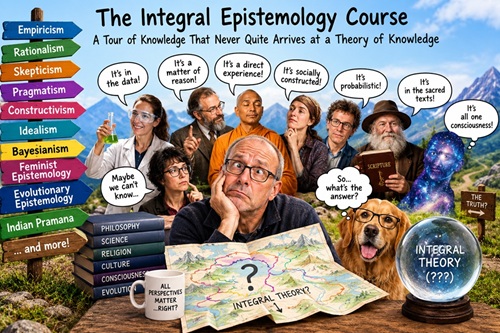
An ambitious curriculum with a conspicuously predetermined destinationIntegral Life's Integral Epistemology, presented by Ken Wilber and Corey deVos in 2021, is an intriguing course because it starts with exactly the right question: How do we know what we know? It surveys empiricism, rationalism, skepticism, pragmatism, naturalized and evolutionary epistemology, feminist epistemology, relativism and constructivism, idealism, Bayesian epistemology, and Indian pramana. The twelfth and final section then asks the inevitable Integral question: How should Integral Theory itself be categorized?
That is an impressive itinerary. But it also reveals the central problem with the course. The course is much better at mapping epistemological positions than at adjudicating between them. It introduces a remarkable variety of ways of knowing, emphasizes that each captures something important, and then proposes that Integral Theory can somehow include them all. But the crucial epistemological work begins precisely where the course tends to stop: when different methods produce incompatible claims about what is actually true. In that respect, Integral Epistemology is less a theory of knowledge than a sophisticated theory of epistemological pluralism. And those are not the same thing. From epistemological crisis to Integral rescueThe course begins with a highly contemporary diagnosis. Social media have fragmented the informational environment, producing epistemic silos and a proliferation of incompatible truth claims. Wilber and deVos connect this with everything from Flat Earth theories to QAnon and describe the situation as an “epistemological crisis.” Their proposed remedy is to become more conscious of the epistemological assumptions and blind spots underlying our various ways of knowing. This is an entirely defensible starting point. Indeed, it may be one of the strongest reasons for teaching epistemology today. People routinely confuse personal conviction with evidence, testimony with expertise, correlation with causation, intuition with perception, coherence with truth, and ideological agreement with confirmation. Learning that different claims require different forms of justification is an important intellectual vaccine against nonsense. But notice what happens next. The course does not primarily ask which epistemological procedures are more reliable under which circumstances. Instead, it moves toward a comprehensive embrace of multiple epistemologies. The stated ambition is to understand the various lenses so that “we can achieve a far more comprehensive and integral view.” That sounds wonderfully inclusive. It also leaves open the hardest question of all: What happens when the lenses disagree? The “everybody is right” problemIntegral Theory famously starts from the intuition that nobody is completely wrong. Integral Life itself presents this as one of the basic ideas of Integral thinking: “no human mind can be 100% wrong,” or, in Wilber's formulation, “everybody is right.” As a charitable principle for intellectual humility, this is excellent. As an epistemological principle, however, it is much more problematic. Suppose an empiricist says that a particular phenomenon has not been demonstrated. A mystic says that it has been directly experienced. A constructivist says that the phenomenon is partly constituted by the interpretive framework. A Bayesian says that the evidence gives the hypothesis a low posterior probability. A traditionalist says that scripture confirms it. A materialist says that there is no evidence for the underlying entity at all. These are not merely different perspectives on the same truth. They can make incompatible truth claims. The epistemological task is therefore not simply to preserve all perspectives. It is to determine which claims survive critical scrutiny. Integral Methodological Pluralism tries to address this problem through its principles of nonexclusion, enfoldment, and enactment. Integral Life describes nonexclusion as accepting valid truth claims from different paradigms, enfoldment as recognizing that some perspectives are more encompassing than others, and enactment as recognizing that different practices disclose different phenomena. This is ingenious. But there is a danger that the framework solves disagreement by changing the meaning of disagreement. Enactment: an ingenious escape route?The most consequential idea here is enactment. If different methodologies disclose different phenomena, then what appears to be a contradiction may instead be the result of using different practices. Change the practice and you may disclose a different reality. explicitly presents the principle in the form: “If you want to know this, do that.” There is something profoundly correct about this. A psychologist, particle physicist, anthropologist and musicologist really do investigate different objects using different procedures. You cannot discover the structure of a symphony with a particle detector, nor discover an electron by interviewing people about their subjective experience. But the principle becomes much more controversial when it moves from different aspects of reality to different realities. A microscope does not create bacteria. A telescope does not create galaxies. A questionnaire does not create personality traits. A particle accelerator does not create quarks merely because quarks become observable through a particular experimental procedure. Scientific instruments and methodologies certainly determine what we can detect. But it does not follow that everything disclosed by a practice has the same ontological status as everything disclosed by every other practice. That distinction is crucial. Otherwise “enactment” can become an epistemological solvent in which almost any disagreement can be dissolved. The curious treatment of empiricismThe course's treatment of empiricism is straightforward: empiricism gives privileged status to experience, especially sensory observation. But empiricism is more than a quaint philosophical school that needs to be supplemented by interior perspectives. Modern science has developed an extraordinarily powerful epistemic system precisely because empirical claims are subjected to public observation, measurement, replication, experimental manipulation, statistical analysis, prediction and correction. That does not make empirical science infallible. It makes it unusually self-correcting. And that is a distinction Integral epistemology should make much more explicit. The important question is not: Is empirical knowledge partial?
Of course it is. The important question is: What kinds of claims does empirical methodology constrain exceptionally well, and what kinds of claims does it constrain poorly?
That question leads toward genuine methodological pluralism without requiring epistemological relativism. The course's strongest inclusion: Bayesian epistemologyInterestingly, Bayesian epistemology may be one of the most useful components of the curriculum because it introduces something often missing from Integral discourse: degrees of rational confidence. The course explains Bayesian epistemology as a formal approach in which beliefs can be represented as subjective probabilities and rational belief revision follows probabilistic norms. This is valuable because it breaks the crude binary between “absolute certainty” and “mere opinion.” We can say: • This hypothesis is possible. • This hypothesis is plausible. • This hypothesis is strongly supported. • This hypothesis is overwhelmingly supported. • This hypothesis has been falsified. That is much closer to how mature inquiry actually works. And Bayesian reasoning immediately exposes a weakness in the Integral “everybody is right” formula. Sometimes one hypothesis simply has vastly more evidential support than another. The existence of multiple perspectives does not imply an equality of probabilities. Constructivism: true, but not in the way Integralists sometimes need itThe course also discusses constructivism, emphasizing that knowledge is constructed rather than simply copied from a neutral external reality. Again, there is an important insight here. Human beings never encounter the world without conceptual, linguistic, biological and cultural mediation. Scientific observations themselves depend upon instruments, concepts, theoretical assumptions and background knowledge. But there is a dangerous slide from: “Our knowledge is constructed” to: “Reality is constructed by our knowing.” The first is almost unavoidable. The second is a much stronger philosophical thesis. A map is constructed. The territory need not be. A scientific theory is constructed. The electron does not thereby become a construction. A cultural category is constructed. The phenomenon being categorized may not be. Integral epistemology sometimes moves too quickly across this distinction. The Kantian shortcutThis becomes particularly visible in the course's opening quotation from Integral Spirituality. Wilber claims that Kant effectively transformed metaphysics by showing that the structures of the knowing subject contribute to the constitution of experienced reality. He then says that ontology “per se just does not exist” and that traditional metaphysics must be abandoned or radically rethought. This is a bold claim—and one that deserves considerably more philosophical qualification than it receives here. Kant did not simply demonstrate that “ontology does not exist.” His critical philosophy complicated the relationship between appearances, things-in-themselves, conceptual structures and knowledge. One may disagree with Kant, reinterpret him, or develop transcendental idealism in different directions, but turning Kant into the philosopher who simply abolished ontology is an enormous simplification. More importantly, Integral Theory subsequently makes plenty of ontological claims. It talks about holons, interiors and exteriors, levels of development, consciousness, Spirit, Eros, states, structures, worldspaces, evolution, involution and Kosmos. So the problem becomes almost paradoxical: Integral Theory declares traditional metaphysics obsolete while continually reconstructing a metaphysics under post-metaphysical terminology. Calling something “enacted,” “worldspace,” “Kosmic address” or “post-metaphysical” does not by itself remove its ontological commitments. The missing lesson from skepticismSkepticism receives its own section, which is appropriate. The course correctly describes skepticism as questioning the possibility of knowledge, whether globally or within particular domains. But skepticism has a more constructive role than merely providing another “partial perspective.” Skepticism is a quality-control mechanism. It asks: • What would count as evidence against this? • How do we know that this experience is veridical? • Could there be an alternative explanation? • Can somebody else reproduce the result? • What biases could generate this conclusion? • What would change my mind? These questions are not simply one epistemology among many. They are procedures for preventing epistemology from becoming self-sealing. This matters enormously when Integral Theory turns toward spiritual experience. If meditation discloses a particular state, that experience is data in a broad phenomenological sense. But the experience alone does not automatically establish the metaphysical interpretation placed upon it. “I experienced unity” is one claim. “There is a universal Self” is another. “Everything is ultimately one consciousness” is another. “The universe itself is conscious” is another. “The universe contains an evolutionary force called Spirit or Eros” is yet another. Each additional inference requires additional justification. That hierarchy of claims is precisely what a rigorous epistemology should make visible. Indian pramana: potentially revolutionary, insufficiently exploitedThe inclusion of Indian pramana is one of the course's most interesting features. The course introduces the idea of valid means of knowledge and notes that different Indian schools accepted different pramanas, including perception, inference, comparison, postulation, non-perception and testimony. This could have been the beginning of a genuinely sophisticated cross-cultural epistemology. Because pramana traditions force precisely the question Integral Theory needs: Which means of knowledge are valid for which objects, under which conditions, and with what limitations? That is much more demanding than simply saying that every perspective contributes something. The Nyaya tradition, for example, was concerned with establishing reliable means of knowledge and distinguishing legitimate inference from defective inference. The Buddhist epistemological traditions developed detailed theories of perception and inference. Jain anekantavada emphasized the partiality of perspectives. These traditions therefore offer Integral Theory more than exotic confirmation of pluralism. They offer epistemic discrimination. And that is where the course could have gone much further. The great omission: no hierarchy of evidential standardsHere, I think, lies the central weakness of the entire course. The curriculum presents a dozen epistemological traditions, but it never seems to establish a sufficiently explicit hierarchy of evidential standards. That is a serious problem because not all knowledge claims are equal. Consider the difference between: • “I feel peaceful after meditation.” • “There is a reproducible psychological effect of meditation.” • “Advanced meditators report experiences of nonduality.” • “Nondual consciousness exists independently of individual brains.” • “Consciousness is fundamental to the universe.” • “Spirit is an evolutionary force.” These statements become progressively more metaphysical. Yet Integral discourse can easily move between them as though they were simply different levels of the same experiential disclosure. They aren't. • The first may require little justification because it is a report about one's own experience. • The second requires empirical investigation. • The third requires careful phenomenological research. • The fourth requires philosophical argument and perhaps empirical evidence. • The fifth is a major metaphysical hypothesis. • The sixth is an extraordinarily ambitious claim about the causal structure of the universe. An epistemology worthy of the name should make those transitions harder, not easier. Integral Methodological Pluralism is better than Integral EpistemologyIronically, Wilber's most defensible contribution may not be his attempt to construct an “Integral epistemology” at all. It may be his attempt to construct an Integral methodology. There is a major difference. We can quite reasonably say: • Use quantitative methods where quantitative questions are being asked. • Use qualitative methods for subjective meaning. • Use phenomenology for first-person experience. • Use social science for cultural and institutional patterns. • Use historical methods for historical questions. • Use mathematics for formal structures. • Use controlled experiments for causal hypotheses. • Use philosophical analysis for conceptual problems. • Use introspective practices to investigate certain features of consciousness. This is genuine methodological pluralism. It does not require the conclusion that every method produces equally authoritative knowledge about every subject. Kurt Koller's work on Integral Science explicitly develops Wilber's injunction-apprehension-consensual-validation framework alongside nonexclusion, enfoldment and enactment. This is potentially useful because it tries to turn the Integral vision into an actual methodology rather than leaving it as a broad philosophy of inclusion. But then the hard work begins: Can these methodologies actually produce convergent, discriminating, testable knowledge? That is the question an Integral epistemology should have to answer. The strange endpoint: “What is Integral Theory?”And then we arrive at Part 12. The course asks whether Integral Theory should be classified as idealism, emergentism, monism, dualism, pluralism—or whether it transcends these categories altogether. This is an excellent question. But it is also where the course conspicuously refuses to deliver its promised conclusion. We are given the twelve perspectives. We are shown their partial truths. We are told they can be integrated. And then we are asked how Integral Theory itself should be categorized. But what exactly is the epistemological argument that makes Integral Theory superior to the alternatives? That is the missing twelfth lesson. • If Integral Theory is simply a pluralistic metatheory, then say so. • If it is a form of critical realism, demonstrate that. • If it is a sophisticated pragmatism, explain why. • If it is a form of transcendental idealism, defend that. • If it is a post-metaphysical reconstruction of metaphysics, show precisely how the reconstruction avoids smuggling metaphysical assumptions back in. • If it claims to transcend all these categories, explain why that is not simply a way of escaping philosophical classification. Integral epistemology and the problem of self-validationThere is an even deeper circularity. Integral Theory says that human beings operate from different perspectives and developmental stages. It then constructs a framework capable of recognizing and integrating those perspectives and stages. But who determines that Integral Theory itself occupies the more comprehensive perspective? The answer cannot simply be: Integral Theory recognizes more perspectives. A map containing more territories is not necessarily a more accurate map. Nor does greater conceptual comprehensiveness automatically produce greater truth. A theory can become infinitely inclusive by adding categories. The decisive question is whether its additional categories increase explanatory and predictive power without increasing ad hoc complexity. This is where Integral Theory needs to meet the philosophy of science much more seriously. What the course gets rightNone of this means that the course is worthless. Quite the contrary. Its greatest virtue is that it refuses to reduce epistemology to science versus religion, or rationalism versus empiricism. It exposes learners to philosophical traditions that genuinely matter. The inclusion of feminist epistemology, Bayesian reasoning, evolutionary epistemology and Indian pramana is especially welcome. It also correctly emphasizes that people carry implicit epistemologies around with them. That is an important pedagogical insight. Most people have strong views about what counts as evidence without ever having examined their assumptions about evidence. And Integral Theory's insistence that different methods disclose different dimensions of complex phenomena is genuinely valuable. The problem begins when this methodological insight becomes an ontological one—or when pluralism becomes a substitute for adjudication. What a better Integral epistemology would look likeA genuinely powerful Integral epistemology would therefore need a second half that this course largely lacks. • It would begin by accepting methodological pluralism. • It would then distinguish experience from interpretation, observation from inference, correlation from causation, coherence from correspondence, possibility from probability, and phenomenological disclosure from ontological explanation. • It would establish different evidential standards for different kinds of claims. • It would explicitly distinguish first-person reports from third-person measurements and second-person/interpersonal validation. • It would ask what constitutes independent confirmation. • It would insist that a spiritual practice can be epistemically legitimate without granting every metaphysical interpretation traditionally attached to that practice. And above all, it would ask the Popperian question: What could prove this wrong? That question is uncomfortable for Integral Theory because some of its central claims are extraordinarily difficult to falsify. If Spirit is defined as an interior dimension of reality, empirical disconfirmation may be declared a category mistake. If different realities are enacted by different practices, contradictory findings can be relocated into different worldspaces. If every perspective contains a partial truth, counterevidence can become another partial truth waiting to be integrated. At that point a theory becomes very difficult to defeat—but also difficult to test. From “everybody is right” to “everybody may have something to contribute”There is a small but crucial reformulation that would greatly strengthen Integral epistemology. Instead of: Everybody is right.
Say: Everybody may have something to contribute, but not every claim is equally justified.
That formulation preserves Integral Theory's openness without sacrificing epistemic discrimination. It also rescues the genuinely valuable intuition behind perspectival pluralism. An astrologer, mystic, physicist, psychoanalyst, feminist theorist and evolutionary biologist may all notice something that another discipline misses. Fine. But their claims do not thereby acquire equal evidential status. The epistemological task is to integrate insights without integrating errors. And that is considerably harder than making room for everybody. The verdictIntegral Epistemology is an excellent introduction to epistemological pluralism, but a less convincing demonstration of an actual Integral theory of knowledge. Its intellectual ambition is admirable. Its range is impressive. Its critique of epistemic fragmentation is timely. Its embrace of multiple methodologies is potentially one of Integral Theory's most defensible contributions. But the course ultimately performs the classic Integral maneuver: it surveys competing positions, identifies something valuable in each, places them inside a larger map, and then treats the larger map as the solution. That is not yet epistemology. It is metatheory. And the difference matters. A map of epistemologies does not automatically tell us which beliefs are true. A framework that tells us that different methods disclose different phenomena does not automatically establish that those phenomena exist in the ontological sense being claimed. And a theory that can accommodate almost every perspective risks becoming so accommodating that it loses the ability to say no. The real test of Integral epistemology, therefore, is not whether it can include empiricism, rationalism, skepticism, pragmatism, constructivism, idealism, Bayesianism and pramana. It plainly can. The real test is whether it can tell us when one of them is wrong. That is where an epistemology earns its name. And that is precisely where the Integral course remains unfinished.
Widget is loading comments...
|