|
TRANSLATE THIS ARTICLE
Integral World: Exploring Theories of Everything
An independent forum for a critical discussion of the integral philosophy of Ken Wilber
  Frank Visser, graduated as a psychologist of culture and religion, founded IntegralWorld in 1997. He worked as production manager for various publishing houses and as service manager for various internet companies and lives in Amsterdam. Books: Ken Wilber: Thought as Passion (SUNY, 2003), and The Corona Conspiracy: Combatting Disinformation about the Coronavirus (Kindle, 2020). Frank Visser, graduated as a psychologist of culture and religion, founded IntegralWorld in 1997. He worked as production manager for various publishing houses and as service manager for various internet companies and lives in Amsterdam. Books: Ken Wilber: Thought as Passion (SUNY, 2003), and The Corona Conspiracy: Combatting Disinformation about the Coronavirus (Kindle, 2020).
Check out my other conversations with ChatGPT Steve McIntosh and the Metaphysics of ProgressA critical examination of integral philosophy's quieter evolutionary prophetFrank Visser / ChatGPT
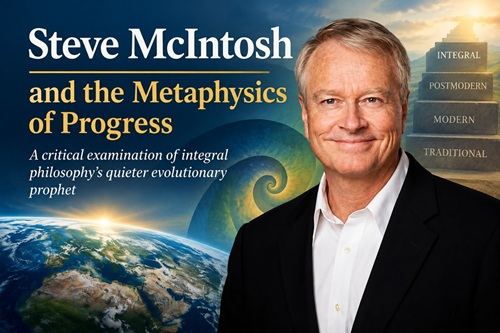 Steve McIntosh occupies an interesting position in the history of integral philosophy. He is neither simply a disciple of Ken Wilber nor a straightforward critic of him. He has criticized important elements of Wilber's AQAL framework, especially its treatment of social systems and developmental lines, while retaining the larger evolutionary architecture in which Wilber's work is embedded. McIntosh has also tried to give integral philosophy something Wilber often leaves frustratingly underdeveloped: a more explicitly philosophical account of value, evolution, progress, culture, and political development. That makes McIntosh worth taking seriously. It also makes him worth criticizing seriously. His central project is ambitious. Evolution, he argues, is not merely a sequence of accidental biological changes. It has generated increasing complexity, consciousness, value and cultural development. The history of humanity consequently exhibits a developmental direction, from traditional to modern to postmodern and ultimately toward an integral worldview. The integral perspective, in turn, can help humanity consciously participate in this evolutionary process. This is a sophisticated version of an ancient philosophical temptation: turn the history of increasing complexity into a history of increasing value, and then turn that history of value into a philosophy of progress. McIntosh's difficulty is that the argument does not quite establish all three steps. The most interesting integral philosopher after Wilber?McIntosh deserves more attention than he usually receives in integral circles because he has attempted something unusual: to move integral theory away from being primarily a giant map of reality and toward being an explicitly philosophical interpretation of evolution. His intellectual lineage is revealing. He places himself in a tradition running through Hegel, Bergson, Whitehead, Teilhard de Chardin, Gebser, Habermas and Wilber. His project is therefore not simply “Wilber plus politics.” It is an attempt to construct a developmental philosophy in which evolution itself becomes the grand organizing principle. His Integral Consciousness and the Future of Evolution presents integralism as a new stage of civilization, while Evolution's Purpose goes deeper into the question that is really driving the entire enterprise: does evolution have a direction and purpose? This is precisely where McIntosh becomes philosophically interesting—and vulnerable. From evolution to progressMcIntosh's basic argument can be reconstructed fairly simply. Evolution produces increasingly complex wholes. Those wholes contain and transcend previous levels. Life emerges from matter, mind from life, and culture from mind. Human culture subsequently develops through increasingly sophisticated value systems. Something important therefore appears to be happening. McIntosh calls attention to the fact that evolution has produced things we ordinarily regard as valuable: consciousness, intelligence, knowledge, cooperation, morality, art, science and increasingly encompassing forms of social organization. From this he develops his account of intrinsic value and instrumental value. Higher-order wholes possess new forms of value because they contain previous capacities while adding new integrative capacities of their own. There is an undeniable philosophical insight here. A universe containing hydrogen atoms is different from one containing galaxies, organisms, nervous systems, language, mathematics, music and moral reflection. Evolutionary history really does exhibit spectacular novelty. But novelty is not automatically progress. That distinction is absolutely crucial. The great evolutionary slideMcIntosh sometimes moves too quickly across three different propositions: Evolution produces novelty. Some evolutionary developments produce greater complexity and capacity. Evolution therefore has an intrinsic direction toward greater value. The first proposition is biological and cosmological description. The second is partly descriptive and partly evaluative. The third is a philosophical thesis. The problem is that the third does not simply follow from the first two. Evolution has produced Mozart and malaria, democracy and genocide, antibiotics and nuclear weapons. It has generated cooperation on astonishing scales and equally astonishing capacities for organized destruction. The appearance of something later in evolutionary history does not establish that it is intrinsically better. Even complexity itself is not an unambiguous measure of value. A parasite can be extraordinarily complex. A cancer can display sophisticated self-organization. A modern weapons system can embody vastly greater informational and technological complexity than an ancient spear without thereby constituting moral progress. McIntosh knows this problem exists. His argument is not the crude claim that everything later is automatically better. He distinguishes healthy from pathological development and repeatedly emphasizes the need to preserve valuable elements from earlier stages while overcoming their limitations. But the fundamental problem remains: Where does the criterion of “better” come from? Beauty, truth and goodness enter the pictureMcIntosh's answer is his famous triad of beauty, truth and goodness. These are not merely convenient categories. He treats them as the primary values toward which evolution tends. They function as “compass headings” for evolutionary development: truth associated with cognition, goodness with ethical relations, and beauty with aesthetic experience. This is philosophically attractive. It also has a distinguished pedigree. McIntosh is not inventing an arbitrary three-part scheme. The relation among truth, goodness and beauty reaches deep into Western philosophy, and related distinctions appear in many traditions. But McIntosh wants to make the triad do considerably more work. He wants beauty, truth and goodness to illuminate not merely human ideals but the direction of evolution itself. That is a much larger claim. There is an important difference between saying: Human beings value truth, beauty and goodness.
and saying: Evolution itself is moving toward increasingly comprehensive realizations of truth, beauty and goodness.
The first is easily defensible. The second requires an argument about nature. And here McIntosh begins to approach the same territory occupied by Wilber's Eros. The secularized Spirit problemMcIntosh's language is often considerably more philosophically respectable than Wilber's talk of Spirit pushing evolution from within. But structurally the two approaches remain surprisingly close. Wilber explains increasing evolutionary development through Eros, Spirit-in-action or some intrinsic evolutionary drive. McIntosh is more careful. He speaks about intrinsic value, emergence, dialectical development and the directions of evolution. He draws heavily upon Whitehead and Teilhard and attempts to avoid crude supernatural intervention. Yet one can still ask: What makes value causally or teleologically operative in evolution? If beauty, truth and goodness merely describe values that human beings discover and cultivate, then they do not explain why evolution proceeds in their direction. If they exist objectively in reality and somehow guide evolutionary development, then McIntosh has introduced a metaphysical principle requiring substantial justification. And if the answer is simply that evolutionary history itself reveals this direction, the argument risks becoming circular: Evolution produces increasingly valuable things because evolution is progressive; we know evolution is progressive because it has produced increasingly valuable things. That is not yet an explanation. The “physics” of the interiorOne of McIntosh's more revealing concepts is his notion of the “internal universe.” He proposes that culture and consciousness possess structures that can be studied somewhat analogously to structures in the natural sciences. His “noosphere” theory describes human relationships and cultural value systems as self-organizing systems that metabolize information, meaning and value. This is imaginative and potentially fruitful. But metaphors can acquire ontological ambitions surprisingly quickly. Calling cultural systems “organisms,” values “food,” and meaning “metabolized energy” can illuminate certain patterns. It does not demonstrate that cultural systems literally possess an internal physics. McIntosh occasionally comes remarkably close to that stronger claim. He describes developmental stages as having an “ontological reality” and as existing independently of any particular person's thinking about them. This is where integral philosophy's favorite move appears again: a useful conceptual model becomes an ontological discovery. The question is not whether developmental stages are useful concepts. They clearly can be. The question is what kind of things they actually are. Is “modernism” an entity? Is “postmodernism” an organism? Does “integral consciousness” exist in the same sense that a human brain, an ecosystem or a molecule exists? Or are these historically useful abstractions imposed upon complicated distributions of people, practices, institutions and ideas? McIntosh needs a much sharper answer. The spiral becomes history's ladderThe problem becomes particularly acute with McIntosh's interpretation of cultural stages. Traditionalism gives way to modernism. Modernism generates postmodernism. Postmodernism generates integralism. McIntosh explicitly describes integral consciousness as a new historically significant stage and compares its emergence to the emergence of modernism during the Enlightenment. This is the familiar integral developmental narrative. And it is undeniably seductive. It explains why history seems to move. It explains cultural conflict. It explains why traditionalists, modernists, postmodernists and integralists often talk past one another. It provides a vocabulary for distinguishing genuine development from simple political disagreement. But it also creates a dangerous intellectual convenience. If you identify yourself with the developmental stage that supposedly transcends and includes the others, you have acquired a ready-made explanation for disagreement. The traditionalist is “earlier.” The modernist is “partial.” The postmodernist has discovered important truths but remains trapped in fragmentation. The integralist understands all of them. This is a magnificent position from which to lose an argument. The transcend-and-include problemMcIntosh is at his most compelling when he argues that earlier cultural forms should not simply be discarded. His “cultural ecosystem” idea is genuinely useful: traditional, modern and postmodern cultures each contain enduring contributions, while each also has characteristic pathologies. Integral development supposedly preserves their healthy contributions while overcoming their limitations. But “transcend and include” can become suspiciously unfalsifiable. Whenever a lower stage contains something valuable, the integral stage supposedly includes it. Whenever the lower stage contains something problematic, the integral stage supposedly transcends it. Thus the integral stage can win every comparison by definition. If traditionalism has community, integralism includes community. If modernism has rationality, integralism includes rationality. If postmodernism has pluralism, integralism includes pluralism. And if any of these stages criticizes integralism, the criticism can itself be interpreted as evidence of the critic's developmental location. That is an epistemological trap. A theory that can incorporate every criticism risks becoming a theory that cannot genuinely be criticized from within its own terms. McIntosh against Wilber—and still inside Wilber's houseMcIntosh's relationship to Wilber is therefore particularly interesting. He is not a passive Wilberite. He has explicitly criticized Wilber's treatment of developmental lines and argued that values/worldviews have a more organizing role than Wilber's “one line among many” model acknowledges. Integral Review He also challenged Wilber's four-quadrant model over the treatment of artifacts and the interobjective domain. McIntosh's critique was substantial enough to generate a published exchange with Mark Edwards, who argued that McIntosh's critique was not supported by metatheoretical evidence. McIntosh subsequently defended and clarified his position. This is one of the better features of his work. McIntosh is willing to criticize his intellectual mentor. But notice the larger picture. He criticizes parts of the map while retaining the developmental cartography. The basic integral commitments remain: developmental stages, holarchical emergence, interior evolution, cultural evolution, increasing integration, evolutionary progress, and an emerging integral stage. In other words, McIntosh's criticism of Wilber is often an intra-integral criticism. He wants to repair the machine rather than dismantle it. Where McIntosh is actually stronger than WilberThis should not be overlooked. McIntosh has several virtues that make his work considerably more interesting than caricatures of “integral philosophy” might suggest. First, he takes philosophy seriously. He engages Hegel, Bergson, Whitehead, Teilhard, Gebser and Habermas rather than treating integral theory as something that began with Wilber. Second, he tries to give integralism a coherent theory of value rather than simply asserting that consciousness evolves. Third, his political thinking is considerably more nuanced than a simplistic left/right scheme. He has explicitly tried to combine progressive concern for social justice with appreciation of individual and economic freedoms. Fourth, he recognizes that developmental categories should not simply become excuses for rejecting earlier cultures. His insistence on preserving genuine achievements from traditionalism, modernism and postmodernism is one of the more useful aspects of his work. And fifth, unlike some integral theorists, McIntosh has actually been willing to criticize Wilber's theoretical machinery. These are significant strengths. But is integral philosophy actually a science of culture?Here the skepticism needs to become sharper. McIntosh repeatedly invokes developmental psychology, sociology, systems theory and evolutionary science. He is careful to distinguish cultural evolution from biological evolution. Yet the argument frequently moves from empirical developmental research to a much larger philosophical structure. Research may show that people exhibit different patterns of values. It may show correlations between education, economic conditions, psychological development and political attitudes. It may even support certain developmental sequences under particular conditions. But none of this automatically demonstrates that humanity as a whole is traveling through a universal evolutionary sequence toward integral consciousness. That is a much stronger thesis. The historical record is also considerably messier than the spiral metaphor suggests. Modernity did not simply replace tradition. Traditional institutions survive inside modern societies. Postmodern sensibilities coexist with highly traditional religious movements. Modern science flourishes alongside myth. Liberal democracy can coexist with authoritarian political culture. Individuals routinely combine values that the developmental model would prefer to place at different stages. History looks less like a staircase than a tangled ecosystem. McIntosh knows this to some degree. His own “cultural ecosystem” metaphor implicitly acknowledges it. But the staircase keeps returning. The problem of calling the future in advanceThere is an even deeper difficulty. McIntosh describes integral consciousness as an emerging stage of cultural evolution. He argues that it provides a new capacity to integrate previous value systems and offers the kind of consciousness required to address global problems. This produces a peculiar situation. Integral philosophers are simultaneously: describing a new historical development and advocating that people adopt it. Those are different activities. If integral consciousness is an empirical historical phenomenon, it should be possible to identify it independently and measure its emergence without first defining it philosophically. If it is a normative ideal, then its superiority must be argued philosophically. If it is both, the two claims need to be kept rigorously separate. Otherwise the existence of integral thinkers becomes evidence that integral consciousness is emerging, while the emergence of integral consciousness becomes evidence that integral thinkers represent a new evolutionary stage. Again, the theory risks becoming self-confirming. From “is” to “ought” to “will”There are really three claims embedded in McIntosh's evolutionary philosophy: Evolution is moving in a particular direction. That direction is objectively valuable. Humanity should consciously participate in it. The first is a scientific or metaphysical proposition. The second is a philosophical proposition. The third is an ethical and political proposition. McIntosh sometimes moves between these levels so smoothly that the transitions disappear. But they are precisely where the argument needs the most scrutiny. Even if evolution had a direction, it would not automatically follow that humans ought to assist it. Even if increasing complexity were valuable, it would not automatically tell us what political institutions we should build. And even if integral consciousness were demonstrably emerging, its emergence would not establish its moral superiority. Nature does not hand us an ethics simply by being evolutionary. That is the old naturalistic fallacy in a remarkably sophisticated new costume. The quiet metaphysics of McIntoshPerhaps the fairest way to understand McIntosh is therefore not as a pseudo-scientist, nor as merely another Wilber disciple, but as a metaphysician attempting to derive spiritual meaning from the evolutionary history of the universe. That is a respectable philosophical project. Indeed, it is one of the oldest. The difficulty begins when the metaphysical interpretation is presented as though it were already contained in the scientific description. McIntosh says that the evolutionary story carries an “unmistakably spiritual message” and that evolution's generation of value reveals its purpose. But evolution does not come with subtitles. The universe gives us stars, chemistry, organisms, nervous systems, minds and cultures. Human beings then interpret this extraordinary sequence. One interpretation is that evolution is spiritually purposive. Another is that evolutionary processes generate increasing complexity under certain conditions without having an ultimate purpose. Another is that “purpose” emerges only when conscious organisms begin pursuing purposes. The scientific evidence by itself does not select among these metaphysical interpretations. That is precisely why the distinction matters. A more modest McIntosh would be more convincingThere is, however, a potentially much stronger version of McIntosh's philosophy hiding inside his existing work. It would begin by abandoning the claim that evolution literally aims at beauty, truth and goodness. Instead, one could say: Evolution has produced beings capable of recognizing values. Human cultural evolution has generated increasingly sophisticated systems for negotiating competing values. Some historical developments demonstrably expand human capabilities, knowledge, freedom, inclusion and cooperation. Those developments can reasonably be called progress relative to defensible human values. Integral philosophy can then function as a normative framework for thinking about how different value systems can coexist and develop, rather than as a metaphysical theory of the universe's hidden intentions. That would be a considerably more modest claim. It would also be considerably harder to dismiss. The paradox of the integral philosopherMcIntosh's work therefore contains an interesting paradox. He wants to rescue evolution from reductionism without falling into supernaturalism. He wants to rescue values from relativism without making them crude absolutes. He wants to rescue progress from naïve triumphalism without abandoning developmental hierarchy. He wants to criticize Wilber without abandoning integral theory. And he wants to describe the emergence of integral consciousness without simply declaring integralists to be the winners of history. These are difficult balancing acts. Sometimes he succeeds. Sometimes the philosophical ambition outruns the evidence. His greatest weakness is not that he believes in evolution, consciousness, values or progress. Those are perfectly legitimate subjects for philosophy. It is that he sometimes appears to move too effortlessly from the fact that evolution has produced value-bearing complexity to the thesis that evolution itself is value-directed. That is the decisive leap. The real contribution of Steve McIntoshMcIntosh is consequently more interesting than either his admirers or his critics sometimes allow. He represents an attempt to make integral philosophy philosophically respectable by giving it a theory of value, cultural development and evolutionary meaning. He also demonstrates that integral theory need not simply be a repetition of Wilber's AQAL system. His criticisms of Wilber show that there is room for serious internal debate within the integral tradition. But the philosophical price of his project is high. Once evolution becomes a story of increasing value, the question immediately arises: who gets to define value, and how do we know that history is actually moving toward it? Once cultural stages become real structures, we need evidence that these structures exist independently of the theoretical scheme used to describe them. Once integral consciousness becomes the next stage of evolution, we need independent criteria for recognizing it. And once beauty, truth and goodness become the “directions of evolution,” we need an account of how normative ideals become evolutionary forces rather than merely human interpretations of evolutionary history. Until those questions are answered, McIntosh's evolutionary philosophy remains what it is at its most compelling and at its most problematic: a beautiful philosophical interpretation of evolution masquerading, at times, as an explanation of evolution. And that may be the deepest irony of the integral project. Its ambition is to transcend the old opposition between science and spirituality. Yet whenever it infers cosmic purpose from evolutionary development, it risks recreating the very metaphysical shortcut that modern science taught us to distrust. McIntosh has made that shortcut considerably more sophisticated than Wilber's Eros. He has not yet made it disappear.
Widget is loading comments...
|