|
TRANSLATE THIS ARTICLE
Integral World: Exploring Theories of Everything
An independent forum for a critical discussion of the integral philosophy of Ken Wilber
  Frank Visser, graduated as a psychologist of culture and religion, founded IntegralWorld in 1997. He worked as production manager for various publishing houses and as service manager for various internet companies and lives in Amsterdam. Books: Ken Wilber: Thought as Passion (SUNY, 2003), and The Corona Conspiracy: Combatting Disinformation about the Coronavirus (Kindle, 2020). Frank Visser, graduated as a psychologist of culture and religion, founded IntegralWorld in 1997. He worked as production manager for various publishing houses and as service manager for various internet companies and lives in Amsterdam. Books: Ken Wilber: Thought as Passion (SUNY, 2003), and The Corona Conspiracy: Combatting Disinformation about the Coronavirus (Kindle, 2020).
Check out my other conversations with ChatGPT Jordan Peterson and the Problem of MeaningThe Psychologist Who Became a ProphetFrank Visser / ChatGPT
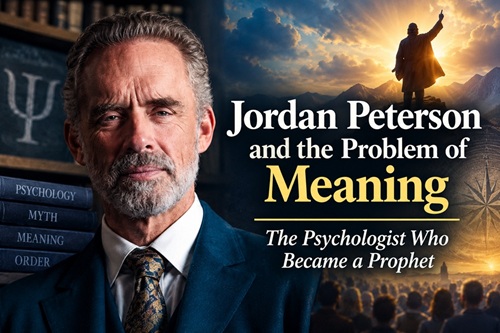 Jordan Peterson is an unusual intellectual phenomenon. He began his public career as a clinical psychologist and professor, became widely known through lectures on personality, mythology, religion, and self-discipline, and then transformed into a cultural critic whose interventions reach far beyond psychology. His appeal is not difficult to understand. Peterson speaks to people who feel that the contemporary world has become morally confused, institutionally unreliable, and psychologically disorienting. He offers an old-fashioned message in contemporary language: take responsibility, tell the truth, put your own house in order, accept suffering as part of life, and find something worth serving. There is considerable value in that message. But Peterson's intellectual project becomes much less convincing when he moves from psychological usefulness to claims about the structure of reality, from mythology to evolutionary biology, and from legitimate criticism of ideological excesses to sweeping political and cultural diagnoses. His great strength is as a synthesizer of psychologically resonant stories. His weakness is his tendency to treat resonance as evidence. The result is a curious mixture: valuable psychological advice embedded in an increasingly elaborate metaphysical and cultural narrative. The appeal of responsibilityPeterson's most successful idea is also his simplest: responsibility matters. His 12 Rules for Life became popular partly because it addressed a genuine psychological need. Modern Western societies have become extremely sophisticated at explaining why people are unhappy. We can identify childhood trauma, social inequality, discrimination, dysfunctional institutions, economic insecurity, family breakdown, addiction, loneliness, and countless other contributing factors. These explanations can be valid. But explanation can quietly become exemption. If every difficulty is primarily somebody else's responsibility, personal agency begins to disappear. Peterson pushes in the opposite direction. Clean your room. Stand up straight. Make a plan. Keep promises. Tell the truth. Accept responsibility for what lies within your control. Help someone who is worse off than you. None of this requires Peterson's more controversial theories. It belongs to a much older tradition of practical wisdom, extending from Aristotle and the Stoics to modern psychotherapy. Indeed, Peterson's psychological advice is strongest when it remains close to this modest level. The difficulty begins when this practical wisdom is presented as if it had been scientifically demonstrated as part of a comprehensive theory of reality. From psychology to mythologyPeterson's intellectual world is heavily populated by myths, especially biblical stories. He reads these stories psychologically, symbolically, evolutionarily, and existentially. Adam and Eve, the serpent, the Fall, Cain and Abel, Noah, Abraham, Christ, and the hero's journey become representations of fundamental patterns of human existence. There is something legitimate here. Myths can indeed encode psychological insights. Stories can function as compressed models of recurrent human problems: temptation, sacrifice, betrayal, responsibility, death, renewal, chaos and order. But Peterson frequently slides between different meanings of "true." A story can be psychologically true without being historically true. It can be culturally influential without being metaphysically true. It can embody an enduring human pattern without revealing the ultimate structure of the cosmos. These distinctions are crucial. Peterson's interpretations become problematic when the symbolic power of a myth is treated as evidence for the objective reality of the metaphysical worldview associated with it. The biblical story of the Fall, for example, can be read as a profound meditation on self-consciousness, mortality, shame, sexuality and responsibility. But demonstrating that it captures important features of human psychology does not demonstrate that Christianity provides the ultimate explanation of existence. Peterson sometimes appears to want to have it both ways. Religious stories are treated neither simply as primitive historical accounts nor merely as human inventions. Instead, they acquire an ambiguous ontological status: they are "true" because humanity has discovered them through an evolutionary and cultural process. But that leaves unanswered the most important question: true in what sense? The evolutionary argumentPeterson's evolutionary psychology is one of the most interesting and problematic aspects of his work. He is right about something fundamental. Human beings are biological organisms whose minds have been shaped by evolutionary history. We did not invent our basic emotional architecture from scratch. Competition, cooperation, status, attachment, aggression, parental investment, sexual selection and threat detection have deep evolutionary roots. But evolutionary explanation is notoriously easy to overextend. A behavior's evolutionary usefulness does not automatically explain its present psychological meaning. Nor does the existence of a recurring behavioral pattern establish a particular moral conclusion. Evolution explains how traits can arise and persist; it does not by itself tell us what we ought to value. Peterson sometimes moves rapidly across these levels. A psychological pattern becomes evolutionary; the evolutionary pattern becomes archetypal; the archetype becomes mythological; the mythological pattern becomes metaphysical; and finally the metaphysical interpretation returns as a prescription for how society should be organized. That is an impressive conceptual journey, but each transition requires an argument. Too often the argument is replaced by an accumulation of suggestive parallels. Lobsters, dominance and the danger of simple storiesOne of Peterson's most famous examples concerns the relationship between hierarchy and serotonin, illustrated through lobsters. Lobsters have ancient nervous systems and establish dominance hierarchies. Their neurochemistry changes depending on their position in those hierarchies. The basic biological observation is interesting. The conclusion sometimes drawn from it is not. Human social hierarchies are not simply lobster hierarchies enlarged to human proportions. Human beings possess language, institutions, symbolic culture, law, technology, moral reasoning and extraordinarily complex forms of cooperation. A human hierarchy can be based on wealth, physical strength, knowledge, hereditary privilege, democratic election, professional competence, charisma or coercion. These are not interchangeable phenomena. The lobster analogy therefore works well as a provocative reminder that status has biological dimensions. It works much less well as a general explanation of human society. This illustrates a recurring problem in Peterson's thinking: a useful analogy becomes a theoretical bridge. Order and chaosPerhaps Peterson's most characteristic conceptual pair is order and chaos. Order represents the known, structured and predictable world. Chaos represents the unknown, the unpredictable and the potentially transformative. A healthy person must inhabit the border between them. Too much order produces rigidity; too much chaos produces disintegration. As a psychological metaphor, this is powerful. It resembles ideas found throughout psychology, mythology and philosophy. Human beings need stability but also adaptation. We need habits but must respond to novelty. We need identity but must remain capable of revision. The trouble is that Peterson sometimes treats this polarity as if it were a fundamental architecture of reality. Here again the metaphor begins doing more work than the evidence warrants. There is nothing wrong with using "chaos" and "order" as conceptual categories. The problem arises when metaphorical categories are allowed to masquerade as scientific ones. Physics already has a precise technical vocabulary for chaos, entropy, complexity, equilibrium and nonequilibrium dynamics. Peterson's use of "chaos" belongs largely to mythology and psychology, not to mathematical chaos theory. The distinction matters because scientific terminology can lend an argument an authority it has not actually earned. Jung enters the pictureCarl Jung provides Peterson with much of the architecture of his symbolic psychology. Archetypes, the shadow, individuation, the collective unconscious and the symbolic interpretation of dreams all play major roles. Jung remains intellectually fascinating. But fascination should not be confused with empirical confirmation. The scientific status of Jung's archetypal psychology is controversial. The collective unconscious, in particular, is difficult to operationalize and test in the way contemporary empirical psychology normally demands. One can use archetypes as interpretive concepts without believing that they constitute scientifically demonstrated structures of the human mind. Peterson frequently combines Jung with evolutionary psychology and neuroscience. The resulting synthesis is intellectually attractive because it appears to connect ancient myth, animal behavior, brain science and clinical psychology. But the existence of meaningful connections between these domains does not establish Peterson's particular synthesis as a scientific theory. There is a danger here of what might be called explanatory over-unification: because several things resemble one another, they are assumed to have the same underlying cause. The Bible as a psychological master textPeterson's increasing emphasis on Christianity is especially revealing. His biblical lectures often contain genuinely perceptive observations. He takes the stories seriously rather than treating them as embarrassing relics of a pre-scientific age. He asks what these narratives might say about suffering, responsibility, sacrifice and moral transformation. But he also increasingly treats the biblical tradition as though it were the culmination of an immense evolutionary process of cultural discovery. This produces an intriguing but circular argument. Human beings have survived partly because certain stories and behavioral patterns were adaptive. Christianity contains these patterns. Christianity therefore expresses profound truths about human existence. The persistence of Christianity then becomes evidence of the truth of the patterns it contains. But survival is not truth. False beliefs can survive. Harmful beliefs can survive. Useful beliefs can be partly false. Different civilizations have independently generated profound moral and psychological insights without converging on a single religious system. Cultural longevity is evidence of cultural significance. It is not, by itself, evidence of metaphysical correctness. The problem of "what works"Peterson sometimes seems to adopt a pragmatic criterion of truth: if a belief helps people orient themselves toward life, responsibility and meaning, then it possesses a kind of truth. There is something sensible in this. Beliefs are not merely propositions sitting in an abstract logical space. They affect behavior. They organize attention. They shape institutions and relationships. But usefulness and truth remain distinct. The placebo effect demonstrates that beliefs can have consequences without being literally true. Political myths can unite societies without describing history accurately. Religious rituals can provide meaning without settling metaphysical questions. A belief can therefore be existentially useful and factually false. This distinction is particularly important when discussing religion. The fact that Christianity can provide a powerful framework for confronting suffering does not establish the resurrection as a historical event. The fact that prayer can produce psychological benefits does not demonstrate supernatural intervention. Peterson's intellectual project would become considerably stronger if it maintained this distinction more consistently. From cultural criticism to culture warPeterson's transformation from psychologist to public intellectual has also changed his rhetoric. His early message was predominantly therapeutic: take responsibility, confront your problems, develop competence, tell the truth. His later message increasingly became political and cultural: universities are captured by ideology; progressive movements are driven by pathological resentment; gender politics threatens civilization; climate activism is irrational; Western culture is under existential attack. Some of these criticisms deserve serious discussion. Universities can indeed become ideologically homogeneous. Activist movements can become dogmatic. Political correctness can suppress legitimate disagreement. Identity politics can encourage tribalism. Institutions deserve criticism regardless of which ideological faction controls them. But Peterson's rhetoric sometimes turns legitimate criticism into civilizational diagnosis. The modern West is not simply divided between courageous truth-tellers and ideological authoritarians. Political reality is considerably messier. There are authoritarian tendencies on the right as well as the left. There are genuine injustices alongside exaggerated claims of injustice. There are rational environmental concerns alongside apocalyptic rhetoric. There are legitimate concerns about gender ideology alongside legitimate concerns about discrimination. A serious cultural critic should resist the temptation to transform a complicated political landscape into a morality play. Ironically, Peterson's own mythological framework makes him particularly vulnerable to doing exactly that. The culture-war paradoxThere is an interesting paradox in Peterson's career. He warns against ideological possession, tribal thinking and resentment. Yet his public persona has increasingly been incorporated into precisely the kind of polarized political identity system he criticizes. He has become a symbol. For some people, "Jordan Peterson" represents courage, free speech and resistance to progressive ideology. For others, he represents reactionary politics, anti-feminism and intellectual overreach. Once an intellectual becomes a cultural symbol, subtle arguments become difficult. Every statement is interpreted as evidence for one side or the other. Peterson himself has contributed to this process. His rhetoric can be deliberately provocative, and provocation is an effective way of gaining attention. But attention has a cost. The more one speaks as a combatant in a cultural war, the harder it becomes to preserve the epistemic humility expected of a scientist. His treatment of sciencePeterson has an ambivalent relationship with science. He clearly respects scientific knowledge and frequently invokes neuroscience, evolutionary biology, psychology and physics. But he also distrusts the reduction of human existence to scientific description. That tension is legitimate. Science does not by itself answer every existential question. Knowing the neural correlates of love does not make love meaningless. Explaining the evolutionary origins of morality does not tell us whether a particular moral principle is justified. The mistake is to infer that because science cannot answer every question, mythological or metaphysical speculation therefore receives a scientific warrant. It does not. There is a middle position between scientistic reductionism and metaphysical inflation: scientific naturalism combined with philosophical reflection. One can acknowledge that humans are biological organisms while recognizing that persons also exist at psychological, social, linguistic and cultural levels. Peterson's best work occasionally approaches this position. His weaker work attempts to turn the hierarchy of explanatory levels into a grand metaphysical system. Peterson and meaningPerhaps the deepest question underneath Peterson's popularity is the problem of meaning. Modern secular societies have become remarkably good at explaining mechanisms. We know more about the brain, genes, evolution, cosmology and social systems than any previous generation. But explanation does not automatically produce orientation. A scientific description of the universe does not tell an individual what to do on Monday morning when his marriage is collapsing, his career has failed, or someone he loves has died. Peterson correctly identifies this gap. But there is no necessity to fill it with metaphysics. Meaning can be constructed from relationships, projects, knowledge, creativity, friendship, love, family, community, intellectual curiosity, moral commitments and participation in the world. None of these requires an invisible cosmic hierarchy. Indeed, one might argue that the challenge of secular meaning is more interesting than Peterson's partial retreat into religious symbolism. If the universe does not guarantee that our lives have meaning, then the task of creating and sustaining meaning becomes ours. That is not necessarily nihilism. It may be maturity. The existential strength of Peterson's messageThis is why dismissing Peterson altogether would be a mistake. His strongest contribution is not his theory of archetypes, his evolutionary mythology, his political commentary, or his increasingly elaborate interpretation of Christianity. It is his insistence that human beings have agency. You cannot control everything that happens to you. You can, however, influence how you respond. You can become more competent. You can become more honest. You can take responsibility for your relationships. You can confront your limitations rather than endlessly blaming the world. These are psychologically serious propositions. They also contain an important corrective to a culture in which victimhood can sometimes become an identity rather than a temporary condition. But responsibility must not become an excuse for ignoring structural conditions. Poverty, discrimination, illness, childhood abuse, war, economic insecurity and institutional dysfunction are not solved simply by telling individuals to "take responsibility." A mature philosophy needs both agency and context. The danger of the grand synthesisPeterson's greatest intellectual temptation is synthesis. He wants to connect neuroscience with mythology, evolutionary biology with Jung, biblical symbolism with clinical psychology, animal hierarchies with human society, individual development with cultural evolution, and personal responsibility with civilizational order. The ambition is admirable. But synthesis is not explanation. To connect two domains intellectually, one must establish the mechanisms by which they are connected. Similarity, analogy, metaphor and narrative resonance can generate hypotheses, but they do not establish them. This is where Peterson's rhetoric can become more convincing than his evidence. He is an extraordinarily gifted lecturer. He can make a connection feel profound before it has been demonstrated. His listeners can experience the coherence of the narrative itself as evidence for the narrative. That is precisely where critical thinking becomes necessary. A psychologist who became a prophetThere is an almost archetypal irony in Peterson's career. The clinical psychologist who warned people against ideological possession gradually became a prophet-like figure for millions of people searching for an alternative worldview. He began by telling individuals to put their lives in order. He ended up offering an account of civilization, religion, evolution, politics, masculinity, femininity, mythology and the future of the West. The transition is understandable. Once people discover that a thinker can help them personally, they naturally ask that thinker what the world as a whole means. But competence in one domain does not automatically transfer to another. A psychologist may offer valuable advice about depression without thereby becoming an authority on climate science. A scholar of mythology may illuminate the Bible without thereby establishing Christian metaphysics. A critic of political correctness may identify genuine excesses without thereby providing a complete political philosophy. Peterson's public career illustrates the importance of keeping these domains separate. Conclusion: valuable provocateur, unreliable oracleJordan Peterson is best understood neither as the intellectual savior celebrated by his admirers nor as the dangerous crank portrayed by some of his critics. He is a talented psychologist, communicator and cultural synthesizer whose central message about responsibility contains genuine value. His attention to meaning, suffering, personal agency and the psychological power of narrative addresses real problems that neither science nor progressive politics can simply wish away. But his intellectual authority declines as the radius of his claims expands. The farther Peterson moves from clinical psychology and practical advice, the more frequently metaphor becomes theory, analogy becomes explanation, evolutionary speculation becomes cultural diagnosis, and psychological usefulness becomes evidence for metaphysical truth. His great insight is that human beings need meaning. His great mistake is sometimes to assume that because a particular mythology supplies meaning, the mythology must therefore disclose the ultimate structure of reality. The more modest conclusion is also the more defensible one. We are evolved organisms living in a physical universe, equipped with remarkable capacities for language, imagination, cooperation, self-reflection and symbolic thought. We inherit stories, but we are not obliged to mistake those stories for revelations. We can learn from myths without believing every metaphysical claim hidden within them. We can take responsibility without denying circumstance. We can seek meaning without pretending that meaning has been written into the cosmos for us. Peterson is at his best when he teaches people how to live. He is at his weakest when he tells them what reality ultimately is. The former requires wisdom. The latter requires evidence.
Widget is loading comments...
|