|
TRANSLATE THIS ARTICLE
Integral World: Exploring Theories of Everything
An independent forum for a critical discussion of the integral philosophy of Ken Wilber
SEE MORE ESSAYS WRITTEN BY FRANK VISSER
NOTE: This essay contains AI-generated content
Check out my other conversations with ChatGPT
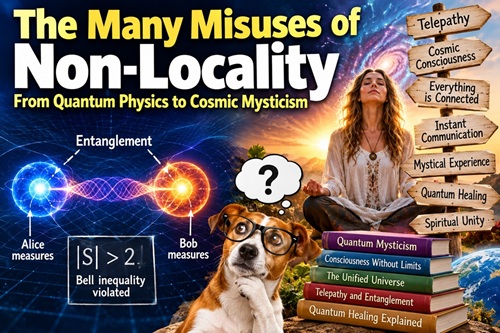
The Many Misuses of
Non-Locality
From Quantum Physics to Cosmic Mysticism
Frank Visser / ChatGPT
Introduction: a legitimate physical phenomenon with an illegitimate afterlife
Few concepts from modern physics have travelled so successfully from the laboratory into the vocabulary of mysticism as non-locality. The word now appears in discussions of consciousness, meditation, telepathy, synchronicity, spirituality, holistic healing, mystical experience and even the alleged interconnectedness of all things.
There is a problem with this migration.
In physics, non-locality is a precise and technically constrained feature of quantum theory, associated especially with entanglement and violations of Bell inequalities. Outside physics, however, the term is frequently transformed into something much larger: a vague principle according to which everything is connected to everything else, information can somehow transcend space, consciousness is not confined to the brain, or minds can communicate instantaneously across arbitrary distances.
These conclusions do not follow.
Indeed, the history of non-locality provides an instructive case study in how a genuine scientific concept can acquire metaphysical meanings by successive conceptual substitutions. Something strange happens in quantum mechanics; this becomes "non-locality"; non-locality becomes "instantaneous connection"; connection becomes "communication"; communication becomes "consciousness"; and consciousness eventually becomes cosmic.
At every step, something has been added.
The result is not necessarily nonsense. Some of the philosophical questions raised by quantum mechanics are profound. But they have to be kept separate from what the physics actually establishes.
What quantum non-locality actually means
The starting point is quantum entanglement.
When two quantum systems interact in an appropriate way, their joint state can become entangled. The resulting correlations between measurements performed on the systems can be stronger than correlations permitted by certain classes of classical local hidden-variable theories.
This is where Bell's theorem becomes crucial.
John Bell showed that if physical systems possess certain local hidden variables satisfying particular assumptions, their statistical correlations must obey inequalities. Quantum mechanics predicts violations of these inequalities, and experiments have repeatedly observed such violations.
This is genuinely remarkable.
It means that nature cannot be described by a theory satisfying all the assumptions built into Bell's local hidden-variable framework.
But notice what has not been established.
Bell violations do not demonstrate that a human mind can influence something instantaneously at a distance. They do not demonstrate telepathy. They do not demonstrate that consciousness is non-local. They do not demonstrate that the universe is literally one mind. And they do not demonstrate that thoughts can travel through entanglement.
The experimental result is considerably more modest—and considerably more interesting.
Quantum correlations cannot be reproduced by the relevant class of local hidden-variable theories.
That is already astonishing enough.
Non-locality is not the same as faster-than-light communication
One of the most persistent misunderstandings concerns the word "instantaneous."
Suppose Alice and Bob possess entangled particles and separate them by a large distance. Alice measures her particle, while Bob measures his.
Their results display correlations that cannot be explained by a suitable local hidden-variable model.
It is tempting to say:
Alice's measurement instantly affects Bob's particle.
That formulation is dangerous.
Different interpretations of quantum mechanics describe the situation differently, but standard quantum theory does not provide Alice with a controllable mechanism for sending a message to Bob faster than light.
Bob's individual measurement results remain statistically random. Alice cannot choose her outcome in such a way that Bob can read a message from it. Only when the two observers later compare their data can the characteristic correlations be established.
This is the significance of the no-signalling principle.
Quantum mechanics therefore gives us a peculiar combination: correlations that resist local classical explanation without providing an ordinary faster-than-light communication channel.
That distinction is routinely erased in popular discussions.
"Non-local correlation" becomes "instantaneous influence," which becomes "instantaneous communication." But those are three different claims.
The "spooky action" trap
Einstein's famous phrase "spooky action at a distance" has contributed enormously to the mythology.
Einstein was highlighting something deeply uncomfortable about quantum mechanics. He did not mean that physics had discovered a mystical force connecting everything with everything else.
The phrase is often quoted as though Einstein had already anticipated modern spiritual notions of universal interconnectedness.
He had not.
In fact, Einstein's concern was precisely about the implications of quantum theory for locality and physical description. His famous EPR argument attempted to show that quantum mechanics might be incomplete.
History did not vindicate the particular local-realist strategy associated with EPR. Bell later demonstrated why.
But Einstein's discomfort should not be converted into a mystical endorsement of quantum interconnectedness.
"Spooky" is not a technical category in physics.
Non-locality does not mean that everything is connected to everything
This is perhaps the most common metaphysical inflation.
A popular argument goes roughly like this:
- Quantum particles can be entangled.
- Entangled particles exhibit non-local correlations.
- Therefore everything in the universe is fundamentally interconnected.
- Therefore separation is ultimately an illusion.
- Therefore consciousness, nature and cosmos form an underlying unity.
The first two steps concern physics.
The remaining steps are philosophical extrapolations.
Even the first step requires qualification. Entanglement is not equivalent to a permanent mystical bond between arbitrary objects. Entanglement is a physical property of particular quantum states, and maintaining useful entanglement in macroscopic environments is extraordinarily difficult because of decoherence.
The universe is not simply a giant collection of conveniently entangled particles whose individual identities have become irrelevant.
Nor does quantum mechanics tell us that ordinary spatial distinctions are unreal.
A chair remains spatially distinct from another chair. Your brain remains physically located where your brain is located. A galaxy remains many thousands of light-years from another galaxy.
Quantum theory does not abolish geography.
Entanglement is not a cosmic Wi-Fi network
Another metaphorical transformation is particularly seductive:
Quantum entanglement means that information is everywhere at once.
It does not.
Quantum information is a technical concept, and entanglement is an important resource in quantum information theory. But this does not mean that ordinary semantic information—words, thoughts, memories, intentions or meanings—can simply be transmitted through entangled particles.
Imagine two people claiming:
"My consciousness is connected with yours because everything is quantum-mechanically entangled."
The argument would have a missing middle.
What physical mechanism turns microscopic quantum entanglement into the transmission of a particular thought?
What preserves the relevant quantum state?
How does the information get encoded?
How is it decoded?
What experiment distinguishes this hypothesis from ordinary communication, coincidence or imagination?
Without answers to these questions, "quantum information" is functioning rhetorically rather than scientifically.
The quantum-consciousness leap
Perhaps the most ambitious application of non-locality concerns consciousness.
Some theories of consciousness invoke quantum processes. That is a legitimate area of speculation and, in some cases, serious scientific investigation.
But a distinction must be made between:
quantum processes may be relevant to consciousness
and
consciousness is therefore non-local.
The second statement does not follow from the first.
The brain is an extraordinarily complicated physical system. It operates through electrochemical activity, molecular interactions, network dynamics and many other processes. Some of these processes are ultimately quantum-mechanical in the trivial sense that all ordinary matter is quantum-mechanical at a fundamental level.
That does not establish that the brain exploits macroscopic quantum entanglement to produce consciousness.
And even if some future theory established a genuinely quantum contribution to consciousness, an additional argument would still be required to establish that consciousness itself can operate non-locally.
Physics cannot be replaced by a chain of adjectives:
quantum ? entangled ? non-local ? consciousness ? cosmic.
Each arrow requires evidence.
Non-locality and telepathy
This is where the misuse becomes especially conspicuous.
Telepathy is sometimes defended by claiming that minds could be quantum-entangled.
But entanglement does not provide a known mechanism for transmitting arbitrary classical information between brains.
More importantly, the existence of quantum correlations does not make every conceivable correlation physically possible.
A theory proposing telepathy must therefore do more than point toward quantum mechanics. It must specify a physical mechanism and generate testable predictions.
If two people happen to think about each other simultaneously, quantum non-locality is not an explanation.
If distant meditators report similar experiences, quantum non-locality is not an explanation.
If a person experiences a striking coincidence, quantum non-locality is not an explanation.
Otherwise "quantum" becomes a scientific-sounding synonym for "mysterious."
Non-locality and mystical experience
The same problem occurs with mystical experience.
A meditator may experience the dissolution of the boundary between self and world. The experience can be profound, transformative and psychologically authentic.
But there is an important difference between:
"I experienced reality as non-dual."
and:
"Quantum physics proves that reality is non-local and therefore my experience reveals its fundamental structure."
The first is a phenomenological statement.
The second is a scientific and metaphysical claim.
The experience does not automatically validate the interpretation.
This distinction is especially important because mystical states can be interpreted through whatever conceptual framework is culturally available. A medieval Christian may experience union with God; a Buddhist may experience emptiness; an Advaitin may experience Brahman; a New Age practitioner may experience cosmic energy.
The intensity of an experience does not determine the correctness of its ontology.
Quantum mechanics does not change that epistemological problem.
The "observer" makes another appearance
Quantum mysticism frequently combines non-locality with the notorious "observer effect."
The argument typically runs:
Quantum mechanics shows that observation affects reality. Therefore consciousness creates reality.
This is another chain of unwarranted inference.
In quantum mechanics, "measurement" has a precise technical meaning. It is not synonymous with a human being looking at something with consciousness.
A detector can register an event. A photographic plate can record a particle. A physical interaction can produce decoherence.
Nothing in the formalism requires a human mind to gaze upon the apparatus and magically bring the result into existence.
The observer problem in quantum foundations is real and fascinating. But turning "observer" into "consciousness" and then into "cosmic consciousness" is a philosophical decision, not an experimental result.
Non-locality is not non-separability in every possible sense
There is another conceptual confusion worth making explicit.
Quantum theory challenges certain classical notions of separability. Entangled systems cannot always be adequately represented as independent states possessing all the properties one might naïvely assign to them individually.
This is philosophically important.
But "the whole is not reducible to independent classical parts" does not entail:
"Everything is one."
Holism comes in many forms.
A flock of birds is a system whose behaviour cannot be predicted simply by looking at one bird. A biological organism has emergent properties. A society possesses collective dynamics. A weather system has enormous interdependence.
None of these facts establishes mystical oneness.
Quantum entanglement is not a universal licence for holism.
The ecological version of quantum mysticism
The concept also appears frequently in ecological and systems-oriented discourse.
One sometimes encounters statements such as:
"Quantum physics shows that everything is interconnected, just as ecology teaches us."
There is a respectable insight hiding inside this formulation: nature consists of networks of causal dependencies and interacting systems.
But ecology does not need quantum mysticism.
The biosphere is interconnected through ordinary, empirically demonstrable mechanisms: food webs, nutrient cycles, atmospheric circulation, hydrology, evolutionary competition and cooperation, geological processes and energy flows.
If one wants to argue for ecological interdependence, those mechanisms are more than sufficient.
Invoking quantum non-locality adds very little—and risks confusing two entirely different levels of description.
The New Age upgrade: from correlation to meaning
Perhaps the deepest misuse is not physical but epistemological.
Non-locality is often invoked whenever someone wants to explain a meaningful coincidence.
Two events happen at a distance.
They seem strangely connected.
Instead of asking whether there is a causal mechanism, statistical explanation, selection effect or psychological bias, the explanation becomes:
"Quantum non-locality."
But correlation is not causation.
And even genuine physical correlation does not automatically carry semantic meaning.
Suppose two quantum systems exhibit a correlation. The correlation itself does not contain a message saying:
"The universe wants you to pay attention."
Meaning enters through an interpreter.
This is why quantum mechanics cannot by itself explain synchronicity, spiritual guidance or cosmic purpose.
Those are different philosophical questions.
The scale problem
There is also a neglected question of scale.
Quantum mechanics is fundamental to physics, but it does not follow that every macroscopic phenomenon displays interesting quantum behaviour in the same form.
Macroscopic systems interact continuously with their environments. Decoherence rapidly suppresses many delicate quantum superpositions and entanglement patterns.
The mere fact that matter is quantum-mechanical does not mean that a football, a tree, a human personality or a civilization behaves like a coherent quantum object.
This is analogous to saying:
"Everything is made of atoms, therefore sociology is really atomic physics."
There is a sense in which this is true.
It is also useless as an explanation of sociology.
The explanatory level matters.
The "everything is quantum" escape hatch
A particularly slippery argument says:
"But everything is ultimately quantum, so quantum effects could underlie consciousness, spirituality and telepathy."
The first half is broadly correct.
The second half does not follow.
A theory must explain how the relevant microphysical properties survive, scale upward and produce the proposed macro-level phenomenon.
Otherwise "quantum" is functioning as an explanatory placeholder.
This is one reason physicists become impatient with quantum mysticism. The problem is not that quantum mechanics is irrelevant to reality. The problem is that its relevance is being asserted rather than demonstrated.
Non-locality versus causality
There is a deeper philosophical lesson here.
Classical physics encouraged a picture in which causes propagate locally through space. Quantum theory complicates that picture.
But abandoning one simple conception of causality does not mean abandoning causality altogether.
Nor does it mean that every distant correlation is a causal interaction.
Physics has several distinct concepts that popular discourse tends to collapse:
locality, causality, separability, entanglement, correlation, signalling, information and influence.
They overlap, but they are not synonyms.
A serious discussion of quantum foundations has to keep these distinctions alive.
A mystical discussion often erases them.
The irony: the real physics is stranger than the mysticism
There is a certain irony here.
Quantum mechanics does not need mystical embellishment to be astonishing.
Bell's theorem is astonishing.
The violation of Bell inequalities is astonishing.
Entanglement is astonishing.
Quantum teleportation is astonishing.
The fact that nature resists certain classical combinations of locality and realism is astonishing.
But these phenomena are interesting precisely because they are experimentally constrained.
The temptation is to make them even more spectacular by turning them into evidence for consciousness, spirituality or cosmic unity.
Yet the result is often a reduction in intellectual depth.
The real lesson of quantum mechanics may be more unsettling than the New Age version: nature does not have to conform to our classical intuitions, and our concepts must be carefully adjusted to what experiments actually show.
That is a much more demanding lesson.
A useful rule: follow the missing mechanism
A simple diagnostic can expose most abuses of non-locality.
Whenever someone makes a claim such as:
"Quantum non-locality explains telepathy."
ask:
What is the mechanism?
If the answer is:
"Entanglement."
ask:
How does entanglement transmit the relevant information?
If the answer is:
"Quantum information."
ask:
What physical system carries it, and how is it encoded and decoded?
If the answer becomes:
"Consciousness is fundamentally non-local."
ask:
What experiment would distinguish this hypothesis from a local model?
At that point, many arguments collapse—not because quantum mechanics has been disproved, but because quantum mechanics has been asked to do work for which no mechanism or evidence has been supplied.
Conclusion: respect the mystery without manufacturing a miracle
Non-locality is one of the places where modern physics genuinely challenges our inherited picture of reality. It should therefore be treated with philosophical seriousness.
But seriousness requires restraint.
Quantum entanglement does not establish telepathy. Bell violations do not establish cosmic consciousness. Non-local correlations do not establish faster-than-light communication. Quantum information does not mean that thoughts can be transmitted instantaneously. The observer effect does not demonstrate that human consciousness creates reality. And the existence of quantum entanglement does not demonstrate that separation is an illusion.
The central mistake is a category error: taking a precisely defined physical phenomenon and promoting it into a general metaphysical principle.
There is nothing wrong with developing philosophical interpretations of quantum mechanics. There is nothing wrong with asking whether quantum theory has implications for our understanding of mind, matter or reality.
What is problematic is presenting the desired metaphysics as though it were already contained in the physics.
Non-locality is mysterious enough.
It does not need to become mystical.
|

 Frank Visser, graduated as a psychologist of culture and religion, founded IntegralWorld in 1997. He worked as production manager for various publishing houses and as service manager for various internet companies and lives in Amsterdam. Books: Ken Wilber: Thought as Passion (SUNY, 2003), and The Corona Conspiracy: Combatting Disinformation about the Coronavirus (Kindle, 2020).