|
TRANSLATE THIS ARTICLE
Integral World: Exploring Theories of Everything
An independent forum for a critical discussion of the integral philosophy of Ken Wilber
  Frank Visser, graduated as a psychologist of culture and religion, founded IntegralWorld in 1997. He worked as production manager for various publishing houses and as service manager for various internet companies and lives in Amsterdam. Books: Ken Wilber: Thought as Passion (SUNY, 2003), and The Corona Conspiracy: Combatting Disinformation about the Coronavirus (Kindle, 2020). Frank Visser, graduated as a psychologist of culture and religion, founded IntegralWorld in 1997. He worked as production manager for various publishing houses and as service manager for various internet companies and lives in Amsterdam. Books: Ken Wilber: Thought as Passion (SUNY, 2003), and The Corona Conspiracy: Combatting Disinformation about the Coronavirus (Kindle, 2020).
Check out my other conversations with ChatGPT The Long Road to UsHow Animal Evolution Made Us HumanFrank Visser / ChatGPT
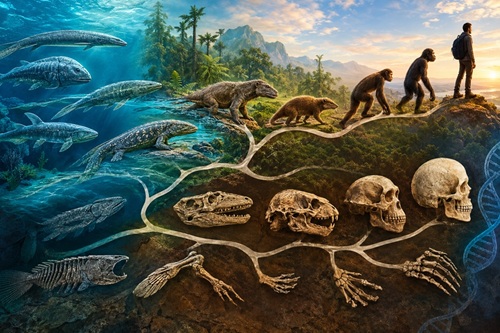 We tend to think of ourselves as starting somewhere in the relatively recent past. Human history begins with agriculture, perhaps, or with the emergence of Homo sapiens around 300,000 years ago. Go further back and we encounter our ape ancestors, the first mammals, the dinosaurs, the earliest vertebrates. But the deeper we travel into evolutionary time, the more striking the story becomes: virtually every feature that makes us human has roots that reach far deeper than humanity itself. Our hands, eyes, nervous system, skeleton, digestive tract, reproductive system, immune system and even some aspects of our social behaviour are inheritances from organisms that lived hundreds of millions of years ago. We are not an independent creation added late to the history of life. We are the latest modification of an extraordinarily ancient biological lineage. The human body is, in this sense, a living fossil record—not because it is unchanged, but because evolution works by modifying structures inherited from the past. Our ancestry is written into our anatomy. Before animals: preparing the stageThe story begins long before animals existed. For most of Earth's history, life consisted entirely of microorganisms. The first cells appeared more than three billion years ago, and for an immense span of time evolution experimented with increasingly complex forms of cellular organization. One of the most consequential developments was the appearance of eukaryotic cells, whose DNA is enclosed within a nucleus and which contain specialized internal structures. The ancestors of mitochondria were once free-living bacteria that entered into a symbiotic relationship with other cells. Eventually this relationship became permanent. This event had enormous evolutionary consequences. Mitochondria became cellular power plants, allowing eukaryotic cells to exploit energy more efficiently. Later, some eukaryotic lineages acquired photosynthetic organisms that became chloroplasts. The lesson is already important. Evolution does not proceed simply by one organism gradually becoming another. Major evolutionary innovations can arise through cooperation, symbiosis, duplication, repurposing and changes in developmental regulation. Eventually, some eukaryotic organisms began forming stable multicellular bodies. And then animals appeared. The animal revolutionThe first animals probably evolved more than 600 million years ago, although exactly when and from what ancestral population remains an area of active research. The earliest animals were nothing like us. They had no bones, brains, limbs or recognizable faces. They were relatively simple multicellular organisms, probably resembling some combination of sponges and other primitive animal forms. Yet the transition to animal life represented a profound change. A multicellular organism could now specialize. Different cells could perform different functions. Some could become sensory cells; others could contract; others could digest food or transport substances. Once cells became organized into tissues, natural selection could operate on increasingly complex bodies. Animals introduced a new biological lifestyle: actively interacting with the environment through movement, sensation, feeding and behaviour. The evolutionary consequences were enormous. The Cambrian experimentAround 540 million years ago, during the Cambrian Period, animal diversity increased dramatically. The "Cambrian explosion" was not literally the sudden appearance of all modern animal groups overnight, but it was nevertheless an extraordinary period of evolutionary diversification. Animals acquired recognizable body plans. Some developed hard external skeletons. Others evolved shells, spines, segmented bodies, grasping appendages and increasingly sophisticated sensory systems. Predation became an important evolutionary force. Once animals began actively hunting one another, natural selection could favour better detection, faster movement, stronger armour, improved camouflage and more effective weapons. The evolutionary arms race helped drive increasing complexity. And somewhere within this ancient experimentation appeared one of the lineages that would eventually lead to us. The invention of the backboneOur ancestry belongs to the chordates, a group characterized by features including a notochord, a dorsal nerve cord and other developmental characteristics. The early chordates were small, soft-bodied animals. They possessed no vertebral column comparable to ours. Eventually, vertebrates evolved. The vertebrate body plan gave our lineage a more substantial internal skeleton and a reorganized head and nervous system. The skull protected the brain, while the vertebral column provided structural support and protection for the spinal cord. This ancient architecture remains visible every time we look in the mirror. Our skull protects a brain that ultimately descends from the nervous systems of these early animals. Our vertebral column is a highly modified descendant of the supporting structures of early chordates. Even our basic organization—head at one end, digestive tract running through the body, spinal cord along the back—is inherited from this ancient history. The evolutionary invention of the jawOne of the great innovations in vertebrate evolution was the jaw. Early vertebrates lacked the familiar hinged jaws of modern fish and terrestrial vertebrates. Jaws evolved from structures associated with the gill arches. This is another recurring pattern in evolution: new structures are often modifications of old ones. The jaws that eventually became instruments for eating were built from anatomical materials that originally served different functions. The same principle will appear repeatedly in our story. Evolution is an improviser. It rarely starts with a blank sheet of paper. From fins to limbsFor hundreds of millions of years, vertebrates remained primarily aquatic. Fish diversified enormously, and among them appeared the lineage of lobe-finned fishes. Some of these animals possessed robust internal skeletal structures within their fins. Over evolutionary time, related structures became increasingly suited to supporting the body in shallow water and eventually on land. The transition from fish to land vertebrates was not a single dramatic leap. It was a long evolutionary process involving many intermediate forms. The limbs of later tetrapods inherited the basic skeletal pattern of these ancient fins. Our arms and legs still reveal that history. The human upper limb contains a single upper-arm bone, two forearm bones, wrist bones and a series of hand bones. The details have been modified enormously, but the underlying pattern is homologous with the corresponding structures of other tetrapods. Our hands are, in a profound sense, transformed fish fins. Life on landOnce vertebrates became established on land, a new evolutionary world opened. Plants had already colonized terrestrial environments. Arthropods were abundant. Vertebrates could exploit new ecological opportunities. But life on land imposed major challenges. Bodies had to support themselves without water. Respiration had to work in air. Reproduction could no longer depend entirely on aquatic environments. Sensory systems had to operate under different physical conditions. Among the descendants of early land vertebrates arose the amniotes, whose reproduction became increasingly independent of open water. From this lineage eventually emerged two major branches: the sauropsids, leading to reptiles and birds, and the synapsids, leading eventually to mammals. We belong to the second branch. The strange road to mammalsThe earliest synapsids looked more like reptiles than modern mammals. Over many millions of years, however, their descendants underwent profound changes. Their teeth became differentiated into specialized types. Their jaws changed. Their posture became more upright. Their metabolism became increasingly active. Hair evolved. The bones of the jaw and middle ear underwent remarkable transformations. One of the most fascinating evolutionary transitions concerns hearing. Several bones that once formed part of the jaw apparatus of ancestral synapsids eventually became the tiny bones of the mammalian middle ear. In other words, some of the machinery with which mammals hear originated in structures that once helped our distant ancestors chew. Evolution repeatedly turns yesterday's equipment into tomorrow's innovation. The mammalian revolutionThe first mammals appeared more than 200 million years ago. For much of the Mesozoic, mammals lived in the shadow of dinosaurs. They were generally small and occupied ecological niches that did not resemble those of the giant reptiles dominating terrestrial ecosystems. But mammals possessed several important characteristics. They had hair. They were endothermic. They possessed highly differentiated teeth. They had relatively large brains for their body size. And they invested heavily in parental care. Their sensory systems also became sophisticated. After the non-avian dinosaurs disappeared in the mass extinction 66 million years ago, mammals diversified dramatically. Among the descendants of this radiation were the primates. The primate experimentPrimates evolved adaptations associated with life in complex three-dimensional environments. Many primates developed grasping hands and feet, nails rather than claws, forward-facing eyes and relatively large brains. Forward-facing eyes provide overlapping visual fields and excellent depth perception. Grasping hands allow precise manipulation of objects and branches. Large brains support increasingly complicated sensory integration and behavioural flexibility. None of these traits evolved because evolution was "trying" to produce humans. They evolved because particular variations affected survival and reproduction in particular environments. Human intelligence is therefore not an isolated miracle. It is the culmination of a long series of adaptations involving perception, manipulation, memory, learning and social behaviour. The ape inheritanceEventually, our lineage became part of the great ape radiation. The common ancestor of humans and chimpanzees probably lived roughly 6-8 million years ago. It was neither a human nor a chimpanzee. From that ancestral population, different lineages diverged. The human lineage subsequently included numerous hominins. Australopithecus species walked upright, but still possessed relatively small brains and retained many climbing adaptations. Bipedalism was one of the great transformations. Walking on two legs freed the hands from locomotion. That did not automatically produce tool use or intelligence, but it created new possibilities for carrying objects, manipulating food and interacting with the environment. Again, evolution worked incrementally. The technological animalMembers of the genus Homo eventually evolved larger brains, more elaborate tools and increasingly flexible behaviour. Homo erectus and related populations spread far beyond Africa. They controlled fire, manufactured sophisticated stone tools and adapted to diverse environments. Later came other members of the human family, including Neanderthals and Denisovans. Our own species, Homo sapiens, appeared in Africa roughly 300,000 years ago. But even here, the story is not one of sudden biological perfection. Early Homo sapiens were anatomically modern but lived in societies that changed gradually. Symbolic behaviour, long-distance exchange, complex tools, art and elaborate social institutions developed through cumulative cultural evolution. Culture became an additional inheritance system. The extraordinary power of cultureThis may be the most important step in understanding what made us human. Genes are not our only inheritance mechanism. Humans transmit information socially: through imitation, teaching, language, stories, rituals, technologies and institutions. A child does not need to rediscover fire, agriculture, writing or mathematics from scratch. Each generation inherits a vast cultural archive. This produces cumulative culture. One person invents something. Others modify it. Someone else combines it with another invention. Over generations, increasingly elaborate systems emerge. The modern human being is therefore the product of two intertwined evolutionary histories: biological evolution and cultural evolution. Our biology created the capacity for culture; culture subsequently became a powerful environment in which human biology itself evolved. The social brainOur brains are profoundly social organs. Humans cooperate, compete, gossip, teach, imitate, form alliances, punish cheaters, care for children and maintain relationships extending far beyond the immediate family. These tendencies have deep evolutionary roots. Primates already possess complex social cognition. Humans expanded these capacities dramatically. Language made it possible to transmit information about absent people and distant events. Shared symbols enabled large numbers of strangers to coordinate. Institutions allowed cooperation to persist beyond individual relationships. Human civilization therefore did not replace our animal nature. It amplified it. The same psychological machinery that evolved in small ancestral communities operates today inside enormous technological societies. The ancient brain inside the modern worldThe human brain is sometimes described as though evolution constructed it layer by layer: a reptilian brain underneath a mammalian brain underneath a human brain. That popular picture is misleading as literal neuroscience. Evolution did not simply stack three brains on top of one another. But there is a deeper truth behind the metaphor. Our nervous system contains structures and circuits with very ancient evolutionary histories. Older biological systems have been extensively modified and integrated with newer ones. We still possess mechanisms regulating hunger, fear, reward, attachment, reproduction, aggression, curiosity and social bonding. Modern humans may contemplate quantum mechanics and write symphonies, but we remain animals with ancient motivational systems. The contradiction is only apparent. Our capacity for abstract thought is itself an evolutionary achievement built upon older biological machinery. The body remembersEvolutionary history is visible everywhere in the human body. • We have five fingers because the basic tetrapod limb pattern was inherited from ancient vertebrates. • We have a spinal column because our ancestors were chordates and vertebrates. • We have jaws derived from ancient skeletal structures associated with feeding. • We have three tiny middle-ear bones because evolutionary transformations converted ancestral jaw elements into auditory structures. • We have lungs descended from ancient respiratory structures of bony vertebrates. • We have hair because our mammalian ancestors evolved it. • We have milk-producing mammary glands because our mammalian lineage developed elaborate parental care. • We have large, forward-facing eyes and grasping hands because of our primate ancestry. • We walk upright because our hominin lineage underwent a prolonged transformation of the pelvis, spine, legs and feet. • And our extraordinarily large brain is the latest development in a much older history of nervous-system complexity. The human body is therefore not a cleanly engineered machine. It is an accumulated historical structure. Evolution's imperfectionsThis historical character also explains why organisms contain so many awkward features. Evolution does not optimize from scratch. It modifies what already exists. The recurrent laryngeal nerve provides a famous example. In humans it travels from the brain down into the chest, loops around an artery, and then travels back upward toward the larynx. Why such a strange route? Because the nerve's developmental history is inherited from our vertebrate ancestors, in which the relevant structures were arranged differently. Our eyes contain a blind spot because the optic nerve passes through the retina. Our backs are vulnerable because the human spine was modified from a body plan originally adapted to four-legged locomotion. The human pelvis must simultaneously accommodate bipedal locomotion and childbirth. These are not signs of failed biology. They are signatures of historical biology. Evolutionary history constrains what can be built. We are not the endpointThere is another important lesson. Evolution does not have a predetermined destination. The emergence of Homo sapiens was not inevitable. If Earth's history were replayed from the beginning, there is no reason to expect humans—or anything resembling humans—to appear again. The dinosaurs did not "fail" because mammals eventually became dominant. Trilobites were not evolutionary dead ends because they disappeared. Evolution has no ladder with bacteria at the bottom, mammals in the middle and humans at the top. There is a branching tree, not a ladder. Most branches eventually end. Our own branch is simply one that remains alive. What does it mean to be human?Seen against this immense history, human uniqueness becomes both more modest and more remarkable. We are not separate from nature. We are an unusually complicated expression of nature. Our consciousness rests upon a nervous system whose deep ancestry reaches into the first animals. Our bodies were assembled from structures modified over hundreds of millions of years. Our social instincts descend from primate and mammalian ancestors. Our capacity for language and abstract reasoning emerged from an already ancient architecture of perception, memory, emotion and social cognition. Even our most apparently "human" characteristics have evolutionary prehistories. Curiosity has roots in animal exploration. Play has roots in mammals and birds. Attachment has roots in parental care. Communication predates language by hundreds of millions of years. Cooperation is older than humanity. Tool use is older than our species. Learning is older than brains. And sensation itself is older than animals. What distinguishes us is not that we suddenly escaped this history, but that several ancient capacities became extraordinarily elaborated and interconnected. The animal that became historicalPerhaps the most revealing way to describe Homo sapiens is as the animal that became deeply historical. Other animals inherit genes and learn from their parents. Humans inherit genes, but also languages, technologies, stories, institutions, sciences and memories of civilizations that disappeared thousands of years ago. We carry several billion years of biological history within us, but we also carry the accumulated cultural history of our species. When we look at a human hand, we are looking at a transformed fish fin. When we listen to a human voice, we are hearing the product of a respiratory and vocal apparatus shaped by mammalian and primate evolution. When we contemplate the universe, we are doing so with a brain descended from the nervous systems of creatures that once crawled through ancient seas. And when we ask where we came from, an extraordinary thing happens. One branch of evolutionary history has become capable of reconstructing evolutionary history itself. That capacity does not place us outside the evolutionary process. It is one of its products. We are the descendants of countless organisms that survived long enough to reproduce. Behind every human being lies an unbroken chain stretching back through hominins, mammals, synapsids, early vertebrates, primitive chordates, the first animals and ultimately the earliest forms of life. Most of those ancestors left no names, no monuments and no conscious memory of their existence. Yet they are still here—in us. The human story is therefore not a story that begins with humans. It is the latest chapter of a story that began billions of years ago. And perhaps the deepest lesson of evolutionary biology is that there was never a sharp boundary between "nature" and "us." We are nature remembering its own history.
Widget is loading comments...
|