|
TRANSLATE THIS ARTICLE
Integral World: Exploring Theories of Everything
An independent forum for a critical discussion of the integral philosophy of Ken Wilber
  Frank Visser, graduated as a psychologist of culture and religion, founded IntegralWorld in 1997. He worked as production manager for various publishing houses and as service manager for various internet companies and lives in Amsterdam. Books: Ken Wilber: Thought as Passion (SUNY, 2003), and The Corona Conspiracy: Combatting Disinformation about the Coronavirus (Kindle, 2020). Frank Visser, graduated as a psychologist of culture and religion, founded IntegralWorld in 1997. He worked as production manager for various publishing houses and as service manager for various internet companies and lives in Amsterdam. Books: Ken Wilber: Thought as Passion (SUNY, 2003), and The Corona Conspiracy: Combatting Disinformation about the Coronavirus (Kindle, 2020).
Check out my other conversations with ChatGPT The Seven SpheresA Cosmic Architecture of the ImaginationFrank Visser / ChatGPT
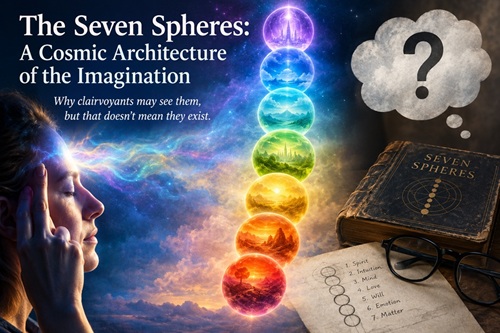 When a vision becomes a worldAmong the oldest habits of esoteric thought is the tendency to turn unusual subjective experiences into maps of objective reality. A mystic encounters luminous beings, a medium perceives planes of existence, a clairvoyant reports successive spiritual realms, and before long these experiences are organized into a cosmic architecture. One particularly persistent version of this architecture is the idea of seven spheres: seven planes, levels, heavens, planetary realms, or concentric domains through which souls supposedly ascend. The remarkable thing is not that human beings have imagined such structures. Human beings are extraordinarily good at constructing invisible worlds. The remarkable thing is that these worlds are often presented not as metaphors, psychological interpretations, or religious symbols, but as discoveries. And this is where the epistemological problem begins. Clairvoyants may sincerely claim to perceive seven spheres. They may describe them in considerable detail. They may even report striking similarities with the visions of other clairvoyants. But none of this, by itself, establishes that seven independently existing spheres have been discovered. The crucial possibility is much less exotic: the seven-sphere cosmology may be a cultural construction that subsequently shapes the very experiences supposedly confirming it. In other words, perhaps the clairvoyants are not seeing the seven spheres because the spheres exist. Perhaps they see seven spheres because the idea of seven spheres has become part of the vocabulary through which anomalous experiences are interpreted. That distinction is enormous. Seven is a suspiciously convenient numberThe first warning sign is the number itself. Why seven? Seven has an extraordinary career in mythology, religion, astrology and esotericism. There are seven days of the week, traditionally associated with the seven visible classical planets; seven heavens in various religious traditions; seven chakras in modern popular presentations of Hindu-derived spirituality; seven seals in Revelation; seven stages or levels in numerous occult systems; and innumerable other sets of seven. This does not demonstrate that every sevenfold scheme is fictitious. Seven is a mathematically and culturally useful number. But its recurrence should make us cautious whenever an alleged discovery of the invisible universe conveniently produces yet another set of seven. The history of Western esotericism makes the suspicion even stronger. The ancient planetary cosmos already provided an elegant sevenfold template: Moon, Mercury, Venus, Sun, Mars, Jupiter and Saturn. These were not merely astronomical objects in premodern thought. They became associated with levels of reality, spiritual influences, gods, psychological qualities and stages of ascent. Once such a symbolic architecture exists, it becomes remarkably easy to reinterpret subjective experience through it. A visionary encounters something strange. The tradition says there are seven levels. The visionary subsequently reports seven levels. The report then becomes evidence that the tradition was correct. This is a classic case of self-confirming interpretation. The clairvoyant problemThe strongest argument in favor of the spheres is presumably experiential: clairvoyants can see them. But what does "see" mean here? If a clairvoyant reports seeing a physical object—a tree, a building, another person—we have a way of checking the claim. Other observers can inspect the same object. Instruments can detect it. The observer can be mistaken, but the claim is at least connected to an independently accessible reality. The situation changes completely when the alleged object is an invisible sphere accessible only through clairvoyance. The clairvoyant says: "I perceive the seventh sphere."
How do we independently determine whether there is a seventh sphere? We cannot simply ask another clairvoyant, because this creates a problem of corroboration without an independent standard. If the second clairvoyant reports the same thing, that may look impressive. But if both have absorbed the same esoteric tradition, they are not independent observers in the relevant sense. Two people can independently reproduce the same cultural error. Indeed, thousands of people can. The map can create the territoryThis is particularly important because clairvoyance does not appear to operate like ordinary sensory perception. Ordinary perception is constrained by an external world. If I claim there is a red chair in the room, you can look for yourself. If there is no chair, the claim encounters an immediate obstacle. Esoteric perception is different. The supposed object is accessed through an interpretive apparatus whose reliability is precisely what is in question. This creates a feedback loop: tradition → expectation → experience → interpretation → confirmation of tradition. The believer expects levels. The unusual experience is interpreted as movement through levels. The interpretation is reported as perception. The report becomes testimony for the existence of levels. The next practitioner encounters the testimony and acquires the same expectations. The cycle continues. The resulting tradition can become extremely elaborate while remaining epistemically circular. This does not mean that the experiences are fake. That distinction is crucial. A person may genuinely experience a luminous landscape, encounter an apparent spiritual being, or feel that consciousness has moved into another dimension. The experience can be psychologically powerful and personally transformative. But the reality of an experience does not automatically establish the reality of its interpretation. A dream is real as an experience. The dream city does not therefore exist somewhere in the universe. A hallucination is real as an event in a nervous system. The perceived object does not therefore exist externally. A mystical experience is real as an experience. Its cosmological interpretation remains an additional hypothesis. Why agreement proves less than we thinkThe usual response is obvious: "But different clairvoyants describe the same spheres." At first glance, this seems like powerful evidence. But we need to ask how independent the reports really are. Suppose ten people read the same book describing seven spiritual planes and subsequently report seven planes during meditation. Their agreement tells us something interesting—but not necessarily about the structure of the universe. It may tell us something about the influence of the book. Even without direct textual transmission, people inhabit common cultural environments. Symbols circulate through religions, occult movements, popular spirituality, dreams, artwork, literature and conversation. A person does not need to consciously remember the source of an image for that image to influence interpretation. And there is an even subtler possibility. Human brains are not passive recording devices. Perception itself is an active process of construction. We continually interpret ambiguous sensory information according to expectations, prior knowledge and context. There is no reason to assume that unusual inner experiences are exempt from this general principle. If ordinary perception is already theory-laden, clairvoyant perception should not be granted immunity from psychological mediation. The missing experimentThere is, however, a straightforward way to strengthen the claim. Ask clairvoyants to describe the spheres without being told beforehand that there are seven. Better still, ask independent clairvoyants from radically different cultural traditions to describe the structure of the invisible world without access to one another's accounts. Then establish the criteria in advance. • How many levels are there? • What distinguishes one from another? • What objects or beings should be found there? • Can these descriptions be compared objectively? • Can the clairvoyants identify information they could not plausibly have obtained through ordinary means? • And can the results be replicated under controlled conditions? This is where esoteric claims usually become much less impressive. A detailed cosmology is easy to construct after the fact. What is difficult is making specific, risky predictions before the fact. • If there are seven spheres, why seven rather than five, nine or twelve? • If they have objective characteristics, what are those characteristics? • If different clairvoyants perceive them, can they independently identify the same unexpected details? • If the spheres are real, what observation would count against their existence? A claim that cannot in principle be wrong is extraordinarily difficult to distinguish from an imaginative construction. The "higher" sphere problemThere is another revealing feature of these systems: the spheres are usually hierarchical. The higher spheres are more spiritual, more refined, more luminous, more unified, more divine. The lower ones are denser, darker, more material and supposedly less evolved. This is exactly what we might expect from a human value system projected onto the cosmos. The architecture conveniently mirrors a moral and spiritual hierarchy. Higher = better. Lower = worse. More subtle = more spiritual. More material = less spiritual. But why should the universe itself possess this value structure? Physics does not tell us that subtle things are morally superior to dense things. Biology does not tell us that complexity automatically means spiritual advancement. Astronomy certainly does not reveal a ladder from matter to God. The hierarchy is imported. This does not make it meaningless. As a symbolic psychology, it may be perfectly legitimate. Human beings routinely organize experience metaphorically along vertical dimensions: higher consciousness, deeper insight, elevated ideals, falling into darkness, ascending toward wisdom. The mistake occurs when the metaphor is promoted to cosmography. From metaphor to metaphysicsThere is a recurring pattern in esoteric literature. First comes an image: "The soul ascends through seven realms."
Then comes a metaphorical interpretation: "The seven realms represent stages of spiritual development."
Then comes an ontological claim: "There really are seven realms."
And finally comes a quasi-scientific description: "Clairvoyants can perceive these realms directly."
Each step adds a stronger claim. • The first may be poetry. • The second may be psychology. • The third is metaphysics. • The fourth is an empirical assertion. These should not be treated as equivalent. Much of the confusion surrounding esotericism arises because the transition between these levels happens almost invisibly. A symbolic map becomes a metaphysical map, and the metaphysical map eventually masquerades as an observation. The perennialist trapThere is a related problem with the perennial philosophy: the temptation to assume that similarities between mystical traditions reveal a single underlying spiritual reality. Perhaps they do. But similarities alone cannot establish this. Human beings share similar nervous systems, similar emotional needs, similar cognitive architecture and similar existential problems. It would be surprising if mystical experiences showed no cross-cultural similarities whatsoever. Moreover, traditions influence one another. Buddhism, Hinduism, Christianity, Neoplatonism, Hermeticism, Theosophy and modern occultism have never existed in sealed compartments. Consequently, finding similar imagery across traditions does not automatically reveal a common metaphysical territory. It may instead reveal something about the common architecture of human imagination. The perennialist interpretation is: Different people see the same reality through different cultural lenses.
The skeptical interpretation is: Different people experience similar psychological phenomena and interpret them through overlapping cultural lenses.
Both are possible. The crucial point is that the first cannot simply be assumed because it is spiritually attractive. The Theosophical contributionModern notions of spiritual planes owe a great deal to nineteenth- and early twentieth-century occultism, particularly Theosophy and its descendants. Here we find increasingly elaborate descriptions of astral planes, mental planes, etheric realms, spiritual hierarchies and stages of postmortem existence. What is striking is the confidence with which these descriptions were often presented. The occultist was not merely saying: "This is a useful symbol for thinking about consciousness."
The claim was much stronger: "This is how reality is structured."
The resulting literature reads almost like a travel guide to an invisible continent. But a travel guide requires travelers whose observations can be checked. If the only evidence for the continent consists of the reports of travelers equipped with a disputed form of perception, the evidential situation is fundamentally different. Why sincerity is not enoughOne of the easiest mistakes in skeptical discussions of clairvoyance is to attack the sincerity of the clairvoyant. That is unnecessary. The clairvoyant can be completely sincere. They may have no intention whatsoever to deceive anyone. They may spend decades practicing meditation, developing sensitivity and recording their experiences. They may even be unusually perceptive people. None of this establishes that the objects they perceive exist independently. History is filled with sincere people who were profoundly mistaken about the causes of their experiences. Sincerity concerns honesty. It does not establish accuracy. And the more meaningful the experience, the greater the temptation to interpret it as revealing something profound about reality. This is precisely why epistemological caution is needed. Seven spheres as a cultural fossilPerhaps the most revealing possibility is that the seven spheres are not an isolated invention at all. They may represent a kind of cultural fossil. Ancient cosmological structures become spiritualized. Astronomical spheres become levels of consciousness. Planets become spiritual influences. Vertical cosmic architecture becomes a hierarchy of souls. Then modern clairvoyants encounter the resulting tradition and report experiences that fit the inherited architecture. What appears to be independent perception may therefore be the latest expression of a very old symbolic grammar. The spheres survive because they are psychologically compelling, not necessarily because they are ontologically real. That distinction deserves to be taken seriously. The burden of proofNone of this proves that seven spheres do not exist. That would itself go beyond the evidence. The appropriate conclusion is more modest—and more devastating to the traditional claim. We do not have good reason to treat the seven spheres as independently established features of reality. The reports of clairvoyants constitute testimony about experiences. They do not automatically constitute evidence for the external existence of the objects supposedly perceived. To establish the latter, we would need something more: independently obtained information, reproducible observations, discriminating predictions, intersubjective verification under controlled conditions, or some other method capable of separating genuine perception from expectation, cultural inheritance, imagination and interpretation. Until then, "I can perceive the seven spheres" remains a statement about someone's experience. It is not yet a map of the cosmos. The irony of esoteric certaintyThere is an irony here. Esoteric traditions often pride themselves on penetrating beyond conventional appearances. They claim to look behind the material world and discover deeper dimensions of reality. Yet they can fall into precisely the epistemic error they accuse ordinary materialism of making: mistaking a particular interpretation of experience for the structure of reality itself. The skeptic does not need to deny the experience. The skeptic needs only to ask one additional question: How do you know what your experience means? That question is enough to separate phenomenology from metaphysics, symbolism from cosmology, and personal revelation from public knowledge. Perhaps there really are seven spheres. But until clairvoyance can demonstrate that these spheres are more than inherited patterns of interpretation, the simplest explanation is considerably less romantic: seven spheres may be something human beings have imagined so consistently that they have eventually mistaken the map for the territory.
Widget is loading comments...
|