|
TRANSLATE THIS ARTICLE
Integral World: Exploring Theories of Everything
An independent forum for a critical discussion of the integral philosophy of Ken Wilber
  Frank Visser, graduated as a psychologist of culture and religion, founded IntegralWorld in 1997. He worked as production manager for various publishing houses and as service manager for various internet companies and lives in Amsterdam. Books: Ken Wilber: Thought as Passion (SUNY, 2003), and The Corona Conspiracy: Combatting Disinformation about the Coronavirus (Kindle, 2020). Frank Visser, graduated as a psychologist of culture and religion, founded IntegralWorld in 1997. He worked as production manager for various publishing houses and as service manager for various internet companies and lives in Amsterdam. Books: Ken Wilber: Thought as Passion (SUNY, 2003), and The Corona Conspiracy: Combatting Disinformation about the Coronavirus (Kindle, 2020).
Check out my other conversations with ChatGPT Richard Maurice Bucke's Cosmic ConsciousnessThe Original Evolutionary Spirituality - and Its Original ProblemFrank Visser / ChatGPT
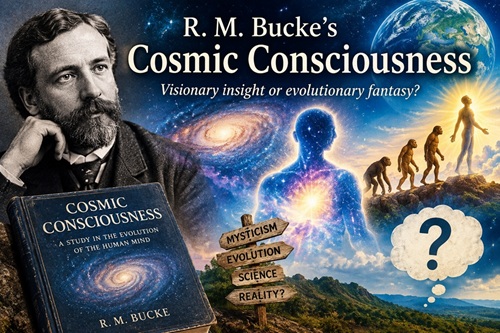 Richard Maurice Bucke's Cosmic Consciousness: A Study in the Evolution of the Human Mind, published in 1901, occupies an oddly important place in the history of modern spirituality. It is simultaneously a pioneering attempt to study mystical experience psychologically, an enthusiastic piece of evolutionary speculation, a celebration of Walt Whitman, and a remarkably early blueprint for the idea that humanity is evolving toward a higher state of consciousness. It is also, from a contemporary scientific perspective, a cautionary tale. Bucke wanted to accomplish something genuinely ambitious: to take mystical experience seriously without simply treating it as the supernatural revelation of traditional religion. Instead, he proposed that mystical illumination represented the emergence of a new faculty of consciousness, one that was itself part of biological and historical evolution. The idea was enormously fertile. It helped shape later discussions of mystical experience and evolutionary spirituality, and it influenced figures such as William James and, much later, the psychedelic and human-potential movements. But Bucke's central intellectual move contains a fundamental confusion. He moves from the fact that people sometimes have extraordinary experiences to the claim that these experiences reveal the next stage of human evolution. The first proposition is well worth investigating. The second requires an entirely different kind of evidence. And Bucke never really supplies it. The basic scheme: three kinds of consciousnessBucke's model is elegantly simple. There are, he argues, three progressively higher forms of consciousness. There is simple consciousness, possessed by animals. There is self-consciousness, possessed by ordinary human beings and characterized by thought, reason, imagination and awareness of oneself as a self. And there is cosmic consciousness, a higher faculty that has appeared only sporadically in human beings but is destined to become increasingly widespread. This is an attractive evolutionary narrative. Consciousness develops from sensation, to self-awareness, and eventually to cosmic awareness. The trouble begins when Bucke quietly converts a descriptive sequence into a theory of cosmic development. The historical appearance of something does not establish that it is an evolutionary adaptation. Nor does its rarity establish that it is the precursor of a new species. Yet Bucke repeatedly treats mystical illumination as precisely this sort of evolutionary innovation. His language is revealing. Cosmic consciousness is not merely an unusual state of mind. It is a new faculty, comparable in importance to the transition from animal consciousness to human self-consciousness. Those who experience it are therefore not merely people who have undergone an unusual psychological event. They are early representatives of humanity's future. That is a gigantic conclusion resting on remarkably slender foundations. From mystical experience to evolutionary destinyBucke's own mystical experience was the decisive event. After an evening spent reading poetry, including Whitman, he experienced a sudden illumination while riding in a cab. He described an intense sense of joy and intellectual illumination and the realization that the cosmos was not dead matter but a living presence. He became convinced of the reality of cosmic consciousness and subsequently spent years looking for examples in history. This is psychologically fascinating. But there is an obvious methodological problem: Bucke had the experience first and constructed his theory afterwards. His book therefore has the structure of a gigantic confirmation exercise. He knows what cosmic consciousness is supposed to be because he experienced it. He then searches history for people who seem to have experienced something similar. Buddha, Jesus, Paul, Plotinus, Dante, Blake, Whitman, Ramakrishna and others are consequently assembled into a kind of retrospective evolutionary family tree. The problem is not that these people failed to have profound experiences. The problem is that Bucke assumes beforehand that their experiences belong to the same phenomenon. A Buddhist awakening, Christian mystical union, Plotinian henosis, Blakean visionary experience and Whitmanesque cosmic exaltation emerge from radically different intellectual, cultural and religious contexts. Bucke's similarities are real enough, but similarities do not automatically establish a single underlying faculty. This is precisely where the book's title becomes misleading. Cosmic Consciousness sounds like the discovery of a psychological phenomenon. Much of the book is actually an argument for a metaphysical interpretation of a family of experiences. The great leap from phenomenology to metaphysicsThere is an important distinction Bucke never adequately maintains: the distinction between what an experience feels like and what the experience tells us about reality. A person can experience the universe as one, alive, sacred and infinitely meaningful. That tells us something extremely interesting about human consciousness. It does not, by itself, establish that the universe really is one, alive, sacred or conscious. Bucke repeatedly crosses this boundary. He reports that cosmic consciousness reveals the universe as spiritual and alive and that it discloses the unity of all things. In his formulation, what appears absurd from ordinary self-consciousness nevertheless becomes "undoubtedly true" from the higher standpoint. This is the familiar noetic fallacy of mystical experience: because an experience feels like knowledge, its contents are treated as knowledge. William James was already more cautious. When discussing Bucke, James accepted mystical experiences as genuine psychological phenomena but did not simply accept every metaphysical proposition delivered by them. His treatment of mystical states in The Varieties of Religious Experience remains valuable precisely because it distinguishes the occurrence of mystical states from the philosophical interpretation subsequently attached to them. That distinction is crucial. Mystical experience is data. Mystical cosmology is interpretation. Bucke too often treats the second as though it followed automatically from the first. The evolutionary argument is backwardsBucke's most ambitious claim is that cosmic consciousness represents the next evolutionary stage of humanity. But evolution does not operate by identifying spiritually attractive states and gradually installing them into the species. Natural selection requires heritable variation, differential reproductive success and population-level consequences. A psychological experience may be profound, transformative or culturally influential without being a biological adaptation. Bucke's argument instead resembles a Great Chain of Being dressed in Darwinian clothing. There is animal consciousness. Then human consciousness. Then cosmic consciousness. Then, implicitly, something approaching divinity. This pattern is much older than Darwin. It belongs to a long tradition of hierarchical ascent—from matter to life, life to mind, mind to spirit. Contemporary scholarship on evolutionary spirituality has pointed out precisely this tendency: spiritual evolution often transforms the old hierarchical ladder into evolutionary language while retaining much of its structure. The terminology changes. The metaphysical architecture survives. The problem of the "next species"Bucke's theory becomes particularly problematic when he imagines cosmic-conscious individuals as the beginning of a new human type. The metaphor is seductive: just as human beings emerged from earlier animals, a spiritually awakened humanity will eventually emerge from present-day humanity. But where is the population genetics? Where is the inherited trait? Where is the reproductive advantage? Where are the measurable developmental mechanisms? Where is the evidence that mystical experience is transmitted biologically rather than culturally? Bucke supplies none of these. Instead, he points to remarkable individuals. That demonstrates that remarkable individuals exist. It does not demonstrate speciation. This is one of the book's deepest category errors: cultural evolution is repeatedly treated as though it were biological evolution. Human beings can certainly change through education, imitation, institutions, language, technology and cultural transmission. A culture can become more contemplative, less violent or more psychologically sophisticated without humanity thereby evolving into a new biological species. Bucke's evolutionary vocabulary obscures this distinction rather than clarifying it. The retrospective selection problemThere is another methodological difficulty. Who counts as cosmic? Bucke selects historical figures whose writings or biographies contain experiences that resemble his own. But the selection criteria are flexible enough to make the conclusion almost inevitable. If someone experiences unity, illumination, divine presence, timelessness or overwhelming love, Bucke can classify the experience as cosmic consciousness. But what about people who experience radically different mystical realities? What about terrifying mystical states? What about experiences interpreted as personal encounters with God rather than cosmic unity? What about Buddhist experiences that explicitly reject the kind of permanent cosmic Self implied by some mystical traditions? What about psychologically transformative experiences that have no metaphysical interpretation whatsoever? And, most importantly, what evidence would have disconfirmed Bucke's theory? This question is devastating. If every sufficiently impressive spiritual figure can be reclassified as an instance of cosmic consciousness, the theory becomes increasingly difficult to test. It starts looking less like an empirical hypothesis and more like an interpretive framework. Bucke's case histories: the book's real treasureAnd yet Cosmic Consciousness should not simply be dismissed. Its strongest material is not its evolutionary theory. It is its collection of experiential reports. Bucke gathered a large number of cases, including contemporary accounts and historical examples. The book contains dozens of attempts to describe unusual states of consciousness, ranging from celebrated religious figures to relatively obscure individuals. Internet Sacred Text Archive This makes the book historically fascinating. Bucke was effectively constructing an early archive of altered and mystical states of consciousness at a time when psychology was still struggling to establish itself as an empirical discipline. His intuition that these experiences deserved serious study was sound. His decision to treat them as merely pathological was not the only available option. And his recognition that similar experiential motifs occur across cultures anticipated a major theme in later comparative psychology of religion. Indeed, modern scholarship continues to study Bucke's own experience in considerable detail. A 2019 study, for example, reconstructed the temporal structure of his experience and examined questions such as ineffability, mystical emotion, noetic cognition and the memory of mystical experience. That is precisely the sort of investigation Bucke himself could only begin. The missing neuroscienceThe enormous historical importance of Bucke's book should not be confused with its scientific status. Bucke had virtually none of the conceptual and technological resources now available for studying consciousness. He could describe experiences. He could compare biographies. He could speculate about evolution. He could invoke contemporary ideas about the nervous system. But he could not investigate the neural mechanisms underlying mystical experience. Today we can at least ask questions that Bucke could not: What happens in the brain during mystical states? How stable are their phenomenological characteristics? What role do expectation, culture and suggestion play? How do meditation, psychedelics, sleep deprivation, temporal-lobe activity and other factors affect the experience? What psychological changes persist afterwards? These questions do not "explain away" mystical experience. They make the subject scientifically tractable. Bucke's mistake was not taking mystical experience seriously. It was thinking that taking it seriously required believing its metaphysical interpretation. The immortality problemBucke also draws a particularly consequential conclusion from cosmic consciousness: the experience carries a conviction of eternal life. This is understandable phenomenologically. A powerful mystical experience can radically alter one's relationship to death. The ordinary sense of being an isolated self may temporarily dissolve. Time may seem absent. The individual may experience an overwhelming sense of participation in something timeless. But again, psychological certainty is not ontological evidence. Feeling immortal does not demonstrate personal immortality. The distinction matters enormously. Human beings can experience themselves as transcending the ordinary boundaries of the ego without thereby demonstrating that consciousness continues after the death of the brain. Bucke's argument therefore reproduces a very old philosophical move: subjective transcendence becomes metaphysical survival. The experience is real. The interpretation remains open. The "living universe" problemPerhaps the most seductive idea in the book is Bucke's vision of the universe as alive. It is easy to understand its appeal. The mechanistic picture of inert matter moving according to impersonal laws can feel existentially impoverished. Mystical experience seems to reverse the picture: reality becomes intimate, unified, meaningful and alive. But there is a difference between rejecting an impoverished interpretation of nature and establishing its metaphysical opposite. The universe need not be either a meaningless machine or a cosmic mind. That false dichotomy has persisted through much twentieth-century spirituality. Today it reappears under names such as panpsychism, cosmopsychism, consciousness-first metaphysics, universal consciousness and evolutionary spirituality. Some contemporary philosophers formulate these positions with considerably greater conceptual sophistication than Bucke. But the explanatory problem remains: if consciousness is fundamental, how exactly do individual conscious subjects arise, interact and combine? Contemporary philosophy of mind recognizes this as a serious problem rather than something that can be solved simply by declaring the universe conscious. Cambridge University Press Bucke's "living universe" is therefore better regarded as a profound interpretation of mystical experience than as a demonstrated theory of cosmology. The Whitman factorThere is also something wonderfully nineteenth-century about the whole enterprise. Bucke was deeply influenced by Walt Whitman. His cosmic vision is saturated with Whitman's celebration of unity, sexuality, democracy, nature and the dissolution of conventional boundaries. This helps explain why the book feels less like a laboratory report than a Victorian spiritual epic. Bucke did not merely discover cosmic consciousness. He found a conceptual home for his own experience in Whitman's poetry. And then he discovered that the entire history of spirituality seemed to confirm it. That is precisely why Cosmic Consciousness remains interesting. It is not merely a failed scientific theory. It is a remarkable document of how a modern educated person attempted to reconcile Darwin, psychiatry, mysticism, Whitman and religion at the dawn of the twentieth century. Its contradictions are therefore historically revealing. The birth of evolutionary spiritualityBucke's greatest legacy may be the framework rather than the evidence. The basic pattern is now familiar: 1. consciousness has evolved; 2. human consciousness is not the endpoint; 3. exceptional individuals experience a higher state; 4. these individuals are early representatives of the next evolutionary stage; 5. mystical experience reveals the nature of reality; 6. humanity is therefore moving toward greater unity, love and spiritual awareness. This template has been reproduced in countless forms. It appears in Teilhard de Chardin's Omega Point, Sri Aurobindo's evolutionary spirituality, various forms of transpersonal psychology, New Age thought, psychedelic spirituality and, in a more philosophically elaborate form, parts of Ken Wilber's integral theory. Bucke is therefore an important ancestor of what might be called evolutionary spirituality. And this is where a contemporary critical reading becomes particularly interesting. The central question is not whether consciousness changes. Of course it does. The question is whether change equals progress, progress equals evolution, evolution equals higher consciousness, and higher consciousness gives privileged access to metaphysical truth. Those are four separate claims. Bucke tends to run them together. From Bucke to WilberKen Wilber's later evolutionary spirituality can be read as a vastly more elaborate version of Bucke's original architecture. Wilber replaces Bucke's three levels with a much more differentiated developmental map: stages, states, lines, levels, structures, quadrants and worldviews. Yet the underlying intuition remains recognizable. Consciousness develops; some individuals reach states or stages beyond the ordinary; these developments can be interpreted as evolutionary advances; and mystical realization is connected to a deeper understanding of reality. The crucial difference is that Wilber has a much larger philosophical and psychological apparatus with which to defend the model. But that creates a familiar danger. A more elaborate map is not necessarily a better empirical theory. Bucke's ladder is crude. Wilber's ladder is sophisticated. Neither fact, by itself, establishes that reality contains the ladder. This is perhaps the most important lesson to take from Cosmic Consciousness today. What Bucke got rightBucke deserves considerable credit for several things. He recognized that mystical experiences are psychologically real phenomena. He recognized that they can radically transform people's lives. He recognized that similar motifs recur across historical and cultural contexts. He understood that mystical experience deserved investigation rather than automatic dismissal. And he anticipated the modern study of altered states of consciousness by treating first-person reports as legitimate data. His book also preserves a remarkable collection of historical and contemporary testimonies that would otherwise be difficult to assemble. IMERE Those are genuine achievements. What Bucke got wrongBut almost every major explanatory step beyond the phenomenology is questionable. He mistakes rarity for evolutionary emergence. He mistakes historical influence for biological evolution. He mistakes subjective certainty for objective knowledge. He mistakes similar experiences for identical phenomena. He mistakes spiritual interpretation for empirical explanation. And he mistakes a compelling developmental metaphor for an established evolutionary mechanism. The result is a book whose empirical and historical material is often more interesting than its conclusions. The enduring paradox of Cosmic ConsciousnessThere is an amusing irony here. Bucke set out to demonstrate that humanity was evolving toward cosmic consciousness. Yet the most enduring contribution of his book is not evidence that humanity is evolving toward anything. It is evidence that human beings have extraordinary experiences and then construct extraordinary theories about them. That is itself a fascinating fact about human consciousness. Bucke experienced an overwhelming state of unity and illumination. He then spent years searching history for confirmation. He found Buddha, Jesus, Plotinus, Blake, Whitman and many others waiting for him in the archive. His personal revelation became a theory of history, then a theory of evolution, then a theory of humanity's future. The transformation from experience → interpretation → metaphysics → evolutionary prophecy is precisely what deserves scrutiny. And this may be the most useful way to read Cosmic Consciousness today. Not as the discovery of humanity's evolutionary destiny. Not as proof that the universe is conscious. Not as evidence for immortality. But as one of the earliest and most influential documents showing how modern spirituality attempted to Darwinize mysticism. Bucke wanted to preserve the grandeur of spiritual experience while removing it from the old supernatural framework. That was an inspired project. Unfortunately, he then smuggled much of the supernatural back in through the back door of evolution. The gods disappeared. Evolution became God. And cosmic consciousness became its promised future. That is the enduring achievement—and the enduring problem—of R. M. Bucke's Cosmic Consciousness.
Widget is loading comments...
|