|
TRANSLATE THIS ARTICLE
Integral World: Exploring Theories of Everything
An independent forum for a critical discussion of the integral philosophy of Ken Wilber
  Frank Visser, graduated as a psychologist of culture and religion, founded IntegralWorld in 1997. He worked as production manager for various publishing houses and as service manager for various internet companies and lives in Amsterdam. Books: Ken Wilber: Thought as Passion (SUNY, 2003), and The Corona Conspiracy: Combatting Disinformation about the Coronavirus (Kindle, 2020). Frank Visser, graduated as a psychologist of culture and religion, founded IntegralWorld in 1997. He worked as production manager for various publishing houses and as service manager for various internet companies and lives in Amsterdam. Books: Ken Wilber: Thought as Passion (SUNY, 2003), and The Corona Conspiracy: Combatting Disinformation about the Coronavirus (Kindle, 2020).
Check out my other conversations with ChatGPT Wilber's Fifth ForceWhat, Exactly, Is Eros?Frank Visser / ChatGPT
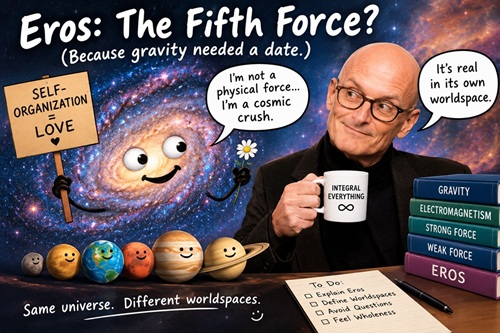 Ken Wilber has never been shy about making large claims. But occasionally a sentence arrives that seems to collapse several layers of his philosophy into one astonishing assertion. One such sentence occurs in Finding Radical Wholeness, where Wilber writes: “The inherent drive of the universe to self-organize has set evolution in motion and then pushed it from within to ever-greater and ever more unified wholes (or holons)…” And then comes the clincher: “This is an inherent drive—an actual force—present in the universe itself. It's as real a force as gravity, electromagnetism, and the strong and weak nuclear forces.” (p. 167) That is an extraordinary statement. It appears to promote Eros—or, as Wilber now sometimes prefers to call it, self-organization—to the status of a fundamental feature of reality alongside the four fundamental interactions of physics. But perhaps we should be charitable. Wilber has another doctrine available to him: what counts as real depends upon the worldspace in which it is enacted or disclosed. A unicorn can be real in a mythic worldspace without being a zoological animal. Buddha-nature can be real in a contemplative worldspace without being an object detectable by a particle accelerator. In his integral semiotics, Wilber explicitly argues that a referent has to be located at the appropriate “Kosmic Address” and that something can be real in one worldspace without being findable in another. So perhaps Wilber did not mean that Eros is literally a fifth physical force. Fine. But then we have to ask the obvious question: what did he mean? And once that question is asked, the impressive sentence on page 167 begins to deflate rather rapidly. The charitable interpretationThe most charitable reading is that Wilber is not proposing another force of nature alongside gravity and electromagnetism. He is proposing a metaphysical principle of cosmic emergence. On this interpretation, gravity describes one kind of physical causation, electromagnetism another, while Eros describes a much broader tendency of reality toward self-organization, increasing complexity, integration and eventually consciousness. It would therefore be a category mistake to ask for an Eros particle, an Eros field equation or an Eros-mediated interaction. This interpretation is certainly compatible with some of Wilber's earlier qualifications. In discussions of evolution, he has sometimes insisted that Eros need not be a “metaphysical force” but could instead be understood as an “intrinsic force of self-organization.” He has also invoked Stuart Kauffman and other complexity theorists as precedents for the idea that self-organization contributes to evolutionary emergence. There is therefore a possible Wilberian distinction: • physical force: a measurable interaction described by physics; • Eros: a trans-physical, metaphysical or ontological tendency toward greater organization and wholeness. If that is what Wilber means, then the problem is not that he has discovered a fifth physical force. The problem is that he has not told us what sort of thing Eros is. The sentence that gives the game awayThe difficulty is that Wilber himself makes the physical analogy extraordinarily strong. He does not merely say that Eros is “real in its own worldspace.” He says it is an “actual force” present in the universe itself and that it is “as real a force as gravity, electromagnetism, and the strong and weak nuclear forces.” That is not ordinary language for a merely interpretive principle. If Wilber had written: “Eros is a metaphysical interpretation of the remarkable tendency of complex systems to generate higher-order organization,” we would have a philosophical proposition to debate. But he didn't. He chose the vocabulary of causal ontology: inherent drive, pushed from within, actual force, present in the universe itself, as real as gravity. And this is not an isolated slip. In the same passage he immediately extends the claim from cosmic evolution to biological and psychological evolution. The force that supposedly produced galaxies and organisms is also the force that produces higher human developmental stages. Elsewhere Wilber has been even more explicit. In a later interview he describes self-organization as one of four forces—alongside Agency, Communion and Agape—and says that these forces operate in different directions within holons. And in an earlier discussion he said that a “force of self-organization” is “built into the universe” and is responsible for at least part of the emergence of complex forms in evolution. So the most defensible reading is not that Eros is literally another fundamental interaction of particle physics. It is that Wilber thinks the universe possesses an intrinsic causal tendency toward increasing organization, complexity, integration and ultimately consciousness. That is a substantial metaphysical claim. And it still needs an argument. “Real in a worldspace” is not a magic solventThis is where Wilber's worldspace doctrine becomes particularly slippery. Suppose we grant the principle that reality is disclosed differently in different worldspaces. That can be useful as a phenomenological observation. A mythic symbol is not experienced in the same way as a chemical molecule; a mathematical object is not encountered in the same way as a physical object; a meditative state is not reducible to a brain scan. But it does not follow that every proposed entity becomes equally explanatory merely because it has been assigned a worldspace. Otherwise “real” becomes dangerously cheap. I can say that Santa Claus is real in a mythic worldspace. Fine. But that does not explain why reindeer fly. I can say that karma is real in a Buddhist worldspace. Fine. But that does not establish karma as a causal mechanism in biology. I can say that Eros is real in a metaphysical worldspace. Fine. But that does not explain why organisms evolve. Wilber himself recognizes the need for a Kosmic Address precisely because different kinds of referents belong to different contexts. But the existence of a context in which something is meaningful is not by itself evidence that the thing possesses causal efficacy in another context. And that is precisely the problem with Eros. Wilber is not merely discussing what evolution means to us. He is claiming something about what made evolution happen. Self-organization is not a cosmic agentThe central sleight of hand occurs in the treatment of “self-organization.” Self-organization is a perfectly respectable scientific concept. Physical, chemical and biological systems can spontaneously develop structure under appropriate conditions. Dissipative structures, convection cells, chemical oscillations and many other phenomena demonstrate that order can emerge without an external designer. But “self-organization” does not therefore constitute a mysterious additional cosmic agent. The word “self” in self-organization does not imply an internal little organizer. A snowflake self-organizes. A hurricane self-organizes. A convection pattern self-organizes. None of this requires a cosmic intention to make the snowflake become increasingly conscious. The scientific concept describes how certain systems behave under particular conditions. Wilber turns that description into a cosmic tendency and then into an evolutionary principle. That is a very different proposition. Indeed, Wilber's own terminology reveals the problem. “Self-organization” begins as a description of spontaneous order. It becomes an “inherent drive.” The inherent drive becomes an “actual force.” And the force becomes Eros. At every step, something more has been added. But where is the evidence for the addition? From order to progressThere is an even deeper problem. Even if we grant that self-organization occurs throughout nature, why should this amount to a drive toward ever-greater and ever more unified wholes? That is not simply a description of self-organization. It is a theory of directionality. The universe contains stars, galaxies, planets, crystals, weather systems, organisms, ecosystems and societies. Some systems become more complex; others become simpler. Some persist; others disappear. Some lineages diversify; others become extinct. Evolution produces spectacular complexity, but it also produces enormous amounts of evolutionary dead ends, parasitism, simplification and extinction. Wilber retrospectively reads the entire 14-billion-year history of the universe as a movement toward greater wholeness. But the retrospective sequence is doing most of the work. We start with the present. We then look backwards and notice that matter produced stars, stars produced heavier elements, planets produced chemistry, chemistry produced life, life produced nervous systems, nervous systems produced minds, and human minds produced increasingly complex forms of culture. From this sequence Wilber infers a cosmic drive. But the existence of a spectacular sequence does not establish the existence of a force that was driving the sequence. That is the crucial logical gap. The universe does not need to know where it is goingThe distinction between emergent directionality and teleological direction is essential here. Evolution can generate increasingly complex structures without complexity being the goal of evolution. Selection can accumulate adaptations without evolution “trying” to produce eyes. Development can produce increasingly differentiated organisms without the universe containing a cosmic intention toward mammals. And human cultural evolution can generate greater conceptual sophistication without the cosmos secretly aiming at Integral consciousness. Wilber turns historical emergence into ontological intention. That is the move that needs justification. Instead, it is repeatedly presented as though the historical sequence itself constitutes the evidence. The universe has become more complex. Therefore the universe contains a drive toward complexity. But that is perilously close to saying: Things became complex because there is a tendency toward complexity, and we know there is a tendency toward complexity because things became complex. That is not an explanation. It is a restatement. The “why” question becomes a trapWilber is right about one thing: science can describe enormous amounts of evolutionary history without necessarily answering every philosophical question about why there is something rather than nothing, why the laws of nature have the form they do, or why the universe permits complexity and life. But the fact that science leaves philosophical questions open does not mean that Eros answers them. Wilber explicitly divides evolution into a “what” and a “why.” The “what” is the empirical history of evolution; the “why” concerns the drive behind that history. He then introduces Whitehead's “creative advance into novelty,” Jantsch's “self-organization through self-transcendence,” Prigogine's “order out of chaos,” Varela's autopoiesis and the philosophical notion of Eros as possible answers. This is an interesting philosophical catalogue. But notice what has happened. A series of quite different scientific and philosophical concepts is assembled under one grand heading: the universe wants to become more whole. Yet these concepts do not automatically entail that conclusion. Prigogine's dissipative structures do not entail spiritual evolution. Autopoiesis does not entail cosmic consciousness. Complexity theory does not entail an evolutionary ladder. And Whitehead's metaphysics does not become empirical evidence merely because it sounds congenial to Wilber's theory. The fact that several thinkers have proposed ways of thinking about novelty and organization does not establish Wilber's particular synthesis. Kauffman is not WilberThis is especially important because Wilber frequently invokes Stuart Kauffman. Kauffman's work on self-organization is genuinely important. But citing Kauffman does not magically convert Wilber's Eros into a scientific theory. Scientific self-organization is about what systems can do under particular physical and chemical constraints. Wilber's Eros is being asked to do something vastly larger: explain the historical movement from matter to life to mind to culture and ultimately to higher consciousness. That is an enormous extrapolation. It is the difference between saying: Complex systems can spontaneously generate order. and saying: The universe contains a fundamental drive toward greater complexity, unity and consciousness. The first is a scientific research program. The second is a metaphysical interpretation. Confusing the two is precisely where Wilber's rhetoric becomes problematic. So what kind of “force” is Eros?We can now return to the original question. Did Wilber mean that Eros is literally a physical force? Probably not—not in the narrow sense in which physicists use the term. There is no indication that he is proposing an additional interaction with a measurable coupling constant, a field, a carrier particle or a mathematical law comparable to the established physical interactions. But that does not make Eros innocuous. The better description is that Wilber appears to mean a cosmic ontological tendency: an intrinsic feature of reality that biases evolutionary processes toward organization, complexity, integration, wholeness and ultimately consciousness. That is stronger than a metaphor. It is stronger than a hermeneutic interpretation. And it is certainly stronger than merely saying that some systems self-organize. It is a metaphysical causal hypothesis. And once we call it that, we can ask the questions Wilber routinely avoids. What exactly is its mechanism? Under what conditions does it operate? How strong is it? When does it fail? What phenomena does it predict? What phenomena would count against it? How can we distinguish an Eros-driven evolutionary event from an event produced by ordinary physical, chemical, developmental and evolutionary processes? What unique empirical consequences follow from adding Eros to our ontology? If the answer to these questions is “none, because Eros operates in another worldspace,” then we have learned something important. Eros may be meaningful as a metaphysical interpretation, but it is not functioning as an empirical explanation of evolution. And that is a perfectly respectable philosophical position—provided it is presented honestly as such. The worldspace escape hatchThis is where Wilber's doctrine of multiple realities becomes both fascinating and potentially evasive. He can say: “Eros is real.” The skeptic asks: “Where is the evidence?” The skeptic asks: “What does Eros causally do?” The skeptic asks: “How does it differ from ordinary self-organization?” At that point the theory has acquired an extraordinary immunity to criticism. And that is precisely the danger. A theory that can always relocate its entities to a different worldspace whenever empirical criticism arrives risks becoming unfalsifiable by design. The worldspace doctrine may be useful for distinguishing different modes of experience. It becomes problematic when it is used to protect causal claims from empirical scrutiny. A metaphysical claim can certainly be meaningful without being scientifically testable. But then it should not borrow the authority of physics by announcing that it is “as real” as gravity. Gravity does not need a Kosmic AddressThere is something almost comical about Wilber's comparison. Gravity does not have to explain which worldspace it belongs to. It makes objects accelerate. Its effects can be measured. Its mathematical description can be tested. It can be distinguished from electromagnetism. Its predictions can fail. It can be incorporated into increasingly successful physical theories. If Wilber wants Eros to be “as real” as gravity, the burden is not merely to say that Eros is real in some higher-order worldspace. He has to tell us what kind of reality is being claimed and what difference that reality makes. Otherwise the comparison with gravity is rhetorical inflation. The phrase “as real as gravity” sounds extraordinarily precise while actually concealing an enormous ambiguity about the word real. The remarkable thing about evolution needs no cosmic ghostThere is an irony here. Wilber does not need Eros to make evolution astonishing. Evolution is already astonishing. The emergence of complexity from relatively simple physical beginnings is one of the great scientific stories of all time. The fact that natural selection, mutation, developmental constraints, ecological interactions, self-organization and physical law can produce organisms of extraordinary complexity is not a problem requiring a cosmic motivational force. Indeed, the scientific story becomes more—not less—astonishing when no cosmic hand is required. The temptation to insert Eros comes from a philosophical discomfort: how could blind processes produce something so magnificent? But “magnificent” is a human evaluation. Nature does not need to contain a corresponding desire for magnificence. The universe does not have to admire the human brain in order for the human brain to exist. Nor does it have to be striving toward consciousness for consciousness to emerge. From explanation to celebrationThis is ultimately what is wrong with Wilber's passage. It begins as explanation but ends as celebration. The universe has produced this “unbelievably beautiful world.” Therefore there must have been an inherent drive toward it. But beauty is not evidence of teleology. It is an assessment made by organisms capable of aesthetic appreciation. Wilber takes the retrospective astonishment we experience before cosmic history and converts it into a property of the cosmos itself. That is a poetic move. It may even be a spiritually inspiring move. But it is not thereby an explanatory one. And this is why the distinction between “Eros as metaphor,” “Eros as metaphysical principle,” and “Eros as actual force” matters so much. If Eros is merely metaphor, there is little to object to—but little explanatory content either. If Eros is a metaphysical principle, it becomes a legitimate philosophical hypothesis, but it must be defended philosophically rather than by invoking gravity, electromagnetism and nuclear forces. If Eros is an actual causal force in the universe, then Wilber owes us something resembling a theory. He cannot have all three meanings simultaneously, switching between them according to the criticism being offered. The final ironyWilber's worldspace theory was designed, among other things, to prevent different kinds of reality from being confused with one another. Yet his Eros argument does almost exactly that. He takes a legitimate scientific phenomenon—self-organization—adds a metaphysical interpretation—cosmic Eros—adds a teleological conclusion—increasing wholeness—and finally gives the entire package the ontological status of gravity. Then, if challenged, he can retreat to the claim that “real” does not necessarily mean physically real. That is precisely the ambiguity that needs to be exposed. The strongest charitable reconstruction of Wilber's position is therefore also its most revealing one: Eros is probably not a fifth physical force. It is a proposed metaphysical tendency of the universe toward greater organization, complexity, integration and consciousness. But once stated that way, the question becomes unavoidable: Why should we believe that such a tendency exists? Not because evolution happened. Not because complexity is beautiful. Not because self-organization exists. Not because Whitehead called novelty “creative advance.” Not because Kauffman studies complex systems. And certainly not because Wilber calls Eros “as real as gravity.” Those things may motivate a metaphysical interpretation. They do not establish the metaphysical entity. The great weakness of Wilber's Eros is therefore not that it is too spiritual, too mystical or insufficiently scientific. It is much simpler. It purports to explain the direction of evolution by giving that direction a name. Eros is the drive toward greater wholeness because the universe displays greater wholeness. It is the force behind self-organization because self-organization occurs. It is the explanation for evolutionary emergence because emergence occurred. And once the metaphysical poetry is stripped away, the alleged cosmic force begins to look suspiciously like a label attached to the very mystery it was introduced to explain. That is not radical wholeness. It is radical question-begging.
Widget is loading comments...
|