|
TRANSLATE THIS ARTICLE
Integral World: Exploring Theories of Everything
An independent forum for a critical discussion of the integral philosophy of Ken Wilber
  Frank Visser, graduated as a psychologist of culture and religion, founded IntegralWorld in 1997. He worked as production manager for various publishing houses and as service manager for various internet companies and lives in Amsterdam. Books: Ken Wilber: Thought as Passion (SUNY, 2003), and The Corona Conspiracy: Combatting Disinformation about the Coronavirus (Kindle, 2020). Frank Visser, graduated as a psychologist of culture and religion, founded IntegralWorld in 1997. He worked as production manager for various publishing houses and as service manager for various internet companies and lives in Amsterdam. Books: Ken Wilber: Thought as Passion (SUNY, 2003), and The Corona Conspiracy: Combatting Disinformation about the Coronavirus (Kindle, 2020).
Check out my other conversations with ChatGPT Integral Post-MetaphysicsHas Wilber Really Left Metaphysics Behind?Frank Visser / ChatGPT
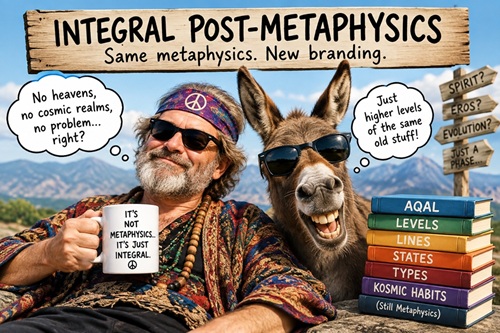 The promise of a post-metaphysical spiritualityFew concepts in the later philosophy of Ken Wilber are more ambitious—and more slippery—than Integral Post-Metaphysics. Introduced most systematically in Integral Spirituality (2006), the project was presented as a way of preserving the deepest insights of premodern spirituality while abandoning the obsolete cosmological assumptions in which those insights had traditionally been embedded. Wilber wanted the wisdom of the mystics without their heavens, planes, subtle bodies, cosmic hierarchies and otherworldly entities. That sounds like a formidable intellectual achievement. And there is something genuinely valuable in the project. Ancient spiritual traditions certainly contain psychological and contemplative insights that need not depend on taking their traditional cosmologies literally. Meditation does not become worthless because ancient Buddhists, Hindus or Christians had mistaken ideas about astronomy. Nor does a mystical experience automatically establish the cosmology in which a tradition interprets it. But Wilber's proposed solution creates a curious paradox. Integral Post-Metaphysics does not so much eliminate metaphysics as relocate it. Metaphysical structures become developmental structures; cosmic realms become structures of consciousness; eternal levels become historically evolved "Kosmic habits"; objective realities become enacted realities; and traditional spiritual claims are reformulated in the language of perspectives, worldspaces, injunctions and developmental stages. The vocabulary changes dramatically. The underlying philosophical problem does not disappear. Indeed, Wilber eventually seems to acknowledge as much. Later formulations speak explicitly of a "minimalist metaphysics", rather than a complete escape from metaphysics. A 2019 special issue devoted to Integral Postmetaphysical Spirituality notes that The Religion of Tomorrow (2017) presents the position more cautiously in precisely this way. The interesting question, therefore, is not whether Integral Post-Metaphysics is literally "beyond metaphysics." It isn't. The interesting question is whether it provides a better way of doing metaphysics. That is a much harder test. What does "metaphysics" mean here?The first difficulty is terminological. In ordinary philosophy, metaphysics is not synonymous with superstition, dogma or "assertions without evidence." It is the systematic investigation of questions concerning reality, existence, causation, identity, possibility, necessity, time, mind and world. Even the statement that reality contains no supernatural entities is, in a broad sense, a metaphysical position. Wilber's usage is narrower and more polemical. In his post-metaphysical formulation, the target is the assumption that there is a pregiven world whose structures can simply be represented by consciousness. The modern critique of naive realism and the postmodern critique of representation are therefore central to his argument. integralpostmetaphysics.ning.com This is an important insight. What we perceive is indeed conditioned by our sensory apparatus, conceptual categories, language, culture, learning history and cognitive development. A bacterium, a dog, a mountain and a galaxy are not experienced in exactly the same way by a bacteriologist, a child, a geologist and a poet. But an epistemological point does not automatically become an ontological one. The fact that our access to reality is perspectival does not establish that reality itself is constituted by those perspectives. That distinction is crucial. From representation to enactmentWilber's major conceptual move is from representation to enactment. Rather than imagining consciousness as a passive mirror reflecting a pregiven world, Integral Post-Metaphysics proposes that different practices and perspectives bring different aspects of reality into disclosure. The famous formulation is that "the meaning of a statement is the injunction of its enactment." In other words, one should specify not merely what is claimed, but who is making the claim, from what developmental perspective, under what conditions, using what method. ResearchGate This has considerable merit as an epistemological discipline. If someone says, "I experienced a subtle energy," one can reasonably ask: Under what circumstances? What practice was being performed? What precisely was experienced? Can other practitioners reproduce it? What distinguishes it from expectation, suggestion, imagination or ordinary physiological effects? That is much better than simply saying: "The ancient tradition says subtle energy exists, therefore subtle energy exists." Integral Post-Metaphysics is strongest when it makes this kind of demand. But then something curious happens. The epistemological insight gets converted into an ontology. Wilber does not stop at saying that people construct different interpretations of experience. He proposes developmental structures that have emerged through evolution and subsequently become "Kosmic habits." Once established, these structures can function as givens for later subjects. Wilber therefore attempts to explain how apparently pre-existing structures can emerge historically without having existed eternally as Platonic or metaphysical structures. integral-life-home.s3.amazonaws.com This is ingenious. But ingenuity is not evidence. The great escape from the Great ChainThe underlying problem becomes clearer if we look at what Wilber is trying to rescue. Premodern traditions commonly presented reality as a hierarchy of levels: matter, life, mind, soul, spirit, God, Brahman, Buddha-nature, heaven, subtle worlds and so forth. Wilber's mature integral theory wants to preserve much of the developmental architecture of this Great Chain while rejecting its naive cosmological interpretation. Instead of saying that subtle and causal realms objectively exist somewhere "out there," the integral theorist can say that these are dimensions of consciousness disclosed under appropriate conditions. That is a useful demythologizing strategy. But there is an obvious danger: the Great Chain can return through the back door. The old metaphysical hierarchy said: Reality is structured into higher and lower levels.
The post-metaphysical version says: Consciousness develops through increasingly inclusive levels, and different developmental stages disclose different structures of reality.
The terminology is different, but the hierarchy has not necessarily disappeared. It has become developmental. And that matters because developmental psychology can describe sequences without thereby proving that those sequences constitute an ontological hierarchy of reality. A person can become better at mathematics without mathematics becoming metaphysically "higher." A person can develop sophisticated moral reasoning without the universe itself thereby acquiring a moral direction. A person can learn to experience nonduality without that experience proving that reality is ultimately One. The move from developmental achievement to ontological significance requires an argument of its own. The problem of "Kosmic habits"The concept of Kosmic habits is perhaps the most interesting—and most vulnerable—part of the system. Wilber's idea is roughly that earlier evolutionary achievements become established structures that later beings inherit. What once had to be created becomes a condition of subsequent development. Thus contemporary human beings do not have to reinvent biological evolution, language, basic cognition or earlier developmental structures from scratch. That is perfectly intelligible in evolutionary terms. But the problem becomes much greater when the same logic is extended to spiritual stages and structures. Suppose exceptionally advanced meditators experience a particular state. Suppose many practitioners independently report something similar. Suppose contemplative traditions develop sophisticated maps of such experiences. Does this demonstrate that a new Kosmic structure has been created and incorporated into the universe? That conclusion is much stronger. It requires evidence that distinguishes at least three possibilities: 1. a genuinely new feature of reality has emerged; 2. human beings have discovered a previously existing feature of reality; 3. human beings have developed a recurrent psychological capacity and constructed cultural interpretations around it. Integral Post-Metaphysics often moves between these possibilities without adequately separating them. This is precisely where critics have pressed Wilber. Magnus Riisager, for example, argues that Wilber's supposedly post-metaphysical position still contains substantial metaphysical commitments, particularly concerning Spirit, developmental levels and the ontological status of structures. The mystical experience problemHere we reach the deepest difficulty. Integral theory places enormous importance on contemplative experience. This is understandable. Mystical states are real experiences, and their phenomenology deserves serious investigation. But there is a fundamental distinction between: "I experienced X" and "X is therefore a feature of ultimate reality." The first is an experiential claim. The second is an ontological claim. The first may be established through phenomenological investigation. The second requires additional justification. This is not an attack on mysticism. It is simply the difference between phenomenology and metaphysics. A person can have an overwhelming experience of unity without that experience proving that the universe is metaphysically One. A person can experience timelessness without demonstrating that time does not exist. A person can experience an absence of self without establishing that no selves exist. A person can experience a luminous presence without establishing an independent spiritual substance. As Magnus Riisager points out, a completely distinctionless experience does not logically entail that all distinctions in reality are unreal. This is where Wilber's epistemology becomes vulnerable to circularity. The advanced practitioner is said to have access to a higher worldspace. The resulting experience confirms the existence of that worldspace. The worldspace is then used to explain why the practitioner had the experience. The argument risks becoming: Advanced practice reveals higher structures because higher structures are what advanced practice reveals.
That is not yet independent evidence. The "community of the adequate"Wilber attempts to avoid private revelation by emphasizing intersubjective verification. This is an important move. If one person reports an unusual experience, skepticism is appropriate. But if thousands of trained practitioners, following comparable practices, independently report broadly similar experiences, the claim deserves greater attention. The difficulty is that agreement among practitioners is not the same thing as objective verification. Religious communities have historically produced remarkable agreement about experiences interpreted through their respective traditions. Christian contemplatives, Hindu yogis, Buddhist meditators and Sufi mystics may report profound experiences, but the interpretations attached to those experiences are not identical. Even within one tradition, practitioners can converge because they share expectations, vocabulary, practices and cultural models. This does not make their experiences unreal. It means that intersubjective agreement itself needs interpretation. Integral Post-Metaphysics sometimes seems to underestimate just how difficult that interpretation is. The paradox of evidenceThere is another problem. Wilber wants post-metaphysics to be more empirically responsible than traditional metaphysics. Claims should be grounded in experience, evidence, methods and communities of inquiry. Excellent. But then what happens to the fundamental integral assumptions themselves? Where does AQAL come from? Where does the developmental hierarchy come from? Where does the evolutionary directionality come from? Where does Eros come from? Where does Spirit come from? Where do the proposed structures of consciousness come from? If the answer is ultimately that these are inferred from the totality of developmental, phenomenological, evolutionary and contemplative evidence, then each individual component still needs independent justification. If, on the other hand, they are regarded as necessary features of the integral framework, then they begin to function as theoretical postulates. That is not necessarily illegitimate. Scientific theories contain theoretical entities all the time. But theoretical entities are not made non-metaphysical simply by calling them "enacted," "emergent" or "Kosmic habits." The issue is always the same: What evidence would distinguish the claim from its competitors? The Eros problem returnsThis exposes a particularly striking tension in Wilber's philosophy. The post-metaphysical turn was supposed to eliminate the need for traditional metaphysical entities. Yet Wilber retains a cosmic developmental impulse, variously described through concepts such as Eros, Spirit, creativity or the drive toward greater complexity and consciousness. Wilber has even compared Eros to fundamental forces of nature. That is an extraordinary claim. A force in physics is not simply a poetic name for a tendency we observe. It enters a framework of measurement, mathematical description, causal explanation and prediction. Calling cosmic creativity "Eros" does not supply such a mechanism. This is precisely where the old metaphysics seems to reappear in modern clothing. The traditional metaphysician said: Spirit drives evolution upward.
The post-metaphysical integral theorist says: Evolution contains a tendency toward greater complexity and consciousness, which can be understood as Eros or creative emergence.
But unless the latter formulation identifies a demonstrable mechanism, independent evidence and testable consequences, it has not really escaped the explanatory problem. It has renamed it. This is why the distinction between describing a developmental pattern and explaining why that pattern occurs is so important. "The universe according to Wilber"There is a temptation in integral discourse to treat AQAL as a neutral meta-framework. Quadrants, levels, lines, states and types supposedly provide a comprehensive architecture within which many different perspectives can coexist. But AQAL is not simply an empty container. It contains substantive assumptions about consciousness, development, evolution, interiors, exteriors, individual and collective dimensions, and the relationship among them. That is perfectly legitimate. A theory needs assumptions. The problem arises when the framework presents itself as if it has somehow escaped the need for ontological justification. Frank Visser has made essentially this criticism in his review of The Religion of Tomorrow: the post-metaphysical approach can be useful for describing mystical states and developmental structures, but it should not be used to infer far-reaching conclusions about the origin and ultimate structure of the universe. That distinction deserves to be taken seriously. There is a perfectly respectable integral psychology waiting to be extracted from Wilber's system. There is a much more controversial integral cosmology hiding behind it. The former does not automatically establish the latter. Ferrer's objection: why not participation?The critique from Jorge N. Ferrer is particularly interesting because it comes from within the transpersonal and integral neighborhood rather than from straightforward scientific reductionism. Ferrer argues that Wilber's post-metaphysical treatment is neither as novel nor as non-metaphysical as advertised. Some Buddhist traditions, for example, had already interpreted spiritual realities in relation to consciousness rather than as simple external objects. Ferrer instead emphasizes a participatory conception in which spiritual realities can be co-created without being reduced to fixed developmental structures. integralworld.net That criticism points toward a larger issue. Wilber's model tends to privilege developmental structure. Ferrer's approach emphasizes creative participation and plurality. The difference is significant. If spiritual development creates a fixed sequence of Kosmic structures, then evolution eventually becomes a kind of metaphysical staircase. If spiritual realities are participatively enacted, however, there may be multiple possible pathways, cultural variations and genuinely novel forms of spirituality. Ferrer explicitly argues that cocreated spiritual realities need not be mandatory, fixed, universally sequential or limited in number. ResearchGate That may actually be closer to what "post-metaphysical" ought to mean: not replacing one universal metaphysical map with another, but becoming more modest about what our maps can legitimately tell us about reality. The later retreat to "minimalist metaphysics"The most revealing development is that Wilber eventually seems to soften his original claim. In later formulations, minimalist metaphysics replaces the more triumphalist notion that metaphysics has simply been transcended. A 2019 review of the field notes this shift explicitly, describing Wilber's 2017 position as more cautious than the 2006 formulation. This is, in my view, an improvement. Everyone has metaphysical assumptions. The scientist has them. The materialist has them. The idealist has them. The Buddhist has them. The phenomenologist has them. The integral theorist certainly has them. The mature question is therefore not: "Are you metaphysical?"
It is: "Which metaphysical claims are you making, what evidence supports them, what alternatives compete with them, and how confidently should we hold them?"
That formulation is much more difficult to market than "post-metaphysics." But intellectually, it is much healthier. What survives the demolition?It would be unfair to conclude that Integral Post-Metaphysics is therefore worthless. Quite the contrary. Several of its strongest insights deserve to survive independently of the grander integral cosmology. First, premodern spiritual cosmologies should not automatically be treated as literal descriptions of physical reality. Second, the observer and the method of observation matter. There is no view from nowhere. Third, different practices disclose different dimensions of experience. Meditation, psychotherapy, scientific observation, artistic practice and social participation genuinely reveal different aspects of human existence. Fourth, development changes what people are capable of noticing, understanding and integrating. Fifth, spiritual experiences deserve neither automatic credulity nor automatic dismissal. They can be studied phenomenologically, psychologically, culturally and, where appropriate, scientifically. Sixth, epistemology matters. Before making an extraordinary claim, one should ask who is making it, how it was obtained and what would count as confirmation or disconfirmation. These are considerable achievements. But none requires a cosmic Spirit. None requires Eros. None requires involution. None requires a metaphysical hierarchy of consciousness. And none requires the conclusion that mystical experience reveals the ultimate architecture of the universe. From "post-metaphysical" to epistemically modestPerhaps the most useful reinterpretation of Integral Post-Metaphysics is therefore a much more modest one. Instead of saying: We have finally discovered how spirituality can become post-metaphysical.
we might say: We have learned that spiritual claims require different kinds of evidence, and that experiences, interpretations and ontological conclusions must not be confused.
That is less spectacular. It is also more defensible. The real contribution of the post-metaphysical turn may lie not in producing a new theory of everything, but in disciplining the transition from experience to interpretation. A meditator can say, "I experienced boundless awareness." A psychologist can ask what cognitive and neurological processes accompany that experience. A phenomenologist can describe its structure. A historian can investigate how different cultures interpret it. A philosopher can ask what, if anything, follows from it about consciousness. A metaphysician can ask whether it supports idealism, panpsychism, nondualism or some other ontology. And a scientist can ask which parts of these claims are empirically testable. That division of labor is far more productive than prematurely declaring the whole enterprise "post-metaphysical." The great ironyThere is an amusing irony here. Wilber's post-metaphysical project was designed to rescue spirituality from the charge of making unsupported metaphysical claims. Yet the more elaborate the system becomes, the more it starts generating precisely the sort of claims it was designed to eliminate: evolutionary direction, Kosmic structures, Spirit, Eros, involutionary givens, developmental hierarchies and an ultimate nondual ground. The old metaphysical furniture has not vanished. It has been renovated. The heavenly realms have become worldspaces. The Great Chain has become developmental levels. Eternal structures have become Kosmic habits. Revelation has become enactment. Metaphysical cosmology has become integral cosmology. This does not make the new version illegitimate. But it does mean that "post-metaphysical" is an overstatement. Conclusion: Metaphysics by another name Integral Post-Metaphysics is best understood not as the abolition of metaphysics but as an ambitious attempt to reconstruct metaphysical discourse after the modern and postmodern critiques of naive realism. That is a worthwhile project. Its enduring insight is that we should be suspicious of the idea that ancient spiritual descriptions are transparent photographs of reality. Experiences are mediated. Perspectives matter. Development matters. Culture matters. Methods matter. The knower cannot simply be removed from the known. But Wilber too often takes the next step too quickly. From the fact that knowledge is enacted, he moves toward claims about what has been enacted. From recurrent mystical experiences, he moves toward structures of consciousness. From developmental sequences, he moves toward evolutionary direction. From spiritual phenomenology, he moves toward cosmology. And there the old metaphysical questions return. The central test is therefore refreshingly simple: What does the theory explain that a less metaphysically loaded theory cannot explain? If "Spirit," "Eros," "Kosmic habits" and developmental levels merely redescribe phenomena that psychology, biology, cultural evolution and phenomenology can already describe, then the integral vocabulary adds interpretation but not explanation. If, however, these concepts generate genuinely new predictions, mechanisms or independently testable discoveries, then the situation changes dramatically. That is the point at which Integral Post-Metaphysics could become more than an elegant philosophical vocabulary. Until then, the phrase is perhaps best read with a wink. Integral Post-Metaphysics is metaphysics that has learned to say it isn't metaphysics. And perhaps that is not the end of metaphysics after all. Sources and further readingWilber's foundational formulation appears in Integral Spirituality (2006), especially the appendix on Integral Post-Metaphysics; his earlier Kosmic Karma and Creativity materials already developed the shift from metaphysical structures toward historically emerging "Kosmic habits." For the subsequent debate, the 2019 special issue of Integral Review devoted specifically to Integral Postmetaphysical Spirituality is particularly useful because it shows that the project developed into a substantial conversation rather than remaining merely Wilber's personal formulation. IntegralReview Jorge Ferrer's critique provides one of the strongest alternative approaches, contrasting Wilber's post-metaphysical model with a participatory spirituality. IntegralWorld Magnus Riisager's critique focuses directly on the tension between Wilber's relativistic epistemology and his continuing substantive commitments to Spirit and developmental structures. IntegralWorld Michael Schwartz's survey is useful for understanding the later transition from "post-metaphysics" toward Wilber's more cautious notion of "minimalist metaphysics." IntegralReview See also Frank Visser's multi-part review of The Religion of Tomorrow, especially Part 1: The involution/evolution cosmology Ken Wilber Holds on to an Outdated Scheme of Existence" IntegralWorld
Widget is loading comments...
|