|
TRANSLATE THIS ARTICLE
Integral World: Exploring Theories of Everything
An independent forum for a critical discussion of the integral philosophy of Ken Wilber
  Frank Visser, graduated as a psychologist of culture and religion, founded IntegralWorld in 1997. He worked as production manager for various publishing houses and as service manager for various internet companies and lives in Amsterdam. Books: Ken Wilber: Thought as Passion (SUNY, 2003), and The Corona Conspiracy: Combatting Disinformation about the Coronavirus (Kindle, 2020). Frank Visser, graduated as a psychologist of culture and religion, founded IntegralWorld in 1997. He worked as production manager for various publishing houses and as service manager for various internet companies and lives in Amsterdam. Books: Ken Wilber: Thought as Passion (SUNY, 2003), and The Corona Conspiracy: Combatting Disinformation about the Coronavirus (Kindle, 2020).
Check out my other conversations with ChatGPT The Added Value of Alethic AIA Critical Examination of Metacognitive AI, Causality, and the Return of MetatheoryFrank Visser / ChatGPT
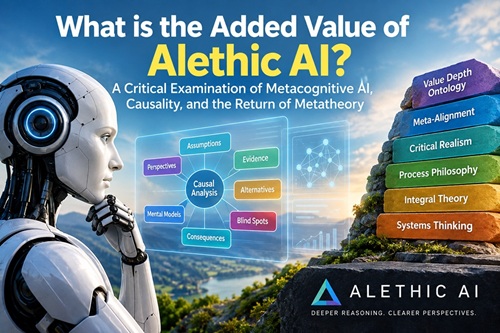 Introduction: A New AI or a New Description of AI?The Institute of Applied Metatheory has begun promoting Alethic AI as something more ambitious than another large-language-model interface. Alethic describes itself as “true causal AI” for difficult or “wicked” problems and claims to help users uncover what is actually producing a situation, what holds it in place, and where it might be open to change. It explicitly contrasts itself with ordinary AI, which it characterizes as producing answers from patterns in its training data. The philosophical ambition is even greater. In Robb Smith and IAM's 2026 paper Beyond Alignment, Alethic AI is presented as an attempt to move beyond conventional AI alignment. Instead of treating human values as a fixed target toward which an AI system should be optimized, the authors propose a “value depth ontology” and a form of “meta-alignment” in which AI navigates a developmental landscape of values while remaining reflexive about its own perspective and conditions of knowing. This is an interesting proposal. But interesting does not mean demonstrated. The central question therefore becomes: what exactly is the added value of Alethic AI? There are at least three possible answers. It might add value as a sophisticated user interface for thinking. It might add value through a genuinely different computational architecture. Or it might add value by introducing a philosophical framework that changes what counts as adequate reasoning. The first is plausible. The second is possible but insufficiently documented publicly. The third is intellectually ambitious but also the most questionable, because Alethic's philosophical foundations contain precisely the kind of metatheoretical assumptions that its proponents criticize ordinary AI for concealing. The danger is that “Alethic” could become less a new form of artificial intelligence than a new layer of philosophical interpretation placed over familiar AI. 1. The Genuine Problem Alethic IdentifiesThere is a legitimate problem underneath the elaborate terminology. Large language models are extraordinarily good at producing plausible linguistic continuations, synthesizing information, identifying patterns and generating arguments. But none of those abilities automatically gives an AI a reliable model of the causal structure of the world. A fluent explanation can still be false. A coherent argument can still rest on false premises. A sophisticated answer can mistake correlation for causation. An AI can also reproduce the conceptual assumptions embedded in its training material without recognizing those assumptions as assumptions. Alethic's emphasis on “frames, grounds and blind spots” is therefore potentially useful. Its current terms of service describe the system as a “metacognitive AI reasoning environment” in which these elements are surfaced alongside the analysis. The system explicitly describes itself as producing analysis rather than advice. That is a worthwhile direction. One can imagine an AI that does not merely answer: What is happening? but also asks: What assumptions am I making about what is happening? What causal mechanisms would have to exist for this explanation to be correct? Which observations would discriminate between competing explanations? What perspectives are missing? What would falsify this interpretation? Those are useful questions regardless of one's philosophical allegiance. In this respect, Alethic's strongest contribution may not be its ontology at all. It may be the systematic introduction of second-order questioning into AI-assisted reasoning. 2. But “Causal AI” Is a Very Big ClaimThe phrase “causal AI” deserves particular scrutiny. Alethic says that it works on “what is actually driving your situation—not on surface patterns.” It defines causality in practical terms as what produces a situation, what holds it in place and what would have to change. That is a useful definition for strategic analysis. But it is not yet equivalent to establishing causal structure in the technical scientific sense. Causal inference has an extensive literature involving causal graphs, structural causal models, interventions, counterfactual reasoning, identification assumptions and experimental or quasi-experimental evidence. A system that generates a convincing causal narrative has not thereby established that the proposed mechanism is causally operative. This distinction matters enormously. Suppose an organization is failing. An ordinary chatbot might say that poor leadership, inadequate communication and organizational silos are contributing factors. An Alethic system might construct a deeper explanation involving institutional incentives, developmental worldviews, reinforcing feedback loops and hidden assumptions. The latter may be much more illuminating. But it may also simply be a more elaborate story. Complexity can improve an explanation, but complexity can also camouflage speculation. Consequently, the crucial empirical test for Alethic is not whether it produces deeper-sounding explanations. It is whether its causal analyses outperform conventional AI and established causal-analysis methods when tested against independently known mechanisms and subsequent interventions. That test is not yet publicly established. 3. The Philosophical LeapThe most ambitious element of Alethic is found in Beyond Alignment. Smith argues that the conventional alignment problem is based on an inadequate conception of values. Human values cannot simply be treated as a collection of preferences that an AI should optimize. Values are instead described as part of a “value depth ontology”: the accumulated temporal and developmental structure of natural complexity and human sensemaking. This is where Alethic becomes distinctly IAM. Critical realism, process philosophy, emergent naturalism and integral post-metaphysics are brought together into a larger account of reality. The result is supposed to provide AI with something more profound than a list of rules: an architecture for navigating a structured normative domain. The attraction is obvious. Instead of saying: “Here are the values humans currently prefer; optimize them.” Alethic says, in effect: “Human values themselves have histories, structures, developmental transformations and relationships. Understand that structure before attempting to optimize anything.” That is a substantial conceptual improvement over naïve preference aggregation. But it does not follow that the proposed ontology is therefore correct. This is the point where the project risks reproducing the very problem of metatheory that IAM is otherwise trying to solve. 4. The Meta-Theory TrapIAM defines metatheory as operating “above” ordinary theory: theories become the data from which metatheory attempts to construct a larger and more coherent picture. Integrative metatheory then attempts to synthesize theories across domains into an even larger framework. This is precisely the intellectual tradition from which Alethic emerges. But there is an old philosophical problem here. How does the metatheory know that its own categories are superior to the categories it is integrating? A system can identify the hidden assumptions of physics, psychology, economics, politics and ethics. But it must itself employ assumptions in order to perform that analysis. Moving to a higher level does not eliminate presuppositions. It merely creates a new level at which presuppositions operate. This creates a potential infinite regress: Theory has assumptions. Metatheory identifies those assumptions. Meta-metatheory identifies the assumptions of the metatheory. And so on. Alethic attempts to escape this problem through reflexivity. The system should disclose its own perspective and conditions of knowing rather than pretending to occupy a neutral God's-eye position. That is sensible. But reflexivity does not automatically produce truth. Knowing that one has a perspective is not the same thing as having overcome that perspective. 5. The Problem of “Depth”The concept of depth is central to the project. Ordinary AI is characterized as operating at the surface level, while Alethic seeks to uncover deeper structures and generative mechanisms. In Beyond Alignment, Smith explicitly connects this distinction to Roy Bhaskar's critical realism and its distinction between the empirical, the actual and the real. This is intellectually coherent within a critical-realist framework. But “deeper” does not necessarily mean “truer.” This is an important distinction. Sometimes the best explanation is deeper than the observable phenomenon. Sometimes the deeper mechanism is exactly what science discovers. But sometimes a proposed deeper level is merely another theoretical construction. The history of intellectual thought contains countless examples of theories that promised access to hidden structures beneath appearances. Some succeeded spectacularly. Others generated elaborate metaphysical systems that explained everything precisely because nothing could falsify them. The word “depth” therefore needs operational definition. What constitutes a deeper explanation? How is depth measured? When do two competing explanations differ in depth? Can a supposedly deeper explanation make predictions that a shallower explanation cannot? Can it be falsified? Unless these questions are answered, “depth” risks becoming a prestige term for explanations that are simply more conceptually elaborate. 6. Developmental Hierarchy Returns Through the Back DoorThere is another particularly important issue for anyone familiar with Integral Theory. Alethic's account of values relies heavily on developmental differentiation. The argument is that human beings do not merely have different preferences; they may inhabit different structures of moral reasoning. Consequently, aggregating their preferences can conceal qualitative differences in how people construct moral problems. This is recognizably developmentalist. And that creates a problem. Who determines which form of reasoning is more developed? The moment “developmental altitude” becomes relevant to AI reasoning, the system requires a theory capable of distinguishing more adequate from less adequate forms of cognition. But that theory itself contains normative judgments. The familiar Integral solution is to say that later stages transcend and include earlier stages. Yet this formulation has always raised an empirical question: to what extent are developmental stages genuine features of human cognition, and to what extent are they interpretations imposed upon heterogeneous psychological and cultural phenomena? IAM is attempting to address this problem empirically. Its current work includes research intended to ground developmental levels with the Lectical Scale. That is precisely the right direction: measurement before metaphysical confidence. But it also demonstrates how much work remains. An AI system should not be granted authority over normative questions merely because its architecture contains a theory of developmental depth. 7. The Interesting Idea: Meta-AlignmentThe strongest philosophical idea in Alethic may be the distinction between alignment and meta-alignment. Traditional alignment asks something like: “How do we make an AI pursue the values we want?” Alethic asks: “What kind of reasoning system could navigate disagreements about values without simply privileging one set of preferences?” That is a genuinely interesting reformulation. It recognizes that there is a difference between: “I know what the correct value is.” and: “I have a disciplined method for examining competing claims about value.” The second is epistemically more modest. It also fits Alethic's stated ambition to leave judgment with the human rather than simply producing recommendations. The public description presents the system as a “copilot” that helps users understand what is producing a situation while leaving judgment to them. That human-in-the-loop orientation is important. But there is an ironic danger. The more sophisticated the AI's interpretation becomes, the less obvious its influence may become. An AI does not have to tell the user what to believe in order to influence the user's beliefs. It can influence the framing of the problem, the causal relationships it foregrounds, the alternatives it makes visible, the developmental categories it applies and the evidence it treats as relevant. In other words, the most consequential form of AI influence may occur before the explicit recommendation. Alethic recognizes this problem. Whether it has actually solved it is another matter. 8. The “Grounds and Blind Spots” TestThis suggests a very practical way of evaluating Alethic. Forget the philosophical vocabulary temporarily. Give Alethic and conventional AI exactly the same difficult problem. Then compare the outputs. Does Alethic identify causal assumptions that conventional systems miss? Does it distinguish facts from interpretations more reliably? Does it identify genuinely relevant perspectives rather than simply generating more perspectives? Does it identify its own errors? Does it produce useful counterfactuals? Does its analysis lead to better interventions? Can independent experts distinguish its analyses from those of sophisticated conventional systems? Most importantly, can these claims be tested prospectively rather than merely judged retrospectively? If the answer is yes, then Alethic has discovered something important. If the answer is merely that Alethic produces richer, deeper, more reflexive prose, then its added value may be primarily methodological and interface-level rather than architectural. That would still be valuable. But it would be a much smaller claim than “a new category of AI.” 9. The Problem of Self-ValidationThere is a particularly awkward feature of the present evidence. The principal philosophical justification for Alethic is being developed by the same institutional ecosystem that is building Alethic. Smith's Beyond Alignment explicitly says that the paper was written to philosophically ground the development of the new AI system. It also states that Alethic itself assisted with literature retrieval and prose editing. The paper is described as an internal working draft rather than a peer-reviewed academic publication. This is not a criticism of the paper's legitimacy. Working papers are perfectly legitimate. But it means that the project currently contains a circularity that deserves attention: The philosophy motivates the architecture. The architecture is then presented as an implementation of the philosophy. The resulting AI is then used to demonstrate the usefulness of the philosophy. That is not independent validation. A stronger research program would separate these stages. First formulate the theoretical principles. Then specify them computationally. Then establish benchmarks. Then compare Alethic against competing systems. Then publish failures as well as successes. Then allow independent researchers to test the system. Only after that could one confidently claim that the metatheory has generated genuine technological advantage. 10. What Is Actually New?It is useful to separate several things that are currently bundled together under the name “Alethic AI.” First, there is structured sensemaking. This is useful and relatively uncontroversial. Second, there is metacognitive prompting: making assumptions, perspectives, grounds and blind spots explicit. Again, potentially useful, but not necessarily revolutionary. Third, there is causal reasoning. This is technically important, but causal inference is already a major field of AI and statistics. Alethic therefore needs to demonstrate what its approach contributes beyond existing causal methods. Fourth, there is knowledge representation. IAM is explicitly working on knowledge representation and graph architecture, including an “integrative worldview” knowledge commons. Its recruitment materials describe work involving relations such as “grounds,” “refines” and “tensions_with,” alongside Cypher and YAML schemas. This could become technically interesting. A carefully constructed semantic graph connecting concepts, theories, perspectives, causal mechanisms and evidential status could indeed provide an important layer between raw language models and complex decision support. Fifth, there is the philosophical ontology. This is the most original component conceptually, but also the least empirically established. The real question is therefore not whether Alethic is new. Parts of it are clearly new as a particular synthesis. The question is which of those parts actually improves AI performance. 11. The Added Value May Be Smaller—and More Interesting—Than ClaimedThere is a temptation in the integral and metatheoretical world to believe that the higher-order framework automatically contains the lower-order frameworks. If one has a bigger map, one assumes one can navigate the territory better. But bigger maps can also become more complicated maps. Alethic's real contribution may ultimately be much more modest and much more defensible. It could become a disciplined environment for thinking with AI about complex situations. That alone would matter. Imagine an AI that routinely forces users to distinguish: facts from interpretations, correlations from causal mechanisms, causes from conditions, first-order explanations from second-order assumptions, stakeholder perspectives from developmental claims, evidence from inference, uncertainty from confidence, and genuine disagreements from disagreements produced by different conceptual frameworks. That would be a significant improvement over the conversational chatbot model. And none of it requires accepting every component of the Alethic ontology. Indeed, Alethic may become more robust if its practical methodology proves useful independently of its strongest metaphysical claims. 12. The Great IronyThere is an irony at the heart of the project. Alethic AI is designed partly as a response to AI systems that mistake linguistic coherence for truth. But metatheories can make exactly the same mistake. A comprehensive conceptual framework can produce an extraordinary feeling of coherence. Critical realism explains depth. Integral theory explains development. Process philosophy explains emergence. Systems theory explains interconnection. Axiological realism explains value. Reflexivity explains perspective. Put them together and the resulting worldview can feel almost inevitable. But coherence is not correspondence. A theory can integrate many ideas while still being wrong. This is perhaps the single most important epistemological test for Alethic. Can it recognize when its own integrative framework is the problem? Can it say: “The evidence does not support the deeper explanation”? Can it reject a developmental interpretation because the empirical data do not warrant it? Can it conclude that there is no deeper mechanism identifiable with the available evidence? Can it distinguish a genuine ontological insight from an attractive metatheoretical construction? If so, Alethic will have achieved something genuinely important. If not, “alethic” risks becoming a sophisticated synonym for “the framework that reveals the deeper truth.” And that would be precisely the kind of epistemic overreach that a genuinely reflexive AI should be designed to prevent. Conclusion: From Bigger Maps to Better NavigationAlethic AI is an interesting experiment at the intersection of artificial intelligence, causal reasoning, metacognition, critical realism and integral metatheory. Its strongest insight is that intelligent assistance should not be limited to producing answers. An AI can also help users examine the assumptions, causal models, perspectives and blind spots underlying those answers. Its second important insight is that alignment cannot be reduced to a simple optimization problem if human values are genuinely plural, historically situated and capable of conceptual transformation. Its weakest point, at least at present, is the jump from these reasonable observations to a comprehensive ontology of value and a claim that such an ontology can provide the architectural basis for a fundamentally different kind of AI. That claim remains to be demonstrated. Alethic's added value will therefore ultimately be decided neither by the elegance of its terminology nor by the grandeur of its philosophical synthesis. It will be decided by comparative performance. Can it uncover causal mechanisms that other systems miss? Can it expose assumptions that users did not recognize? Can it distinguish depth from elaboration? Can it remain open to evidence that contradicts its own metatheoretical categories? Can it improve decisions without covertly becoming the decision-maker? And can independent investigators demonstrate these advantages? Those are the tests that matter. The Institute of Applied Metatheory has correctly recognized that the AI problem is also a problem about knowledge, values and perspective. But recognizing the metaproblem is not the same thing as solving it. The ultimate irony would be if Alethic AI succeeded in teaching conventional AI to become more reflexive while failing to apply the same reflexivity to its own metatheory. The real achievement would be more demanding: an AI that does not merely claim to uncover reality, but is structurally capable of discovering that its own preferred way of uncovering reality may sometimes be wrong. That would be an Alethic AI worthy of the name.
Widget is loading comments...
|