|
TRANSLATE THIS ARTICLE
Integral World: Exploring Theories of Everything
An independent forum for a critical discussion of the integral philosophy of Ken Wilber
  Frank Visser, graduated as a psychologist of culture and religion, founded IntegralWorld in 1997. He worked as production manager for various publishing houses and as service manager for various internet companies and lives in Amsterdam. Books: Ken Wilber: Thought as Passion (SUNY, 2003), and The Corona Conspiracy: Combatting Disinformation about the Coronavirus (Kindle, 2020). Frank Visser, graduated as a psychologist of culture and religion, founded IntegralWorld in 1997. He worked as production manager for various publishing houses and as service manager for various internet companies and lives in Amsterdam. Books: Ken Wilber: Thought as Passion (SUNY, 2003), and The Corona Conspiracy: Combatting Disinformation about the Coronavirus (Kindle, 2020).
Check out my other conversations with ChatGPT NATO's 'One Inch' ProblemA critical review of M. E. Sarotte's Not One Inch: America, Russia, and the Making of Post-Cold War StalemateFrank Visser / ChatGPT
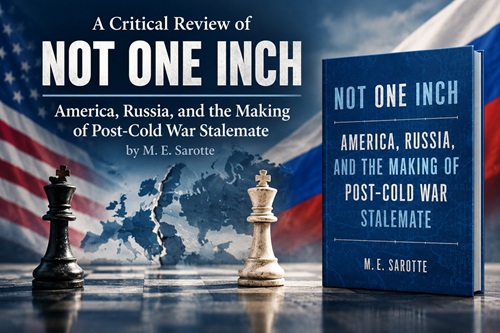 M. E. Sarotte's Not One Inch: America, Russia, and the Making of Post-Cold War Stalemate is one of the most important histories of the end of the Cold War and its surprisingly unhappy aftermath. Published by Yale University Press in 2021, with the paperback appearing in 2022, the book runs to nearly 600 pages and draws on an unusually extensive archive of diplomatic documents, memoranda, interviews and previously unpublished material. Its central concern is deceptively simple: how did the extraordinary opportunity created by the peaceful end of the Cold War turn into the enduring confrontation between Russia and the West? The timing of the book's appearance could hardly have been more dramatic. Sarotte completed her historical investigation before Russia's full-scale invasion of Ukraine in February 2022, yet that invasion transformed Not One Inch from a work of diplomatic history into an essential document in the argument over how Europe arrived at its present predicament. The book neither accepts the Russian narrative that NATO expansion was simply an act of Western treachery nor dismisses Russian grievances as mere Kremlin propaganda. Its great strength is precisely that it makes the story more complicated. But complexity can also become a problem. Sarotte's enormous accumulation of evidence sometimes produces a rather American-centric explanation of a process that was more multinational, more structural and ultimately more ideological than her narrative suggests. She is particularly persuasive in demonstrating that NATO enlargement was not inevitable and that alternatives existed. She is less convincing when moving from that counterfactual possibility to the implication that a different American policy could plausibly have produced a fundamentally different Russian-Western relationship. The result is a remarkable book—and one that deserves to be read critically rather than turned into ammunition for either side of the familiar “NATO provoked Putin” versus “NATO had nothing to do with it” argument. The great virtue: history instead of mythologyThe title Not One Inch refers to the famous February 1990 conversation between U.S. Secretary of State James Baker and Soviet leader Mikhail Gorbachev. Baker asked whether Gorbachev would prefer a unified Germany outside NATO or a unified Germany inside NATO, accompanied by assurances that NATO's jurisdiction would move “not one inch” eastward. This episode has subsequently acquired almost mythological significance. Vladimir Putin and Russian officials have repeatedly presented it as evidence that the West promised Moscow that NATO would never expand eastward. Yet there was no treaty establishing such a prohibition, and the immediate context was the status of a reunified Germany, not a comprehensive future settlement of Eastern Europe. Sarotte's achievement is to demonstrate that the truth is simultaneously less dramatic and more disturbing. There was no simple broken treaty. But neither is it satisfactory to say that nothing had been promised and therefore nothing had been violated. Diplomatic negotiations consist of more than treaties. Politicians communicate expectations, make provisional assurances, float possible bargains and create understandings that may never become legally binding. Sarotte shows how statements made during the extraordinarily fluid diplomacy of 1989-90 subsequently acquired meanings that their authors had not anticipated. The “one inch” formulation was part of an evolving negotiating process, not a solemn American promise to Russia covering all of Eastern Europe. Yet Soviet and later Russian leaders had legitimate reasons to conclude that the West was contemplating some limitation on NATO's geographical expansion. This distinction is crucial. The West did not break a clear-cut treaty promising never to enlarge NATO. But Western governments also did not behave as though Russian expectations were completely irrelevant. That is a much more historically interesting conclusion. The book's real subject is not NATO—it is the lost settlementIt would be easy to read Not One Inch as simply another book about NATO enlargement. That would undersell it. Sarotte is really interested in the collapse of a possible post-Cold War European security settlement. In 1989-91 virtually everything was negotiable. The Warsaw Pact disappeared. The Soviet Union disappeared. Germany reunified. Communist governments collapsed across Eastern Europe. NATO itself was searching for a new purpose. For a brief historical moment, the political imagination was unusually open. What should replace the Cold War security system? Should NATO survive? Should it expand? Should Russia eventually join? Could the Conference on Security and Cooperation in Europe—the future OSCE—become the principal European security institution? Could NATO and Russia become partners rather than adversaries? Could the newly liberated states of Eastern Europe receive security guarantees without extending a Western military alliance all the way toward Russia? These were not imaginary alternatives. They were discussed seriously. Sarotte's most interesting contribution is therefore not the discovery of a secret “promise.” It is her reconstruction of the roads not taken. One particularly important alternative was the Partnership for Peace, which initially offered a framework capable of bringing NATO and the former communist countries into a common security structure without immediately extending full Article 5 membership. The program even attracted Russian interest. Yet Central and Eastern European leaders increasingly regarded partnership as an inferior substitute for actual NATO membership, while American policymakers gradually committed themselves to enlargement. This is where Sarotte's history becomes genuinely tragic. The West had invented an institution designed to overcome the old division of Europe—and then increasingly used an existing Cold War institution to reorganize Europe instead. The American triumphalist temptationOne of Sarotte's strongest themes is the psychological transformation that took place in Washington. In 1989, American policymakers were dealing with a Soviet Union that still possessed enormous military power. By 1991, that superpower had collapsed. The United States had won the Cold War. That created an enormous temptation to interpret the new situation not merely as an opportunity for cooperation but as confirmation of American geopolitical supremacy. George H. W. Bush was initially cautious. His administration worried about destabilizing Gorbachev and about the consequences of the Soviet collapse. But the mood changed rapidly after 1991. The famous Bush remark reported in the historical literature—“to hell with that! We prevailed and they didn't”—captures something important about the emerging mentality. The question became less: How can we construct a European order acceptable to both sides? and increasingly: How can we consolidate the order that the West has won? This distinction matters enormously. The former approach produces a common security architecture. The latter produces an enlarged Western security architecture. Sarotte is at her best when she documents this transition without reducing it to a conspiracy. Nobody sat down in Washington and decided to deliberately manufacture a future Russian enemy. Instead, a sequence of apparently reasonable decisions accumulated into a structure that increasingly excluded Russia from the central European security system. That is the book's concept of stalemate. The Central and Eastern Europeans complicate the storyHere, however, Sarotte's American-centered narrative becomes less satisfactory. There is an obvious danger in describing NATO enlargement primarily as something America did to Russia. Poland wanted NATO membership. Hungary wanted NATO membership. The Czech Republic wanted NATO membership. Later, the Baltic states wanted NATO membership. These countries were not passive pawns moved around a Washington-Moscow chessboard. They had their own historical memories, security concerns and political agency. For countries that had spent decades inside the Soviet sphere, NATO membership was not necessarily perceived as an aggressive geopolitical project. It was often perceived as escape. This creates a fundamental moral and strategic dilemma. From Moscow's perspective, NATO expansion moved the Western military alliance toward Russia. From Warsaw's perspective, NATO expansion moved Poland away from Russia. Those are not merely two interpretations of the same fact. They are two radically different historical experiences. Several reviews of Sarotte's book have identified precisely this weakness: the autonomy and preferences of countries other than the United States and Russia receive less attention than they deserve. This is an important criticism. The enlargement question cannot adequately be formulated as: Did America unnecessarily provoke Russia? It must also be formulated as: Did Russia have the right to veto the security choices of its former satellites? There is no easy answer that dissolves the contradiction. Russia was not simply a passive victimThis is where a more critical reading of Sarotte is necessary. The great danger in the contemporary NATO debate is retrospective monocausality. Once the present catastrophe is known, historians are tempted to identify one earlier decision as the decisive cause. Sarotte herself is more cautious than many of her readers. Her book does not establish that NATO enlargement caused Putin's invasion of Ukraine. Indeed, one of the most valuable features of the book is its demonstration that Russian-Western relations were already deteriorating for multiple reasons. Russia was experiencing economic catastrophe, political instability and an acute crisis of national identity. Yeltsin's Russia was hardly a stable liberal democracy. The shelling of the Russian parliament in 1993 and the First Chechen War revealed the fragility and violence of the new Russian political order. Nor was Russian opposition to the West confined to NATO. The Kosovo War of 1999 was enormously important. Russia regarded NATO's intervention in Yugoslavia as an affront to its international status and as evidence that the United States was willing to use military power without Russian approval. Carnegie's contemporary assessment of U.S.-Russian relations in 1999 listed Kosovo alongside NATO enlargement, missile defense, arms control, Iran, Iraq and other disputes. This matters because it weakens any simple NATO-enlargement explanation. The deterioration was a bundle of conflicts. NATO enlargement was one of them. Kosovo was another. Russia's internal political transformation was another. The collapse of Russian power and status was another. American unilateralism was another. And, increasingly, incompatible conceptions of what the post-Cold War international order should look like were another. The status problemOne of the most revealing criticisms of the NATO-provocation thesis comes from scholarship arguing that Russian resentment was not primarily about military vulnerability but about status. A counterfactual study of NATO enlargement argues that Russia's turn against the West preceded the American decision to enlarge NATO and that domestic politics on both sides were more important than military threat perceptions. It also argues that Russian resentment was aggravated particularly by Western military action in the Balkans. This provides an important corrective to Sarotte's emphasis. Russia was not merely asking: “Will NATO tanks eventually attack Moscow?” It was also asking: “What happened to us? Why are we no longer one of the powers deciding Europe's future?” That is a different question. The humiliation of post-Soviet Russia cannot be reduced to NATO's military geography. A former superpower had collapsed into economic and political weakness while its former sphere of influence was integrating into institutions from which Russia itself remained excluded. That was bound to produce resentment. But resentment is not the same thing as legitimate entitlement. And this is where the contemporary debate frequently goes astray. The uncomfortable legitimacy of Russian security concernsSarotte deserves credit for refusing to dismiss Russian concerns. Russia had repeatedly expressed opposition to NATO enlargement. Yeltsin publicly warned in the 1990s about the consequences of NATO moving toward Russia, while Russian officials regarded the alliance's expansion as a major challenge to Russian interests. These concerns were not invented by Vladimir Putin in 2022. They existed under Yeltsin. They existed among Russian liberals as well as nationalists. They existed before Putin. They therefore deserve historical consideration. But there is an important distinction between understanding a security concern and accepting a sphere-of-influence entitlement. If Russia says: “NATO expansion makes us feel less secure,” that is a legitimate subject of international diplomacy. If Russia says: “Therefore Poland, Ukraine or Georgia may not choose their own alliances,” the argument becomes fundamentally different. The security concerns of one great power collide with the sovereignty of smaller states. That tension is not something Sarotte can solve because it is not a historical error that can simply be corrected. It is one of the permanent problems of international politics. Where Sarotte's counterfactuals become vulnerableSarotte is particularly interested in alternatives that might have produced a better outcome. The Partnership for Peace is perhaps the most interesting. Had Washington developed PfP more fully and resisted the pressure for early NATO enlargement, perhaps Russia could have been integrated into a broader European security structure. Perhaps. But counterfactual history has a dangerous seduction: the existence of an alternative does not demonstrate its feasibility. An alternative policy has to survive contact with the political preferences of all the actors involved. Would Poland really have accepted permanent neutrality? Would the Baltic states have accepted security arrangements that left them vulnerable to Russian pressure? Would Russia have accepted a genuinely pluralistic European security system in which its neighbors remained free to choose Western integration? Would Congress have accepted it? Would NATO members have accepted it? Would Russian nationalists have accepted it? Would Yeltsin's successors have accepted it? Sarotte cannot answer these questions definitively because nobody can. Her evidence establishes that different choices were possible. It does not establish that those choices would have produced the peaceful alternative history we now imagine. The problem of “provocation”This is perhaps the most important conceptual issue raised by Not One Inch. NATO expansion can simultaneously be: a response to the security fears of Eastern European states, a source of Russian insecurity, an expression of American strategic ambition, and a consequence of the collapse of the Soviet order. These propositions are not mutually exclusive. The mistake is to demand a single cause. Russia's reaction to NATO expansion was foreseeable. That does not mean Russian aggression was inevitable. American policymakers could reasonably have anticipated that NATO enlargement would anger Moscow. Some did. Critics inside the United States—including George Kennan, Brent Scowcroft and Sam Nunn—warned about the consequences of enlargement. But the fact that Washington made a foreseeable strategic error does not transform subsequent Russian aggression into an automatic or predetermined response. Between NATO expansion and the invasion of Ukraine lie more than two decades of Russian and Western decisions. The 2007 Munich speech. The 2008 Bucharest NATO declaration concerning Ukraine and Georgia. The Russo-Georgian War. The 2014 annexation of Crimea. The war in Donbas. The Minsk agreements. The 2021 Russian demands for a radically revised European security order. And finally the full-scale invasion. Each represents another decision point. The causal chain is therefore real, but it is not a straight line. Ukraine is where the book becomes prophetic Perhaps the most striking part of Not One Inch, viewed from the present, is its discussion of Ukraine. Sarotte shows that even NATO enlargement advocates recognized that Ukraine was fundamentally different from Poland, Hungary or the Czech Republic. Ukraine was enormous, strategically located and deeply connected to Russia historically, economically and culturally. The Clinton administration understood that Ukrainian membership would be vastly more provocative than earlier enlargement. Even Richard Holbrooke, one of NATO enlargement's strongest advocates, described Ukraine as “the most delicate issue.” This is extraordinarily revealing. The Western policy eventually adopted at Bucharest in 2008—that Ukraine and Georgia “will” become NATO members—created perhaps the worst of all possible arrangements. It did not give Ukraine NATO's Article 5 guarantee. But it told Ukraine that membership was theoretically coming. Russia interpreted the declaration as a strategic threat. Ukraine was left in an intermediate position. This created precisely the kind of grey zone that NATO enlargement had supposedly been designed to eliminate. Sarotte's argument therefore contains an important paradox: By enlarging NATO successfully in Central Europe, the West made the unresolved security status of the countries farther east more dangerous. The enlargement process did not produce a unified European security system. It produced a new frontier. The book's greatest weakness: America is too centralThe deepest criticism I would make of Not One Inch is not that Sarotte is “wrong” about NATO enlargement. It is that she sometimes gives the United States too much causal responsibility for the shape of post-Cold War Europe. Washington mattered enormously. But Europe was not simply an American project. Germany mattered. France mattered. Britain mattered. Poland mattered. The Baltic states mattered. Ukraine mattered. Russia mattered. And NATO itself was an institution whose members had different interests. A recent scholarly discussion has similarly noted that Sarotte's focus can understate the autonomy of other NATO members and the broader international context in which enlargement occurred. This matters because it changes the moral structure of the story. If NATO enlargement was simply an American decision imposed upon Russia and Eastern Europe, then the history becomes one of American hubris. If it was a negotiated process involving states emerging from Soviet domination and seeking institutional protection, then the story becomes much more complicated. Sarotte provides much of the evidence for the second interpretation herself, even when her narrative framework sometimes points toward the first. The “Russia was humiliated” thesis needs qualificationThere is another issue that deserves careful scrutiny: the language of Russian humiliation. There unquestionably was a profound loss of Russian international status. But “humiliation” can become a dangerously elastic explanatory category. Was Russia humiliated because NATO expanded? Yes, in the sense that its former sphere of influence disappeared. Was it humiliated because its economy collapsed? Certainly. Was it humiliated because it lost superpower status? Obviously. Was it humiliated because former Soviet satellites chose Western institutions? That was clearly perceived negatively in Moscow. But none of these propositions tells us what Russia was entitled to expect from its neighbors. There is a subtle but important distinction between historical grievance and historical right. Sarotte is strongest when she reconstructs the grievance. The reader must supply the distinction between grievance and entitlement. What the book gets exactly rightThe enduring value of Not One Inch is that it destroys several simplistic stories simultaneously. It destroys the Russian claim that there was a straightforward written promise never to expand NATO. It also destroys the opposite Western myth that Russian complaints about NATO expansion were invented retrospectively by Putin. It shows that Western leaders knew Russian opposition was serious. It shows that NATO enlargement was politically contested inside the United States. It shows that alternative institutional arrangements were discussed. It shows that Central and Eastern European governments were active participants rather than passive objects. And it shows that the deterioration of relations was cumulative rather than predetermined. That is an impressive achievement. What the book cannot establishBut the book cannot establish—and should not be used to establish—that NATO enlargement caused the invasion of Ukraine. That stronger proposition requires a different argument. At most, Sarotte establishes a historically plausible chain: Cold War victory ? American unilateral confidence ? NATO enlargement ? Russian resentment ? erosion of cooperative possibilities ? European security division. That is a powerful historical interpretation. But it is not equivalent to: NATO enlargement ? Putin's invasion. The second proposition compresses decades of political development into a single causal mechanism. The subsequent history of Russia itself makes that impossible to sustain as a complete explanation. Putin's conception of Ukraine, his understanding of Russian history, his rejection of Ukraine's separate political trajectory and his broader conception of Russia as a great power all have to be incorporated into any explanation of the 2022 invasion. Indeed, Fred Kaplan's contemporary review of Sarotte makes precisely this distinction: NATO expansion contributed to Russian resentment, but Putin's imperial ambitions and his denial of Ukrainian sovereignty cannot be reduced to NATO policy. A tragedy of incompatible national memoriesPerhaps the deepest lesson of Not One Inch is that the post-Cold War settlement failed to create a common historical narrative. For many Central Europeans, 1989 meant: We escaped Russia. For many Russians, 1991 meant: We lost our country and our status. For Americans, it meant: We won the Cold War. For Ukrainians, it eventually became: We became independent but were never securely anchored in either Europe or Russia. These memories are not merely propaganda. They reflect different historical experiences. And they point in different political directions. That is why the debate over NATO expansion is so persistent. It is not simply a disagreement about military strategy. It is a disagreement about what the end of the Cold War was supposed to mean. Sarotte versus the “NATO provoked everything” schoolSarotte occupies an interesting middle ground. She is much more critical of Western policy than the standard triumphalist NATO narrative. But she is considerably more cautious than the strongest versions of the realist argument. That middle position is important. The strongest realist critique says that NATO enlargement was strategically reckless because it unnecessarily antagonized Russia. The strongest liberal interpretation says that former Soviet satellites had every right to choose their alliances and that Russia's objections amounted to an attempt to preserve a sphere of influence. Both contain elements of truth. Sarotte's contribution is to show that both sides had agency and both sides made choices. The West made choices that narrowed the available Russian-Western relationship. Russia subsequently made choices that narrowed it still further. The tragedy is cumulative. A history of missed opportunities—or a history of unavoidable conflict?There is a temptation after reading Sarotte to imagine that the 1990s contained a lost golden opportunity. Perhaps there was a European security order in which Russia, Ukraine, Eastern Europe and NATO could have been accommodated. Perhaps NATO could have transformed itself into something more inclusive. Perhaps Russia could have become a genuine partner. Perhaps the Partnership for Peace could have evolved into something much larger. Perhaps Ukraine could have occupied a stable neutral position. Perhaps. But history does not permit us to know. The alternatives were politically difficult precisely because the underlying interests were contradictory. Poland wanted NATO because it feared Russia. Russia opposed NATO because it feared NATO's expansion. Ukraine wanted room to maneuver because it feared domination by either side. The United States wanted to preserve its European leadership. Western Europe wanted greater independence from American power while also relying upon American security guarantees. These tensions existed independently of any particular Clinton-era mistake. The post-Cold War settlement therefore may have been less a matter of one wrong turn than a failure to reconcile incompatible ambitions. The title is more revealing than it first appears“Not One Inch” eventually becomes almost a metaphor for the entire failed post-Cold War settlement. The West insisted that sovereign states should be free to choose their alliances. Russia insisted that its security required privileged influence over its neighborhood. Eastern European states insisted that independence meant freedom from Russian domination. The United States insisted that NATO remained the principal instrument of European security. The result was a Europe in which every side could point to a principle it considered legitimate. The tragedy was that these principles could not all be satisfied simultaneously. Conclusion: an indispensable but incomplete historyNot One Inch is an extraordinary work of diplomatic history. Its archival depth, reconstruction of decision-making and attention to contingency make it essential reading for anyone who wants to understand the origins of the current European security crisis. Yale describes it as an account of how tensions between America, NATO and Russia transformed geopolitics in the decade after the Berlin Wall; that is precisely what Sarotte succeeds in documenting. But the book should not become a morality tale in which Washington made the original mistake and Moscow merely reacted. Its own evidence makes such a reading too simple. The United States mishandled an extraordinary historical opportunity. It underestimated Russian resentment, overestimated the ability of NATO enlargement to coexist indefinitely with a cooperative relationship with Moscow, and failed to resolve the dangerous grey zone that emerged around Ukraine and Georgia. At the same time, Russia was not simply a passive object of Western policy. Russian leaders made their own choices. Russian politics underwent its own transformation. Russian elites retained powerful ideas about great-power status and privileged influence in the former Soviet space. And under Putin those ideas eventually hardened into an increasingly revisionist conception of the post-Cold War order. The most defensible conclusion is therefore neither “NATO caused the war” nor “NATO had nothing to do with it.” It is more uncomfortable: The West helped construct the strategic environment in which a future confrontation with Russia became increasingly difficult to avoid, but Russia's later decisions cannot be read as mechanically determined by that environment. That distinction is precisely why Sarotte's book is so valuable—and why it should be read as history rather than as a brief for either Moscow or Washington. The real tragedy documented by Not One Inch is not that the West broke a simple promise. It is that, after the Cold War, Europe had a rare opportunity to create a security order that transcended the old division—and instead reproduced a new version of it. The Cold War ended. The Cold War security architecture did not entirely end with it. And the unresolved question of who belonged inside Europe's security order, and who had the right to decide that question, became one of the central conflicts of the twenty-first century.
Widget is loading comments...
|